

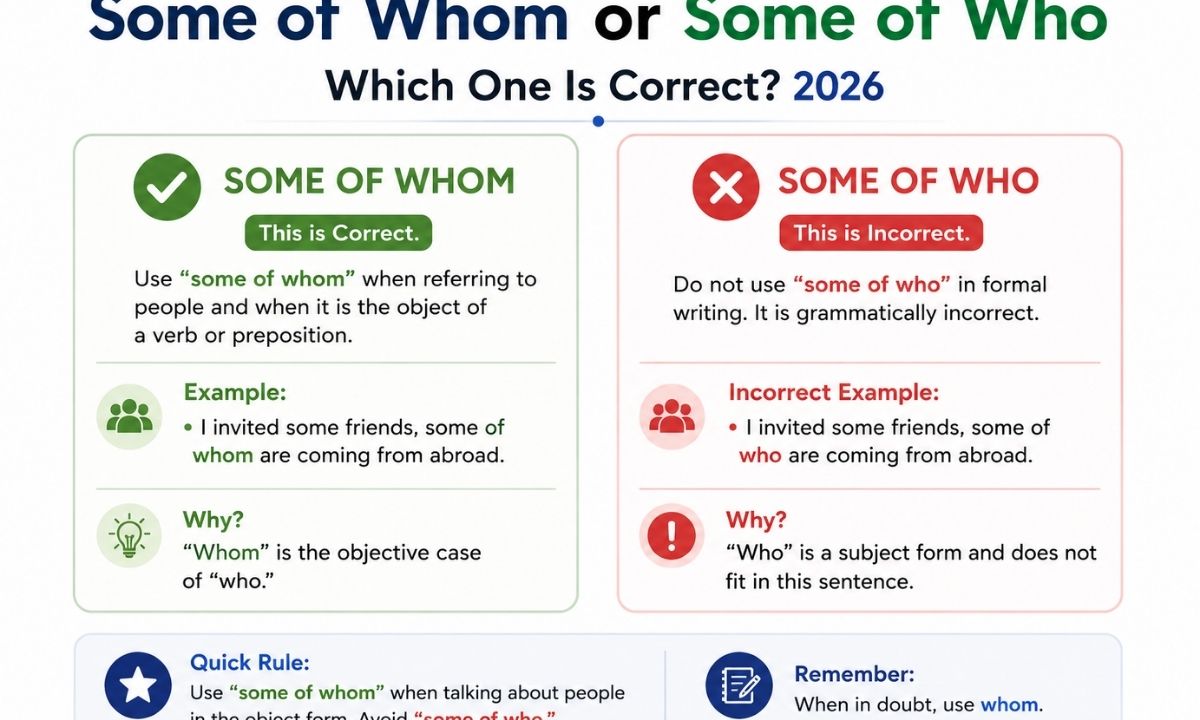
Some of Whom or Some of Who Which One Is correct? You’re not alone. Many English learners and even native speakers pause when choosing between some of whom and some of who because the two phrases sound similar. However, only one of them follows standard English grammar.
The correct phrase is some of whom. That’s because whom functions as the object of the preposition of, while who is used as a subject pronoun. Although who has become more common in casual speech, some of who is still considered incorrect in formal writing, academic English, and professional communication.
In this guide, you’ll learn the difference between who and whom, why some of whom is always correct, common mistakes to avoid, practical examples, memory tricks, and answers to frequently asked questions.
The Quick Answer
Here’s the short answer:
✅ Some of whom = Correct
❌ Some of who = Incorrect
Use some of whom whenever you’re referring to part of a previously mentioned group.
Examples:
- I interviewed ten candidates, some of whom had international experience.
- She invited several friends, some of whom couldn’t attend.
- We visited five museums, some of whom offered free admission.
Notice that whom refers to people and follows the preposition of.
By contrast:
❌ I interviewed ten candidates, some of who had international experience.
This sentence is grammatically incorrect because who cannot function as the object of the preposition of.
If you’re writing an essay, email, report, or article, always choose some of whom.
Who vs. Whom What’s the Real Difference?
The confusion between who and whom has existed for decades because the two words refer to people and are pronounced similarly in everyday speech. However, they perform different grammatical roles.
The simplest way to understand them is this:
- Who is used as the subject of a clause.
- Whom is used as the object of a verb or a preposition.
This distinction is especially important in formal English, where correct pronoun usage improves clarity and accuracy.
What Does “Who” Mean?
who (hoo)
Part of Speech
Pronoun
Dictionary Meaning
Who is a relative or interrogative pronoun used to refer to the person performing an action or serving as the subject of a sentence.
Think of who as replacing he, she, or they.
Examples of “Who”
- Who called you yesterday?
- The teacher who inspired me has retired.
In each sentence, who performs the action or introduces the subject of the clause.
What Does “Whom” Mean?
whom (hoom)
Part of Speech
Pronoun
Dictionary Meaning
Whom is an object pronoun used to refer to the person receiving an action or serving as the object of a verb or preposition.
Think of whom as replacing him, her, or them.
Examples of “Whom”
- To whom should I address the letter?
- The woman whom I met yesterday is an architect.
In each example, whom receives the action rather than performing it.
Who vs. Whom Quick Comparison
Although who and whom refer to people, they are not interchangeable. Their grammatical roles determine which one you should use.
| Feature | Who | Whom |
| Part of Speech | Pronoun | Pronoun |
| Grammar Role | Subject | Object |
| Replaces | He, She, They | Him, Her, Them |
| Used After Prepositions | ❌ No | ✅ Yes |
| Common in Casual Speech | ✔ Very Common | Less Common |
| Preferred in Formal Writing | ✔ Yes | ✔ Yes |
| Example | Who is calling? | To whom did you speak? |
The Subject vs. Object Rule
The easiest way to choose between who and whom is to identify whether the pronoun is acting as the subject or the object.
Use who when the person is doing the action.
Examples:
- Who wrote this article?
- She’s the student who won the award.
Use whom when the person receives the action or follows a preposition.
Examples:
- To whom did you send the email?
- The author whom we interviewed was very kind.
A useful shortcut is the he/him test:
- If he fits, use who.
- If him fits, use whom.
For example:
- Who called? → He called. ✔
- You invited whom? → You invited him. ✔
This simple test works in most situations and is especially helpful for learners.
“Some of Whom” Meaning, Rule & Why It’s Always Correct
The phrase some of whom is the grammatically correct expression when referring to part of a group of people that has already been mentioned. In English grammar, whom functions as the object of the preposition of, which is why this construction is correct.
You’ll commonly find some of whom in formal writing, academic papers, news articles, business reports, books, and professional communication. Although it may sound slightly more formal than everyday speech, it remains the standard choice whenever you want to write grammatically correct English.
Consider this example:
The company hired twelve interns, some of whom had previous work experience.
Here, whom refers back to twelve interns, and because it follows the preposition of, whom is the correct pronoun.
The Grammar Rule
The rule is straightforward:
After the preposition “of,” use “whom” when referring to people.
This pattern also appears in similar expressions, such as:
- many of whom
- several of whom
All of these phrases follow the same grammatical rule because whom serves as the object of of.
Examples of “Some of Whom”
- I interviewed ten candidates, some of whom spoke three languages.
- She invited twenty guests, some of whom arrived early.
In every sentence above, whom refers to people and correctly follows the preposition of.
Why It Sounds Formal
Many learners notice that some of whom sounds more formal than everyday conversation. That’s because modern spoken English often avoids whom, especially in casual situations.
For example, a native speaker might simply say:
I met several people. Some of them were doctors.
Instead of:
I met several people, some of whom were doctors.
Both sentences communicate the same idea, but the second version is more concise and is generally preferred in formal writing.
If you’re writing essays, reports, blog posts, or professional emails, some of whom is the better choice.
“Some of Who” Why It’s Always Wrong
Because who is much more common than whom in everyday speech, many learners assume that some of who must also be correct. However, this phrase breaks a fundamental grammar rule.
The word who functions as a subject pronoun, not an object pronoun. After the preposition of, English requires an object pronoun, which is whom.
That’s why some of who is considered grammatically incorrect in standard English.
Incorrect vs. Correct Examples
❌ I interviewed several applicants, some of who had master’s degrees.
✅ I interviewed several applicants, some of whom had master’s degrees.
❌ We visited ten families, some of who had lived there for generations.
✅ We visited ten families, some of whom had lived there for generations.
❌ The conference welcomed hundreds of delegates, some of who represented international organizations.
✅ The conference welcomed hundreds of delegates, some of whom represented international organizations.
❌ She thanked her friends, some of who helped organize the event.
✅ She thanked her friends, some of whom helped organize the event.
❌ The school recognized several students, some of who earned perfect grades.
✅ The school recognized several students, some of whom earned perfect grades.
Why Do People Make This Mistake?
There are several reasons:
- Who is much more common than whom in everyday speech.
- Many native speakers rarely use whom in casual conversations.
- Because who and whom sound similar, learners often don’t notice the grammatical difference.
- Informal online writing sometimes ignores traditional grammar rules.
Despite these trends, some of whom remains the correct form in standard written English.
Common Grammar Mistakes Related to “Who” and “Whom”
Confusion between who and whom extends beyond some of whom. Similar mistakes appear in many other expressions involving prepositions.
Here are some of the most common errors.
| Incorrect | Correct |
| some of who | some of whom |
| many of who | many of whom |
| all of who | all of whom |
| one of who | one of whom |
| several of who | several of whom |
| each of who | each of whom |
| none of who | none of whom |
Using “Who” After “Of”
❌ Several students, some of who received awards, attended the ceremony.
✅ Several students, some of whom received awards, attended the ceremony.
Forgetting That “Whom” Is an Object
Remember:
- Who = subject
- Whom = object
If the pronoun follows a preposition such as of, to, for, with, or by, whom is usually the correct choice.
Examples:
- to whom
- with whom
- from whom
- of whom
- by whom
Assuming Casual Speech Changes Grammar
In conversation, native speakers often simplify sentences by avoiding whom altogether.
For example:
Instead of saying:
The students, some of whom passed the exam, celebrated together.
They might say:
Some students passed the exam and celebrated together.
This doesn’t mean some of who becomes correct. It simply means speakers often choose a different sentence structure.
Using “Who” After Other Prepositions
Incorrect:
- to who
- from who
- with who
- by who
Correct:
- to whom
- from whom
- with whom
- by whom
These combinations follow the same grammar rule as some of whom.
Some of Whom vs Some of Who Context Usage
In Academic Writing
Academic writing values grammatical accuracy, so some of whom is always the preferred choice.
Example:
- The researchers interviewed 200 participants, some of whom had previous medical conditions.
In Professional Emails
Professional communication should also follow the standard rule.
Example:
- We interviewed several candidates, some of whom meet all the job requirements.
In Journalism
News articles frequently use some of whom because it creates concise and formal sentences.
Example:
- Emergency crews rescued dozens of residents, some of whom required medical treatment.
In Everyday Conversation
In casual speech, many people avoid whom entirely by rewriting the sentence.
Instead of saying:
I met several people, some of whom were teachers.
Someone might say:
I met several people. Some of them were teachers.
Both versions are natural, but some of whom remains the grammatically correct choice when using this structure.
American vs British English Usage
A common question is whether American English and British English treat some of whom differently. The answer is no. Both varieties of English follow the same grammar rule.
Whether you’re writing for readers in the United States, the United Kingdom, Canada, Australia, or New Zealand, some of whom is the correct phrase. Some of who is considered grammatically incorrect in standard written English.
The only noticeable difference is in everyday conversation. In informal speech, especially in American English, many native speakers avoid whom altogether by rewriting the sentence.
For example:
Formal:
- The company hired twenty employees, some of whom had previous experience.
Informal:
- The company hired twenty employees. Some of them had previous experience.
Both sentences are natural, but the first is preferred in academic, professional, and published writing because it follows standard grammar.
Quick Tricks to Remember: Some of Whom or Some of Who
Remembering when to use whom becomes much easier once you know a few simple grammar tricks.
The Preposition Rule
One of the easiest rules is this:
If the pronoun follows the preposition “of,” choose “whom.”
Examples:
- some of whom
- many of whom
- all of whom
- several of whom
- none of whom
Because of is a preposition, it requires an object pronoun, and whom is the correct object form.
.
Think: Subject = Who, Object = Whom
A quick way to remember the difference is:
- Who → Subject
- Whom → Object
Examples:
Who
- Who wrote the report?
- Who answered the phone?
- Who won the competition?
Whom
- To whom did you send the email?
- With whom are you traveling?
- Some of whom received awards.
Whenever the pronoun receives the action or follows a preposition choose whom.
Practice Quiz
Choose the correct answer.
The school welcomed many students, received scholarships.
A. some of who
B. some of whom
✅ Answer: B. some of whom
The guests, traveled overseas, arrived yesterday.
A. many of who
B. many of whom
✅ Answer: B. many of whom
The company hired several engineers, specialized in cybersecurity.
A. some of who
B. some of whom
✅ Answer: B. some of whom
Which phrase is grammatically correct?
A. some of who
B. some of whom
✅ Answer: B. some of whom
The professor taught many students, later became researchers.
A. several of who
B. several of whom
✅ Answer: B. several of whom
FAQs Some of Whom or Some of Who
Why is “some of whom” correct but “some of who” wrong?
Some of whom is correct because whom functions as the object of the preposition of. In English grammar, object pronouns must follow prepositions. Since who is a subject pronoun, some of who is grammatically incorrect.
Is it necessary to follow this rule in informal writing?
In casual conversations, people often avoid the structure entirely by saying some of them instead of some of whom.
How can I remember the difference easily?
The easiest memory trick is:
- After “of,” use “whom.”
- Who = subject
- Whom = object
Will practice really help me avoid confusion?
Absolutely. Like any grammar rule, repeated practice makes it feel natural. Reading professionally edited books, newspapers, and academic articles will also help you recognize some of whom as the standard expression.
Is “whom” disappearing from English?
Not entirely. While whom is less common in everyday speech than it once was, it is still widely used in formal writing, legal documents, academic publications, journalism, and professional communication
The Bottom Line
Although some of whom and some of who differ by only one word, the grammatical distinction is important. Because whom functions as the object of the preposition of, some of whom is the only correct choice in standard English.
While casual conversations often avoid whom, it remains the preferred form in essays, reports, business communication, journalism, and professional writing. By remembering that who is a subject pronoun and whom is an object pronoun, you’ll avoid a common grammar mistake and write with greater confidence and accuracy.