

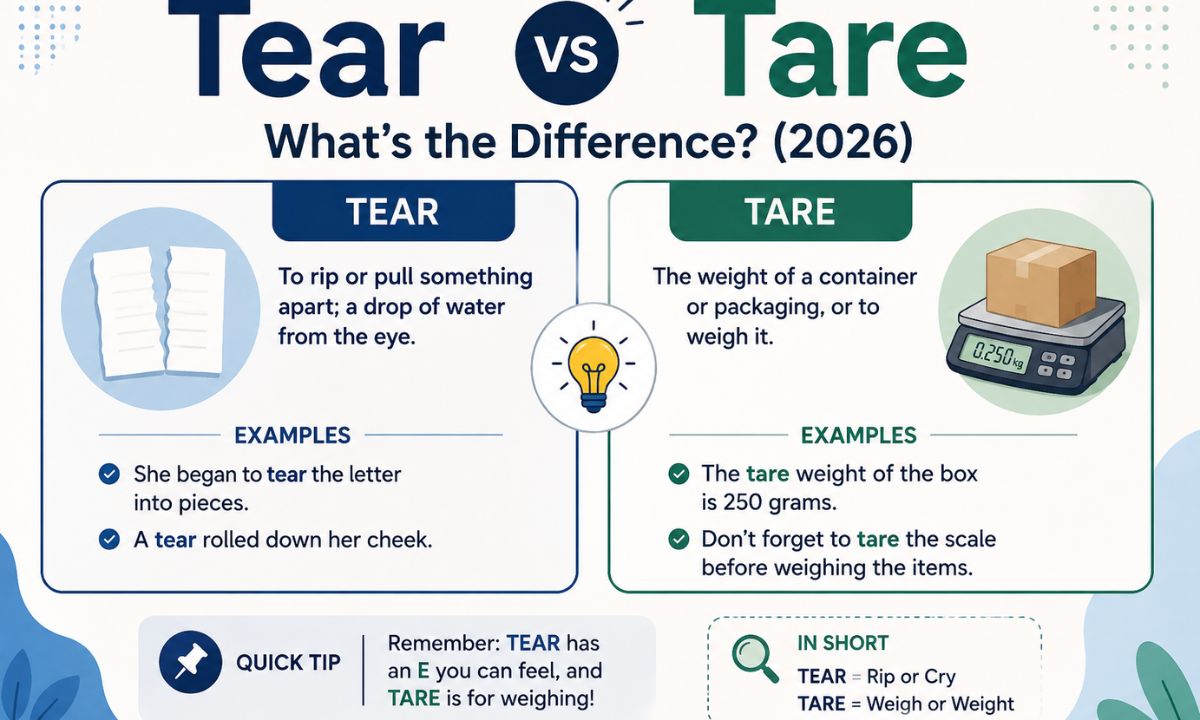
The words tear vs tare sound alike in some situations, but they have completely different meanings. Tear usually refers to ripping something or to a drop of liquid from the eye, while tare is a technical term used to describe the weight of an empty container or the process of resetting a weighing scale. Because the two words can share the same pronunciation in certain contexts, many learners mix them up. This guide explains their meanings, differences, correct usage, and easy ways to remember which word to use.
What Do Tear and Tare Actually Mean?
Tear
Pronunciation:
- As a verb meaning to rip: /ter/ (rhymes with air)
- As a noun meaning a drop from the eye: /tɪr/ (rhymes with ear)
Part of Speech:
- Verb
- Noun
Definition
As a verb, tear means to pull or split something apart by force. It describes damage to paper, fabric, clothing, or other materials.
As a noun, tear refers to the small drop of liquid that forms in your eye when you cry or when your eyes react to dust, wind, or emotion.
Examples of “Tear” (Verb)
- Be careful not to tear the receipt.
- The child accidentally tore the picture.
- Strong winds can tear weak tents apart.
- She did not want to tear the old letter.
- Please tear the page along the dotted line.
Examples of “Tear” (Noun)
- A single tear rolled down her cheek.
- Tears filled his eyes after the surprise.
- She wiped away every tear.
- The emotional speech brought tears to many people.
- One tear fell onto the photograph.
Tare
Pronunciation:
/ter/ (rhymes with air)
Part of Speech:
- Noun
- Verb
Definition
Tare is a technical word used in weighing, shipping, manufacturing, and logistics.
As a noun, it means the weight of an empty container, package, or vehicle before adding its contents.
As a verb, it means to reset a scale to zero after placing an empty container on it, allowing only the contents to be measured.
Examples of “Tare”
- The operator recorded the tare weight before loading the truck.
- Press the tare button before adding the ingredients.
- The digital scale lets you tare the bowl easily.
- Every shipping label includes the tare weight.
- The technician tared the balance before the experiment.
Tear vs Tare Quick Comparison
| Feature | Tear | Tare |
| Meaning | To rip something or a drop from the eye | Weight of an empty container or resetting a scale |
| Part of Speech | Noun, Verb | Noun, Verb |
| Common Context | Everyday English | Weighing, shipping, cooking, laboratories |
| Pronunciation | /ter/ or /tɪr/ | /ter/ |
| Common Mistake | Confused with tare because of pronunciation | Mistakenly used instead of tear |
Tear vs Tare Key Differences Explained
Although tear and tare may sound identical when tear means to rip, their meanings have nothing in common.
Tear belongs to everyday vocabulary. People use it when talking about damaged paper, ripped clothes, broken packaging, or emotional crying.
Tare, on the other hand, belongs mainly to technical fields. You will often hear it in kitchens, laboratories, warehouses, grocery stores, factories, and transportation industries.
Consider these examples:
- Please tear the envelope open.
- Press tare before weighing the flour.
The first sentence describes a physical action. The second refers to preparing a scale for an accurate measurement.
Another important difference is pronunciation.
When tear means rip, it rhymes with air.
When tear means a drop from the eye, it rhymes with ear.
Tare always rhymes with air.
Understanding both meaning and pronunciation helps you choose the correct word every time.
Common Mistakes
❌ Press the tear button on the scale.
✅ Press the tare button on the scale.
❌ The package’s tear weight is 2 kilograms.
✅ The package’s tare weight is 2 kilograms.
❌ Please tare this piece of paper.
✅ Please tear this piece of paper.
❌ She had a tare in her eye.
✅ She had a tear in her eye.
American vs British English
Both American English and British English use tear and tare with the same spellings and meanings.
There is no spelling difference between the two varieties.
However, tare appears more frequently in industries such as shipping, engineering, manufacturing, agriculture, and laboratory work, while tear is common in everyday speech and writing.
Word Origins
Tear comes from Old English teran, meaning to pull apart or rend.
The noun tear (from the eye) comes from Old English tēar, meaning a drop from the eye.
Tare comes through Old French from Arabic ṭarḥa, meaning a deduction. Over time, English adopted it to describe the weight deducted from a gross measurement to determine the net weight.
Learning these origins makes the meanings easier to remember.
How to Use Tear Correctly in a Sentence
Use tear whenever you mean to rip, split, or damage something, or when referring to the liquid that comes from the eyes.
Examples (Verb)
- Please tear the wrapping paper carefully.
- He accidentally tore his favorite jacket.
- Strong branches can tear the roof during a storm.
- Never tear important documents without checking them first.
- She tore the ticket into two pieces.
Examples (Noun)
- A tear appeared as she laughed with joy.
- His farewell speech brought a tear to her eye.
- The movie ended with tears of happiness.
- She brushed away every tear before smiling.
- One tiny tear reflected the sunlight.
Tips for Correct Usage
Use tear when discussing:
- Paper
- Books
- Clothing
- Fabric
- Plastic
- Emotional crying
- Eye drops caused by dust or wind
If your sentence has nothing to do with ripping or crying, tear is probably not the correct choice.
How to Use Tare Correctly in a Sentence
Use tare when talking about weighing, scales, or the weight of an empty container. You will most often encounter this word in cooking, laboratories, warehouses, manufacturing plants, shipping companies, and trucking.
As a verb, tare means to reset a scale to zero after placing an empty container on it. Doing this ensures the scale measures only the contents inside the container.
As a noun, tare refers to the weight of the empty container itself.
Examples (Verb)
- Press the tare button before adding the flour.
- The technician tared the laboratory balance.
- Always tare the bowl before measuring ingredients.
- She tared the digital scale to improve accuracy.
- We tared the container before weighing the chemicals.
Examples (Noun)
- The invoice includes the tare weight.
- The driver recorded the truck’s tare before loading cargo.
- Remove the tare from the total weight to calculate the net weight.
- Every container has a printed tare weight.
- Inspectors verified the tare during the safety check.
Tips for Correct Usage
Use tare whenever your sentence involves:
- Digital scales
- Kitchen measurements
- Shipping containers
- Trucking
- Laboratory equipment
- Warehouse operations
- Net weight calculations
If your sentence relates to measuring weight rather than ripping paper or crying, tare is almost certainly the correct word.
Memory Tricks to Remember Tear vs. Tare Forever
Remembering the difference becomes much easier with a few simple tricks.
Tear = Rip
Think of tear whenever something tears apart.
Tear → Paper → Rip
Tare = Scale
Notice that tare contains the letter “a.” Associate it with accurate weighing.
Tare → Accurate Scale
Connect the Situation
Ask yourself a quick question.
- Am I talking about paper, clothes, or crying? → Tear
- Am I talking about weighing something? → Tare
Think of the Button
Most digital kitchen scales have a button labeled TARE.
If you can picture that button, you’ll remember that tare belongs to weighing—not ripping.
FAQs About Tear vs. Tare
What is the difference between tear and tare?
Tear can mean to rip something or a drop of liquid from the eye. Tare is mainly used to describe the weight of packaging or a container.
Is it tear or tare for weight?
Use tare when talking about the weight of an empty container or packaging. For example, “The tare weight of the box is 200 grams.”
What does tear mean?
Tear has two common meanings: to rip or pull something apart, and the clear liquid produced by your eyes.
What does tare mean?
Tare is a noun or verb related to the weight of a container. It is commonly used when calculating the net weight of goods.
Are tear and tare pronounced the same?
Not always. Tear has different pronunciations depending on its meaning, while tare is pronounced like “tair.”
How do you remember tear vs. tare?
Remember tare = container weight. Tear = rip something or a drop from your eye.
Conclusion
Although tear and tare may sound alike, they serve entirely different purposes. Tear relates to ripping something apart or to the drops of liquid that come from your eyes. Tare, by contrast, belongs to the world of weighing and refers to the weight of an empty container or the function that resets a scale to zero.
Understanding the context makes choosing the correct word easy. If you’re talking about paper, fabric, emotions, or crying, use tear. If you’re discussing scales, containers, shipping, or measurements, use tare. Mastering this distinction will improve both your writing and your confidence in English..
Whether you’re improving your writing, preparing for exams, or building better content for your website, our goal is to provide reliable grammar resources that you can trust.