

Picture this: you’re writing a chemistry report, a school essay, or even a quick text to a friend, and suddenly you freeze. Should it be “gases” or “gasses”? Both words look almost identical, yet only one fits most sentences. This tiny spelling choice trips up students, writers, and even native speakers every single day.
The good news? Once you understand the simple rule behind these two words, you’ll never second guess yourself again. In this guide, we’ll break down the meaning, grammar, and real life usage of both words, plus share memory tricks that make the difference stick forever.
Gases or Gasses Why Does This Confusion Exist?
English spelling often ignores logic. Many words that sound alike carry completely different meanings, and “gases” versus “gasses” is a textbook example. Because the base word “gas” ends in a single consonant, our brains naturally expect the plural to double that consonant, similar to how “bus” becomes “buses” or “kiss” becomes “kisses.”
However, standard English grammar treats “gas” a bit differently. The confusion also grows because “gasses” genuinely exists as a word just not as a plural noun. It functions as a verb, which throws people off even more. Add regional spelling habits, outdated textbooks, and autocorrect inconsistencies into the mix, and it’s easy to see why so many people type the wrong version without noticing.
What Does “Gases” Mean? The Correct Plural Form of Gas
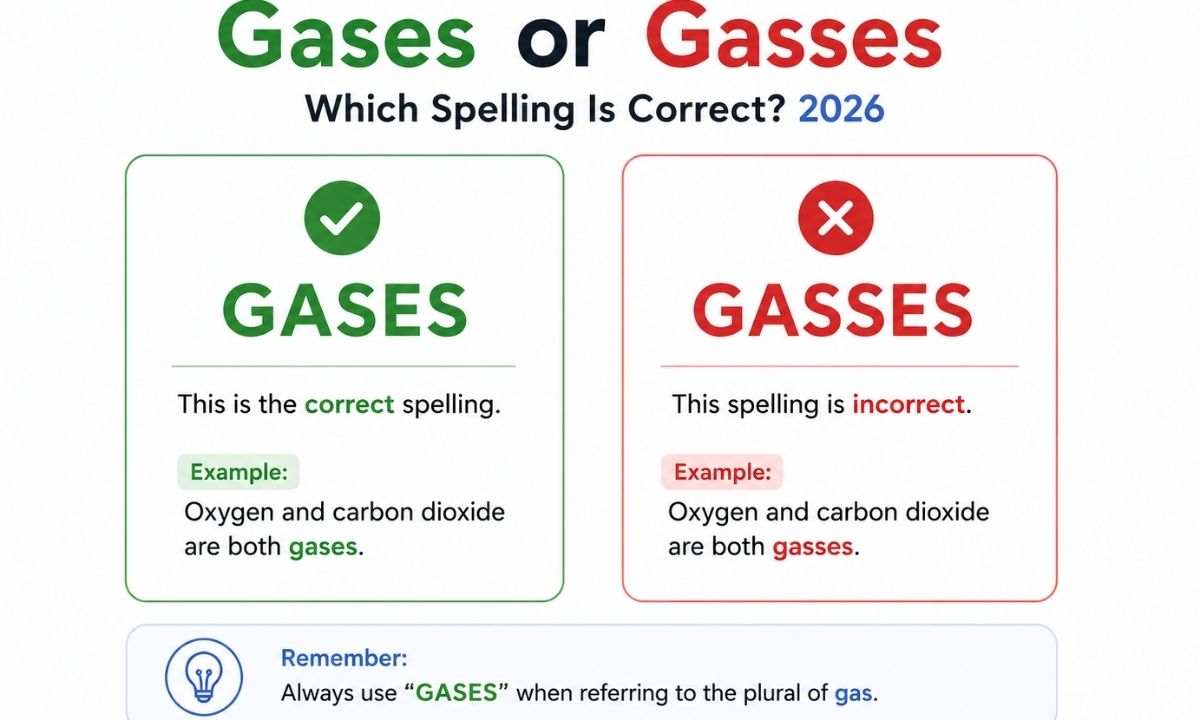
“Gases” is the standard, widely accepted plural noun form of “gas.” Whenever you’re referring to more than one type of gas whether in science, cooking, or casual conversation “gases” is the word you need.
Think about a chemistry classroom. A teacher might explain how oxygen, nitrogen, and carbon dioxide are all naturally occurring gases in our atmosphere. Similarly, a mechanic could mention that certain vehicles release harmful exhaust gases. Even in everyday speech, someone might joke that spicy food always gives them gases after dinner.
This spelling follows a pattern many other English nouns share. Just like “plan” becomes “plans” and “fan” becomes “fans” without doubling the final letter, “gas” simply adds an “-es” to form its plural. No doubling, no exceptions just a straightforward rule that dictionaries, textbooks, and style guides consistently support.
What Does “Gasses” Mean? When the Verb Form Is Correct
Unlike “gases,” the word “gasses” isn’t a noun at all. Instead, it acts as the third-person singular form of the verb “to gas.” This verb describes the action of exposing something (or someone) to gas, often in a harmful or deliberate way.
For instance, a news report might state that a factory illegally gasses its waste materials into the atmosphere. Alternatively, a pest control worker could explain that a certain chemical gasses insects out of their hiding spots. In historical or wartime contexts, this verb sometimes appears in serious discussions about chemical warfare.
Because this usage is far less common in daily conversation, many writers forget it exists altogether which is exactly why “gases” gets used incorrectly, or why “gasses” sometimes sneaks into sentences where a plural noun was actually needed.
Gasses (Verb) Examples
Seeing the verb form in action makes the distinction much clearer. Below are a few natural, real-world sentences:
- The exterminator gasses the basement every spring to eliminate pests.
- According to reports, the plant illegally gasses nearby wetlands.
- In the documentary, the narrator explains how the machine gasses old tires to break them down safely.
- Farmers sometimes worry that faulty equipment gasses their crops with unintended chemicals.
Notice how each sentence describes an action being performed, not a group of substances. That single distinction is the entire key to using these words correctly.
Is “Gasses” a Real Word? Dictionary Confirmation
Yes, “gasses” is a genuine, dictionary recognized word it just isn’t a plural noun. Major dictionaries, including Merriam Webster and Cambridge, list “gasses” strictly as a conjugated verb form. This confirms that the word isn’t a typo or informal slang; it simply serves a different grammatical purpose than most people assume.
Understanding this distinction matters because spell checkers won’t always catch the error. Since both “gases” and “gasses” are technically correct spellings, autocorrect tools rarely flag misuse. That’s exactly why understanding the grammar behind each word matters more than relying on software alone.
Gases vs. Gasses: Grammar Rules Explained Simply
Here’s the rule broken into simple terms:
- Gases = plural noun (more than one gas)
- Gasses = verb (an action someone or something performs)
A quick trick: ask yourself whether the word is naming things or describing an action. If you’re listing substances like helium, methane, or carbon monoxide you need “gases.” If you’re describing what someone does to something, “gasses” fits.
Grammar guides, including Merriam Webster and Oxford, confirm this pattern. Meanwhile, style manuals used in academic and technical writing rarely, if ever, accept “gasses” as a plural noun. Sticking to this rule keeps your writing accurate, professional, and easy to trust.
Gases vs Gasses
Let’s place both words side by side for instant clarity:
| Word | Part of Speech | Meaning | Example |
| Gases | Noun (plural) | More than one gas | The lab tested several gases for purity. |
| Gasses | Verb | Performs the action of gassing | The technician gasses the chamber before testing. |
This side-by-side comparison shows exactly why context matters so much. Reading the surrounding sentence almost always reveals which version belongs there.
Common Mistakes People Make With Gases and Gasses
Even confident writers slip up occasionally. Here are the most frequent errors worth watching for:
- Doubling the “s” out of habit. Many assume “gas” follows the same pattern as “bus,” leading to the incorrect plural “gasses.”
- Using “gasses” in scientific writing. Research papers, lab reports, and textbooks should always use “gases” when referring to substances.
- Forgetting the verb exists. Some writers avoid “gasses” entirely, unintentionally choosing awkward alternatives instead of a perfectly valid verb.
- Relying only on autocorrect. Since both spellings exist in English, spell-checkers won’t warn you when the wrong one appears in the wrong context.
Avoiding these small missteps instantly makes your writing look more polished and professional.
Why English Spelling Makes This Tricky
English borrows rules from multiple languages, and consonant-doubling isn’t applied consistently. Words like “bus” become “buses,” yet “gas” doesn’t follow the same doubling pattern in its plural form. This inconsistency isn’t a personal failure it’s simply how English evolved over centuries, absorbing spelling conventions from Latin, French, and Old English all at once.
Adding to the confusion, some British and American sources historically used varied spellings before dictionaries standardized modern English. Today, though, “gases” remains the accepted plural across both American and British English.
Gases in Everyday Life Real World Examples
Beyond textbooks, “gases” shows up constantly in daily routines and conversations. A person filling up their car might mention rising fuel gases, while a home cook could complain about kitchen gases lingering after boiling cabbage.
Weather reporters often reference greenhouse gases when explaining climate patterns, and doctors sometimes discuss digestive gases when addressing bloating or discomfort.
These everyday examples prove that “gases” isn’t limited to laboratories. It’s a word people use naturally at gas stations, dinner tables, doctor’s offices, and news broadcasts alike making correct usage genuinely useful, not just academically important.
Easy Memory Tricks to Never Mix Up Gases and Gasses Again
Try these simple tricks the next time you’re unsure:
- Think “ACTION = TWO S’s.” Verbs describing action, like “gasses,” “passes,” or “misses,” often double the consonant. Since “gasses” is a verb, this trick helps it stick.
- Picture a science class. Teachers talk about gases, never gasses, when discussing oxygen or hydrogen.
- Swap the sentence. Replace “gasses” with another verb, like “poisons” or “sprays.” If the sentence still makes sense, you’re using the verb correctly.
- Remember: nouns stay simple. “Gas” plus “-es” equals “gases” no extra letters needed.
With a little practice, choosing the right word becomes second nature.
Final Verdict Which One Should You Use?
If you’re counting substances, always choose “gases.” If you’re describing an action, “gasses” is your word. This single rule resolves nearly every situation you’ll encounter, whether you’re writing a school paper, a technical report, or a casual message to a friend.
When doubt creeps in, pause and ask: am I naming things, or describing what something does? That one question instantly points you toward the correct spelling.
Wrapping It Up
Choosing between “gases” and “gasses” doesn’t need to feel confusing anymore. Remember: “gases” names more than one substance, while “gasses” describes an action. Once that distinction clicks, you’ll write with confidence in emails, essays, reports, and everyday conversations alike.
Related Posts
- Affect vs. Effect: A Simple Guide
- Advice vs. Advise: What’s the Difference?
- Fewer vs. Less: When to Use Each
FAQ’s About Gases or Gasses
What is the difference between gas and gases?
“Gas” refers to a single substance, such as helium or oxygen, while “gases” refers to multiple substances at once. For example, a balloon contains gas, but a chemistry lab studies many gases together.
Is it gases or gasses in America?
American English almost always uses “gases” as the plural noun. “Gasses” only appears as a verb, describing an action rather than naming multiple substances.
Which is correct about gases?
“Gases” is correct when referring to more than one type of gas, such as natural gases, greenhouse gases, or industrial gases used in manufacturing.
Is it fox or foxes?
“Fox” is singular, while “foxes” is the correct plural form. Like many English nouns ending in a consonant plus a hissing sound, it takes “-es” rather than just “-s.”
What is the plural of princess?
The plural of “princess” is “princesses.” Because the word already ends in “-ss,” English adds “-es” to keep the pronunciation smooth and natural.
Our Vision
Our goal is simple: to make English grammar approachable, practical, and genuinely useful for everyday writers, students, and professionals. We believe clear communication shouldn’t feel complicated, so we break down tricky rules like this one into guides anyone can understand and apply immediately.