

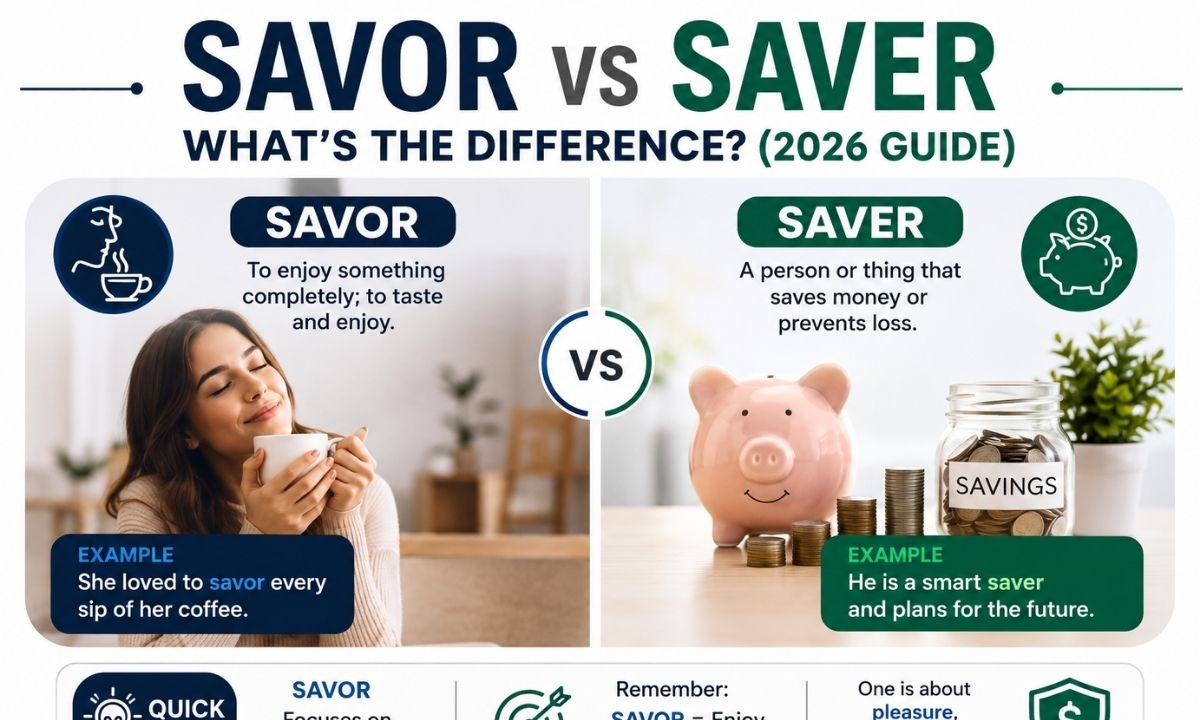
The words savor vs saver look similar, but they have completely different meanings. Savor means to fully enjoy or appreciate something, especially food, experiences, or special moments. Saver, on the other hand, refers to a person or thing that saves time, money, effort, or resources.
Because only one letter separates these words, many English learners accidentally confuse them. This guide explains their meanings, usage, differences, and simple memory tricks to help you choose the correct word every time.
What Do Savor and Saver Mean?
Although savor and saver share similar spellings, they belong to different parts of speech and describe entirely different ideas.
Savor
Part of Speech:
- Verb
- Noun
Definition
As a verb, savor means to enjoy, appreciate, or experience something slowly and completely.
As a noun, it refers to a distinctive taste, smell, flavor, or pleasing quality.
Dictionary Meaning
Verb: To enjoy something completely, especially by taking time to appreciate it.
Noun: A distinctive taste, flavor, aroma, or pleasant quality.
Examples
- Take time to savor every bite of your meal.
- She savored the peaceful evening.
- We should savor life’s happiest moments.
- He savored the success after years of hard work.
- Tourists savored the beautiful mountain views.
Saver
Part of Speech:
- Noun
Definition
A saver is a person or thing that saves something, such as money, time, energy, space, or effort.
It often appears in compound nouns and marketing phrases.
Dictionary Meaning
A person or object that saves or helps conserve something valuable.
Examples
- She is an excellent saver who plans her finances carefully.
- The new software is a real time saver.
- Coupons can be money savers.
- This storage box is a space saver.
- The automatic system is an energy saver.
Savor vs Saver Quick Comparison
| Feature | Savor | Saver |
| Meaning | Enjoy fully or appreciate | A person or thing that saves |
| Part of Speech | Verb, Noun | Noun |
| Common Context | Food, experiences, memories | Money, time, energy, storage |
| Example | Savor every moment. | This app is a time saver. |
| Common Confusion | Mistaken for saver | Mistaken for savor |
Although the words sound the same, they describe completely different actions and ideas.
How to Use Savor Correctly
Use savor whenever you mean to enjoy something slowly and completely.
People often savor:
- food
- drinks
- memories
- achievements
- conversations
- vacations
- peaceful moments
The word encourages slowing down and appreciating an experience rather than rushing through it.
Savor as a Verb Enjoying Something Fully
This is the most common use of savor.
Examples
- Savor every moment with your family.
- We savored the delicious homemade dessert.
- She savored the quiet morning before work.
- He savored his championship victory.
- Travelers should savor the local culture.
In every sentence, the speaker enjoys an experience thoughtfully and completely.
Common Expressions
Native speakers often say:
- savor the moment
- savor the flavor
- savor every bite
- savor the experience
- savor the victory
- savor success
- savor the memories
These expressions appear frequently in books, travel writing, advertisements, and everyday conversation.
Savor as a Noun Taste, Flavor, or Quality
Although less common today, savor can also function as a noun.
In this form, it refers to flavor, aroma, or a distinctive quality.
Examples
- The soup had a rich savor.
- Fresh herbs added extra savor to the meal.
- The cheese developed a pleasant savor.
- Every spice contributed to the dish’s savor.
- The wine had a unique savor.
Modern English more commonly uses flavor in everyday conversation, but savor still appears in literature and descriptive writing.
How to Use Saver Correctly
Unlike savor, saver is always a noun.
It describes someone who saves money or something that helps save time, energy, or resources.
Examples
- She has always been a careful saver.
- This dishwasher is a huge time saver.
- The insulation acts as an energy saver.
- Digital notes are excellent paper savers.
- Meal planning can become a money saver.
Notice that saver never means “to enjoy.”
Saver as a Noun A Person or Thing That Saves
People often use saver to describe habits or products.
Examples
- My grandfather was a lifelong saver.
- The budgeting app helps every saver manage expenses.
- Automatic savings plans benefit new savers.
- She became a disciplined saver after college.
- Good financial habits turn people into successful savers.
In finance, saver commonly refers to someone who regularly saves money.
Common Compound Words with Saver
Many English compound nouns include saver.
Examples include:
- time saver
- money saver
- energy saver
- life saver
- space saver
- screen saver
- fuel saver
- labor saver
Example Sentences
- Online banking is a time saver.
- LED bulbs are excellent energy savers.
- This compact desk is a space saver.
- Password managers are real time savers.
- Cloud storage can be a lifesaver for businesses.
These compounds appear frequently in advertising, technology, education, and everyday English.
Savor vs Saver Key Differences Explained
Although savor and saver share the same pronunciation, they differ in meaning, grammar, and usage.
Savor relates to enjoyment and appreciation.
Saver relates to saving resources, money, time, or effort.
Compare these examples:
- Savor the beautiful sunset.
- This travel app is a real time saver.
One describes an emotional experience, while the other describes practical usefulness.
American vs British English
One additional point often confuses learners.
In American English, the preferred spelling is:
Savor
In British English, the preferred spelling is:
Savour
Both words have the same meaning and pronunciation.
Examples:
American English:
- Savor every bite.
British English:
- Savour every bite.
The word saver, however, keeps the same spelling in both American and British English.
Common Mistakes and How to Avoid Them
Many learners accidentally substitute one word for the other because they sound identical.
Incorrect
❌ Please saver every moment.
✅ Please savor every moment.
❌ This app is a great savor.
✅ This app is a great time saver.
❌ She is a careful savor.
✅ She is a careful saver.
❌ We should saver this delicious meal.
✅ We should savor this delicious meal.
Memory Tricks to Remember Savor vs Saver
Savor = Flavor
Both words relate to enjoying food.
Savor → Flavor → Enjoy
Saver = Save
Think of saving money.
Saver → Save → Money
Ask Yourself One Question
Are you talking about enjoying something?
→ Savor
Are you talking about saving something?
→ Saver
Picture the Situation
Savor a delicious dessert.
Saver saves money.
This simple mental image makes the difference easy to remember.
FAQS
Is saver ever used as a verb?
No. Saver is only a noun. The verb is save.
How can I remember the difference?
Think of savor = enjoy and saver = saves. The extra er often indicates a person or thing.
Is savor spelled differently in British English?
Yes. American English uses savor, while British English spells it savour.
Can saver describe a money saving item?
Yes. A money saver or time saver is something that helps save money or time.
Final Verdict
Although savor vs saver sound identical, they serve completely different purposes in English. Savor means to enjoy or appreciate something fully, while saver refers to a person or thing that saves time, money, energy, or other resources.
To avoid mistakes, remember one simple rule: if you’re talking about enjoyment, choose savor. If you’re talking about saving, choose saver. Understanding this distinction will make your writing clearer, more accurate, and more professional.
Related Posts
If you enjoyed this guide, you may also like these grammar articles:
- Prescribe vs. Proscribe What’s the Real Difference?
- Eaten or Ate Which One Is Correct?
- Hastle or Hassle Which Is Correct?
- Continuous vs. Continous What’s the Difference?
- Tear vs Tare What’s the Difference?
- Raise vs Rise
- Impatient vs Inpatient
- Introduction To vs. Introduction Of
These guides explain confusing English words and grammar rules with clear definitions, comparison tables, practical examples, and easy memory tricks.
Our Vision
Our vision is to make English grammar simple, practical, and accessible for everyone. We publish accurate, easy to understand grammar guides that help students, professionals, bloggers, and ESL learners communicate with confidence.
Every article combines trusted grammar rules, real world examples, and practical learning tips to make confusing words easier to understand. Whether you’re preparing for exams, improving your writing, or creating SEO friendly content, our goal is to provide reliable grammar resources you can trust