

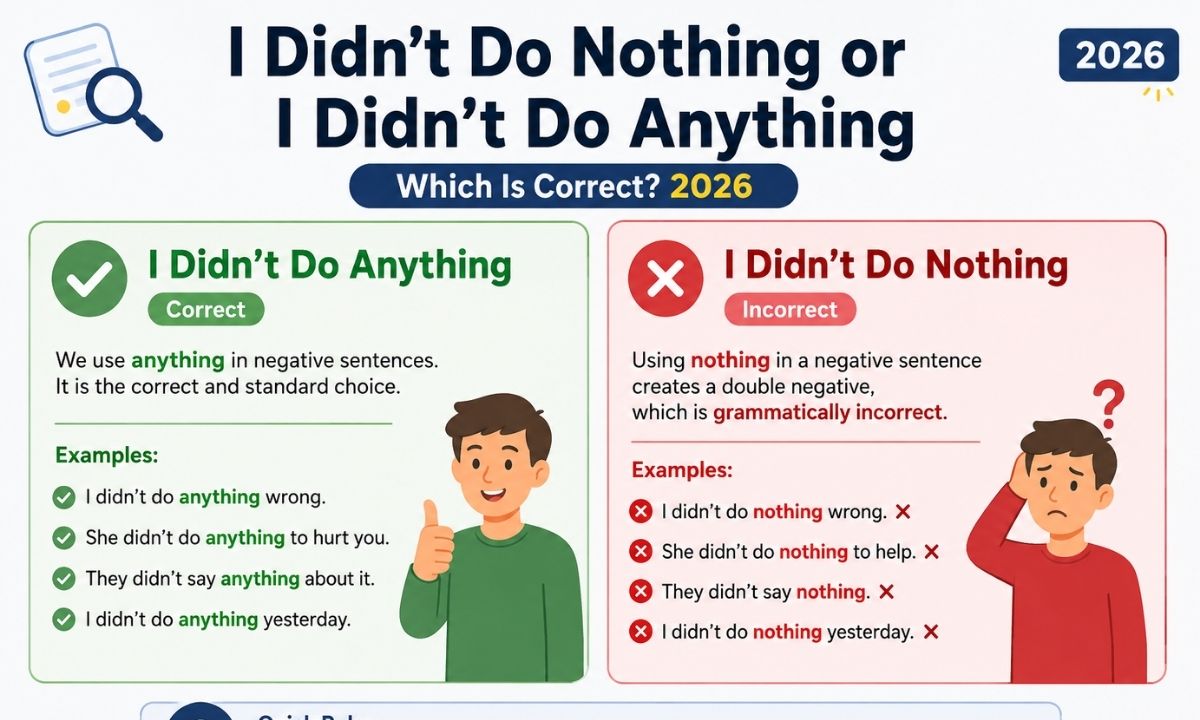
Many English learners wonder whether they should say “I didn’t do nothing” or “I didn’t do anything.” Although both expressions appear in everyday conversations, only one is considered correct in Standard English. “I didn’t do anything” is the grammatically correct choice because it uses a single negative. By contrast, “I didn’t do nothing” contains a double negative, which can create confusion or unintentionally suggest the opposite meaning. This guide explains the difference, grammar rules, real-world usage, and when each expression is appropriate.
What’s the Real Difference
At first glance, these two sentences seem to communicate the same idea. However, Standard English treats them very differently.
I didn’t do anything uses one negative word (didn’t) and one indefinite pronoun (anything). Together, they clearly express that no action took place.
I didn’t do nothing, on the other hand, combines two negative words:
- didn’t
- nothing
This combination creates a double negative.
In Standard English grammar, two negatives usually cancel each other out. As a result, the sentence can logically suggest that you actually did something, even if that was not your intention.
Compare these examples:
✅ I didn’t do anything.
Meaning: I did not do any action.
❌ I didn’t do nothing.
Literal grammatical meaning: I did something.
Although many native speakers understand the intended meaning from context, formal English considers this construction incorrect.
Quick Comparison
| Feature | I Didn’t Do Anything | I Didn’t Do Nothing |
| Grammar | Standard English | Double negative |
| Formal Writing | ✅ Correct | ❌ Incorrect |
| School & Exams | ✅ Recommended | ❌ Usually marked incorrect |
| Job Interviews | ✅ Appropriate | ❌ Avoid |
| Casual Speech | Common | Common in some dialects |
| Literal Meaning | No action happened | Double negative may imply the opposite |
Why “I Didn’t Do Anything” Is Standard English
Standard English avoids double negatives because they can confuse readers and listeners.
Instead of pairing didn’t with nothing, English pairs negative verbs with words such as:
- anything
- anyone
- anywhere
- ever
Examples:
- I didn’t see anyone.
- She didn’t buy anything.
- We didn’t go anywhere.
- They didn’t hear anything.
- He didn’t say anything.
Each sentence contains only one grammatical negative, making the meaning clear.
Professional writers, teachers, editors, and examination boards all recommend this structure because it communicates your message accurately.
More Correct Examples
- I didn’t do anything wrong.
- We didn’t find anything useful.
- She didn’t tell anyone.
- They didn’t buy anything yesterday.
- He didn’t notice anything unusual.
These sentences sound natural in academic writing, business communication, and everyday conversation.
Does “I Didn’t Do Nothing” Really Mean You Did Something?
From a grammatical perspective, yes.
In Standard English, two negatives often cancel each other out.
Think of simple mathematics:
Negative × Negative = Positive
Grammar works similarly in many cases.
Consider these examples:
❌ I don’t know nothing.
Literal meaning: I know something.
✅ I don’t know anything.
Meaning: I know nothing.
Another example:
❌ She didn’t tell nobody.
Literal meaning: She told somebody.
✅ She didn’t tell anybody.
Meaning: She told no one.
Although most native speakers understand that the speaker intends to deny something, grammar rules still classify these expressions as double negatives.
Why Native Speakers Still Use It
You may hear expressions like “I didn’t do nothing” in movies, songs, television shows, or everyday conversations.
That happens because some regional dialects treat double negatives as negative emphasis rather than incorrect grammar.
For example, several dialects of English use double negatives naturally, including:
- African American Vernacular English (AAVE)
- Southern American English
- Cockney English
- Some Northern English dialects
In these dialects, speakers do not intend a positive meaning. Instead, the second negative strengthens the first one.
Even so, schools, universities, businesses, and formal publications still follow Standard English rules.
Therefore, use I didn’t do anything whenever accuracy and professionalism matter.
The Right Way vs. The Wrong Way Grammar Rules You Need to Know
Understanding one simple grammar rule will help you avoid this mistake forever.
Rule : Use One Negative in Standard English
Correct:
- I didn’t do anything.
- She didn’t buy anything.
- We didn’t meet anyone.
- They didn’t say anything.
- He didn’t find anything.
Rule : Avoid Double Negatives
Incorrect:
- I didn’t do nothing.
- She didn’t see nobody.
- We don’t need no help.
- He can’t find nothing.
- They didn’t go nowhere.
Replace the second negative word with an any- word.
| Incorrect | Correct |
| didn’t do nothing | didn’t do anything |
| didn’t see nobody | didn’t see anybody |
| didn’t go nowhere | didn’t go anywhere |
| didn’t hear nothing | didn’t hear anything |
| didn’t tell nobody | didn’t tell anybody |
Rule : Match the Context
Choose I didn’t do anything when writing:
- Essays
- Emails
- Reports
- Exams
- Business documents
- Job applications
- Academic assignments
Only use I didn’t do nothing when quoting someone’s speech, writing realistic dialogue, or representing a dialect intentionally.
Common Mistakes
❌ I didn’t buy nothing.
✅ I didn’t buy anything.
❌ She doesn’t know nobody.
✅ She doesn’t know anybody.
❌ We didn’t hear nothing.
✅ We didn’t hear anything.
❌ He couldn’t find nowhere to park.
✅ He couldn’t find anywhere to park.
American vs. British English
Both American English and British English follow the same Standard English rule:
✅ I didn’t do anything is grammatically correct.
❌ I didn’t do nothing is considered a double negative in formal writing.
However, both varieties of English include regional dialects where speakers naturally use double negatives in casual conversation. While these expressions are acceptable within those dialects, they are generally avoided in academic, professional, and formal contexts.
FAQ’s “I Didn’t Do Nothing” vs. “I Didn’t Do Anything”
Is “I didn’t do anything” correct?
Yes, it is the standard and grammatically correct form.
It means that you did not do anything.
Is “I didn’t do nothing” correct?
In standard English, it is considered incorrect because it uses a double negative.
Use “I didn’t do anything” instead.
What does “I didn’t do anything” mean?
It means you did not perform any action or activity.
Example: “I didn’t do anything yesterday.”
Why is “I didn’t do nothing” considered incorrect?
“Didn’t” already makes the sentence negative, so “nothing” creates a double negative.
Standard English uses “anything” after “didn’t.”
Can “I didn’t do nothing” ever be used?
Yes, some dialects and informal speech use double negatives.
However, it should be avoided in formal or standard English.
Which sentence should I use in formal English?
Use “I didn’t do anything” in formal and standard English.
It is the clearest and safest choice.
Final Verdict
The choice between “I didn’t do nothing” and “I didn’t do anything” is simple once you understand the grammar. “I didn’t do anything” is the correct form in Standard English because it uses a single negative and communicates your meaning clearly. It is the preferred choice for school assignments, professional writing, business communication, and everyday formal conversation.
By contrast, “I didn’t do nothing” contains a double negative. Although many native speakers use it in regional dialects and informal speech for emphasis, it is generally considered incorrect in formal contexts. If you want your English to sound accurate, polished, and professional, choose “I didn’t do anything.”
Related Posts
If you found this guide helpful, you may also enjoy these grammar articles:
- Continuous vs. Continous What’s the Difference?
- Tear vs. Tare What’s the Difference?
- Impatient vs. Inpatient
- Raise vs. Rise
- Introduction To vs. Introduction Of
- Passersby vs. Passerby vs. Passerbyers
- Whole Day or All Day
- Time Slot vs. Timeslot
These articles explain confusing English words and expressions with clear definitions, practical examples, comparison tables, and memory tips.
Our Vision
Our vision is to make English grammar clear, practical, and accessible for everyone. We create well researched guides that simplify confusing words, phrases, and grammar rules for students, professionals, bloggers, and ESL learners.
Every article focuses on accuracy, readability, and real world usage while following trusted grammar standards. Whether you’re preparing for an exam, improving your writing, or creating SEO friendly content, our goal is to provide reliable resources that help you communicate with confidence.