

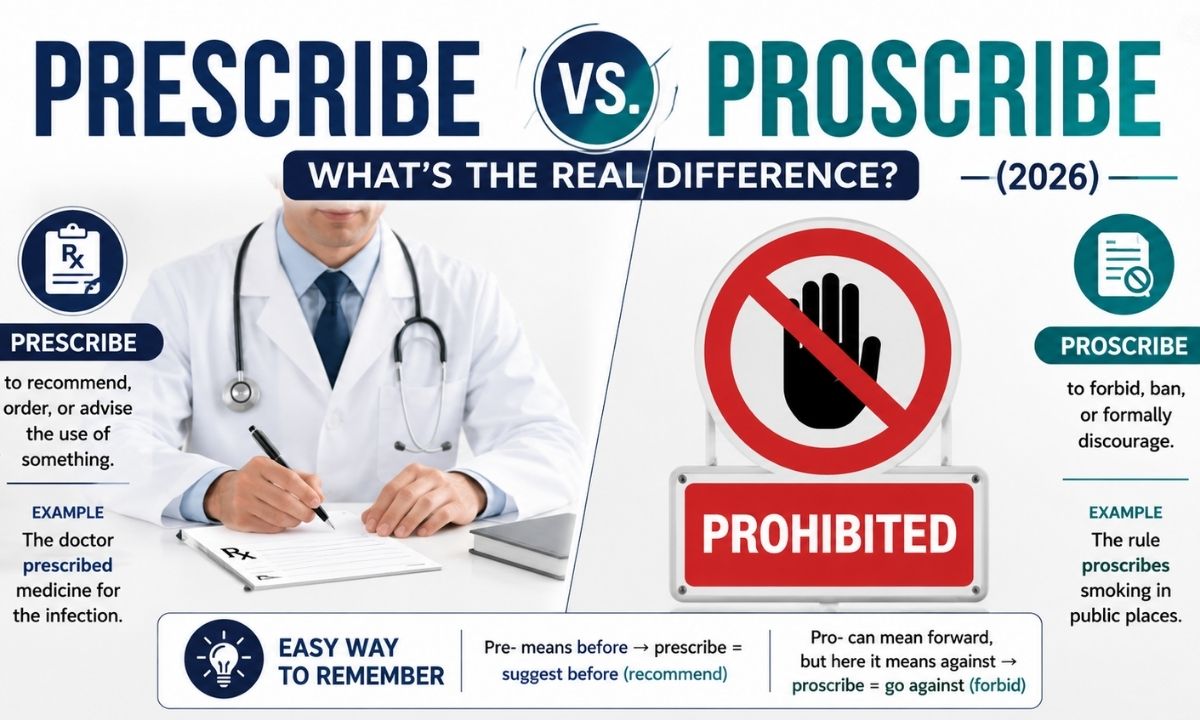
The words prescribe vs proscribe look and sound remarkably similar, yet they have almost opposite meanings. Prescribe means to recommend, authorize, or officially order something, while proscribe means to forbid, prohibit, or outlaw it.
Because only two letters separate these words, many students, writers, and even native English speakers confuse them. This guide explains their meanings, origins, correct usage, and simple memory tricks so you can choose the right word with confidence.
What Do Prescribe and Proscribe Mean?
Although prescribe and proscribe share similar spellings and Latin roots, they serve entirely different purposes in English.
Prescribe
Part of Speech: Verb
Definition
Prescribe means to recommend, authorize, or officially order something. It most commonly refers to a doctor ordering medicine or treatment, but it also appears in law, education, and everyday communication to describe setting rules or instructions.
Dictionary Meaning
A doctor, authority, or organization officially recommends or orders a medicine, treatment, action, or rule.
Examples
- The doctor prescribed antibiotics for the infection.
- The teacher prescribed additional reading for the class.
- The law prescribes strict safety standards.
Proscribe
Part of Speech: Verb
Definition
Proscribe means to forbid, ban, prohibit, or officially condemn something. Governments, organizations, and institutions often proscribe activities, substances, or groups that violate laws or policies.
Dictionary Meaning
To officially forbid, outlaw, or prohibit something.
Examples
- The government proscribed the illegal organization.
- School rules proscribe bullying.
- The company proscribes workplace harassment.
- Several countries proscribe certain dangerous chemicals.
- The law proscribes insider trading.
Quick Comparison
| Feature | Prescribe | Proscribe |
| Meaning | Recommend or authorize | Forbid or prohibit |
| Part of Speech | Verb | Verb |
| Common Context | Medicine, education, law | Law, politics, workplace policies |
| Opposite Idea | Allow or recommend | Ban or outlaw |
| Example | The doctor prescribed medicine. | The law proscribed the activity. |
Although the words differ by only two letters, their meanings move in opposite directions.
Latin Roots Where Prescribe and Proscribe Come From
Understanding the Latin origins makes these words much easier to remember.
Prescribe
The word prescribe comes from the Latin praescribere.
- prae means before.
- scribere means to write.
Originally, the word meant to write beforehand or to give written instructions. Over time, it developed the modern meaning of officially recommending medicine, rules, or procedures.
Proscribe
Proscribe comes from the Latin proscribere.
Originally, it referred to publishing someone’s name as an outlaw. Ancient Roman authorities publicly displayed lists of people who had been condemned or banned.
As the language evolved, proscribe came to mean officially forbid or outlaw.
Although both words share scribere (“to write”), their prefixes create completely different meanings.
Why Their Roots Matter
Knowing the origins helps explain why these words often appear in official contexts.
For example:
- Doctors prescribe medicine.
- Governments proscribe illegal organizations.
- Schools prescribe academic requirements.
- Laws proscribe criminal behavior.
Thinking about who has the authority to recommend or prohibit something makes choosing the correct word much easier.
How to Use Prescribe vs Proscribe Correctly
The easiest way to choose between these verbs is to ask one simple question:
Am I recommending something or banning it?
If the answer is recommend, use prescribe.
If the answer is ban, use proscribe.
Correct Examples
- Doctors prescribe medication.
- Teachers prescribe required textbooks.
- Company policies prescribe safety procedures.
- Governments proscribe terrorist organizations.
- Workplace policies proscribe discrimination.
Notice that each verb reflects a different type of authority.
Prescribe in Medicine, Law, and Everyday Use
Although people often associate prescribe with healthcare, its use extends far beyond medicine.
In Medicine
- The physician prescribed pain medication.
- The dentist prescribed antibiotics.
- The specialist prescribed physical therapy.
- Doctors prescribe vaccines when appropriate.
- The pharmacist explained how to take the prescribed medicine.
In Law
Legal systems often prescribe procedures or penalties.
Examples:
- The law prescribes a minimum sentence.
- Regulations prescribe workplace safety standards.
- The contract prescribes payment deadlines.
In Everyday English
People also use prescribe more generally.
Examples:
- The coach prescribed a new training schedule.
- The instructor prescribed daily practice.
- The consultant prescribed several improvements.
- Good habits prescribe better organization.
- The handbook prescribes professional conduct.
In every example, prescribe introduces guidance, rules, or recommendations.
Proscribe in Law, Politics, and Workplace Policies
Unlike prescribe, proscribe almost always involves prohibition.
In Law
- The statute proscribes tax fraud.
- National law proscribes bribery.
- The regulations proscribe unsafe practices.
- Courts enforce laws that proscribe discrimination.
- Local ordinances proscribe illegal dumping.
In Politics
Governments may proscribe organizations or activities.
Examples:
- The government proscribed the extremist group.
- Several countries proscribe human trafficking.
- International agreements proscribe chemical weapons.
In the Workplace
Organizations also use proscribe when establishing prohibited behavior.
Examples:
- Company policy proscribes harassment.
- The employee handbook proscribes data theft.
- Workplace rules proscribe discrimination.
- The organization proscribes conflicts of interest.
- Safety regulations proscribe dangerous shortcuts.
Because proscribe is more formal than ban, it appears most often in legal, governmental, and institutional writing.
Easy Memory Tricks to Never Confuse Them Again
Learning two similar words becomes much easier when you associate each one with a simple idea.
Pre = Prescription
Think of prescribe and prescription.
Doctors write prescriptions, so they prescribe medicine.
Prescription → Prescribe
Proscribe = Prohibit
Both proscribe and prohibit begin with pro.
Although the prefixes do not share the same meaning, remembering that both words relate to banning creates an easy mental shortcut.
Proscribe → Prohibit → Ban
Ask One Question
Before choosing a word, ask yourself:
- Am I recommending something?
- Prescribe
- Am I forbidding something?
- Proscribe
This simple question eliminates most confusion.
Think of Authority
Imagine two authority figures.
A doctor prescribes medicine.
A government proscribes illegal activities.
Different authorities, different actions.
The Difference Comes Down to One Choice
The difference between prescribe and proscribe comes down to one simple choice: recommend or prohibit.
Use prescribe whenever someone officially recommends, authorizes, or instructs an action. Doctors prescribe medicine, laws prescribe procedures, and teachers prescribe assignments.
Use proscribe whenever an authority officially forbids or outlaws something. Governments proscribe illegal organizations, companies proscribe harassment, and regulations proscribe unsafe practices.
Although these words differ by only two letters, choosing the correct one makes your writing clearer and more precise. Remember the connection between prescribe and prescription, and link proscribe with prohibit. Those two memory aids will help you avoid confusion in both writing and conversation.
Related Posts
If you found this guide helpful, you may also enjoy these grammar articles:
- Raise vs. Rise
- Impatient vs. Inpatient
- Passersby vs. Passerby vs. Passerbyers
- Introduction To vs. Introduction Of
These articles explain confusing English words and grammar rules with clear definitions, practical examples, comparison tables, and easy memory tricks.
FAQs About Prescribe vs Proscribe
What is the difference between prescribe and proscribe?
Prescribe means to recommend or authorize, while proscribe means to forbid or ban.
Can prescribe and proscribe be used interchangeably?
No. They have opposite meanings and should never be used in place of each other.
Is prescribe used only in medicine?
No. It can also mean to set rules, methods, or guidelines.
When should I use proscribe?
Use proscribe when referring to something that is officially prohibited or outlawed.
How can I remember the difference?
Think pre = recommend and pro = prohibit to keep the meanings clear.
Our Vision
Our vision is to make English grammar simple, practical, and accessible for everyone. We create accurate, easy to understand grammar guides that help students, professionals, bloggers, and ESL learners write and speak with confidence.
Every article focuses on clarity, real world examples, and trusted explanations while following modern grammar standards. Whether you’re preparing for exams, improving workplace communication, or creating SEO friendly content, our goal is to provide reliable grammar resources you can use every day.