

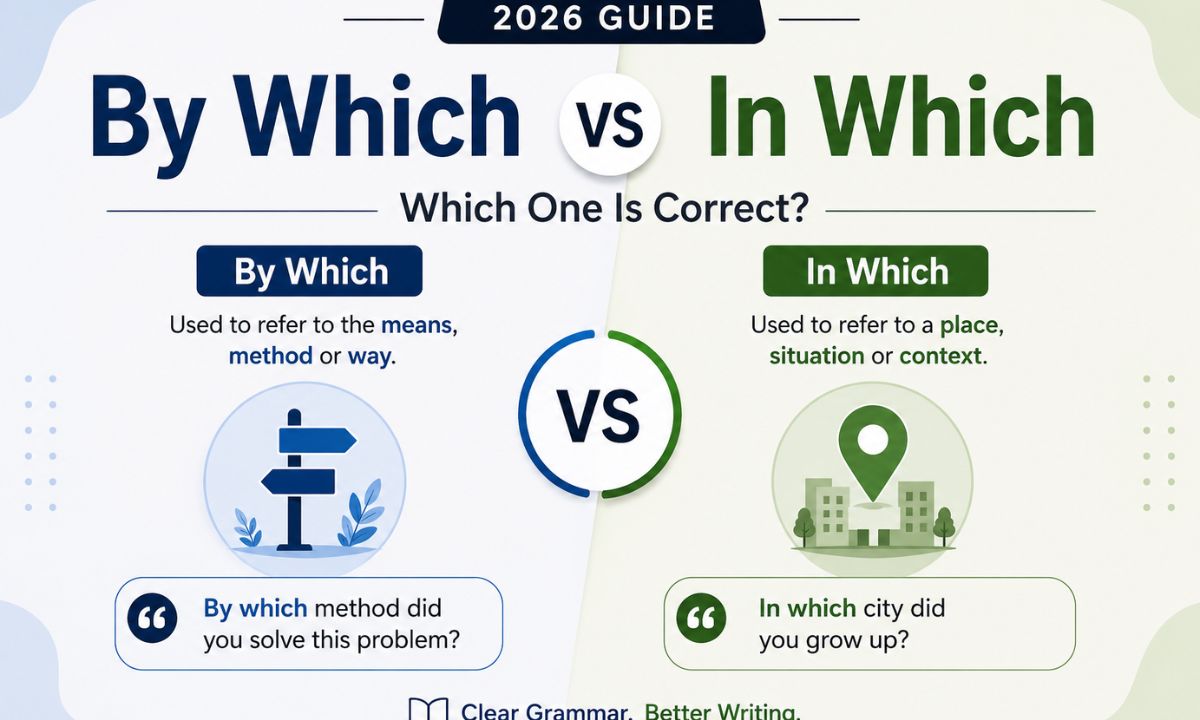
By Which or In Which
English learners often struggle with phrases that look similar but have different meanings. One common confusion is By Which or In Which. Both expressions use the relative pronoun “which,” but the prepositions “by” and “in” create completely different meanings.
Understanding the difference between By Which or In Which can improve your writing, speaking, and comprehension. These phrases appear frequently in academic papers, professional documents, legal writing, and formal conversations.
This guide explains their meanings, usage rules, examples, common mistakes, and practical tips. By the end, you will know exactly when to use “by which” and when to use “in which” with confidence.
Definition of By Which or In Which
By which refers to the method, process, means, or way something happens. It usually answers the question “how?”
In which refers to a situation, place, condition, system, or context where something happens. It often answers the question “where?” or “within what situation?”
These expressions are both grammatically correct, but they cannot always replace each other because they communicate different ideas.
Meaning of “By Which”
The phrase by which means “through which,” “using which,” or “by the method that.”
It explains the tool, method, or process used to achieve a result.
Examples:
- This is the method by which scientists discovered the answer.
- The machine by which the products are created saves time.
- She explained the process by which the company improved efficiency.
In each example, “by which” describes the method or mechanism.
Meaning of “In Which”
The phrase in which means “where,” “within which,” or “inside which.”
It describes a place, situation, environment, or condition.
Examples:
- This is the room in which the meeting was held.
- We studied the environment in which plants grow.
- She described the situation in which the problem occurred.
Here, “in which” identifies the setting or context.
Importance of Understanding By Which or In Which
Using the correct phrase improves clarity. A small preposition change can completely alter the meaning of a sentence.
Consider these examples:
- The process by which the company increased sales was effective.
- The market in which the company increased sales was competitive.
The first sentence focuses on the method. The second focuses on the environment.
Correct usage helps writers:
- Communicate ideas more clearly
- Avoid confusing readers
- Create professional quality writing
- Improve academic and business communication
- Sound more natural in English
By Which or In Which: How It Works
The difference comes from the meaning of the prepositions.
| Phrase | Main Meaning | Question Answered | Example |
| By which | Method, way, process | How? | The system by which data is stored |
| In which | Place, situation, context | Where? | The situation in which data was lost |
The relative pronoun “which” refers to a previously mentioned noun. The preposition changes the relationship between that noun and the rest of the sentence.
Step by Step Guide to Choosing the Correct Phrase
Identify the Meaning
Ask yourself what relationship you want to describe.
Does the sentence explain:
- A method?
- A tool?
- A process?
Use by which.
Does it explain:
- A place?
- A situation?
- A condition?
Use in which.
Replace the Phrase With Simpler Words
Try replacing the phrase.
If “through which” works, choose by which.
Example:
The technique by which the artist created the painting was unique.
The technique through which the artist created the painting was unique.
Both work.
If “where” works, choose in which.
Example:
The city in which I was born is beautiful.
The city where I was born is beautiful.
Both work.
Check the Noun Before “Which”
The noun often provides a clue.
- method
- process
- system
- technique
- approach
- procedure
Common nouns in which:
- place
- situation
- environment
- condition
- context
- period
Common Mistakes With By Which or In Which
Using “By Which” for Locations
Incorrect:
The house by which I lived was large.
Correct:
The house in which I lived was large.
A house is a location, so “in which” is appropriate.
Using “In Which” for Methods
Incorrect:
The method in which the machine works is complicated.
Better:
The method by which the machine works is complicated.
The sentence describes how the machine works.
Avoiding Prepositions Completely
Some writers remove prepositions unnecessarily.
Example:
The process which the company uses is effective.
This is grammatically acceptable, but:
The process by which the company operates is more formal and precise.
Pros and Cons of Using These Expressions
| Expression | Advantages | Limitations |
| By which | Precise, formal, explains methods clearly | Can sound formal in casual speech |
| In which | Clearly describes situations and contexts | May be replaced by simpler words like “where” |
Myths vs Facts
| Myth | Fact |
| “By which” and “in which” mean the same thing | They describe different relationships |
| “In which” is always more formal | It depends on the sentence meaning |
| “By which” is outdated | It remains common in professional writing |
| Prepositions before which are incorrect | They are grammatically correct |
Expert Tips for Better Usage
Use Natural Alternatives When Appropriate
Although By Which or In Which are correct, simpler options may improve readability.
Examples:
Formal:
- The method by which the company achieved success.
Simple:
- The method the company used to achieve success.
Formal:
- The situation in which the decision was made.
Simple:
- The situation where the decision was made.
Match Your Audience
Academic and professional writing often uses these structures.
Casual conversation usually prefers simpler alternatives.
Choose the style that fits your reader.
Read the Sentence Aloud
If the sentence sounds unnatural, test whether “how,” “where,” or “through which” makes sense.
This quick check often reveals the correct choice.
Best Practices for Using By Which or In Which
- Understand the meaning before choosing the phrase.
- Focus on the relationship between the noun and action.
- Use “by which” for methods and processes.
- Use “in which” for places and situations.
- Avoid replacing one with the other automatically.
- Prefer clarity over unnecessary complexity.
Featured Snippet Quick Answer
What Is the Difference Between By Which and In Which?
By which describes the method or process used to do something, while in which describes the place, situation, or context where something happens. “By which” answers “how,” while “in which” answers “where” or “within what condition.”
Numbered Explanation List
- Identify whether the sentence describes a method or situation.
- Use “by which” when explaining a process or mechanism.
- Use “in which” when describing a location or context.
- Replace the phrase with “how” or “where” to test accuracy.
- Choose the option that creates the clearest meaning.
Bullet List Summary
- “By which” explains a method.
- “In which” explains a situation.
- Both are grammatically correct.
- The preposition changes the meaning.
- Context determines the correct choice.
Latest Trends in English Usage
Modern English writing increasingly favors clarity and simplicity. While expressions like by which and in which remain important in formal communication, many writers now combine grammatical accuracy with easier sentence structures.
Professional writers often use these phrases when precision matters but choose simpler alternatives when communicating with general audiences.
Advanced Explanation of By Which or In Which
To fully understand the difference between by which and in which, it is important to look at the relationship between the noun and the action in a sentence. Many grammar mistakes happen because learners focus only on the word “which” and ignore the meaning created by the preposition before it.
The word “by” usually shows connection with a method, tool, agent, or process. It tells the reader how something is achieved or performed. On the other hand, “in” creates a relationship with a place, situation, environment, or condition. It explains the background in which an event happens.
For example:
The method by which the teacher explained the lesson was effective.
Here, the focus is on the method or approach used by the teacher.
The classroom in which the teacher explained the lesson was crowded.
Here, the focus is on the place where the lesson happened.
Although both sentences contain “which,” the prepositions completely change the meaning.
By Which or In Which in Formal Writing
These expressions are especially common in formal English. You will often find them in academic articles, research papers, business reports, and legal documents. Writers use them because they allow them to connect ideas in a precise and professional way.
Examples:
The process by which information is collected must follow strict guidelines.
This sentence explains the procedure used for collecting information.
The environment in which information is collected can affect the results.
This sentence explains the conditions surrounding the collection process.
In professional writing, choosing the correct phrase helps readers understand whether you are discussing a method or a context.
Difference Between By Which and In Which in Everyday Examples
Understanding everyday examples can make these grammar rules easier to remember.
Example
The way by which he solved the problem was impressive.
Meaning: The technique or method he used was impressive.
The situation in which he solved the problem was difficult.
Meaning: The circumstances surrounding the problem were difficult.
Example
The system by which payments are processed is secure.
Meaning: The payment method or mechanism is secure.
The system in which payments are processed is outdated.
Meaning: The platform or environment where payments happen is outdated.
These examples show that the same noun can sometimes work with both phrases, but the meaning changes depending on the preposition.
How Native Speakers Choose Between Them
Native speakers usually decide between “by which” and “in which” by understanding the idea they want to express rather than memorizing a fixed rule.
Ask these questions:
Am I explaining a way something happens?
- How was it done?
- What method was used?
- What process created the result?
Use by which.
Am I explaining the setting or circumstances?
- Where did it happen?
- Under what conditions did it happen?
- In what situation did it occur?
Use in which.
This simple method helps avoid most common mistakes.
Common Situations Where “By Which” Is Used
“By which” is often used with words connected to systems and procedures, including:
- Method by which
- Process by which
- Means by which
- System by which
- Technique by which
- Approach by which
- Procedure by which
Examples:
The method by which employees communicate has changed over time.
Scientists discovered the process by which cells reproduce.
The technique by which the artist created the design was unique.
Common Situations Where “In Which” Is Used
“In which” is commonly used with words related to places, experiences, and conditions, such as:
- Situation in which
- Environment in which
- Context in which
- Period in which
- Condition in which
- Place in which
Examples:
The period in which this invention was created was important in history.
The environment in which students study influences their performance.
The situation in which the decision was made required careful thinking.
Final Tip for Mastering These Phrases
The best way to master by which or in which is through regular reading and practice. Notice how professional writers use these expressions in articles, books, and reports. Over time, you will naturally understand which phrase sounds correct.
Remember this simple formula:
By = How (method, process, way)
In = Where (place, situation, condition)
When you focus on the meaning of the sentence instead of only the grammar rule, choosing the correct phrase becomes much easier.
Frequently Asked Questions
What is the difference between by which and in which?
By which explains the method, process, or tool used to complete an action. In which explains the place, situation, or context where something happens.
Is “by which” grammatically correct?
Yes, “by which” is completely grammatically correct. It is commonly used in formal writing, academic research, and professional communication.
Is “in which” the same as “where”?
In many situations, “in which” can be replaced with “where,” especially when discussing locations. However, “in which” can also describe abstract situations and conditions where “where” may sound less precise.
Can I use by which and in which interchangeably?
No. Although both phrases contain “which,” they have different meanings. Replacing one with the other can create an incorrect sentence. Use “by which” for methods and “in which” for places, situations, or conditions.
Why do writers use phrases like by which and in which?
Writers use these phrases because they provide precision. They are especially useful in academic, legal, scientific, and professional writing where explaining relationships between ideas clearly is important.
How can I remember when to use by which or in which?
Remember the simple rule: “by” relates to a method, while “in” relates to a place or condition. Ask yourself whether you are explaining how something happens or where something happens. That answer will usually guide you to the correct phrase.
Are by which and in which common in everyday English?
They are more common in formal English than casual conversation. In everyday speech, people often use simpler expressions like “how,” “where,” or “the way that.”
Conclusion
`Understanding By Which or In Which helps you write clearer and more accurate English. Although these phrases look similar, they serve different purposes. “By which” explains a method or process, while “in which” describes a place, situation, or context.
Using the correct phrase improves professional writing, academic communication, and everyday language skills. The key is to focus on meaning rather than memorizing rules. Practice with real examples, check the relationship between ideas, and choose the phrase that communicates your message best.
Continue improving your grammar skills and apply these rules in your writing for stronger, clearer communication.