

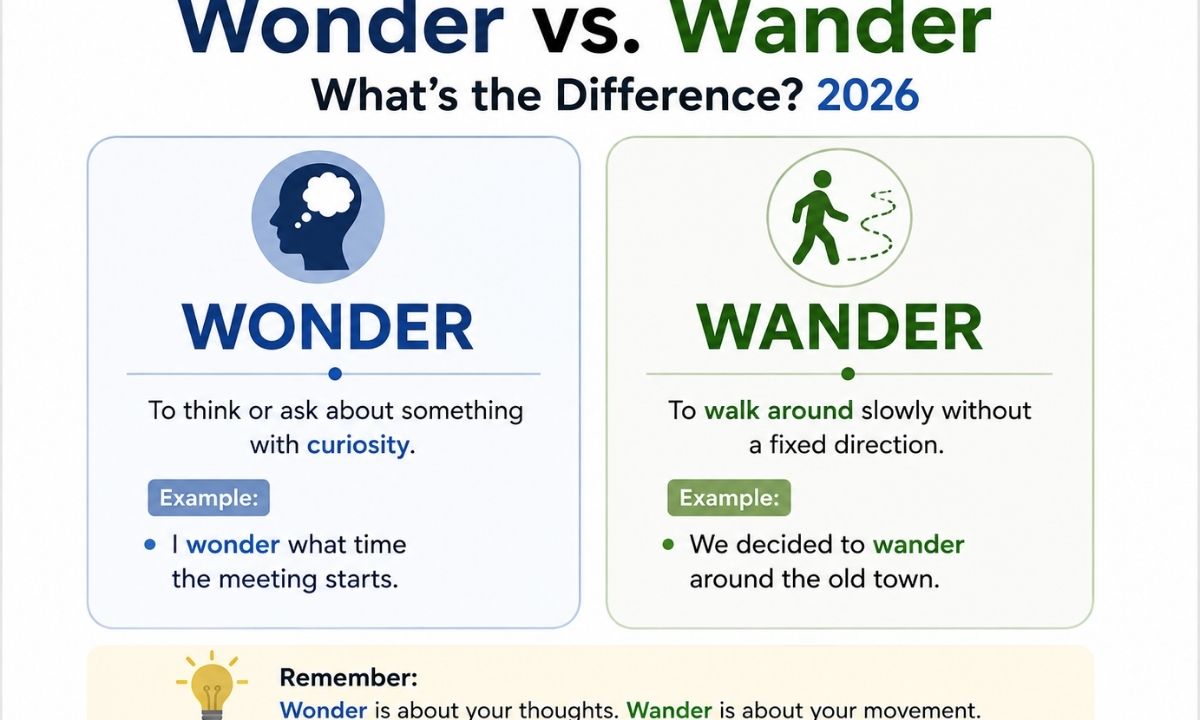
Have you ever paused mid sentence, unsure whether to write “wonder” vs. “wander”? You’re far from alone. These two words sound almost identical when spoken aloud, yet they carry completely different meanings. One describes a feeling of curiosity, while the other describes physical movement without a clear destination.
This mix up happens constantly, even among confident writers. Students confuse the words in essays, professionals slip up in emails, and casual texters swap them without noticing. Part of the problem comes from how close the spellings look on a page: swap a single letter, and the entire meaning of a sentence shifts from a thought to an action.
This guide breaks the confusion down into simple, practical terms. By the end, you’ll understand exactly when to use each word, see real examples from everyday conversation, learn where each term originally came from, and pick up several memory tricks that make the difference stick for good. We’ll also cover common mistakes, useful synonyms, and a full comparison table you can reference anytime doubt creeps back in.
What Do Wonder and Wander Actually Mean?
Although these words look alike on paper, they belong to entirely separate categories of meaning. One lives inside the mind, while the other lives inside the body. Understanding this basic split makes every other rule far easier to remember.
Wonder The Word for Curiosity and Amazement
“Wonder” refers to a feeling of curiosity, amazement, or gentle questioning. It can function as a verb, describing the act of thinking or questioning, or as a noun, describing a feeling of awe.
As a verb, wonder usually introduces a question inside the sentence itself, even without a question mark. A student might wonder why a historical event unfolded the way it did. A new parent might wonder whether their baby is sleeping enough. These sentences describe an internal process, a quiet moment of thinking rather than speaking aloud.
As a noun, wonder describes a powerful emotional reaction, often tied to beauty, mystery, or scale. Museums are frequently described as places filled with wonder, since visitors encounter objects and ideas far beyond their everyday experience. Phrases like “a sense of wonder” or “wide eyed wonder” capture this emotional weight perfectly.
For example, a child staring up at the night sky might wonder how many stars actually exist. A traveler standing before the Grand Canyon could feel a deep sense of wonder at its size. Even in casual conversation, someone might say, “I wonder what’s for dinner tonight,” simply expressing mild curiosity about an everyday situation.
A scientist reading unexpected results might wonder if the experiment needs to be repeated, while a reader finishing a mystery novel might wonder about the fate of a favorite character long after closing the book.
Wander The Word for Aimless Movement
“Wander” describes physical movement that lacks a fixed destination or purpose. It almost always functions as a verb and often carries a relaxed, exploratory tone.
Unlike words such as “walk” or “travel,” which can describe purposeful movement toward a known destination, wander specifically implies uncertainty or freedom from a set path. Someone walking to work has a clear goal. Someone wandering through a city on a lazy Sunday afternoon does not, and that lack of direction is exactly what gives the word its relaxed, unhurried feel.
Picture someone strolling through an old European city with no map and no plan, simply letting their feet decide the route. That person is wandering. A lost puppy roaming through a neighborhood, unsure which way leads home, is also wandering.
Even attention can wander, such as when a student’s focus drifts away from a lecture and toward daydreams instead. A hiker without a set trail might wander through a forest simply enjoying the scenery, while a shopper with no specific item in mind might wander through a mall, browsing without commitment.
How Wonder and Wander Function in a Sentence
Grammar offers a reliable way to separate these two words. “Wonder” typically pairs with thoughts, questions, or feelings, while “wander” pairs with physical space or movement.
Notice the pattern in these examples:
Sentences using wonder often include question words like “why,” “how,” or “what.” A person might wonder why the sky appears blue, or wonder how a magician performed a trick. These sentences almost always describe mental activity rather than physical action.
Sentences using wander usually mention a location, direction, or lack of direction. Someone wanders through a forest, wanders along a beach, or simply wanders without any destination in mind. These sentences describe movement through physical or, occasionally, figurative space.
Recognizing whether a sentence describes a thought or a movement instantly reveals which word belongs.
Pronunciation and Spelling Patterns Worth Noticing
Part of why these words get confused so easily comes down to pronunciation. In fast, casual speech, the vowel sounds in “wonder” and “wander” can blur together, especially across different regional accents. Someone speaking quickly might pronounce both words in a way that sounds nearly identical, even though the spelling on paper remains distinct.
A helpful pattern to notice: “wonder” contains the letter combination “on,” which pairs naturally with words describing internal states, like “ponder” or “consider.”
Meanwhile, “wander” contains the letter combination “an,” which appears in movement related words like “amble” or “travel.” While this isn’t a strict linguistic rule, many learners find that grouping similar looking words together helps reinforce spelling over time.
Reading each word aloud slowly, rather than relying purely on how it sounds in casual speech, often makes the difference between the two much easier to hear and remember.
Wonder vs. Wander Real Examples in Context
Seeing both words used naturally makes the distinction even clearer. Below are everyday examples that mirror how people actually speak and write.
Wonder examples:
She began to wonder whether she had locked the front door before leaving. Scientists still wonder about the true depths of the ocean. He looked at the ancient ruins with pure wonder in his eyes. I wonder if it will rain later this afternoon.
Wander examples:
The children wandered through the park, chasing butterflies along the way. His mind wandered during the long meeting, drifting toward weekend plans. Tourists often wander the narrow streets of old towns without a set itinerary. The dog wandered off while its owner wasn’t watching.
Placing these examples side by side highlights just how differently each word behaves, even though their spelling looks remarkably similar.
Quick Reference Wonder vs. Wander at a Glance
| Word | Part of Speech | Meaning | Common Use | Example |
| Wonder | Verb / Noun | Curiosity, amazement, or questioning | Thoughts, feelings, questions | She wondered about the ending of the movie. |
| Wander | Verb | Aimless physical movement | Walking, exploring, drifting | They wandered through the quiet village streets. |
This quick comparison offers an instant visual reference whenever doubt creeps in during writing.
Common Mistakes People Make With Wonder and Wander
Even experienced writers occasionally mix these words up. A few frequent errors include swapping “wander” into sentences meant to express curiosity, such as mistakenly writing “I wander what happened” instead of “I wonder what happened.” Another common slip involves using “wonder” when describing physical motion, like writing “she wondered through the museum” instead of “she wandered through the museum.”
This error appears frequently in travel writing, where authors describe exploring a new city. A blog post meant to say “we wandered through narrow cobblestone streets” sometimes mistakenly becomes “we wondered through narrow cobblestone streets,” instantly confusing readers about whether the writer was walking or simply thinking. Similarly, product reviews sometimes include phrases like “I wander if this is worth the price,” when the intended meaning was clearly about curiosity, not movement.
Autocorrect tools rarely catch these mistakes because both words are spelled correctly on their own. The error lies entirely in meaning, not spelling, which makes careful reading essential before hitting send or publish. Reading a sentence aloud, or asking whether the word relates to thought or motion, remains the fastest way to catch this type of mistake before it reaches an audience.
Where Wonder and Wander Come From
Both words trace back to Old English roots, though their paths diverged early on. “Wonder” descended from a term connected to astonishment and marvel, closely tied to emotional reaction. “Wander,” on the other hand, developed from a term associated with roaming or turning, emphasizing physical motion rather than feeling.
This shared ancestry explains why the words look so similar today, even though centuries of language evolution pushed their meanings in completely different directions.
Wonder and Wander in Everyday Conversation
Beyond textbooks and grammar guides, both words appear constantly in daily life. A parent might wonder whether their child ate lunch at school, while that same child wanders across the playground during recess. A writer might wonder how to phrase a difficult paragraph, then take a walk to let their thoughts wander freely before returning to the desk.
These natural, relatable scenarios prove that mastering the difference isn’t just useful for essays or reports. It shapes clearer communication in texts, emails, and everyday small talk alike.
Can a Sentence Use Both Words Together?
Interestingly, yes. Since one word describes mental activity and the other describes physical movement, they can appear in the same sentence without contradiction. For example: “As she wandered through the quiet garden, she began to wonder about the history of the old stone fountain.” Here, the physical action and the mental curiosity happen simultaneously, showing exactly how naturally these words coexist in real writing.
Synonyms That Can Help Reinforce the Difference
Learning related words often reinforces understanding. Synonyms for “wonder” include ponder, question, marvel, and muse. Synonyms for “wander” include roam, stroll, drift, and meander. Practicing these substitute words in sentences can help solidify which category each original word belongs to.
Final Verdict Which One Should You Use?
If you’re describing a thought, question, or feeling of amazement, choose “wonder.” If you’re describing movement without a clear destination, choose “wander.” This single distinction resolves nearly every situation, whether you’re writing a story, a message, or a school assignment.
Whenever uncertainty strikes, pause and ask yourself a simple question: is this about the mind, or is this about the feet? That question alone will guide you toward the correct word almost instantly.
FAQs About Wonder vs. Wander
What is the main difference between Wonder and Wander?
“Wonder” relates to thoughts, curiosity, and amazement, while “wander” relates to physical movement without a set direction. One lives in the mind, and the other lives in motion.
Can Wonder and Wander be used interchangeably?
No, these words cannot replace each other. Swapping them changes the meaning of a sentence entirely, since one describes mental activity and the other describes physical action.
How can I remember which word to use?
Try linking “wonder” to questions, since both words contain similar sounds tied to curiosity. Link “wander” to walking, since both involve movement across space.
Can the mind both wonder and wander?
Yes, the mind can do both. A person might wonder about a topic while their thoughts simultaneously wander away from the original subject, drifting toward something unrelated.
Is wander ever used metaphorically?
Yes, “wander” often appears metaphorically, especially when describing attention, focus, or thoughts drifting away from a task, even without any physical movement involved.
Related Posts
Affect vs. Effect: A Simple Guide Advice vs. Advise: What’s the Difference Fewer vs. Less: When to Use Each
Leave a Comment Cancel reply
Still unsure about a tricky word pair? Share your question in the comments below, and we’ll help clear things up.
Our Vision
Our mission is simple: to make English grammar approachable, practical, and genuinely useful for everyday writers, students, and professionals. We believe clear communication shouldn’t feel complicated, so we break down confusing word pairs into guides anyone can understand and apply right away.