

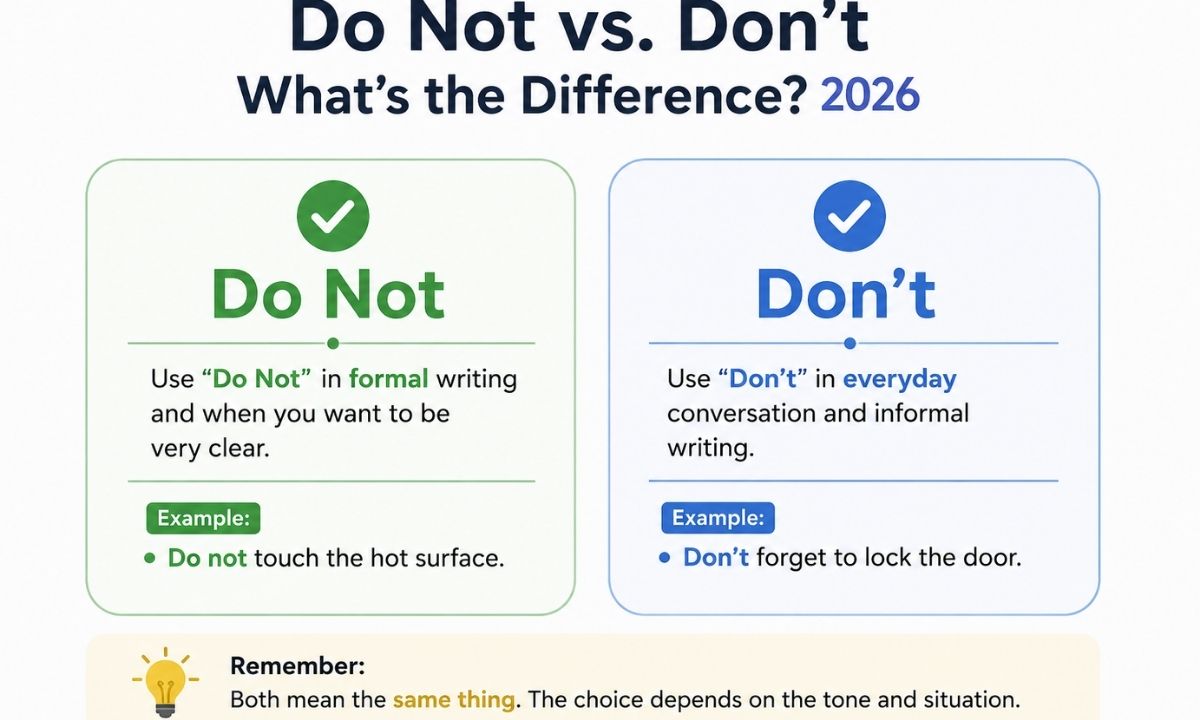
Have you ever wondered whether you should write do not vs. don’t? Both forms are correct, so the choice can feel confusing at first.
The simple answer is that don’t is the short form of do not. Both expressions create a negative statement or command. However, they can sound different because they suit different situations.
For instance:
I do not understand the question.
and:
I don’t understand the question.
Both sentences mean the same thing. However, the first version sounds more formal, while the second feels more natural in everyday conversation.
Therefore, the right choice depends on your audience, purpose, and tone. Do not often fits formal writing, official instructions, and serious warnings. Meanwhile, don’t appears frequently in conversations, messages, friendly emails, and informal writing.
This guide explains Do Not vs. Don’t in simple English. You will learn their meanings, grammar, differences, real-life uses, examples, pros and cons, and common mistakes.
What Does Do Not Mean?
Do not is the full form used to make a negative statement or command.
It can show that someone does not perform an action.
For example:
I do not eat fish.
The sentence tells us that the speaker does not eat fish.
Consider another example:
We do not need another chair.
Here, the speaker says another chair is unnecessary.
You can also use do not for instructions:
Do not open the door.
That sentence tells someone to avoid opening the door.
Simple Meaning
In simple terms:
Do not = a full negative form
It commonly appears before the base form of a verb.
Examples include:
- do not know
- do not understand
- do not agree
- do not want
- do not remember
- do not use
Notice that the verb after do not stays in its base form.
For example:
I do not like coffee.
Not:
I do not likes coffee.
The first sentence follows the correct grammar rule.
What Does Don’t Mean?
Don’t is a contraction of do not.
A contraction combines words into a shorter form. The apostrophe shows that some letters have been removed.
So:
do not → don’t
For example:
I don’t know.
has the same basic meaning as:
I do not know.
Similarly:
They don’t live here.
means:
They do not live here.
Why Use Don’t?
English speakers commonly use contractions in normal conversation because they make speech sound natural and relaxed.
For example, a friend may say:
I don’t understand.
A teacher might say:
Don’t worry about the answer yet.
A family member could say:
Don’t forget your keys.
These sentences sound natural in everyday English.
Do Not vs. Don’t
The main difference involves style and tone, rather than meaning.
| Feature | Do Not | Don’t |
| Form | Full form | Contraction |
| Meaning | Negative | Negative |
| Formality | More formal | More casual |
| Everyday speech | Less common | Very common |
| Friendly messages | Sometimes | Very common |
| Academic writing | Often suitable | Depends on style |
| Official notices | Very common | Sometimes used |
| Strong emphasis | Can sound stronger | Usually softer |
| Correct spelling | Yes | Yes |
As you can see, both forms work correctly. However, context should guide your decision.
When to Use Do Not
Use do not when you want a sentence to sound formal, serious, or deliberate.
For example:
Please do not share your password.
Do not enter this room.
We do not accept incomplete applications.
I do not agree with this conclusion.
These sentences suit professional, academic, or official situations.
Formal Writing
Writers often prefer full forms in formal documents.
For example:
The results do not support the proposed explanation.
This sentence sounds appropriate in an academic report.
A casual version would be:
The results don’t support the proposed explanation.
The second sentence remains grammatically correct. However, the first one creates a more formal impression.
When to Use Don’t
Use don’t when the situation feels conversational or informal.
For example:
I don’t know the answer.
Don’t worry about it.
We don’t need anything else.
They don’t want to come.
These expressions are common in everyday speech.
Casual Messages
Suppose a friend asks whether you need anything from the store.
You might reply:
I don’t need anything, thanks.
Similarly, before a friend leaves home, you could say:
Don’t forget your wallet.
These examples sound natural because contractions are common in relaxed communication
Why Does It Sound Strong?
The full form can add emphasis.
Compare these two sentences:
Don’t touch that.
Do not touch that.
The first sounds conversational. The second can sound firmer and more serious.
Therefore, signs, teachers, supervisors, and officials may choose do not when they want an instruction to sound especially clear.
A Friendly Tone
Consider this sentence:
Don’t worry about the mistake.
It sounds friendly and reassuring.
Now compare:
Do not worry about the mistake.
This version sounds more formal and deliberate.
Both sentences are correct. The difference comes from tone.
Do Not in Academic Writing
Academic writing often uses a more formal style. Therefore, writers may prefer do not instead of don’t.
For example:
Many students do not recognize the importance of revision.
Another example:
These results do not provide enough evidence.
However, you should always follow your teacher’s or institution’s style requirements.
If an assignment asks for a conversational tone, contractions may be perfectly acceptable.
Formal Example
Researchers do not always reach the same conclusion.
Casual Example
Researchers don’t always reach the same conclusion.
Both sentences are grammatical. The first simply sounds more formal.
Don’t in Everyday English
Native English speakers use don’t constantly in everyday communication.
You might hear:
I don’t know.
I don’t think so.
Don’t worry.
Don’t forget.
We don’t have time.
They don’t understand.
These phrases are so common that the full form may sound unusual in some casual situations.
For example:
I do not know what you mean.
is correct, but:
I don’t know what you mean.
usually sounds more natural in ordinary conversation.
Do Not in Emails
Your choice can depend on the type of email.
A formal business message might say:
Please do not send the document again.
A friendly message could say:
Don’t forget to send the document.
Both versions communicate the same basic idea.
Professional Example
Please do not hesitate to contact us if you need further information.
This expression frequently appears in professional communication.
Friendly Example
Don’t hesitate to message me if you need help.
The second version sounds warmer and more relaxed.
Do Not vs. Don’t in School
Students may encounter both forms in school.
Teachers can use do not in rules:
Do not use your phone during the examination.
Students may use don’t during a casual conversation:
I don’t understand this question.
Therefore, students should learn both forms rather than treating one as incorrect.
In Assignments
If you write an academic essay, consider the required tone.
For a formal paragraph:
People do not always understand the effects of pollution.
For dialogue:
“I don’t understand this problem,” Ali said.
The context determines the better choice.
Tone and Emphasis
The choice between these forms can subtly change the emotional tone.
Consider:
Don’t call me tonight.
This may sound like an ordinary personal request.
Now consider:
Do not call me tonight.
The second sentence may sound more serious or firm.
Similarly:
Don’t worry.
usually feels warm and conversational.
Meanwhile:
Do not worry.
can sound more formal or carefully chosen.
Therefore, think about the feeling you want to create.
Pros and Cons
Both forms have advantages and disadvantages.
Pros of Do Not
- It sounds formal.
- It works well in academic writing.
- It suits official instructions.
- It can create stronger emphasis.
- It looks appropriate in policies and reports.
- It avoids contractions.
Cons of Do Not
- It can sound stiff in casual conversations.
- It may feel overly formal in text messages.
- It can make friendly communication seem distant.
- It may sound stronger than the writer intended.
Pros of Don’t
- It sounds natural in conversation.
- It works well in casual messages.
- It creates a friendly tone.
- It is common in spoken English.
- It makes sentences shorter.
- It works naturally in dialogue.
Cons of Don’t
- It may sound too casual in formal documents.
- Some academic styles prefer full forms.
- It may not suit official policies.
- It can reduce the formal tone of a serious instruction.
Common Mistakes
One common mistake involves thinking that don’t is incorrect.
It is not.
Don’t is a standard English contraction.
Another mistake involves writing the contraction without an apostrophe.
Incorrect:
I dont know.
Correct:
I don’t know.
The apostrophe matters because it shows that letters have been omitted.
Another Common Error
Some learners write:
I don’t likes coffee.
That sentence contains a separate grammar problem.
The correct form is:
I don’t like coffee.
After don’t, use the base form of the main verb.
The same rule applies to other verbs:
They don’t work here.
Not:
They don’t works here.
Don’t vs. Dont
The correct contraction contains an apostrophe:
don’t
The form dont is not standard English.
For example:
❌ Dont forget your bag.
✅ Don’t forget your bag.
Another pair:
❌ I dont understand.
✅ I don’t understand.
Therefore, whenever you shorten do not, remember the apostrophe.
How to Choose the Right Form
Choosing between do not and don’t becomes easy when you consider the situation.
Choose Do Not
Use do not when writing:
- Formal essays
- Official notices
- Academic reports
- Business policies
- Professional instructions
- Serious warnings
For example:
Do not share confidential information.
Choose Don’t
Use don’t when writing:
- Text messages
- Friendly emails
- Casual posts
- Conversations
- Personal notes
- Informal dialogue
For example:
Don’t forget to call me.
One Simple Rule
Remember:
Formal → Do not
Casual → Don’t
This rule will work in most everyday situations.
Real Life Examples
The following examples show how both forms appear naturally.
At Home
Don’t leave the lights on.
Do not leave the door unlocked.
At School
Don’t forget your notebook.
Do not use your phone during the test.
At Work
Don’t forget the meeting.
Please do not change the settings.
With Friends
I don’t want pizza tonight.
Don’t worry about it.
On a Website
Do not enter incorrect information.
Don’t forget to save your changes.
These examples demonstrate that both forms have useful places in English.
Quick Comparison
| Situation | Better Choice | Example |
| Formal essay | Do not | The results do not support the claim. |
| Friendly chat | Don’t | I don’t know. |
| Official warning | Do not | Do not enter. |
| Casual advice | Don’t | Don’t worry. |
| Business policy | Do not | Employees do not need approval. |
| Friendly email | Don’t | Don’t forget the meeting. |
| Dialogue | Don’t | “Don’t be late.” |
| Serious instruction | Do not | Do not touch the equipment. |
Easy Memory Trick
You can remember the difference with one simple idea:
Do not = full and formal
Don’t = short and casual
Also remember:
DON’T = DO NOT
The apostrophe replaces missing letters.
If you are writing an official rule, do not often fits better.
If you are talking with a friend, don’t usually sounds more natural.
FAQs Do Not vs. Don’t
Is “do not” the same as “don’t”?
Yes. Don’t is the contraction of do not, so both forms have the same basic meaning.
Is “don’t” grammatically correct?
Yes. Don’t is a standard English contraction and is very common in speech and informal writing.
Is “do not” more formal?
Usually, yes. Do not often sounds more formal, serious, or emphatic than don’t.
Can I use “don’t” in an essay?
Yes, if the required style allows contractions. However, formal academic writing often favors do not.
Is “dont” correct?
No. The standard contraction requires an apostrophe: don’t.
Which form is better for conversation?
Don’t usually sounds more natural in everyday conversation because English speakers commonly use contractions while speaking.
Conclusion
The difference between do not and don’t is simple once you understand their purpose.
Both forms have the same basic meaning. Don’t is simply the contracted version of do not.
However, the two forms create different tones. Do not generally sounds more formal, serious, or emphatic. Therefore, it often appears in academic writing, official notices, policies, and instructions.
On the other hand, don’t sounds relaxed and conversational. As a result, it works especially well in everyday speech, text messages, friendly emails, and dialogue.
So, remember this easy rule:
Do not = full, formal, and sometimes emphatic
Don’t = short, natural, and conversational
Finally, always include the apostrophe in don’t. The spelling dont is incorrect in standard English.
Once you understand the difference in tone, choosing between do not and don’t becomes quick and easy.