

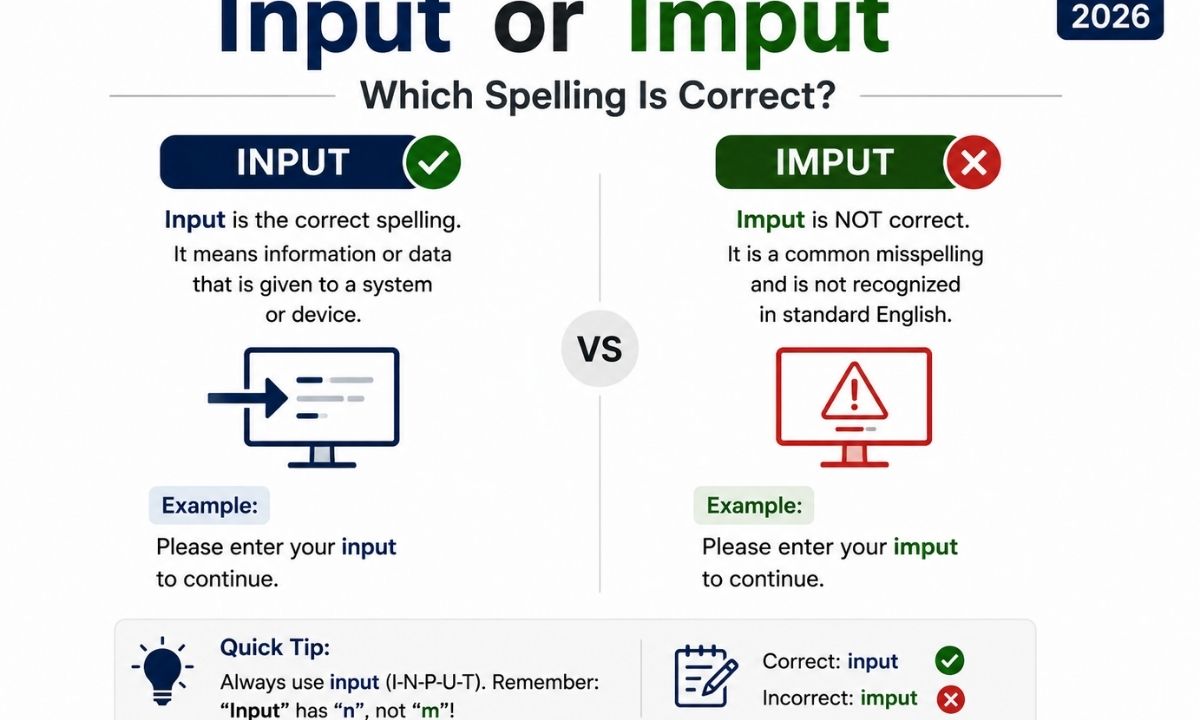
Have you ever typed imput and wondered whether it is actually correct? You are not alone. Many English learners and even native speakers sometimes write imput when they mean input.
The correct spelling is input. The spelling imput is a common mistake and does not work as the standard English word.
You can use input as a noun or a verb. It commonly refers to information, data, ideas, opinions, or something that you put into a system. For example, you might input data into a computer, ask for someone’s input on a decision, or enter your password as input.
Understanding this small spelling difference can help you write better emails, assignments, reports, messages, and technical content.
In this guide, we will explain Input vs Imput in simple English. You will learn the correct spelling, meaning, pronunciation, grammar, everyday uses, common mistakes, and real-life examples.
Input or Imput: Which Is Correct?
Input is the correct spelling.
Imput is an incorrect spelling in standard English.
| Word | Correct? | Meaning |
| Input | Yes | Information, data, advice, or something entered into a system |
| Imput | No | Common spelling mistake |
For example:
Please input your password.
This sentence uses the correct spelling.
Another example is:
I need your input before I make a decision.
Here, input means advice or an opinion.
Therefore, whenever you want to use this word, choose input, not imput.
What Does Input Mean?
The word input has several closely related meanings.
In simple English, it can mean something that you put into something else.
The “something” can be:
- Information
- Data
- Numbers
- Instructions
- Ideas
- Opinions
- Advice
- Commands
- Personal details
The exact meaning depends on the situation.
For example:
Enter your input in the box.
Here, input means information entered into a form or system.
However:
Thanks for your input.
Here, input means someone’s opinion, advice, or contribution.
Input as Information
In everyday situations, input can mean information that someone provides.
For example:
The teacher asked for student input.
This means the teacher wanted students to share their ideas or opinions.
Another example:
We need everyone’s input before choosing the date.
Here, input means everyone’s opinion or suggestion.
Input as Data
In technology, input often means data entered into a computer or another device.
For example:
The program needs user input.
This means the program needs information from the user.
A person might type a name, number, password, or command. The system receives that information as input.
Input as a Noun
Input commonly works as a noun.
A noun names a person, place, thing, or idea. When input acts as a noun, it often refers to information, advice, or data.
Consider these examples:
Your input was helpful.
We need more input from the team.
The computer received the input.
Her input improved the project.
Please provide your input.
In each sentence, input names something that someone provides or enters.
Everyday Examples
You may hear input in normal conversations.
At school:
“Can I get your input on my presentation?”
At work:
“We need your input before the meeting.”
At home:
“I would like your input before we buy it.”
With friends:
“What’s your input on this idea?”
In these examples, input means an opinion, suggestion, or contribution.
Input as a Verb
Input can also work as a verb.
As a verb, it means to enter information into a computer, system, form, or device.
For example:
Please input your phone number.
I need to input the data manually.
She input the information into the system.
The employee input the customer’s details.
The verb describes the action of entering information.
Common Verb Uses
You can use input when talking about:
- Entering a password
- Entering a number
- Adding customer information
- Entering data
- Adding commands
- Recording details in a system
For example:
Input your username and password.
This means you should enter your username and password into the appropriate fields.
Why Do People Write Imput?
If input is correct, why does imput appear so often?
The main reason is pronunciation.
Many speakers pronounce input in a way that can make the middle sound unclear. When people hear or say the word quickly, they may think the spelling contains m rather than n.
This can lead to the incorrect form imput.
Another reason involves the sound that occurs when n comes before p. In natural speech, the pronunciation can make the n sound resemble an m.
For example, when people say input quickly, the word may sound closer to “imput.”
However, the spelling remains:
I-N-P-U-T
A Pronunciation Trap
This is an important spelling lesson: pronunciation does not always tell you the exact spelling.
You may hear something that sounds like “imput,” but the written word is input.
That is why checking the spelling matters when writing formal English.
Input vs Imput in Technology
Technology uses input constantly.
In computing, input refers to information or commands that a person or another system gives to a computer.
For example, when you:
- Type on a keyboard
- Click a button
- Enter a password
- Speak into a microphone
- Scan a document
- Upload information
you provide some form of input.
Simple Computer Example
Imagine a login page.
You enter:
Username: Sarah123
Password: ********
The information you enter becomes input for the system.
The system then processes that information and produces a result.
This creates a simple pattern:
Input → Processing → Output
For example:
You enter a calculation → the computer processes it → the answer appears.
So, input plays an important role in computing.
Input in Everyday Life
You do not need to work with computers to use the word input.
People use it when they ask for opinions or suggestions.
For example:
“What is your input on the new plan?”
This does not mean the person wants you to type something into a computer. Instead, they want your thoughts.
Another example:
“I appreciate your input.”
Here, the speaker thanks someone for their advice or contribution.
At School
Students can use the word naturally.
“I need your input on my project.”
“The teacher asked for our input.”
“Can you give me some input about this topic?”
These sentences sound natural in everyday academic conversations.
At Work
You may hear:
“We need everyone’s input.”
“Please give me your input by Friday.”
“Her input helped us solve the problem.”
In professional English, input often means advice, feedback, or useful ideas.
Input in Business
Businesses frequently use input when discussing decisions and teamwork.
Managers may ask employees for input before changing a process.
For example:
The manager asked for employee input before changing the schedule.
This means the manager wanted employees to share their opinions.
Similarly:
Customer input helped the company improve the product.
Here, customer opinions or feedback helped guide the company’s decisions.
Useful Business Examples
We value your input.
Please share your input during the meeting.
The team used customer input to improve the service.
Your input will help us make a better decision.
These examples show how flexible the word can be.
Input in Forms and Apps
You may also see input in websites, applications, and online forms.
For example, a form might ask you to provide:
- Your name
- Your email
- Your address
- Your age
- Your phone number
When you type this information into the form, you provide input.
In technical writing, you might see:
Enter your input in the required field.
A programmer might also refer to an input field, which is an area where users enter information.
Common Digital Terms
Some common phrases include:
- Input field
- Input box
- User input
- Input data
- Input device
- Input value
- Input method
For example:
Enter the value in the input field.
This is common language in software and website instructions.
Input Devices
In computing, an input device allows a user to send information or commands to a computer.
Common examples include:
- Keyboard
- Mouse
- Microphone
- Scanner
- Touchscreen
- Camera
For example, when you type a sentence using a keyboard, the keyboard helps send that information to the computer.
Common Sentences With Input
Here are some natural sentences you can use in everyday English:
I need your input.
Thanks for your input.
Please input your details.
We value your input.
Enter the input carefully.
The system received the input.
She provided useful input.
Can I get your input?
The program requires user input.
Your input helped us decide.
Notice that input works naturally in both casual and formal situations.
Common Mistakes
The biggest mistake is writing imput instead of input.
Incorrect Form
❌ Please imput your information.
Correct Form
✅ Please input your information.
Another example:
❌ I need your imput.
✅ I need your input.
The second sentence correctly uses input to mean an opinion or contribution.
Why This Mistake Happens
The mistake usually comes from the way people pronounce the word.
Because the n before p can sound like an m, some people write what they hear.
However, the standard spelling always uses n:
IN + PUT = INPUT
This simple breakdown can help you remember it.
How to Remember Input
The easiest trick is to divide the word into two parts:
IN + PUT = INPUT
Think about the meaning.
When you input something, you put it in.
For example:
Input your name.
Means:
Put your name into the system.
This connection makes the spelling easier to remember.
Easy Memory Rule
Remember:
Input = put information in
Imput = incorrect spelling
Whenever you are unsure, think:
“I put information in.”
That points you toward input.
Input vs Imput: Quick Comparison
| Point | Input | Imput |
| Correct spelling | Yes | No |
| Standard English | Yes | No |
| Can be a noun | Yes | No |
| Can be a verb | Yes | No |
| Used in technology | Yes | No |
| Used for opinions | Yes | No |
| Common spelling mistake | No | Yes |
The choice is therefore simple: use input.
SEO and Writing Tips
If you are writing an article, blog post, assignment, or website page, always use input as the correct spelling.
You can mention imput when explaining the common mistake, but do not treat it as an alternative spelling.
For example:
Input is the correct spelling, while imput is a common spelling error.
This sentence clearly explains the difference without confusing readers.
Keep the Word Natural
Avoid repeating input in every sentence.
Instead, use natural related expressions when appropriate:
- Information
- Data
- Feedback
- Advice
- Opinion
- Contribution
- Entry
For example, instead of writing:
We need your input. Your input will help. Please send your input.
You could write:
We need your input. Your feedback will help us make the right decision.
This approach keeps your writing clear and natural.
FAQs Input or Imput
Is input the correct spelling?
Yes. Input is the correct standard spelling. Imput is a common spelling mistake.
Why do people spell input as imput?
The mistake often comes from pronunciation. The n before p can sound similar to an m in quick speech.
What does input mean?
Input can mean information, data, advice, feedback, or an action of entering information into a system.
Can input be a verb?
Yes. As a verb, input means to enter information into a computer, form, system, or device.
Can input mean advice?
Yes. In everyday and professional English, input can mean someone’s opinion, advice, feedback, or contribution.
How can I remember the spelling?
Think of IN + PUT = INPUT. When you input something, you put it into a system. This makes the correct spelling easier to remember.
Conclusion
The answer is simple: input is correct, while imput is incorrect in standard English.
The word input has several useful meanings. It can describe information entered into a computer, data provided to a system, or an opinion or contribution from another person.
You can use it as both a noun and a verb. For example, you can ask someone for their input, or you can input information into a system.
The spelling mistake imput usually happens because of pronunciation. When people say input quickly, the sound can resemble “imput.” However, the written form always uses n.
So, whenever you are unsure, remember the simple rule:
IN + PUT = INPUT
If you mean information that you put into a system or someone’s advice or contribution, input is the word you need.