

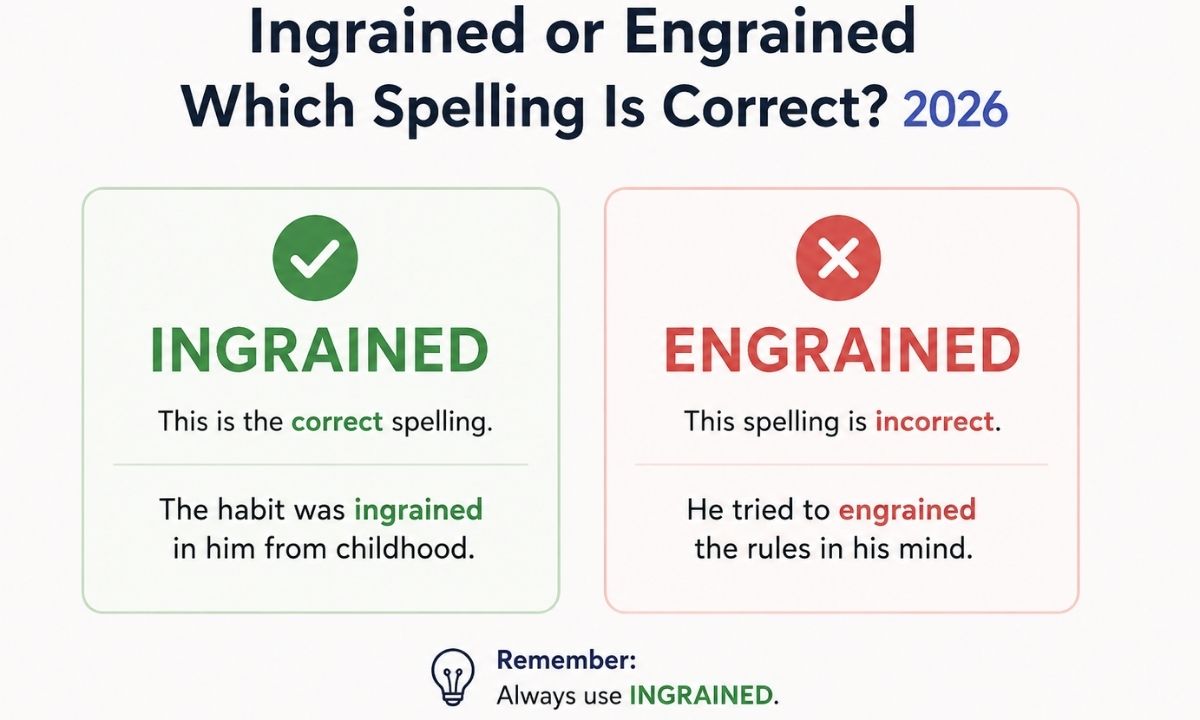
Have you ever seen Ingrained or Engrained? This is a common English spelling question because both forms appear online.
The standard and most widely accepted spelling is ingrained. It describes something that has become deeply fixed in a person’s mind, habits, behavior, or character. For example, if someone has an ingrained habit, they have practiced it so often that it feels natural.
The word can also describe something deeply established in a group, culture, system, or society.
For example:
Good manners were ingrained in her from childhood.
However, engrained also appears in dictionaries and real-world writing as a variant spelling. In modern standard English, ingrained remains the safer and more common choice, especially in formal writing.
This guide explains ingrained vs engrained in simple English. You will learn their meanings, origins, differences, pronunciation, grammar, everyday uses, examples, common mistakes, and easy ways to remember the correct spelling.
Ingrained or Engrained: Which Is Correct?
Ingrained is the preferred spelling in modern English.
Engrained also exists as a variant, but many style guides and writers prefer ingrained, particularly when discussing deeply established habits, beliefs, or attitudes.
| Word | Status | Common meaning |
| Ingrained | Preferred | Deeply fixed or established |
| Engrained | Variant | Deeply fixed or established |
For most school assignments, professional writing, articles, and formal communication, ingrained is the best choice.
For example:
His ingrained habit of checking his phone was difficult to change.
You can also say:
The belief was deeply ingrained in the community.
Simple Answer
If you only want one spelling to remember, choose:
INGRAINED
It is the clearest and most widely preferred form.
What Does Ingrained Mean?
Ingrained means deeply fixed, established, or difficult to change.
It often describes something that develops over a long period.
The word can describe:
- Habits
- Beliefs
- Attitudes
- Behaviors
- Values
- Ideas
- Traditions
- Opinions
- Social practices
For example:
She has an ingrained habit of waking up early.
This means waking up early has become a strong and regular part of her routine.
Another example:
Respect for elders was ingrained in him from childhood.
Here, respect became deeply established through his upbringing.
Easy Meaning
A simple way to understand ingrained is:
Something ingrained is deeply fixed and not easy to change.
Think about a habit that you repeat so often that you do it almost automatically. That habit may become ingrained.
What Does Engrained Mean?
Engrained is used as a variant spelling of ingrained.
In many contexts, writers use it with the same meaning: something has become deeply established or fixed.
For example:
The tradition is engrained in the local culture.
You may see this spelling in books, websites, articles, and everyday writing.
However, if you want the most widely accepted and recognizable form, ingrained is generally the better option.
Why Is It Confusing?
The confusion comes from the fact that engrained looks natural.
English already has the word engrave, so some people connect engrained with the idea of something being deeply marked.
However, ingrained has a different historical connection.
Understanding its origin can make the spelling easier to remember.
Where Does Ingrained Come From?
The word ingrained comes from the idea of something becoming deeply embedded.
Historically, grain referred to the natural texture or fibers of a material. When something became deeply fixed in the grain, it was difficult to remove.
Over time, English speakers began using the idea figuratively.
Instead of talking only about material, people started describing habits, ideas, and beliefs as ingrained.
For example:
The habit became ingrained over many years.
The idea is that the habit became so deeply established that removing it would be difficult.
From Material to Ideas
The meaning developed from something physical to something abstract.
A mark can become deeply fixed in material.
Similarly, a habit can become deeply fixed in someone’s behavior.
A belief can become deeply fixed in someone’s mind.
A tradition can become deeply established in a culture.
That is why ingrained works naturally with both physical and abstract ideas.
Ingrained vs Engrained
The two spellings create confusion because they can appear in similar contexts.
However, there is an important practical distinction.
Ingrained is the preferred modern spelling when you mean something deeply established or fixed.
Engrained appears as a variant, but it is less common.
For example:
Good manners were ingrained in the children.
This is the safest form for formal writing.
Another example:
The company’s values are deeply ingrained in its culture.
Again, ingrained sounds natural and standard.
Quick Comparison
Ingrained: preferred and widely used.
Engrained: variant spelling that appears in some sources.
If you are unsure, use ingrained.
Ingrained in Everyday Life
The word appears frequently in normal conversations.
People use it when talking about habits, routines, beliefs, and behavior.
For example:
“Waking up early is ingrained in my routine.”
Someone might say this when they have followed the same morning schedule for years.
Another example:
“Checking everything twice has become ingrained in her.”
This means the person has developed a strong habit of checking things repeatedly.
At Home
Parents may teach children certain behaviors from an early age.
For example:
Good manners should become ingrained from childhood.
The sentence suggests that polite behavior can become a natural part of someone’s character through repeated practice.
At School
Teachers may encourage students to develop good study habits.
For example:
Regular reading can become an ingrained habit.
Once students practice regularly, studying may become a natural part of their routine.
At Work
Companies may develop strong workplace habits.
For example:
Safety procedures are deeply ingrained in the company culture.
This means employees have learned those procedures so well that they naturally follow them.
Ingrained Habits
One of the most common phrases is ingrained habit.
An ingrained habit is a behavior that has become deeply established through repetition.
Examples include:
Checking your phone can become an ingrained habit.
She has an ingrained habit of making lists.
His morning routine is deeply ingrained.
Saving money became an ingrained habit.
Not every repeated action becomes ingrained immediately. Usually, the word suggests something that has existed for a long time or has become particularly strong.
Good Habits
Ingrained habits can be positive.
For example:
Exercise became an ingrained part of her routine.
Saying thank you was ingrained in him from childhood.
Keeping things organized became an ingrained habit.
These examples describe useful behaviors that became natural over time.
Unhelpful Habits
The word can also describe habits that someone wants to change.
For example:
His habit of staying up late became ingrained.
She developed an ingrained tendency to worry about small things.
In these examples, the behavior has become difficult to change because it has existed for a long time.
Ingrained Beliefs
Ingrained can describe beliefs that people hold strongly.
For example:
He has an ingrained belief that hard work leads to success.
This means the belief has become deeply established in his thinking.
Another example:
The idea is deeply ingrained in the community.
Here, many people in the community have accepted the idea over a long period.
Ingrained Attitudes
The word can also describe attitudes.
For example:
Her positive attitude is deeply ingrained.
The organization has an ingrained commitment to quality.
Respect for others was ingrained in their family.
These sentences show how ingrained can describe qualities that become an important part of someone’s thinking or behavior.
Ingrained in Culture
Some traditions become deeply established within communities.
For example:
The festival is ingrained in the local culture.
This means the festival has become an important and long standing part of that culture.
Other examples include:
Family traditions can become deeply ingrained.
Certain customs are ingrained in the community.
The practice is deeply ingrained in local culture.
This use is common in articles about history, society, traditions, and cultural practices.
Ingrained in Business
Businesses also use the word when describing company culture.
For example:
Teamwork is ingrained in the company’s culture.
This means teamwork is not simply a written rule. Employees have developed it as a normal part of how they work.
Another example:
Customer service is deeply ingrained in the brand’s values.
The word can therefore describe ideas that influence how an organization operates.
Professional Examples
Attention to detail is ingrained in our work process.
Innovation is deeply ingrained in the company’s culture.
Ethical behavior should become ingrained in professional practice.
These examples work well in reports, business articles, and workplace discussions.
Ingrained in Education
Education often involves developing habits and values.
For example:
Reading regularly can become an ingrained habit.
Critical thinking should become ingrained in students’ learning.
Good study habits become easier when they are ingrained early.
The word works especially well when discussing skills that develop through repeated practice.
Ingrained vs Deeply Rooted
You may wonder whether ingrained and deeply rooted mean the same thing.
They are often similar, but they have slightly different shades of meaning.
Ingrained usually focuses on something deeply fixed through repetition, experience, or long use.
Deeply rooted often emphasizes something that has a strong foundation or long history.
For example:
Her ingrained habit of planning helped her stay organized.
But:
The tradition is deeply rooted in the community.
Both expressions suggest something strong and established, but the context determines which one sounds more natural.
Common Mistakes
The most common mistake is assuming that engrained must be the correct spelling because it looks similar to engrave.
For standard writing, choose ingrained.
Wrong or Less Preferred
His habit was engrained from childhood.
Preferred
His habit was ingrained from childhood.
Another mistake involves using ingrained for something that has not existed long enough to become established.
For example, saying:
My new habit from yesterday is deeply ingrained.
sounds unusual because one day usually does not provide enough time for a habit to become deeply established.
Better Example
My habit of exercising every morning has become ingrained over the years.
The longer time period makes the meaning clearer.
How to Remember Ingrained
A simple trick can help you remember the spelling.
Think of the word grain.
IN + GRAIN + ED = INGRAINED
Imagine something becoming deeply fixed in the grain of a material.
Then connect that physical image with an abstract idea:
Ingrained = deeply fixed.
For example:
A habit can become ingrained.
A belief can become ingrained.
A tradition can become ingrained.
Easy Memory Rule
Remember:
IN GRAINED = deeply fixed
If you need the safest spelling, choose ingrained.
Pronunciation
Ingrained is usually pronounced approximately like:
In GRAYND
The ending sounds similar to the word grained.
Engrained has a similar pronunciation, which adds to the confusion.
Because the two forms sound almost identical, spelling becomes especially important.
Why Pronunciation Causes Confusion
When people hear a word rather than see it written, they may not know which spelling to choose.
This happens with many English words.
For ingrained, remembering the word grain gives you a useful spelling clue.
Ingrained in Formal Writing
Ingrained works well in:
- School assignments
- Essays
- Business reports
- News articles
- Academic writing
- Blog posts
- Professional emails
For example:
The study examines how ingrained habits affect daily behavior.
Or:
Respect for education remains deeply ingrained in the community.
The word sounds natural in both formal and everyday English.
Ingrained vs Engrained
Both ingrained and engrained appear in English writing, which can make the choice confusing. However, ingrained is the preferred spelling when you mean something that has become deeply fixed or established.
| Feature | Ingrained | Engrained |
| Standard spelling | Yes | Variant |
| Common in modern English | Very common | Less common |
| Meaning | Deeply fixed or established | Same meaning in most uses |
| Used for habits | Yes | Sometimes |
| Used for beliefs | Yes | Sometimes |
| Used for traditions | Yes | Sometimes |
| Formal writing | Recommended | Better to avoid |
| Everyday writing | Common | Less common |
| Best choice | Yes | Usually no |
Ingrained: Pros and Cons
Pros:
- It is the most widely preferred spelling.
- It works well in formal and academic writing.
- It clearly describes deeply established habits or beliefs.
- Most readers recognize it immediately.
- It works naturally in everyday conversations.
Cons:
- Its spelling can confuse learners.
- Its pronunciation can make people think it starts with en-.
- Some readers may still use engrained because they see it elsewhere.
Engrained: Pros and Cons
Pros:
- It appears in real-world English writing.
- Many readers understand it without difficulty.
- It can occur as a variant of ingrained.
Cons:
- It is less common than ingrained.
- It can look like a spelling mistake in formal writing.
Quick Examples
Here are several real-life examples:
Her love of reading is ingrained.
Good manners were ingrained from childhood.
The habit became deeply ingrained.
Teamwork is ingrained in their culture.
His belief in hard work is ingrained.
The tradition is deeply ingrained in the community.
Checking the details became an ingrained habit.
These sentences show how widely the word can be used.
FAQs Ingrained or Engrained
Is ingrained the correct spelling?
Yes. Ingrained is the preferred and most widely used spelling for something deeply fixed or established.
Is engrained wrong?
Engrained appears as a variant spelling, but ingrained is generally the safer choice for modern formal English.
What does ingrained mean?
Ingrained means deeply fixed, established, or difficult to change, especially when describing habits, beliefs, attitudes, or traditions.
What is an ingrained habit?
An ingrained habit is a behavior that has become deeply established through repetition and is therefore difficult to change.
Can ingrained describe beliefs?
Yes. You can describe a strong, deeply established belief as ingrained.
How do I remember the spelling?
Think of IN + GRAIN + ED = INGRAINED. Connecting the word with grain can help you remember the correct spelling.
Conclusion
The safest answer to ingrained or engrained is ingrained.
Ingrained means deeply fixed, established, or difficult to change. It commonly describes habits, beliefs, attitudes, values, traditions, and behaviors.
Although engrained appears in real-world writing and can occur as a variant, ingrained remains the preferred form for most modern English writing.
So, when you are writing an assignment, article, email, or professional document, choose:
Ingrained ✅
rather than:
Engrained ⚠️
A simple memory trick makes the spelling easier: IN + GRAIN + ED = INGRAINED.