

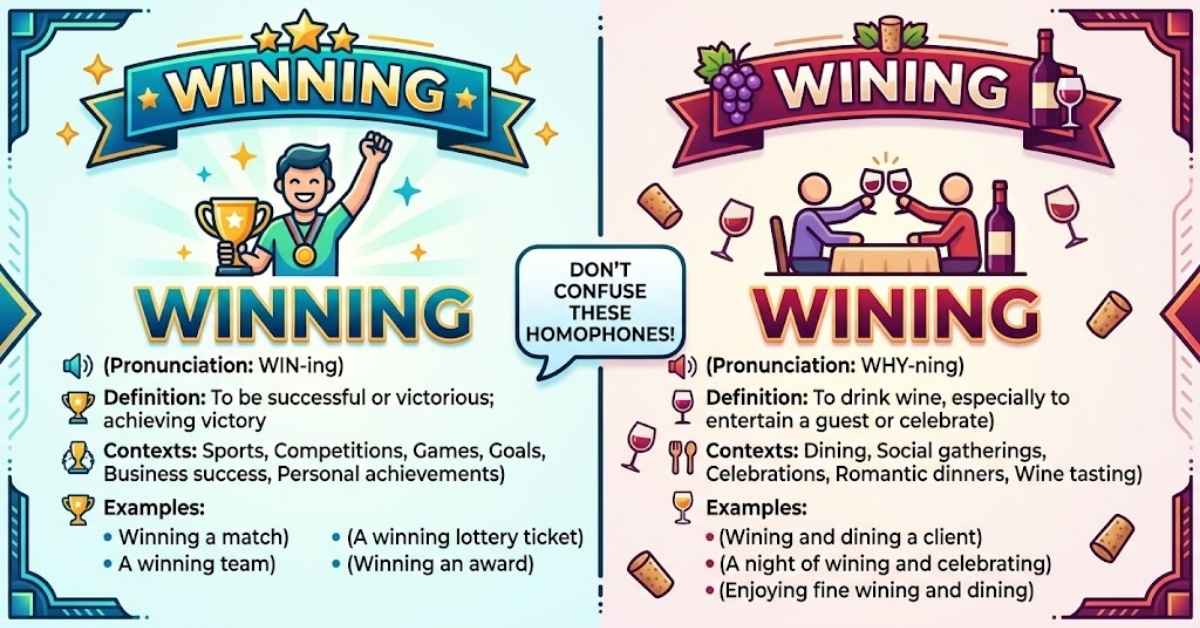
Winning or wining? If you’re talking about success, victory, a competition, or achieving a goal, the correct spelling is winning. Wining is also a real English word, but it comes from wine and is used in the context of serving or entertaining someone with wine.
The difference is only one letter, but the meaning changes completely:
| Word | Comes from | Meaning | Example |
|---|---|---|---|
| winning | win | succeeding or achieving victory | She is winning the race. |
| wining | wine | serving or entertaining with wine | They were wining and dining their guests. |
Cambridge lists winning as the present participle of win, while its American English definition of win includes defeating a competitor, achieving first position, or receiving a prize. Cambridge also recognizes wine as a verb in the expression “wine and dine someone.”
So, if you searched “is it winning or wining,” the answer depends on what you mean—but for ordinary situations involving success or victory, use winning.
Winning vs. Wining at a Glance
The easiest way to separate the two words is to look at their base forms:
win → winning
wine → wining
That extra n isn’t decorative. It tells the reader that the word comes from win, not wine.
| If you mean… | Use… |
|---|---|
| winning a game | winning |
| winning a race | winning |
| winning an award | winning |
| winning a competition | winning |
| winning someone’s trust | winning |
| achieving success | winning |
| serving wine | wining |
| entertaining guests with wine | wining |
| “wining and dining” | wining |
The fastest rule
Success or victory = winning
Wine or wine-based entertaining = wining
That single distinction resolves most cases of winning vs. wining.
What Does “Winning” Mean?
Winning comes from the verb win. It describes achieving victory, succeeding in a competition, obtaining a prize, or successfully gaining something you were trying to obtain.
Cambridge defines win in American English as defeating a competitor or achieving first position or a prize in a competition. It also gives broader uses involving gaining support, approval, love, or trust.
For example:
- Our team is winning the game.
- She is winning the race.
- He celebrated after winning the award.
- They are winning more customers.
- She worked hard at winning the team’s trust.
- The company is winning new contracts.
- Winning takes preparation and persistence.
The word is not limited to sports. You can win an argument, win support, win someone’s confidence, win an award, win a competition, or win a contract.
Winning as a verb
In:
The team is winning the game.
Winning is part of the verb phrase is winning.
Winning as a noun or gerund
In:
Winning takes discipline.
Winning refers to the activity or concept of achieving victory.
Winning as an adjective
In:
She presented a winning strategy.
Winning describes the strategy.
Other common adjective uses include:
- winning team
- winning smile
- winning combination
- winning attitude
- winning strategy
- winning entry
This broader grammatical range is one reason winning appears so frequently in everyday English.
What Does “Wining” Mean?
Wining comes from the verb wine, not win.
The verb wine is associated with providing or serving wine, particularly as part of entertaining someone. Cambridge specifically lists the expression “wine and dine someone” for entertaining someone by giving them food and drinks.
For example:
They were wining and dining their clients.
Here, wining is related to wine, while dining refers to eating.
Because this use is relatively uncommon outside wine, hospitality, social, and business-entertainment contexts, many people assume wining is simply a misspelling of winning.
It isn’t.
Wining is a real word—but it does not mean achieving victory.
Winning or Wining: Which Is Correct?
Both words can be correct, but they cannot replace each other.
Consider these two sentences:
Our team is winning the championship.
Correct: the team is succeeding in a competition.
The hotel is wining and dining its guests.
Correct: the hotel is entertaining guests with food and wine.
Now switch the words:
Our team is wining the championship.
If you mean victory, this is incorrect.
And:
The hotel is winning and dining its guests.
That changes the meaning and does not express the intended wine-related phrase.
So when someone asks “winning or wining which is correct?”, there is no universal answer without context. The practical answer is:
Use winning for win, victory, success, and achievement. Use wining for wine-related entertaining.
LEARN MORE: Payor vs Payer
Why Does “Win” Become “Winning”?
This is one of the most useful grammar points in the entire comparison.
A common English spelling pattern doubles the final consonant of a short word such as win before adding a vowel-initial suffix like -ing.
Therefore:
win + ing → winning
The same general pattern appears in:
- run → running
- sit → sitting
- swim → swimming
- stop → stopping
- plan → planning
So wining is not the normal present-participle spelling of win.
The form wining has a different source:
wine + ing → wining
The final e in wine is removed before adding -ing.
Compare:
- win → winning
- wine → wining
The spelling difference reflects the fact that these are two different verbs.
Why Do People Confuse Wining and Winning?
The confusion is understandable.
1. The words look almost identical
The difference is only one letter:
wining
winning
When typing quickly, it is easy to leave out an n.
2. “Wining” is uncommon
Most people regularly encounter winning but rarely encounter wining outside phrases connected with wine.
That makes wining look like a typo even when it is being used correctly.
3. Context determines the meaning
Both words can appear with an -ing ending, but they come from different base verbs.
- win → winning
- wine → wining
4. Spellcheck may not save you
This is an especially tricky spelling error because wining is a legitimate word.
A spellchecker may recognize it as correctly spelled even when it is the wrong word for your sentence.
That’s why context matters more than spellcheck.
Winning or Wining in a Sentence
Real examples make the distinction much easier to remember.
Examples with “winning”
Sports
The basketball team is winning by eight points.
Competition
Maria is winning the spelling competition.
Awards
He is excited about winning the award.
Business
The company is winning new customers.
Trust
Honest communication can help you with winning someone’s trust.
Personal achievement
She felt proud after winning the scholarship.
In every example, the meaning involves success, achievement, victory, or gaining something desirable.
Examples with “wining”
Hospitality
The resort is known for wining and dining its guests.
Business entertainment
The executives spent the evening wining and dining potential clients.
Social setting
They spent the weekend wining and enjoying long dinners.
These examples are connected to wine or wine-based hospitality, not victory.
What Does “Wining and Dining” Mean?
Wining and dining is a well-established expression.
It means entertaining someone with food and drinks, traditionally including wine. Cambridge gives wine and dine someone this sense directly.
For example:
The company was wining and dining its business partners.
The important distinction is:
wining and dining ≠ winning and dining
If you are describing hospitality involving wine, wining is the intended word.
This is one of the clearest situations where wining is genuinely correct.
Are Winning and Wining Pronounced the Same?
They are based on different words with different vowel sounds:
- win has the short vowel sound found in words such as sit and thin.
- wine has the long vowel/diphthong sound found in words such as fine and line.
That means the underlying forms are different:
win → winning
wine → wining
In some accents or rapid speech, the distinction may be less noticeable to a listener, but the words still have different lexical origins and meanings.
If you’re unsure which spelling to use, look at the meaning rather than relying only on how the word sounds.
Winning vs. Wining in American English
For American English, the rule is straightforward:
Winning is used for success, victory, competition, achievement, and similar meanings.
Wining is used for the wine-related verb, particularly in expressions involving entertaining or serving wine.
This is not a major American-versus-British spelling difference. The distinction comes from the different words win and wine, not from two regional spelling systems.
For U.S. writing—including school assignments, business communication, websites, emails, and social media—the same distinction applies.
Common Mistakes to Avoid
Here are some of the most common errors.
Mistake 1: “I am wining the game.”
❌ I am wining the game.
✅ I am winning the game.
The sentence is about victory, so use winning.
Mistake 2: “She is wining the award.”
❌ She is wining the award.
✅ She is winning the award.
The person is receiving an award through success, so winning is correct.
Mistake 3: “They were winning and dining their guests.”
❌ They were winning and dining their guests.
✅ They were wining and dining their guests.
Here the meaning involves wine and hospitality.
Mistake 4: Assuming “wining” is always wrong
❌ “Wining is never a word.”
That’s inaccurate.
Wining is a real word, but it has a different meaning from winning.
The important question isn’t:
“Is wining a word?”
It is:
“Does wining express what I mean in this sentence?”
A Three-Second Test for Winning vs. Wining
When you’re writing and suddenly stop at winning or wining, ask:
Question 1: Am I talking about success?
If yes → winning
She is winning the race.
Question 2: Am I talking about competition or achievement?
If yes → winning
They are winning the championship.
Question 3: Am I talking about wine or entertaining with wine?
If yes → wining
They were wining and dining their guests.
That’s all you usually need.
The simplest memory aid
Think of the base word:
WIN → WINNING
WINE → WINING
If you can identify the base word, the spelling becomes much easier.
Winning or Wining Meaning: The Difference in One Line
If you’re specifically searching for “wining or winning meaning,” remember:
Winning means achieving success or victory; wining means serving or entertaining with wine.
That distinction is supported by the dictionary definitions of win and wine.
Is “Wining” a Real Word?
Yes.
Wining is a legitimate English form derived from the verb wine.
However, it is much less common than winning, and its everyday use is largely associated with wine-related hospitality and expressions such as wining and dining.
Therefore, seeing wining in a sentence does not automatically mean the writer made a spelling mistake.
You have to examine the context.
LEARN MORE: Inaccessible or Unaccessible
Is Wining the -Ing Form of Win?
No.
The standard -ing form of win is:
winning
The spelling follows the consonant-doubling pattern:
win → winning
Wining comes from wine:
wine → wining
So if your sentence means “achieving victory,” wining is not the correct spelling.
Why Does Winning Have Two N’s?
Because win follows a common English spelling pattern in which the final consonant is doubled before a suffix beginning with a vowel.
Compare:
- win → winning
- run → running
- sit → sitting
- swim → swimming
The double n helps preserve the short-vowel structure of the base word.
You therefore should not write wining when you mean the action of winning.
Which Word Should You Use in Professional Writing?
For professional, academic, business, and everyday writing, use winning whenever the meaning involves success, victory, competition, achievement, or gaining something.
For example:
The team is winning new contracts.
She is winning customer confidence.
The company developed a winning strategy.
Use wining only when your meaning genuinely involves wine or wine-related entertaining:
The resort specializes in wining and dining its guests.
When in doubt, identify the base word before you add -ing.
FAQs About Winning or Wining
Is winning or wining correct?
Both are legitimate words, but they have different meanings. Use winning for victory, success, and achievement. Use wining for wine-related entertaining or serving wine.
Is it “winning” or “wining” a game?
It is winning a game.
Our team is winning the game.
Is “wining” a real English word?
Yes. Wining is a real word derived from wine, although it is much less common than winning.
What is the difference between wining and winning?
Winning comes from win and means succeeding or achieving victory. Wining comes from wine and refers to wine-related entertaining or serving wine.
Is “wining and dining” correct?
Yes. Wining and dining is correct when you mean entertaining someone with food and drinks, especially wine.
Why does “winning” have two n’s?
The final consonant of the short verb win is doubled before adding -ing, producing winning.
Can I write “wining” when I mean winning?
No. If your meaning is success or victory, write winning.
Which spelling is more common?
Winning is much more common in ordinary English because it applies to sports, competitions, achievements, business, relationships, and many other contexts.
Is winning a verb or adjective?
It can be used in more than one grammatical role. It is the present participle of win, and it can also function as a gerund or adjective, depending on the sentence.
For example:
She is winning.
Winning takes practice.
They developed a winning strategy.
What is the easiest way to remember the difference?
Remember the base words:
win → winning
wine → wining
If the sentence is about victory, choose winning. If it is about wine, choose wining.
Final Answer: Winning or Wining?
If you’ve been wondering “winning or wining which is correct?”, the answer is straightforward once you identify the meaning.
Winning = success, victory, competition, achievement, or gaining something.
Wining = serving or entertaining with wine.
So:
She is winning the race. ✅
but:
They are wining and dining their guests. ✅
The extra n in winning matters because the word comes from win, while wining comes from wine.
When you’re unsure, don’t rely on appearance or spellcheck alone. Find the base word and ask what you mean. If you mean win, write winning. If you mean wine, wining may be the word you need.