

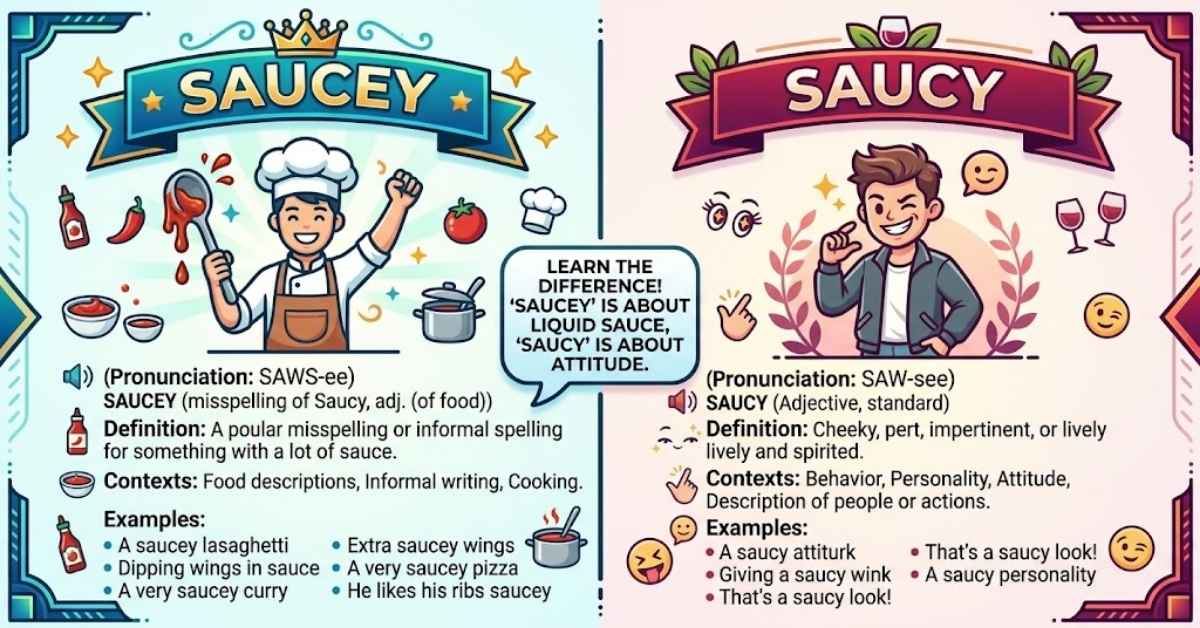
Saucey or saucy? If you’re writing standard American English, saucy is the spelling you should normally use. It can describe food that contains plenty of sauce, or it can describe someone or something that is cheeky, bold, playful, or mildly provocative. Saucey does appear as an alternative or creative spelling, including in names and branding, but it is not the standard spelling of the adjective.
The easiest way to remember it is:
sauce → saucy
Not sauce → saucey.
Cambridge, Oxford, Dictionary.com, and the American Heritage Dictionary all recognize saucy as the established adjective.
Saucey or Saucy? The Quick Answer
If you’re wondering “is it saucy or saucey?”, use saucy in ordinary English writing.
| Spelling | Standard adjective? | Typical use |
|---|---|---|
| saucy | Yes | Food, personality, comments, behavior |
| saucey | Not the normal standard spelling | Alternative/creative spelling or proper name |
For example:
Correct:
The chicken wings are incredibly saucy.
Correct:
He made a saucy comment.
For standard writing, avoid:
The chicken wings are saucey.
He made a saucey comment.
There is one useful qualification: saucey is attested as an alternative form of saucy, so calling it completely nonexistent would be too broad.
The practical rule for modern American English remains simple:
Use “saucy.”
Why “Saucy” Is the Standard Spelling
The confusion comes from the word sauce.
It is tempting to think:
sauce + y = saucey
But English does not simply preserve every letter of the base word when forming an adjective.
The established form is:
sauce → saucy
Oxford traces saucy to sauce + -y, while Dictionary.com records saucy as the standard adjective and gives its comparative and superlative forms as saucier and sauciest.
This is why the spelling is:
saucy ✅
rather than:
saucey ❌ for ordinary standard usage.
Similar spelling patterns can be seen in words such as:
- ice → icy
- spice → spicy
- juice → juicy
- noise → noisy
- shine → shiny
The broader lesson is that English spelling sometimes changes the appearance of a base word when a suffix is added.
Is “Saucey” a Word?
This question needs a little more nuance than a simple yes-or-no answer.
Saucey is not the normal standard spelling of the adjective in contemporary American English. If you’re writing an essay, article, email, report, menu description, or professional document, saucy is the form you should choose.
However, saucey has been attested as an alternative form of saucy, and it can also appear intentionally in names, usernames, branding, and other creative contexts. Wiktionary records historical examples of saucey as an alternative form.
That distinction matters.
Compare:
The pasta is saucy.
This is standard English.
But if a company deliberately calls itself “Saucey,” you should preserve its official spelling because it is a proper name, not an attempt to follow ordinary adjective spelling.
So the safest rule is:
Use “saucy” for the ordinary adjective; preserve “Saucey” when it is intentionally part of a name or brand.
What Does “Saucy” Mean?
Saucy has several meanings, and context tells you which one is intended.
At its simplest, it can relate directly to sauce.
It can also describe someone or something that is:
- cheeky
- bold
- impudent
- playful
- spirited
- mildly provocative
Cambridge describes saucy as rude or disrespectful, sometimes in a humorous way, and its American entry also includes the sense of being confident and energetic in an entertaining or exciting way.
The American Heritage Dictionary includes meanings involving playful disrespect, attractiveness or stylishness, and food covered with or having the consistency of sauce.
That gives us several useful contexts.
Saucy When Describing Food
When you describe food as saucy, you’re usually saying that it has a generous amount of sauce or a sauce-rich consistency.
For example:
These barbecue ribs are incredibly saucy.
I prefer saucy pasta to dry pasta.
The chicken came with a rich, spicy, saucy coating.
These wings are messy but wonderfully saucy.
In food writing, saucy is normally positive.
A restaurant might describe:
- saucy chicken wings
- saucy barbecue ribs
- saucy pasta
- saucy noodles
- saucy meatballs
- saucy shrimp
- saucy burgers
- saucy sandwiches
The word emphasizes the presence or character of the sauce.
Saucy When Describing a Person
When saucy describes a person, the meaning changes.
It can suggest someone is:
- cheeky
- bold
- sassy
- playfully disrespectful
- confident
- mischievous
For example:
The child gave his teacher a saucy answer.
The speaker isn’t saying the child contains sauce. The meaning is figurative: the answer was cheeky or disrespectfully bold.
Saucy for Comments, Jokes and Behavior
You can also describe speech or behavior as saucy.
Examples include:
That was a saucy joke.
She made a saucy comment.
He gave me a saucy smile.
The comedian has a saucy sense of humor.
Depending on context, saucy can suggest anything from harmless cheekiness to something mildly sexual or provocative. Cambridge specifically includes humorous references to sex among its senses.
That’s why context matters.
Calling a plate of pasta saucy is straightforward.
Calling a person saucy carries a completely different social meaning.
Saucey or Saucy Food: Which One Should You Use?
If your search is specifically “saucey or saucy food,” the answer is saucy.
Use:
saucy food
saucy chicken
saucy wings
saucy pasta
saucy noodles
saucy barbecue ribs
For example:
These buffalo wings are saucy, spicy, and messy.
Not:
These buffalo wings are saucey.
The reason is simple: you’re using the established adjective saucy to describe food containing or covered with sauce.
Cambridge defines sauce as a thick liquid eaten with food to add flavor, which provides the literal culinary relationship behind the adjective.
Is “Saucy” a compliment when describing food?
Usually, yes.
If someone says:
“That pasta looks really saucy.”
they are generally complimenting the dish’s generous sauce or appealing texture.
But saucy doesn’t automatically mean delicious. A dish can be saucy without being tasty.
That’s an important distinction in food writing.
Saucy describes the amount or character of sauce; it doesn’t guarantee quality.
LEARN MORE: Winning or Wining
Why Does Sauce Become Saucy?
The spelling question becomes much easier once you stop thinking of the process as simply “adding y.”
The established form is:
sauce → saucy
The final e does not remain.
You can see a similar pattern in:
- ice → icy
- spice → spicy
- juice → juicy
- noise → noisy
- shine → shiny
So:
sauce + y → saucy
not:
sauce + y → saucey
The important point is not that English has one perfectly universal rule with no exceptions. English spelling has many historical patterns and exceptions.
Instead, remember that saucy is the established lexical form.
That is more reliable than trying to construct the spelling from scratch every time.
Saucy vs. Saucey in American English
For U.S. English, saucy is the standard spelling.
This isn’t a situation like:
- color vs. colour
- center vs. centre
- organize vs. organise
There is no ordinary American-English rule that changes saucy into saucey.
Both American and British dictionaries recognize saucy. Cambridge provides separate U.S. and U.K. pronunciation information while retaining the spelling saucy.
So if you’re writing for an American audience, use:
saucy
not:
saucey
unless Saucey is intentionally part of a proper name.
How Do You Pronounce “Saucy”?
In American English, Cambridge gives saucy as /ˈsɑː.si/ on its U.S. dictionary entry.
It has two syllables:
sau-cy
The important point for spelling is that the pronunciation doesn’t justify inserting an extra e.
You may hear the same basic word pronounced somewhat differently across English accents, but the standard spelling remains saucy.
Saucy, Saucier, and Sauciest
The word has regular comparative forms:
saucy → saucier → sauciest
Examples:
This pasta is saucy.
This pasta is saucier than the other dish.
These are the sauciest wings on the menu.
Notice that the spelling does not become:
sauceier ❌
or:
sauceiest ❌
The y changes to i before the comparative and superlative endings.
Dictionary.com and Oxford both record saucier and sauciest as the standard forms.
Common Mistakes with Saucey and Saucy
Mistake 1: Keeping the “e”
❌ The chicken is saucey.
✅ The chicken is saucy.
Mistake 2: Assuming the word only describes food
❌ “Saucy” only means something with sauce.
✅ Saucy can also describe a person’s attitude, words, expression, humor, or behavior.
Mistake 3: Writing “sauceier”
❌ This pasta is sauceier.
✅ This pasta is saucier.
Mistake 4: Treating every “Saucey” as a spelling error
A brand, business, username, character, product, or other proper name can intentionally use “Saucey.”
Don’t “correct” someone’s official name merely because saucy is the standard adjective.
Mistake 5: Assuming spellcheck settles everything
Spellcheck is useful, but it isn’t a linguistic authority.
A word can be:
- spelled correctly but used incorrectly
- nonstandard but intentionally branded
- an alternative form
- a proper name
Context still matters.
An Easy Way to Remember the Spelling
Use this simple chain:
SAUCE → SAUCY
Then compare it with:
ICE → ICY
SPICE → SPICY
JUICE → JUICY
The final e disappears in the established adjective.
If you’re writing about a dish, you can also use the sentence:
“The food is saucy because it has sauce.”
That keeps the two related words connected without adding an unnecessary e.
Real-World Sentence Examples
Food
The restaurant is known for its saucy chicken wings.
I like my pasta extra saucy.
The ribs were tender, smoky, and saucy.
Add more sauce if you want the dish to be even more saucy.
Personality
Don’t give me that saucy attitude.
The child gave his mother a saucy reply.
She has a playful, saucy sense of humor.
Comments and humor
He made a saucy joke during dinner.
Her saucy comment made everyone laugh.
Facial expressions
She gave him a saucy smile.
Here, saucy has nothing to do with food. The meaning is closer to cheeky, playful, bold, or flirtatious.
LEARN MORE: Payor vs Payer
Saucey or Saucy Spelling: The Simple Rule
If you’re specifically searching for “saucey or saucy spelling,” remember:
The standard spelling is SAUCY.
Think:
sauce + y → saucy
not:
sauce + y → saucey
For standard American English, this is the spelling to use in:
- school assignments
- articles
- websites
- business emails
- professional documents
- restaurant descriptions
- recipes
- product descriptions
If Saucey is a proper name, however, keep the intentional capitalization and spelling of that name.
FAQs
Is it saucy or saucey?
Saucy is the standard spelling in modern American English. Saucey appears as an alternative or creative spelling, but it isn’t the normal spelling to use for the adjective.
Is saucey a real word?
There is an important nuance here. Saucey is attested as an alternative form of saucy, including historical examples, but saucy is the established standard spelling for normal modern English.
What does saucy mean?
Saucy can describe food that contains or is covered with sauce. It can also describe someone or something as cheeky, bold, playful, impudent, or mildly provocative, depending on context.
What does saucy mean when describing food?
When describing food, saucy generally means that the food contains plenty of sauce or has a sauce-rich consistency.
The wings are saucy.
Is “saucey or saucy food” correct?
Use saucy food.
The restaurant serves saucy chicken.
I love saucy noodles.
Why isn’t saucy spelled saucey?
The established adjective is formed as sauce → saucy. The final e is not retained in the standard spelling.
Is saucy American or British?
Both American and British English use “saucy.” It is not an American-vs.-British spelling difference.
Is saucy a positive word?
It depends on context.
For food, it is usually positive.
For a person, it can be playful or complimentary, but it can also suggest cheekiness, disrespect, or mild sexual/provocative behavior.
What is the opposite of saucy food?
Depending on what you mean, possible descriptions include dry, unsauced, or lightly dressed.
What is the comparative form of saucy?
Saucier.
This dish is saucier than the other one.
What is the superlative form?
Sauciest.
These are the sauciest wings I’ve ever had.
Can Saucey be a name?
Yes. A company, product, username, character, or other proper name can intentionally use Saucey. A proper name does not have to follow the ordinary spelling of an adjective.
Is “saucy” formal?
Saucy is a standard English word, but its tone varies. The food sense can work naturally in menus and food writing. The cheeky or provocative sense is more conversational and may not suit every formal context.
Final Answer: Saucey or Saucy?
If you’re deciding between saucey or saucy, choose saucy for standard American English.
Saucy is the established spelling and can describe:
- food with plenty of sauce
- a cheeky person
- a bold comment
- a playful smile
- mildly provocative humor or behavior
Saucey does appear as an alternative or creative spelling and can be intentionally used in names or branding, so it is too broad to say that the sequence of letters is completely nonexistent. But if you’re simply trying to spell the adjective correctly, saucy is the form you want.
The easiest memory aid is:
sauce → saucy
If you’re describing food, write saucy food.
If you’re describing a cheeky remark, write a saucy remark.
And if Saucey is someone’s official brand or name, preserve the name as written.