

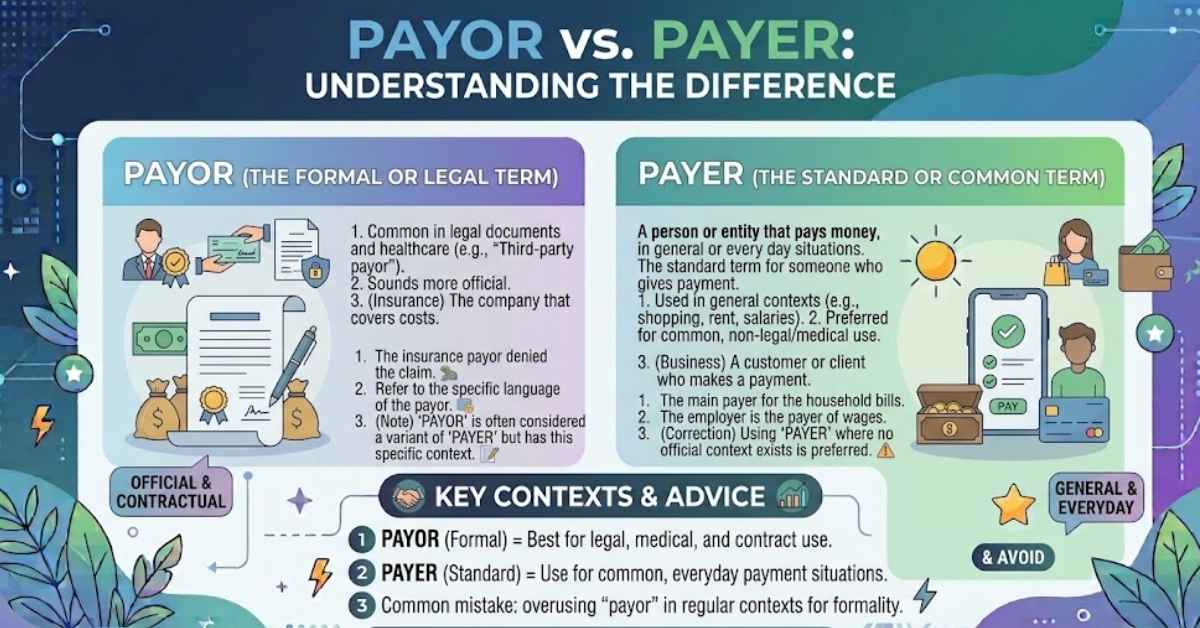
Payor vs payer is a spelling question with a surprisingly practical answer: both “payer” and “payor” are correct, and they generally have the same meaning. The main difference is usage and context, not a different definition. Payer is the ordinary, widely recognized form, while payor is a specialist variant that appears frequently in legal, financial, insurance, and some healthcare contexts.
If you’re writing a normal email, article, report, or general business document, payer will usually be the more natural choice. If you’re working with a contract, defined legal term, banking terminology, or an organization’s established terminology, payor may be the form you need to preserve.
The important point is this: you should not treat “payor” as a misspelling of “payer.”
Payor vs Payer at a Glance
| Question | Payer | Payor |
|---|---|---|
| Is it a real word? | Yes | Yes |
| Basic meaning | Person/entity that pays | Person/entity that pays |
| General English | Common | Less common |
| Legal writing | Used | Common in some contexts |
| Healthcare | Widely used | Also used |
| Insurance | Widely used | Also used |
| Banking | Common | Established in “payor bank” terminology |
| Tax/payment reporting | Common official terminology | Also encountered |
| Meaning difference | None in ordinary usage | None in ordinary usage |
Oxford lists payer as the ordinary noun and payor as a specialist form meaning a person who pays or has to pay.
So if you’re asking “payer or payor?”, the safest starting point is not “which one is correct?” but:
Which spelling does this document, organization, industry, or governing source use?
What Does “Payer” Mean?
A payer is a person or organization that makes a payment or is responsible for paying.
The word can describe an individual, business, government program, insurer, or another entity.
Examples:
- The payer submitted the payment.
- The customer is the payer on the invoice.
- The insurance company is the payer for the covered service.
- The employer may be the payer under the agreement.
- The IRS form identifies information about the payer and payee.
In everyday English, payer is the spelling most readers will immediately recognize.
The word follows a familiar English pattern:
- pay → payer
- teach → teacher
- drive → driver
- work → worker
That makes payer the natural general-English choice.
What Does “Payor” Mean?
Payor means essentially the same thing as payer: a person or organization that makes a payment or is responsible for paying.
The difference is primarily register and convention.
Oxford labels payor as a specialist form rather than giving it a separate meaning.
For example:
- The payor must satisfy the payment obligation.
- The agreement identifies the payor and the beneficiary.
- The payor is responsible for the scheduled payments.
- The provider submitted the claim to the payor.
This spelling has a particularly strong history in legal, financial, insurance, and administrative terminology.
That does not make it more “correct” than payer. It means that certain professional environments have established a preference for it.
Is It Payor or Payer?
If you’re asking “is it payor or payer?”, the answer is:
Both spellings are correct.
Use payer when you’re writing in ordinary English or following an organization’s standard terminology.
Use payor when the document, contract, legal terminology, database, or professional environment specifically uses that form.
For example:
The payer paid the invoice on time.
and:
The contract identifies the payor as the party responsible for monthly payments.
Both sentences are grammatically correct.
The spelling itself does not change who is responsible for the payment.
Payor or Payer Difference: Is There a Difference in Meaning?
The payor or payer difference is primarily a difference in usage, not meaning.
Both words identify the party that pays or is obligated to pay.
Compare:
The payer must submit payment by Friday.
The payor must submit payment by Friday.
The meaning is essentially the same.
Where things become more interesting is when you move into specialized U.S. terminology.
A legal document may use payor because that is the defined term.
A federal healthcare document may use payer because that is the agency’s terminology.
A bank-related legal rule may use payor in a specific expression.
Therefore, institutional terminology matters more than a simplistic “right versus wrong” rule.
Payer or Payor Meaning in Plain English
The payer or payor meaning can be reduced to one simple idea:
A payer/payor is the person or entity that makes a payment or is responsible for making it.
For an everyday transaction:
Maria buys a product and pays the invoice. Maria is the payer.
For a contract:
Company A is obligated to make monthly payments. Company A is the payer or payor, depending on the document’s terminology.
The For healthcare:
An insurance plan may be responsible for paying a covered medical claim. It is the payer in the terminology used by CMS.
For a bank transaction:
A bank can be described as a payor bank under established U.S. commercial-law terminology.
The Important U.S. Healthcare Question: Payer or Payor?
This is where many online explanations become too simplistic.
You may have heard:
“Healthcare always uses payor.”
That’s not an accurate universal rule.
The Centers for Medicare & Medicaid Services (CMS) repeatedly uses payer in its current healthcare terminology. CMS explains primary and secondary payers, calls each type of other health coverage a “payer,” and uses terms such as payer-to-payer in interoperability materials.
CMS also describes payer as an industry term that can include a health plan and certain other entities involved in healthcare payment.
So both forms can appear in healthcare.
Healthcare examples using “payer”
- primary payer
- secondary payer
- commercial payer
- payer mix
- payer contracting
- payer data
- payer-to-payer
- payer-provider relationship
CMS itself uses primary payer and secondary payer terminology when explaining Medicare coordination of benefits.
Why do you still see “payor” in healthcare?
Healthcare organizations often have legacy terminology, contracts, databases, billing systems, and internal style conventions that use payor.
That means a medical billing department might write:
primary payor
while another organization writes:
primary payer
Neither spelling automatically tells you that the underlying concept is different.
The better rule is:
Follow the terminology of the system, contract, payer agreement, or organization you’re working with.
Payer vs Payor in Insurance
Insurance is another area where both spellings appear.
An insurance company or health plan can be described as the entity responsible for paying covered claims.
For example:
The payer approved the claim.
or:
The payor approved the claim.
If the insurer’s policy, provider agreement, claims platform, or internal documentation consistently uses payor, maintaining that terminology can be sensible.
If you’re writing a public-facing explanation, payer is usually easier for a general American audience to recognize.
The key is consistency and context, not treating one spelling as universally invalid.
Payer vs Payor in Legal Writing
Legal writing deserves special attention because payor has an established place in U.S. legal terminology.
Cornell’s Legal Information Institute states that payor is used interchangeably with payer and defines the term as the person making a payment, satisfying a claim, or settling a financial obligation.
Why “payor” appears in contracts
Legal documents frequently use specialized labels for parties, including words such as:
- grantor
- guarantor
- obligor
- lessor
- lessee
- payor
- payee
A contract might therefore say:
“The Payor shall make all payments due under this Agreement.”
If Payor is a defined term in that contract, the safest editorial approach is normally to preserve the defined terminology rather than casually replacing it with Payer.
The important distinction
A contract’s choice of Payor does not prove that Payer is wrong.
It means the document has chosen one spelling as its terminology.
That distinction is extremely useful for anyone editing:
- contracts
- agreements
- policies
- insurance documents
- settlement documents
- financial instruments
- legal correspondence
“Payor Bank” Is a Special U.S. Legal Term
One of the clearest examples of established payor terminology is payor bank.
U.S. commercial-law terminology uses payor bank for the bank ultimately responsible for paying a draft in the relevant transaction.
This is a good example of why saying “always use payer” can be misleading.
In a specialized legal phrase, payor may be the established form.
So:
payor bank is an established U.S. legal term.
That doesn’t mean that payor has a different general definition from payer.
It means the particular legal terminology has settled on that spelling.
Payer vs Payor in Tax and Government Documents
Government terminology provides another useful reality check.
The IRS commonly uses payer in payment-reporting materials, including its current instructions for information returns.
For example, IRS instructions discuss the payer and payee relationship when explaining payment reporting.
This matters because it disproves another oversimplification:
“Formal government documents always use payor.”
They don’t.
Government terminology varies by agency and legal context.
If you’re completing an IRS form, use the terminology printed on the form or instructions.
If you’re dealing with a contract containing a defined Payor, follow the contract.
LEARN MORE: Resell or Resale
Payer vs Payee: Don’t Confuse These Two
A common source of confusion is payer vs payee.
The easiest way to remember the relationship is:
Payer = the one who pays.
Payee = the one who receives the payment.
Example:
The company pays the contractor $2,000.
The:
- company = payer
- contractor = payee
Another example:
An insurance plan pays a medical provider for a covered claim.
The:
- insurance plan = payer
- provider = payee/recipient of the payment, depending on the specific transaction and terminology
This distinction is more important than whether you spell the first term payer or payor.
Common Expressions With Payer
Payer is widely used in modern professional and government terminology.
Common expressions include:
Payer mix
The distribution of revenue or payments among different payer sources.
The hospital analyzed its payer mix.
Payer contracting
Negotiating contractual terms between a healthcare provider and a health plan.
The organization is reviewing its payer contracts.
Payer enrollment
The process of enrolling a provider with a health plan or other payer.
Primary payer
The entity with primary responsibility for paying a claim.
CMS uses primary payer as an established Medicare coordination-of-benefits term.
Secondary payer
An entity that may pay after the primary payer has paid its share.
Third-party payer
A payer other than the patient or provider that is responsible for some or all of a healthcare payment.
Common Expressions With Payor
Payor also appears in established professional and legal phrases.
Examples include:
- payor
- payors
- payor bank
- third-party payor
- payor agreement
- payor contract
- payor responsibility
- payor obligation
The important point is not that these phrases make payor a different word.
They demonstrate that specialized terminology can preserve a spelling that is less common in ordinary English.
Payers or Payors: What Is the Plural?
The plural forms are straightforward:
- payer → payers
- payor → payors
Examples:
Several payers rejected the claim.
The agreement identifies multiple payors.
Do not change the spelling halfway through a document:
The payer must notify all payors…
That might technically be possible if you’re referring to distinct terminology, but if both words mean the same role in your document, switching unnecessarily creates inconsistency.
Common Mistakes to Avoid
Mistake 1: Assuming “payor” is misspelled
It isn’t.
Payor is a recognized spelling.
Oxford explicitly lists it as a specialist form.
Mistake 2: Assuming “payer” is too informal for healthcare
That’s also incorrect.
CMS itself uses payer extensively in healthcare administration and Medicare terminology.
Mistake 3: Saying healthcare always uses “payor”
Healthcare organizations use both.
Some contracts and legacy systems may use payor, while current federal healthcare terminology frequently uses payer.
Mistake 4: Changing a contract’s defined term
If a contract explicitly defines:
“Payor means…”
don’t casually replace every occurrence with payer during editing.
Defined terminology should be treated as document-specific language.
Mistake 5: Mixing the spellings without a reason
If you’re writing one article, report, or internal document and the term has the same meaning throughout, choose a convention and stick with it.
Consistency makes professional writing easier to read and maintain.
Mistake 6: Believing “-or” automatically means legal English
English contains many -or agent nouns, but spelling alone doesn’t determine whether a word is legal terminology.
The reason payor survives in specialized fields is historical and institutional usage, not because the suffix automatically makes a word “more legal.”
When Should You Use Payer?
Use payer when:
- you’re writing for a general audience
- you’re writing ordinary business communication
- you’re preparing general educational content
- you’re following CMS terminology
- you’re following IRS terminology
- your organization’s style guide uses payer
- your software or data dictionary uses payer
- the document doesn’t already define the term as Payor
Examples:
The payer must verify the transaction.
CMS identifies the primary payer for Medicare claims.
The payer information appears on the form.
The provider submitted the claim to the payer.
When Should You Use Payor?
Use payor when:
- an existing contract defines Payor
- a specific legal term uses payor
- you’re referring to an established phrase such as payor bank
- your organization’s established terminology uses payor
- you’re reproducing or discussing source material that uses payor
- a particular industry system or agreement requires that spelling
Examples:
The Payor shall remit payment within 30 days.
The agreement defines the Payor and Payee.
The bank qualifies as a payor bank under the relevant terminology.
The goal is not to make every document use payer. The goal is to use the terminology appropriate to the document.
LEARN MORE: Inaccessible or Unaccessible
A Simple Decision Framework
If you’re staring at a sentence and thinking, “Is it spelled payer or payor?”, use this checklist.
1. Is this ordinary English?
Use payer.
2. Is this an official form?
Use the spelling used by the agency or form.
3. Is this a healthcare document?
Check the organization’s terminology. Payer is completely valid and widely used; payor may also appear.
4. Is this a legal contract?
Follow the contract’s defined terms.
5. Is this a specialized legal expression?
Check the established terminology. Payor bank is a good example.
6. Is this an internal business document?
Follow your organization’s style guide or terminology.
7. Are you writing a general article?
Payer is usually the clearer default for a general American audience.
Payer vs Payor: Which One Is More Professional?
Neither spelling is inherently more professional.
Professional writing is more concerned with:
- accuracy
- consistency
- audience
- established terminology
- document requirements
- clear definitions
A contract using Payor is not unprofessional simply because a general article would normally use payer.
Likewise, a healthcare document using payer is not less professional because another organization uses payor.
Context determines the appropriate convention.
Payer vs Payor: Which One Should You Use in the U.S.?
For general U.S. writing, payer is the safer default because it is the familiar dictionary form and is widely used by federal agencies.
But payor is also correct and has established uses in U.S. legal, financial, insurance, and administrative terminology.
The strongest practical rule is:
Use payer as your general-English default, but follow the terminology of the specific institution, contract, legal term, or system when one already exists.
That rule is more accurate than saying “payer is correct and payor is wrong” or “healthcare always prefers payor.”
Frequently Asked Questions
Is it payor or payer?
Both are correct. Payer is the more common general-English spelling, while payor is a recognized specialist variant used in some legal, financial, insurance, and administrative contexts.
Is it spelled payer or payor?
Both spellings are legitimate: payer and payor.
What is the payor or payer difference?
There is generally no difference in core meaning. Both refer to the person or entity that makes or is responsible for a payment. The difference is mainly usage, institutional preference, and specialized terminology.
Is payer or payor more common?
Payer is the more familiar general-English form. Payor is less common overall but remains established in specialized contexts.
Is payor a real word?
Yes. Oxford lists payor as a specialist form meaning a person who pays or has to pay.
Is payer a real word?
Yes. Payer is the ordinary noun for a person who pays or is required to pay.
Is payer or payor correct in healthcare?
Both can be correct. CMS itself uses payer extensively, while payor remains present in healthcare contracts, systems, and industry terminology.
Should I write payer or payor for an insurance company?
Either can occur, but payer is a strong general choice. If the insurance company’s policy, contract, or system specifically uses payor, follow that established terminology.
Is “primary payer” correct?
Yes. Primary payer is an established U.S. healthcare term, including in CMS Medicare coordination-of-benefits materials.
Is “secondary payer” correct?
Yes. CMS uses secondary payer when describing an entity that pays after the primary payer in applicable circumstances.
Is “third-party payor” correct?
Yes. Third-party payor is an established expression, particularly in legal and healthcare writing. Third-party payer is also correct.
Is “payer mix” or “payor mix” correct?
Both can be encountered. Use the spelling adopted by your organization, reporting system, or source document. In current federal healthcare terminology, payer is widely used.
Can payer and payor be used interchangeably?
Generally, yes, when they refer to the same person or entity responsible for payment. But don’t change a defined legal term or standardized system terminology casually.
Can I use “payor” in general English?
Yes. It is not wrong. It is simply less common and more specialized than payer.
Can I use “payer” in a legal document?
Yes, unless the particular document, agreement, statute, regulation, or established term requires or defines Payor.
Why are there two spellings?
English has competing agent-noun patterns, and payor became established in formal and specialized usage while payer became the more common general form.
What is the opposite of payer?
The most common counterpart is payee—the person or entity that receives the payment.
What is a payor bank?
Payor bank is an established U.S. commercial-law term associated with the bank responsible for paying a draft.
Should I use payer or payor in a contract?
If the contract already defines Payor, preserve that terminology. If you’re drafting a new contract, follow the applicable legal drafting conventions and your organization’s style guide rather than assuming one spelling is universally mandatory.
Final Answer: Payor vs Payer
Payer and payor are both correct.
The difference is primarily usage, convention, and context—not meaning.
Use payer as the natural default for general American English and in terminology used by organizations such as CMS and the IRS.
Use payor when it is part of an established legal, financial, insurance, banking, contractual, or organizational terminology.
The most useful rule is:
Payer = general/default spelling. Payor = recognized specialist variant.
And when a document already defines the term, follow the document’s terminology consistently.
That approach answers payer or payor, payor or payer, is it payor or payer, payor or payer difference, payer or payor meaning, and is it spelled payer or payor without pretending that one spelling is universally right and the other universally wrong.