

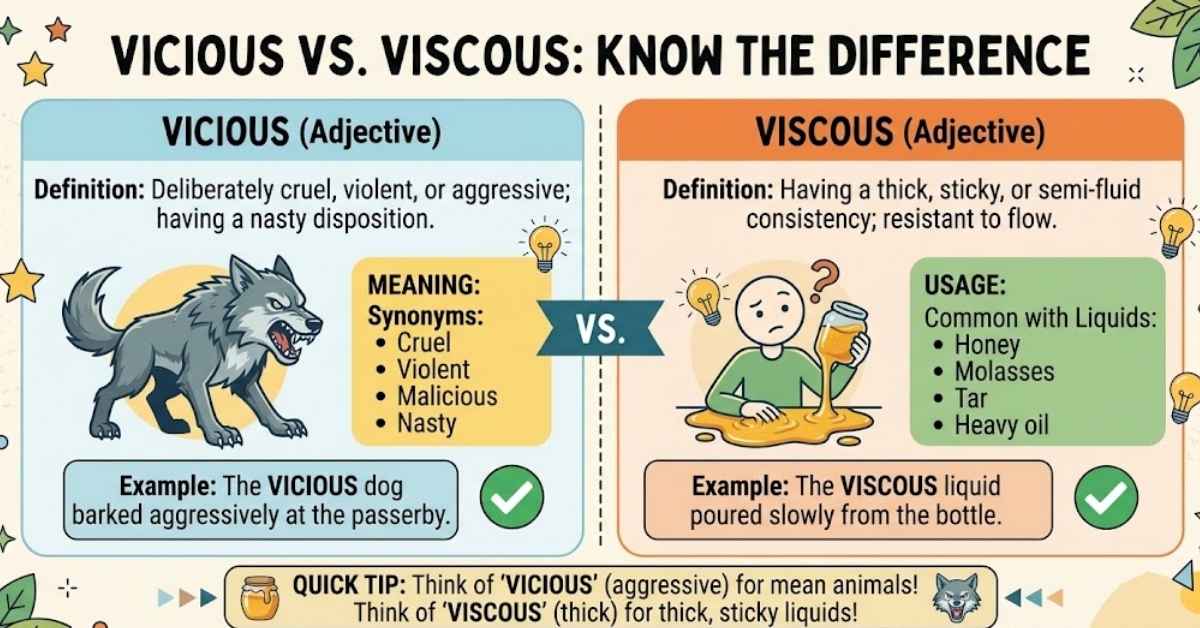
Vicious vs viscous is a classic English word-choice problem: vicious describes something cruel, aggressive, violent, malicious, or seriously harmful, while viscous describes a liquid or substance that is thick and resistant to flowing easily. The two words look almost identical, but they belong to completely different meanings.
If you are describing an attack, rumor, dog, or harsh comment, use vicious. If you are describing honey, oil, syrup, or another fluid that flows slowly, use viscous.
The easiest way to remember the distinction is:
Vicious = harmful or aggressive. Viscous = resistant to flow.
Both are legitimate English words, which is why a spell-checker may not warn you when you choose the wrong one.
Vicious vs Viscous at a Glance
| Word | Meaning | Usually describes | Example |
|---|---|---|---|
| Vicious | Cruel, violent, aggressive, malicious, or harmful | People, animals, actions, attacks, words, situations | a vicious attack |
| Viscous | Thick, sticky, and resistant to flowing easily | Liquids, fluids, and some fluid-like materials | viscous honey |
Both words are adjectives, so their grammar can look almost identical.
- The dog was vicious.
- The syrup was viscous.
The grammar is not what separates them. Meaning and context do.
What Does “Vicious” Mean?
Vicious generally describes something that is cruel, aggressive, violent, malicious, or seriously harmful.
Cambridge gives examples involving vicious people, animals, attacks, lies, accusations and other things that cause serious physical or emotional harm.
Vicious for people and animals
You can describe someone or an animal as vicious when their behavior suggests serious aggression or a willingness to cause harm.
Examples:
- The dog became vicious when it felt threatened.
- The attacker was described as vicious.
- The animal had a reputation for being vicious.
Importantly, vicious is stronger than simply “angry.” An angry dog is not automatically vicious. The word suggests a more dangerous, hostile, cruel, or harmful quality.
Vicious for attacks and actions
One of the most common uses is with actions involving violence or aggression.
- a vicious attack
- a vicious assault
- a vicious fight
- a vicious bite
- a vicious beating
- a vicious response
For example:
The boxer delivered a vicious punch.
Here, vicious emphasizes the force, aggression, or severity of the punch.
Vicious can describe words, criticism, and rumors
This is where the simple rule “vicious means violent” becomes too narrow.
Something does not have to involve physical violence to be vicious.
You can have:
- vicious criticism
- vicious comments
- vicious rumors
- vicious accusations
- vicious lies
- vicious insults
For example:
The writer received vicious criticism after publishing the article.
The criticism is not physically attacking anyone. It is harsh, malicious, or deliberately hurtful.
Oxford also gives examples involving vicious attacks, criticism, insinuations and misinformation, while noting an informal use for something extremely severe, such as a headache.
Vicious can mean extremely severe
There is another useful sense that many quick comparison articles overlook.
In informal English, vicious can describe something extremely unpleasant or severe:
- a vicious headache
- a vicious wind
- a vicious cold
- a vicious price spiral
So the word is not restricted to people or physical violence.
What Does “Viscous” Mean?
Viscous describes a liquid or fluid that is thick, sticky, and resistant to flowing easily.
Cambridge defines a viscous liquid as thick and sticky and not flowing easily.
Think about the difference between water and honey.
Water pours quickly.
Honey moves much more slowly and tends to cling to the spoon or container.
That slower flow is associated with viscosity, so honey can be described as viscous.
Common examples include:
- honey
- molasses
- syrup
- some oils
- thick sauces
- certain industrial fluids
- some laboratory materials
Examples:
The honey was extremely viscous.
The engineer tested a viscous fluid.
The sauce became more viscous as it cooled.
Viscous does not simply mean “thick”
“Thick” is a useful everyday approximation, but viscous is more precise.
The scientific idea is about resistance to flow.
NIST describes viscosity as a measure of resistance to flow: higher viscosity means greater resistance, using honey as an example of a high-viscosity substance and water as an example of a low-viscosity substance.
That distinction matters in scientific and technical writing.
For example, instead of simply saying:
The fluid is thick.
a scientist or engineer may need to communicate something more specific about how the material flows and resists deformation.
The Real Difference Between Vicious and Viscous
The easiest reliable distinction is not actually the spelling.
Ask:
What am I describing?
If you are describing behavior, aggression, cruelty, hostility, harm, or severe unpleasantness, choose vicious.
If you are describing a fluid’s consistency or resistance to flow, choose viscous.
Compare:
The dog was vicious.
The sentence describes behavior.
The honey was viscous.
The sentence describes a physical property.
That is why these sentences sound wrong:
The dog was viscous. ❌
The honey was vicious. ❌
The words are correctly spelled, but the meanings do not fit the context.
Vicious vs Viscous Pronunciation
Pronunciation is another reason these words are easy to confuse.
In American English:
- vicious — /ˈvɪʃ.əs/
- viscous — /ˈvɪs.kəs/
Cambridge lists these American pronunciations for the two words.
The important difference is in the middle:
vicious has the “sh” sound.
viscous has the “sk” sound.
So when spoken carefully, they are not homophones.
However, pronunciation should be treated as a helpful clue rather than your main decision rule. Meaning is more reliable.
If you are writing and cannot remember which spelling you need, first identify what the word describes.
Vicious Cycle or Viscous Cycle?
This is one of the most important special cases.
The correct expression is:
vicious cycle
or:
vicious circle
It is not normally “viscous cycle” when you mean a repeating negative situation.
A vicious cycle is a situation in which one problem causes another problem, which then makes the original problem worse. Cambridge gives this meaning for vicious circle and notes vicious cycle as the American variant.
For example:
Lack of sleep can reduce productivity, which creates stress, which makes it harder to sleep. It can become a vicious cycle.
Nothing is physically thick or sticky.
Here, vicious means that the pattern is harmful and self-reinforcing.
Another example
Falling sales led to layoffs, which reduced production and caused sales to fall further—a vicious cycle.
The negative conditions feed into one another.
Common Mistakes With Vicious and Viscous
1. “A viscous attack”
Incorrect:
The newspaper reported a viscous attack.
Correct:
The newspaper reported a vicious attack.
An attack can be violent, cruel, or aggressive, so vicious is the appropriate adjective.
2. “A vicious liquid”
Incorrect:
The scientist examined a vicious liquid.
Correct:
The scientist examined a viscous liquid.
The sentence concerns the liquid’s physical flow, so viscous is correct.
3. “The oil is vicious”
Incorrect:
The engine oil became vicious.
Correct:
The engine oil became viscous.
The relevant property is resistance to flow.
4. “She made a viscous comment”
Incorrect:
She made a viscous comment.
Correct:
She made a vicious comment.
The comment is being described as cruel or hurtful.
5. “A viscous cycle”
Incorrect when referring to a harmful repeating situation:
The company was trapped in a viscous cycle.
Correct:
The company was trapped in a vicious cycle.
The word vicious describes the harmful feedback loop.
Why Spell-Check May Not Catch This Mistake
This is one of the most practical things to understand about vicious vs viscous.
Both words are real English words.
That means your software may see:
The sauce was vicious.
and decide that there is no spelling error.
But the sentence may still contain a word-choice error.
The same happens with:
The attack was viscous.
There is nothing misspelled about “viscous.” The problem is that the word does not communicate the intended meaning.
So if you’re unsure between these two words, don’t ask only:
“Is this spelling correct?”
Ask:
“Does this word describe the thing I am talking about?”
That is the better test.
Vicious vs Viscous in Different Contexts
Everyday English
The dog became vicious when approached.
The caramel was too viscous to spread easily.
Workplace writing
The employee received vicious criticism online.
The engineer selected a more viscous lubricant for the equipment.
Academic writing
The character becomes trapped in a vicious cycle of poor decisions.
The experiment examined the movement of a viscous fluid.
Science and engineering
Viscous is particularly useful when discussing fluids, flow, viscosity, and related physical properties.
NIST’s rheology work, for example, focuses on flow properties such as viscosity and yield stress.
Journalism
Vicious frequently appears with attacks, criticism, rumors, accusations and other forms of harmful behavior or language.
Oxford and Cambridge both provide examples demonstrating these broader uses.
Word Forms and Related Vocabulary
Understanding the word families makes the distinction easier to retain.
Words related to vicious
- vicious — adjective
- viciously — adverb
- viciousness — noun
Example:
The animal attacked viciously.
The article was criticized for its viciousness.
Related words include:
- cruel
- brutal
- aggressive
- malicious
- hostile
- savage
- harmful
- fierce
These words overlap with vicious, but they are not perfect synonyms in every sentence.
Words related to viscous
The most important related word is:
- viscous — adjective
- viscosity — noun
Example:
The liquid is viscous.
The liquid has a high viscosity.
Viscosity is the property associated with resistance to flow.
You may also encounter viscid, which means sticky or adhesive.
Where Did Vicious and Viscous Come From?
Their similar spelling does not mean they developed from the same word.
Origin of vicious
Vicious ultimately comes from Latin vitiosus, meaning faulty, defective, corrupt, or morally flawed, from vitium, meaning fault or vice.
That history helps explain the word’s development toward meanings involving:
fault → corruption → harmful or immoral behavior → cruelty/aggression
Origin of viscous
Viscous comes from Late Latin viscosus, meaning sticky, and is related to Latin viscum, referring to a sticky substance or birdlime associated with mistletoe.
Its historical path is therefore associated with:
sticky substance → stickiness → slow flow → viscosity
So the two words only look like close relatives today. Their histories point in very different directions.
LEARN MORE: Learnt vs Learned
How to Remember Vicious vs Viscous
Memory trick 1: Vicious → violence
Connect:
vicious → violence → harm
Think:
- vicious attack
- vicious dog
- vicious fight
- vicious criticism
Memory trick 2: Viscous → viscosity
Connect:
viscous → viscosity → flow
Think:
- viscous honey
- viscous oil
- viscous syrup
- viscous fluid
This is the more useful memory connection because viscosity is directly related to the property described by viscous.
Memory trick 3: The SH vs SK clue
vicious → “sh” sound
viscous → “sk” sound
You should not depend on pronunciation alone, but it can reinforce the distinction.
Memory trick 4: The honey test
Imagine the sentence is about honey.
If you’re describing how slowly the honey pours:
viscous
If you’re describing a cruel attack:
vicious
A simple mental contrast is:
Vicious can hurt; viscous can flow slowly.
The 10-Second Decision Test
When you’re writing quickly, use this:
Step 1: What am I describing?
A person, animal, attack, comment, rumor, behavior, criticism, conflict, or harmful situation?
→ Vicious
A liquid, fluid, oil, syrup, honey, sauce, or material’s resistance to flow?
→ Viscous
Step 2: Can I connect it to viscosity?
If yes, you probably need:
→ viscous
Step 3: Is the idea about harm or hostility?
If yes, you probably need:
→ vicious
This works better than memorizing isolated sentences because it focuses on meaning rather than spelling.
Quick Practice: Vicious or Viscous?
Choose the correct word.
- The dog became extremely __ when threatened.
- The laboratory tested the __ liquid.
- She received __ criticism after the interview.
- The honey was too __ to pour quickly.
- The company became trapped in a __ cycle.
- The engineer measured the fluid’s __.
- The newspaper described the attack as __.
- The sauce became more __ as it cooled.
Answers
- vicious — describes aggressive behavior.
- viscous — describes a liquid’s flow properties.
- vicious — describes harsh or malicious criticism.
- viscous — describes honey’s resistance to flowing.
- vicious — describes a harmful repeating pattern.
- viscosity — the noun for the property.
- vicious — the attack is violent or severe.
- viscous — the sauce became thicker and more resistant to flow.
Notice the pattern: you don’t need to memorize all eight answers individually. Identify the semantic category first.
Frequently Asked Questions About Vicious vs Viscous
What is the difference between vicious and viscous?
Vicious means cruel, aggressive, violent, malicious, harmful, or severely unpleasant. Viscous describes a liquid or fluid that is thick, sticky, and resistant to flowing easily.
Is it vicious or viscous liquid?
Use viscous liquid.
A liquid can be viscous when it has relatively high resistance to flow.
Is it vicious or viscous attack?
Use vicious attack.
An attack can be cruel, violent, aggressive, or severe.
Is honey vicious or viscous?
Honey can be viscous because it flows relatively slowly and has a high resistance to flow compared with a low-viscosity liquid such as water.
Can a person be viscous?
Not in the normal meaning of the word. Viscous is generally used for fluids or substances in relation to their flow properties.
For a cruel or aggressive person, use vicious.
Can a liquid be vicious?
Not when you mean that it is thick or slow-flowing. Use viscous for that meaning.
Is it “vicious cycle” or “viscous cycle”?
The established expression is vicious cycle. It describes a harmful pattern in which problems reinforce one another. Vicious circle is another established form.
Are vicious and viscous homophones?
No. They are similar-sounding words, but not exact homophones. In American English, vicious is /ˈvɪʃ.əs/, while viscous is /ˈvɪs.kəs/.
Is viscous the same as thick?
Not exactly. Thick is an everyday description, while viscous more specifically concerns a substance’s resistance to flow. NIST defines viscosity in terms of resistance to flow.
Is vicious always about violence?
No. Vicious can describe cruelty and aggression, but it can also describe malicious criticism, rumors, accusations, severe conditions, and a harmful vicious cycle.
Final Answer: Vicious vs Viscous
The distinction is simple once you focus on meaning:
Vicious = cruel, aggressive, violent, malicious, harmful, or severely unpleasant
Viscous = thick, sticky, and resistant to flowing easily
So write:
- a vicious attack
- a vicious rumor
- a vicious dog
- a vicious cycle
- viscous honey
- viscous oil
- viscous syrup
- a viscous fluid
When you’re unsure, don’t rely on spelling alone. Ask what you’re describing.
Harm or aggression? Choose vicious.
Fluid flow or viscosity? Choose viscous.
That single distinction will resolve most vicious vs viscous questions correctly.