

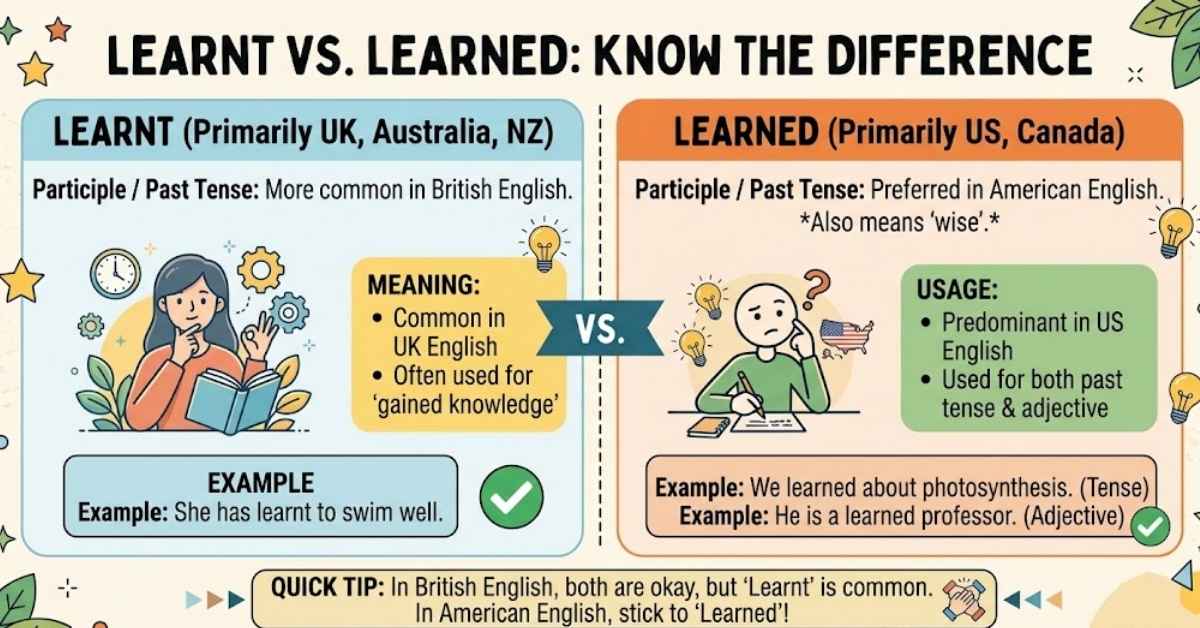
Learnt vs learned is mainly a question of regional English usage, not a difference in basic meaning. Both are correct past-tense and past-participle forms of learn, but learned is the standard and preferred form in American English, while learnt is especially common in British English. British English also accepts learned, so it is not accurate to say that learnt is the only British form.
If you are writing for a U.S. audience, use learned: I learned a lot from the experience. If you are intentionally following British English, I learnt a lot from the experience is also correct.
Learnt vs Learned at a Glance
| Feature | Learned | Learnt |
|---|---|---|
| Base verb | learn | learn |
| Simple past | Yes | Yes |
| Past participle | Yes | Yes |
| American English | Preferred | Less common |
| British English | Correct | Common |
| Basic meaning as a verb | Gain knowledge/skill | Gain knowledge/skill |
| Adjective meaning “scholarly” | Yes | No |
| Best choice for U.S. writing | Learned | Usually avoid |
The important point is that learnt is not simply a misspelling of learned. It is an established variant of the verb’s past forms. Oxford lists learned as the past simple and past participle and identifies learnt as an especially British alternative.
What Does “Learned” Mean?
Learned is the regular past tense and past participle of learn and is the form most naturally used in American English.
The verb learn means to gain knowledge, understanding, a skill, or an ability through study, experience, instruction, or practice.
Learned as the simple past
Use learned when an act of learning happened in the past.
For example:
- I learned a new skill yesterday.
- She learned Spanish in college.
- We learned an important lesson.
- He learned how to repair the computer.
- The students learned about American history.
For American readers, these sentences sound natural and standard.
Learned as a past participle
Learned can also follow helping verbs such as have, has, and had.
- I have learned a lot this year.
- She has learned from her mistakes.
- They had learned the procedure before the test.
- We have learned several valuable lessons.
The basic American-English pattern is:
learn → learned → learned
What Does “Learnt” Mean?
Learnt is another past-tense and past-participle form of learn. It has the same basic meaning as learned when it functions as a verb.
It is particularly associated with British English.
For example:
- I learnt a new skill.
- She learnt French at school.
- We learnt an important lesson.
- He has learnt from his mistakes.
- They had learnt the rules before the game.
In these sentences, replacing learnt with learned does not change the basic meaning.
For example:
I learnt a valuable lesson.
and
I learned a valuable lesson.
Both mean that the speaker acquired an important lesson or understanding.
The difference is primarily regional and stylistic.
Learnt vs Learned: What Is the Actual Difference?
The learnt vs learned meaning is essentially the same when both words are being used as forms of the verb learn.
The main distinction is which variety of English you are following.
American English
American English strongly favors:
learned
British English
British English commonly uses:
learnt
But British English also accepts:
learned
That last point matters. A simple chart saying “American = learned, British = learnt” is useful for beginners, but it is too rigid. Oxford lists both forms and labels learnt as especially British, while the British Council similarly explains that learned is standard in American English and learnt is commonly used in British English.
So the better rule is:
U.S. English → learned is the normal choice.
British English → learned and learnt are both possible, with learnt being traditionally/common associated with British usage.
Learnt vs Learned in American English
If your target audience is in the United States, choose learned.
This applies to most American:
- school assignments
- college papers
- websites
- business documents
- emails
- reports
- articles
- books
- professional communication
For example:
I learned how to drive when I was sixteen.
This is the natural American-English version.
You may occasionally encounter learnt in American writing, especially in quotations, international material, literature, or writing influenced by another English variety. But that does not make learnt the normal U.S. choice.
If your website specifically targets American English, consistency is the simplest strategy: use learned.
Learnt vs Learned in British English
The situation is slightly more flexible in British English.
A British writer can use:
I learnt something important today.
They can also use:
I learned something important today.
Both forms are recognized for the verb learn. Oxford specifically lists both, with learnt marked as especially British.
This means you should not “correct” every occurrence of learnt to learned simply because you personally prefer American English.
Instead, consider the English variety, publication style, and consistency of the document.
If a British publication consistently uses learnt, keep it.
If its style consistently uses learned, keep that instead.
“I Learned” vs “I Learnt”
One of the most common searches behind learnt vs learned is whether to write “I learned” or “I learnt.”
The answer depends on your intended variety of English.
American English
I learned a lot from that experience.
British English
I learnt a lot from that experience.
Also possible in British English
I learned a lot from that experience.
The meaning remains the same.
Here are more examples:
| Meaning | American English | British English option |
|---|---|---|
| Acquired a skill | I learned to swim. | I learnt to swim. |
| Gained knowledge | I learned about history. | I learnt about history. |
| Gained experience | We learned from the mistake. | We learnt from the mistake. |
| Studied something | She learned French. | She learnt French. |
| Discovered information | He learned the truth. | He learnt the truth. |
For a U.S.-focused article, “I learned” is the form to recommend.
Learnt vs Learned Grammar: Past Tense and Past Participle
Understanding the grammar makes this comparison much easier.
The verb learn has these forms:
| Verb form | American English | British alternative |
|---|---|---|
| Base form | learn | learn |
| Third-person singular | learns | learns |
| Present participle | learning | learning |
| Simple past | learned | learnt / learned |
| Past participle | learned | learnt / learned |
Simple past
Use the simple past for a completed event:
I learned the answer yesterday.
British-style:
I learnt the answer yesterday.
Past participle
Use the past participle with auxiliary verbs:
I have learned a great deal.
British-style:
I have learnt a great deal.
You can also use the past participle in passive constructions:
The students were taught and learned new techniques.
The important thing is that learnt and learned are both legitimate verb forms, but the preferred form depends on English variety.
The Important Exception: “Learned” as an Adjective
This is the part many short articles fail to explain clearly.
Learned can also be an adjective meaning highly educated, knowledgeable, or scholarly.
For example:
She is a learned professor.
Here, learned does not mean “she learned something.”
It describes the professor as knowledgeable or scholarly.
Other examples include:
- He is a learned historian.
- The university invited a learned scholar to speak.
- She wrote a highly learned article.
- The book contains a learned discussion of medieval history.
In this adjective use, learnt is not the replacement.
Verb vs adjective
Compare these sentences:
She learned mathematics at university.
Here, learned = verb.
She is a learned mathematician.
Here, learned = adjective.
There is also a pronunciation difference. As a verb, learned is generally pronounced as one syllable. As the adjective meaning scholarly, it is pronounced with two syllables.
That distinction is particularly useful for English learners.
Learned vs Learnt Spelling Difference
The spelling difference is simple:
learn + ed = learned
learn + t = learnt
Both forms developed as accepted past forms of learn.
This is part of a broader pattern in English where some verbs have both -ed and -t past forms.
Examples include:
- dreamed / dreamt
- burned / burnt
- spelled / spelt
- learned / learnt
- leaped / leapt
The preferred form can vary by region, style, and individual usage.
For American English, the -ed form is generally the safer and more familiar choice for this particular verb.
How Do You Pronounce “Learnt” and “Learned”?
As verb forms, learnt and learned are normally pronounced as one syllable.
The final consonant differs:
- learnt ends with a /t/ sound.
- learned as a verb ends with a /d/ sound.
The adjective learned, however, is different.
In:
a learned professor
learned has two syllables.
That pronunciation difference helps identify the grammatical role.
Compare
Verb:
I learned something new.
Adjective:
He is a learned scholar.
The spelling is identical, but the meaning, grammar, and pronunciation are different.
When to Use Learnt vs Learned
If you are unsure which form to choose, ask one question:
Who is your audience?
Writing for Americans?
Use learned.
I learned an important lesson.
Writing in British English?
Learnt is a natural option.
I learnt an important lesson.
But learned is also possible in British English.
Writing for an international audience?
Learned is usually the safer choice because it is standard in American English and also accepted in British English.
Reproducing someone’s original wording?
Keep the original form if you are accurately quoting or preserving their regional voice.
Writing dialogue?
Choose the form that fits the speaker or setting. A British character may naturally use learnt, while an American character would normally use learned.
Examples of Learnt vs Learned in Real Writing
Academic writing
American English:
The researchers learned that the original hypothesis required revision.
British English:
The researchers learnt that the original hypothesis required revision.
The meaning does not change.
Professional writing
Our team learned several important lessons from the project.
This is the natural choice for a U.S.-focused business document.
Casual writing
I learned something interesting today.
A British speaker might naturally say:
I learnt something interesting today.
Learning a skill
She learned how to play the piano as a child.
British version:
She learnt how to play the piano as a child.
Learning from mistakes
We learned from our mistakes.
British version:
We learnt from our mistakes.
Present relevance
I have learned a lot since starting this job.
British version:
I have learnt a lot since starting this job.
Common Mistakes With Learnt and Learned
Mistake 1: Thinking “learnt” is always wrong
It isn’t.
Learnt is a legitimate form of the verb learn, particularly associated with British English.
Mistake 2: Thinking “learned” is only American
It isn’t.
British English also uses learned.
The distinction is one of preference and usage, not a strict grammatical border.
Mistake 3: Writing “learnted”
This is incorrect.
Do not write:
❌ I have learnted a lot.
Use:
✅ I have learnt a lot.
or:
✅ I have learned a lot.
Mistake 4: Treating learned as an adjective in every sentence
In:
I learned French.
learned is a verb.
In:
She is a learned scholar.
learned is an adjective.
Context matters.
Mistake 5: Mixing regional styles unnecessarily
A document might contain:
I learned the process yesterday.
and later:
We learnt the process last week.
This is not necessarily grammatically wrong, but unexplained switching can make the writing look inconsistent.
If you’re writing for an American audience, choose learned and stick with it.
Is “Learnt” Correct in American English?
Yes, learnt can be understood and is not inherently an impossible English form, but it is much less common in American English than learned.
For ordinary U.S. writing, learned is the better choice.
This is especially true for:
- academic papers
- professional reports
- business emails
- American websites
- educational materials
- general-audience articles
So if the question is:
“Which should I use in American English?”
The practical answer is:
Use learned.
That does not mean that every occurrence of learnt is a grammar error.
Is “Learned” Correct in British English?
Yes.
British English uses learnt frequently, but learned is also accepted as a past form of learn. Oxford lists both forms and specifically identifies learnt as especially British.
Therefore, the statement:
“Learned is American and never British.”
is too absolute.
A more accurate explanation is:
Learned is the standard preferred form in American English, while British English commonly uses both learned and learnt, with learnt having a particularly strong British association.
That distinction gives readers a much more accurate understanding of the language.
A Simple Memory Trick
If you are writing for an American audience, remember:
U.S. → learned
If you’re deliberately following traditional British usage:
UK → learnt is common
But remember the bigger rule:
British English can use learned too.
This is better than memorizing an absolute “American versus British” rule.
Why Do English Verbs Have Both Forms?
English has developed through centuries of language change, and some verbs retain competing past-tense patterns.
The -ed ending is extremely productive in modern English, while older -t forms remain in certain verbs and varieties.
That is why English has pairs such as:
- learned / learnt
- dreamed / dreamt
- burned / burnt
- spelled / spelt
- spilled / spilt
Different English-speaking communities have developed different preferences.
The existence of learnt therefore isn’t evidence that someone “forgot” the correct spelling. It reflects variation within English.
LEARN MORE: Bearable vs Bareable
Which One Is Better for Formal Writing?
For American formal writing, use learned.
For example:
The participants learned how to use the new software.
This is the natural U.S. form.
For British formal writing, learnt can be perfectly appropriate:
The participants learnt how to use the new software.
But learned is also possible.
The most important editorial principle is consistency with the chosen variety of English.
Quick Decision Framework
When deciding between learnt vs learned, use this checklist:
1. Writing for a U.S. audience? → Choose learned.
2. Writing in British English? → Learnt is common; learned is also acceptable.
3. Describing someone as scholarly? → Use learned, not learnt.
4. Writing dialogue? → Match the speaker’s English variety.
5. Maintaining a quotation? → Preserve the original wording when appropriate.
6. Unsure and writing for a broad international audience? → Learned is generally the safest choice.
Frequently Asked Questions
Is “learnt” grammatically correct?
Yes. Learnt is a correct past-tense and past-participle form of learn, especially common in British English.
Is “learned” or “learnt” correct?
Both are correct when used as forms of the verb learn. The choice mainly depends on English variety and style.
Is learnt American or British?
Learnt is particularly associated with British English. American English strongly prefers learned.
Should Americans use “learnt”?
Americans will understand it, but for standard U.S. writing, learned is the normal and preferred choice.
Can British people say “learned”?
Yes. British English accepts learned as well as learnt for the verb.
What is the difference between “I learned” and “I learnt”?
There is generally no difference in meaning when they are used as past forms of learn. The difference is primarily regional preference.
Is “learned” an adjective?
Yes. Learned can be an adjective meaning highly educated, knowledgeable, or scholarly.
For example:
She is a learned historian.
Can I say “a learnt professor”?
No. When you mean scholarly or highly educated, use learned.
What is the past tense of learn?
The past tense can be learned or learnt. Learned is preferred in American English, while learnt is especially common in British English.
What is the past participle of learn?
Both learned and learnt can function as the past participle.
For example:
I have learned a lot.
or:
I have learnt a lot.
Which spelling should I use in an American article?
Use learned.
Is “learnted” correct?
No. The correct forms are learned and learnt. Never add -ed to learnt.
Final Verdict: Learnt vs Learned
The learnt vs learned difference is primarily about English variety and usage, not meaning.
If you’re writing in American English, choose learned. It is the standard and familiar form for both the simple past and past participle of learn.
If you’re writing in British English, learnt is common and natural, while learned is also accepted.
The one distinction you should remember is that learned has an additional adjective use meaning scholarly or highly educated:
He is a learned professor.
So for most U.S. readers, the rule is wonderfully simple:
Use “learned” when you mean that someone gained knowledge or a skill in the past.
Use “learned” as well when you mean scholarly or highly educated.
And if you encounter learnt, don’t assume it is a spelling mistake. It is a legitimate English variant with a strong British association.