

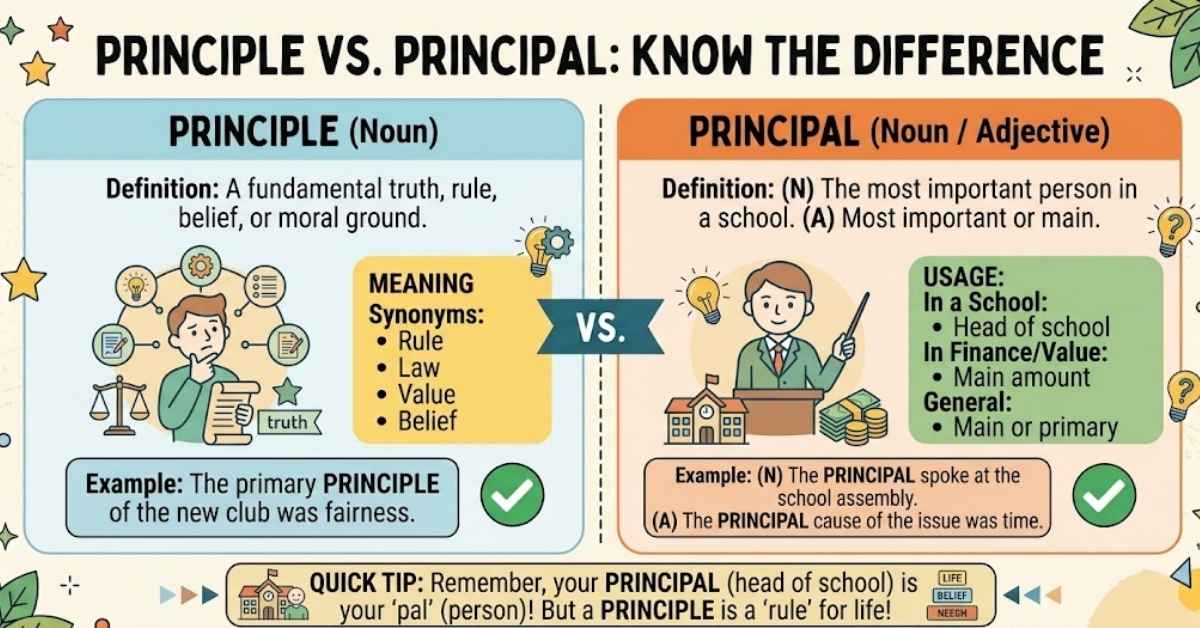
Principle vs principal is a common English word-choice problem because the two words sound the same but have different spellings, meanings, and grammatical uses.
The simplest answer is: principle means a rule, belief, standard, or fundamental idea, while principal can mean a person in charge, something main or most important, or an original amount of money.
Once you connect each spelling to its meaning, the difference becomes much easier to recognize.
Principle vs Principal at a Glance
| Word | Part of speech | Main meaning | Example |
|---|---|---|---|
| Principle | Noun | Rule, belief, standard, or fundamental idea | Honesty is an important principle. |
| Principal | Noun | Person in charge or original financial amount | The school principal spoke to the students. |
| Principal | Adjective | Main, chief, or most important | Safety is our principal concern. |
| Principal | Noun | Money borrowed or invested | She paid down the loan principal. |
Here is the fastest practical rule:
Principal = person, main thing, or money. Principle = rule, belief, standard, or fundamental idea.
Cambridge classifies principal as both an adjective and a noun, while principle is a noun.
What Does “Principle” Mean?
A principle is a rule, belief, standard, or fundamental idea that influences behavior, decisions, or the way something works.
It is always used as a noun.
For example:
- Honesty is an important principle.
- She refused the offer on principle.
- The company follows strong ethical principles.
- The experiment demonstrates an important scientific principle.
- He believes fairness should be a basic principle of leadership.
The word does not have to be about morality. That is an important distinction.
Principle as a moral rule or belief
A principle can describe a personal or ethical standard.
She refused to lie because it went against her principles.
Here, principles means beliefs about how a person should behave.
Another example:
He would not accept the money on principle.
The phrase means he refused because doing so conflicted with a personal belief or standard.
Oxford and Cambridge both give this moral or behavioral sense of principle.
Principle in science, logic, and theory
A principle can also describe a basic rule or idea that explains how something works.
For example:
Students learned the basic principles of physics.
Here, principle does not mean a personal moral belief. It refers to a fundamental idea or rule within a field of study.
You can therefore think of principle more broadly as a foundational rule or idea.
What Does “Principal” Mean?
Principal has several meanings, which is why it causes more confusion.
It can function as both a noun and an adjective.
Principal as a person in charge
In American English, a principal is commonly the person who leads a school.
The principal welcomed the new students.
I spoke with the school principal yesterday.
This is one of the most familiar uses of the word in the United States.
Cambridge specifically identifies principal as the person in charge of a school in U.S. English.
Remember:
A school has a principal, not a “principle.”
Principal as “main” or “most important”
This is where the words become particularly easy to confuse.
Principal can be an adjective meaning:
- main
- chief
- primary
- leading
- most important
For example:
The principal reason for the delay was bad weather.
You can replace principal with main:
The main reason for the delay was bad weather.
That tells you that principal is correct.
More examples:
- Cost was the principal concern.
- Education is the principal goal of the program.
- Her principal objective was to improve customer service.
- This is the company’s principal source of income.
Cambridge lists “most important” as the adjective meaning of principal.
Principal vs Principle Meaning: What Is the Real Difference?
The biggest difference is what the word represents.
Principle represents an idea, rule, belief, standard, or fundamental concept.
Principal represents a person, main thing, or financial amount, and it can also describe something that is most important.
Consider these examples:
Honesty is a principle.
Honesty is a belief or standard.
The school principal announced the new policy.
The principal is a person.
Safety is the principal concern.
Principal means the main concern.
The borrower paid down the principal.
Principal means the financial amount owed.
The spelling changes because the meaning changes.
Principal vs Principle Money: Which One Is Correct?
When talking about money, loans, mortgages, or investments, the correct word is principal.
Never write principle when you mean the amount of money borrowed or invested.
What is loan principal?
The principal is generally the amount of money borrowed, excluding interest and other charges.
For example:
Maria borrowed $20,000. Her original loan principal was $20,000.
As payments are made, the outstanding principal can decrease.
For example:
Maria made an extra payment that reduced her principal balance.
Financial documents commonly distinguish between principal and interest. U.S. consumer-finance materials use “principal” for the loan amount and distinguish it from interest and finance charges.
Principal vs. interest
These terms describe different parts of borrowing.
- Principal = the amount borrowed or outstanding balance
- Interest = the cost charged for borrowing money
For example:
Your monthly payment may include both principal and interest.
If you write “principle and interest” when referring to a loan payment, the spelling is wrong.
Principal in investments
The word principal can also refer to the original amount invested.
For example:
She invested $10,000 and wanted to protect her principal.
The investment may later produce earnings or returns, but the original invested amount is referred to as the principal.
When to Use Principal vs Principle
Instead of memorizing dozens of sentences, use this three-question test.
Question 1: Does it mean a rule or belief?
Use principle.
Respect is an important principle.
She acted according to her principles.
The decision violated a basic ethical principle.
Question 2: Does it mean main or most important?
Use principal.
What is the principal reason for the change?
Replace it with main:
What is the main reason for the change?
If “main” works naturally, principal is usually the correct choice.
Question 3: Does it refer to a person or money?
Use principal.
The school principal called a meeting.
We need to reduce the loan principal.
This gives you a simple decision framework:
| If you mean… | Use |
|---|---|
| Rule | principle |
| Belief | principle |
| Moral standard | principle |
| Scientific foundation | principle |
| Person in charge | principal |
| Main thing | principal |
| Most important | principal |
| Loan amount | principal |
| Investment amount | principal |
In Principle vs In Principal
One of the most common mistakes is writing “in principal.”
The standard expression is:
in principle
It means in theory, generally, or as a basic idea, without necessarily agreeing on every practical detail.
For example:
I agree in principle, but we still need to discuss the details.
Another example:
The committee approved the proposal in principle.
Here, the word is principle because the expression refers to a basic idea or general agreement.
“On principle” is also correct
On principle means because of a firm belief or moral standard.
She refused the offer on principle.
He does not support the policy on principle.
You can also say:
It is a matter of principle.
These are fixed or common expressions worth remembering.
Common Mistakes With Principle and Principal
Mistake 1: “The school principle”
❌ The school principle spoke to the students.
✅ The school principal spoke to the students.
The word refers to a person, so use principal.
Mistake 2: “The principal of honesty”
❌ Honesty is an important principal.
✅ Honesty is an important principle.
Here, honesty represents a belief or standard, so principle is correct.
Mistake 3: “The principle reason”
❌ Price was the principle reason for the decision.
✅ Price was the principal reason for the decision.
Here, principal means main.
Mistake 4: “Loan principle”
❌ I made a payment toward the loan principle.
✅ I made a payment toward the loan principal.
Money terminology uses principal.
Mistake 5: “In principal”
❌ We agree in principal.
✅ We agree in principle.
The established expression is in principle.
Mistake 6: “On principal”
❌ She refused the offer on principal.
✅ She refused the offer on principle.
The meaning is based on a belief or standard, so use principle.
Principle and Principal in Real-World Writing
The distinction becomes easier when you see how each word behaves in different fields.
In school writing
The principal announced the new attendance policy.
Principal refers to the school leader.
Respect is one of the school’s core principles.
Principles refers to guiding values.
In business writing
Customer satisfaction is our principal objective.
Principal means main.
Transparency and fairness are our core principles.
Principles means guiding standards.
In academic writing
The principal finding of the study was unexpected.
Principal means main or most important.
The researchers examined the principles behind the theory.
Principles refers to fundamental ideas.
In financial writing
The borrower still owes $15,000 in principal.
Principal refers to the financial amount.
The bank explained how interest is calculated on the outstanding principal.
Again, the financial meaning requires principal.
In scientific writing
The experiment demonstrates a basic principle of physics.
Principle refers to a fundamental scientific concept.
Other Uses of “Principal” You May Encounter
The school and finance meanings are only part of the picture.
Principal investigator
A principal investigator, often abbreviated PI, is the lead researcher responsible for a study or research project.
Dr. Lee is the principal investigator for the study.
Principal dancer
In dance and performing arts, a principal dancer is a leading performer.
She became a principal dancer after years of training.
Principal actor
A principal actor can refer to a leading or major performer in a production.
Principal party or legal principal
In legal and business contexts, principal can also refer to a person or entity represented by another person, such as an agent.
For example:
The agent acted on behalf of the principal.
These uses all connect to the broader idea of someone or something primary, leading, or central.
Can Principle and Principal Appear in the Same Sentence?
Yes—and seeing them together is one of the best ways to understand the difference.
The principal followed the school’s guiding principles.
Here:
- principal = school leader
- principles = guiding beliefs
Another example:
The company’s principal objective was to operate according to ethical principles.
Here:
- principal = main
- principles = ethical standards
One more:
The school principal explained the principle behind the new policy.
This sentence contains both words correctly because they have completely different meanings.
How to Remember the Difference
The popular mnemonic is:
The principal is your pal.
The ending -pal in principal can remind you of a person.
Another useful association is:
Principle = rule
The ending can remind you of rule, since both words are associated with standards or guiding ideas.
These memory tricks are useful, but there is an even better method: look at the meaning of the sentence.
Ask:
Does this mean main, person, or money?
If yes → principal.
Ask:
Does this mean rule, belief, standard, or fundamental idea?
If yes → principle.
That context test is more reliable than trying to remember a mnemonic every time you write.
Why Spell-Checkers May Not Catch Principle vs Principal
This is an important practical point.
If you type:
The principle reason was cost.
Both principle and principal are legitimate English spellings.
Therefore, a basic spell-checker may not treat principle as a spelling error. The problem is context, not whether the individual word exists.
The same thing happens with many commonly confused English words. A writing tool must understand the sentence’s intended meaning to identify the substitution accurately.
That is why proofreading should involve more than checking for red underlines.
LEARN MORE: Vicious vs Viscous
Principal vs Principle: A 10-Second Decision Test
When you’re unsure, use this:
Step 1: Is it a person?
→ Principal
Step 2: Is it money borrowed or invested?
→ Principal
Step 3: Does it mean main, chief, or most important?
→ Principal
Step 4: Is it a rule, belief, moral standard, or fundamental idea?
→ Principle
Step 5: Is the phrase “in principle” or “on principle”?
→ Principle
Example
The __ reason I rejected the proposal was cost.
Does “main reason” work?
Yes.
Therefore:
The principal reason I rejected the proposal was cost.
Now:
I rejected the proposal because it violated an ethical __.
Does “ethical rule” work?
Yes.
Therefore:
I rejected the proposal because it violated an ethical principle.
Principle vs Principal Examples
Here are some quick examples for practice:
| Correct word | Example | Why? |
|---|---|---|
| principle | Honesty is a valuable principle. | Moral standard |
| principal | The principal addressed the students. | Person in charge |
| principal | Safety is our principal concern. | Main concern |
| principle | The theory is based on a scientific principle. | Fundamental idea |
| principal | She paid down the loan principal. | Money |
| principle | He refused on principle. | Personal belief |
| principal | The principal objective is growth. | Main objective |
| principle | Fairness is one of our guiding principles. | Guiding standard |
| principal | The principal investigator led the research. | Lead researcher |
| principle | The agreement is acceptable in principle. | General idea/agreement |
Frequently Asked Questions
Is it principal or principle?
Both are correct words, but they have different meanings. Principal refers to a person in charge, something main or most important, or a financial amount. Principle refers to a rule, belief, standard, or fundamental idea.
Is a school leader a principal or a principle?
A school leader is a principal.
The principal met with the teachers.
The spelling principle is incorrect in this context.
What is the principal vs principle meaning in simple English?
The simplest distinction is:
Principal = person, main thing, or money.
Principle = rule, belief, standard, or basic idea.
What is the principal vs principle definition?
Principal can be a noun meaning a person in charge or a financial amount, and it can be an adjective meaning main or most important.
Principle is a noun meaning a rule, belief, standard, or fundamental idea.
Is “principal” an adjective?
Yes. Principal can be an adjective meaning main, chief, primary, or most important.
The principal reason for the change was cost.
Is “principle” an adjective?
No. Principle is a noun.
If you want an adjective related to moral principles, principled may be the word you need.
She is a principled leader.
Is it “in principle” or “in principal”?
The correct expression is in principle.
I agree in principle, but we need to discuss the details.
Is it “on principle” or “on principal”?
The correct expression is on principle when you mean that someone acts according to a belief or moral standard.
He refused the offer on principle.
Is it principal or principle when talking about money?
Use principal.
The borrower paid $500 toward the loan principal.
In finance, principal refers to the amount borrowed or the outstanding amount of the loan, separate from interest.
Are principal and principle homophones?
Yes. In standard American English, they are pronounced alike, which is one reason they are so easy to confuse. Their spelling and meaning, however, are different. Oxford lists them as homophones.
Can principal and principle be used in the same sentence?
Absolutely.
The principal explained the school’s guiding principles.
The first word identifies a person; the second identifies rules or values.
Which word should I use in formal writing?
Use whichever word matches the intended meaning. Principal is correct for “main,” a person in charge, or money. Principle is correct for a rule, belief, standard, or fundamental idea.
Formal writing does not change the distinction.
Final Verdict: Principle vs Principal
The principle vs principal difference becomes straightforward once you stop relying only on spelling and focus on meaning.
Use principle for a rule, belief, moral standard, guiding value, or fundamental idea.
Use principal for a person in charge, something main or most important, or an amount of money borrowed or invested.
The fastest memory rule is:
Principal = person, main, or money. Principle = rule, belief, or standard.
So you have a school principal, a principal reason, and a loan principal—but an ethical principle, scientific principle, and the phrases in principle and on principle.
Once you learn to identify the meaning first, the spelling usually takes care of itself.