

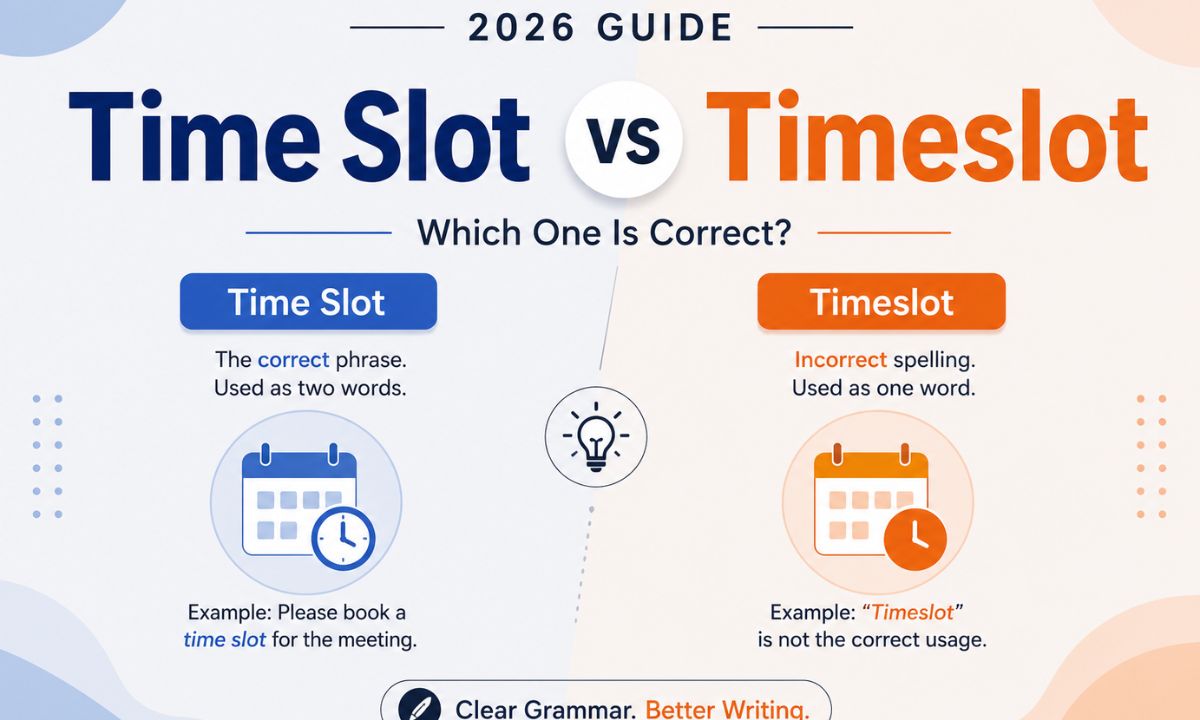
English has many words that create confusion because their spelling changes over time. Time Slot vs Timeslot is one common example. Many writers, marketers, broadcasters, and business professionals wonder whether these two forms mean different things or whether one spelling is incorrect.
The short answer is that both forms refer to a specific period of time reserved for an activity. However, their usage and popularity can vary depending on the context, industry, and style guide.
In this guide, you will learn the meaning of time slot and timeslot, understand the spelling difference, see real-world examples, and discover which version works best in professional writing, scheduling, media, and everyday communication.
Time Slot vs Timeslot What’s the Difference?
Quick Definition (Featured Snippet Answer)
Time slot and timeslot both describe a specific period of time assigned for an event, activity, appointment, or program.
What Does Time Slot Mean?
A time slot is a designated period when something is planned to happen. The phrase is made up of two separate words:
- Time = a measurable period
- Slot = a reserved position or space
Together, time slot means a reserved block of time.
For example:
- A doctor reserves a 30 minute time slot for each patient.
- A company schedules interviews in different time slots.
- A teacher assigns students specific presentation time slots.
The term is commonly used in scheduling, appointments, meetings, calendars, and event planning.
What Does Timeslot Mean?
Timeslot is a closed compound version of the same concept. Instead of writing two separate words, it combines them into one.
It is especially common in industries where scheduling is central, such as:
- Television broadcasting
- Radio programming
- Digital media
- Streaming platforms
- Marketing campaigns
Examples:
- The show received a prime evening timeslot.
- The radio station changed its morning timeslot.
- The streaming service created a new release timeslot.
Although many dictionaries recognize “timeslot,” some style guides still prefer “time slot.”
Time Slot vs Timeslot: Comparison Table
| Feature | Time Slot | Timeslot |
| Spelling | Two words | One word |
| Meaning | A reserved period of time | A reserved period of time |
| Grammar type | Open compound noun | Closed compound noun |
| Common usage | General scheduling | Media and broadcasting |
| Professional acceptance | Widely accepted | Accepted but less universal |
| Example | “Choose a time slot for your appointment.” | “The program has a popular timeslot.” |
Is Time Slot or Timeslot Correct?
Both spellings can be correct depending on context.
However, time slot is usually the safer choice because it is:
- More common in everyday English
- Easier for readers to understand
- Preferred in many professional documents
- Frequently used in scheduling software and calendars
Timeslot is often preferred when discussing:
- Television schedules
- Radio programming
- Entertainment industries
- Media planning
For example:
✅ Correct:
Please select a time slot for your meeting.
✅ Correct:
The television show moved to a later timeslot.
Why Does This Spelling Difference Exist?
The difference comes from how English evolves.
Many English words begin as separate words and later become combined. These are called compound words.
Examples:
| Original Form | Combined Form |
| web site | website |
| on line | online |
| e mail | |
| time line | timeline |
The same pattern applies to words like “timeslot.” Over time, some writers began combining the words into one.
However, not every compound word follows the same timeline. Some remain separate because readers recognize them more easily.
How to Use Time Slot Correctly
Step by Step Guide
Follow these steps when deciding whether to use “time slot”:
Identify the Meaning
Ask yourself:
“Am I talking about a reserved period of time?”
If yes, both forms may work.
Example:
I booked a time slot with my dentist.
Consider Your Audience
For general readers:
Use:
time slot
For media professionals:
Either may work:
The network changed the show’s timeslot.
Follow Your Style Guide
Businesses, universities, and publishers often follow specific writing rules.
Consistency matters more than choosing one form.
Avoid switching between:
- time slot
- timeslot
within the same article or document.
Real Examples of Time Slot vs Timeslot
Business Scheduling Examples
Meetings
Correct:
The manager selected a morning time slot for the client meeting.
Meaning:
A specific period was reserved for the meeting.
Appointments
Correct:
Patients can choose an available time slot online.
Meaning:
The scheduling system provides available periods.
Interviews
Correct:
Each candidate received a 20 minute time slot.
Meaning:
Every person was assigned a specific interview period.
Timeslot Examples in Media
Television
The network moved the drama series to a Friday night timeslot.
Here, “timeslot” refers to a position in a broadcast schedule.
Radio
The presenter has the most popular morning timeslot.
The word describes a scheduled broadcasting period.
Online Content
The company chose a weekly release timeslot for its podcast.
The meaning remains the same: a planned time period.
Common Mistakes When Using Time Slot and Timeslot
Assuming One Spelling Is Always Wrong
Many people believe “timeslot” is incorrect because “time slot” is more familiar.
Reality:
Both forms are used in modern English.
Mixing Both Spellings
Example:
Incorrect style:
The first time slot was full, but the second timeslot was available.
The meaning is clear, but the writing looks inconsistent.
Better:
The first time slot was full, but the second time slot was available.
Using Timeslot in Formal General Writing
In business emails, reports, and academic writing, “time slot” is usually the clearer choice.
Example:
Better:
Please select an available time slot.
Instead of:
Please select an available timeslot.
Benefits of Using the Correct Form
Choosing the right spelling improves:
Professional Communication
Correct terminology makes emails, reports, and documents appear polished.
Reader Understanding
Common spelling reduces confusion.
Search Visibility
For online content, using both variations naturally helps search engines understand topic relevance.
Brand Consistency
Companies benefit from using consistent language across:
- Websites
- Marketing materials
- Scheduling tools
- Customer messages
Best Practices for Writers and Businesses
Use “Time Slot” for General Communication
Recommended:
- Emails
- Reports
- Customer service messages
- Appointment systems
- Workplace documents
Example:
Your consultation time slot has been confirmed.
Use “Timeslot” for Media Contexts
Recommended:
- Television schedules
- Radio programs
- Entertainment discussions
Example:
The show earned strong ratings in its new timeslot.
Check Audience Expectations
Different industries develop different language habits.
A broadcaster may naturally write “timeslot,” while a healthcare provider may prefer “time slot.”
Expert Tips for Choosing Between Time Slot and Timeslot
- Choose clarity over trends.
The easiest spelling for readers is usually the best option. - Match industry language.
Follow common usage in your field. - Stay consistent.
Pick one form and use it throughout your content. - Consider search intent.
Online articles can mention both forms because users search for both spellings. - Avoid forced keyword placement.
Natural language creates better reader experiences.
Pros and Cons
Time Slot
Pros
- Most widely understood
- Professional and clear
- Works in almost every situation
- Preferred for general writing
Cons
- Less common in some media industries
- Takes slightly more space when writing
Timeslot
Pros
- Common in broadcasting
- Modern compound-word style
- Shorter visual form
Cons
- Some readers may consider it less standard
- Not preferred by all style guides
Myths vs Facts
| Myth | Fact |
| Timeslot is always wrong | Timeslot is accepted in many contexts |
| Time slot and timeslot have different meanings | They usually mean the same thing |
| Only broadcasters can use timeslot | Other industries may use it too |
| English spelling never changes | Compound words often evolve over time |
Latest Usage Trends in 2026
Language continues to become more flexible as digital communication grows.
In 2026:
- “Time slot” remains the dominant general purpose spelling.
- “Timeslot” continues to appear frequently in media and entertainment.
- Digital scheduling platforms mostly use “time slot.”
- Search engines understand both variations as closely related terms.
For SEO writers, the best strategy is not to force one spelling but to naturally cover both forms.
How Time Slots Work in Real World Scheduling
A time slot works by dividing a larger period into smaller, organized blocks. These blocks help people and organizations manage activities efficiently.
Common examples include:
- Online appointment booking
- Calendar applications
- Event registration systems
- Airline and hotel reservations
- Customer support scheduling
Time Slot vs Timeslot in Different Industries
The preferred spelling often depends on the industry.
Healthcare
Healthcare organizations usually use time slot.
Example:
Please choose an available time slot for your medical consultation.
Why?
Because healthcare communication focuses on clarity and accessibility.
Education
Schools and universities commonly use time slot.
Examples:
- Exam time slots
- Class time slots
- Presentation time slots
Example sentence:
Students must select a presentation time slot before Friday.
Business and Corporate Settings
Companies generally prefer time slot.
Common phrases include:
- meeting time slot
- interview time slot
- appointment time slot
- available time slot
Example:
I reserved a time slot for our strategy meeting.
Television and Broadcasting
Media companies often use timeslot.
Examples:
- prime time timeslot
- evening timeslot
- weekend timeslot
Example:
The channel moved the series to a better evening timeslot.
Marketing and Advertising
Both forms appear.
Advertisers may discuss:
- campaign time slots
- advertising timeslots
- promotional schedules
Example:
The brand purchased an advertising time slot during the event.
Numbered Guide: How to Choose Between Time Slot and Timeslot
- Identify the context.
Decide whether you are discussing general scheduling or media programming. - Use “time slot” for everyday communication.
It is the safest choice for most audiences. - Use “timeslot” when discussing broadcasting.
It fits naturally with TV and radio scheduling. - Follow your organization’s writing style.
Consistency improves professionalism. - Review the final document.
Make sure the same spelling appears throughout.
Quick Answer Section
Is “time slot” one word or two?
The standard spelling is usually two words: time slot. The combined form timeslot is also used, especially in broadcasting and media contexts. Both refer to a specific period reserved for an event, activity, or program.
Featured Snippet Bullet List: Key Differences
- Time slot is the more common general spelling.
- Timeslot is often used in television and media industries.
- Both terms describe a scheduled period.
- Consistency matters more than choosing one spelling.
- “Time slot” is usually the safest option for professional writing.
Example for a Scheduling Website
Better:
Customers can select a convenient time slot using our online booking system.
Why?
The audience expects simple and familiar language.
Example for a Television Article
Better:
The show achieved record ratings after moving to a new prime-time timeslot.
Why?
Media audiences commonly recognize this usage.
Common Questions Writers Ask
Should SEO content include both time slot and timeslot?
Yes, but naturally.
Search engines understand that both terms are closely related. A helpful article can mention both variations without repeating them unnecessarily.
Example:
A time slot (sometimes written as timeslot) refers to a reserved period for an activity.
This helps users who search using either spelling.
Does Google consider time slot and timeslot different keywords?
Google generally understands related word variations and user intent. However, including both forms naturally can help your content match a wider range of searches.
The goal should always be usefulness, not keyword repetition
Frequently Asked Questions (FAQs)
What is the difference between time slot and timeslot?
The main difference is spelling and usage preference. “Time slot” is more common in general writing, while “timeslot” appears frequently in broadcasting, television, and media discussions.
Is time slot the correct spelling?
Yes, “time slot” is the widely accepted and commonly recommended spelling. It works well in professional communication, scheduling systems, business documents, and everyday conversations.
Is timeslot a real word?
Yes, timeslot is a recognized compound word used in modern English. It is especially common in industries related to television, radio, and entertainment. While some writers still prefer “time slot,” the one word version is widely understood and used.
Should I write time slot or timeslot in a business email?
In most business emails, “time slot” is the better choice. It looks professional, follows common writing practices, and avoids confusion.
Why do TV networks use the word timeslot?
Television networks often use “timeslot” because programs compete for specific positions in a broadcast schedule. A prime timeslot can influence audience size, advertising revenue, and a show’s success.
Can I use both time slot and timeslot in the same article?
Yes, but use them carefully. Choose one primary spelling and use the other only when it naturally fits the context. For example, a scheduling article may mainly use “time slot” while explaining that broadcasters often use “timeslot.”
Conclusion
Understanding Time Slot vs Timeslot helps writers create clearer and more professional content. Both spellings describe a reserved period for an activity, appointment, or program, but their usage differs slightly. “Time slot” remains the safest and most widely accepted option for everyday communication, while “timeslot” is common in broadcasting and entertainment.
The best choice depends on your audience, industry, and writing style. Focus on consistency, clarity, and natural language rather than simply choosing one spelling.
Use the right form in your content, emails, and business communication to improve readability and professionalism.