

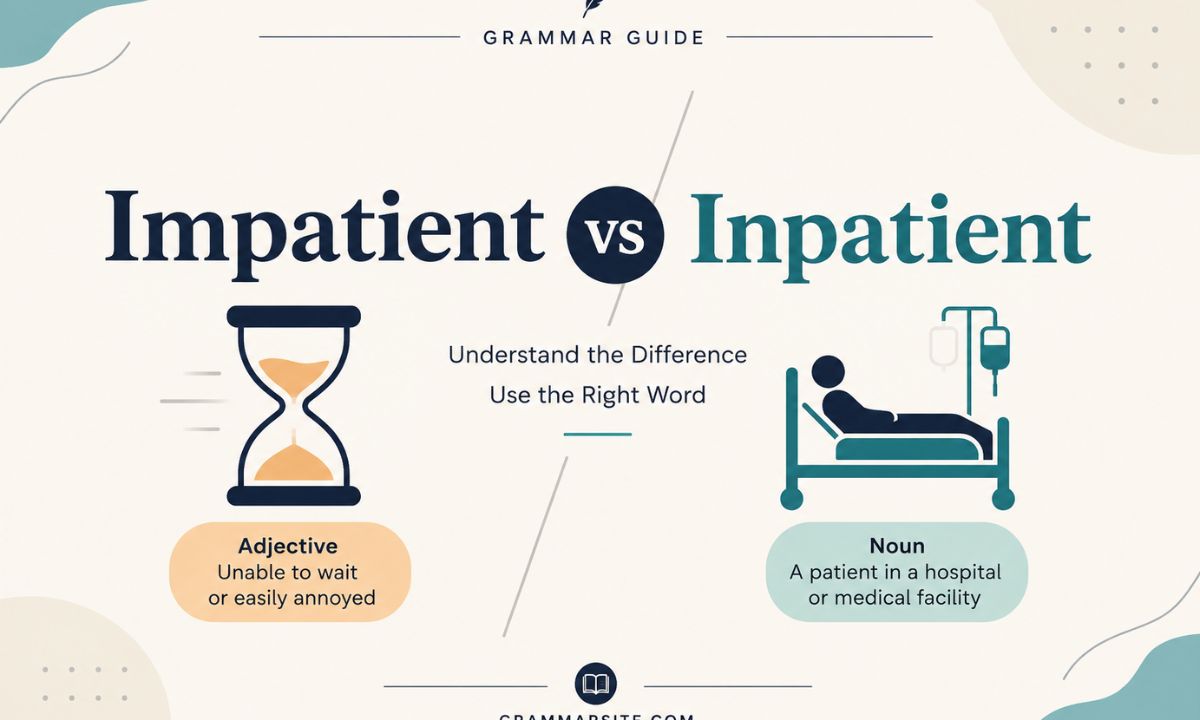
Many English learners confuse impatient vs inpatient because the words look almost identical. However, they have completely different meanings. One describes a person’s feelings, while the other refers to a patient receiving medical treatment in a hospital.
Using the wrong word can completely change the meaning of your sentence. This guide explains the difference between impatient vs inpatient with simple definitions, comparison tables, examples, grammar tips, common mistakes, and memory tricks so you’ll never mix them up again.
Although only one letter separates these words, they belong to entirely different contexts.
- Impatient relates to emotions and behavior.
- Inpatient relates to hospitals and healthcare.
Understanding this distinction will instantly improve your English writing and speaking.
Quick Answer: impatient vs inpatient
| Word | Meaning | Used For |
| Impatient | Unable to wait calmly | Feelings and emotions |
| Inpatient | A person admitted to a hospital for treatment | Medical settings |
Example
✅ She became impatient after waiting for an hour.
✅ The doctor examined the inpatient before surgery.
Why People Confuse It
These two words are frequently confused because:
- They differ by only one letter.
- Their pronunciation is very similar.
- Both contain the word patient.
- Autocorrect sometimes replaces one with the other.
- Fast typing often causes spelling errors.
However, their meanings have absolutely nothing in common.
What Does Impatient Mean?
Meaning
Impatient is an adjective that describes someone who becomes annoyed, restless, or frustrated because something is taking too long.
Someone who is impatient dislikes waiting.
Dictionary style definition
Feeling annoyed because something is happening too slowly.
Examples
- I became impatient after waiting thirty minutes.
- The children grew impatient before dinner.
- She was impatient to receive the exam results.
- He looked impatient during the meeting.
- Customers became impatient because of the long line.
Notice that every example talks about emotions not hospitals.
What Does Inpatient Mean?
An inpatient is a patient who stays in a hospital for medical care, usually overnight or longer.
Unlike an outpatient, an inpatient is officially admitted to the hospital.
Definition
A hospital patient who receives treatment while staying in the hospital.
Examples
- The inpatient remained in the hospital for five days.
- Doctors visited every inpatient during morning rounds.
- The nurse checked each inpatient carefully.
- She became an inpatient after surgery.
- The hospital admitted several inpatients overnight.
- Every inpatient receives meals.
Unlike impatient, every example here relates to healthcare.
Impatient vs Inpatient Comparison Table
| Feature | Impatient | Inpatient |
| Part of Speech | Adjective | Noun (also adjective in healthcare) |
| Meaning | Unable to wait calmly | Hospital patient staying overnight |
| Context | Everyday conversations | Medical settings |
| Emotion? | Yes | No |
| Hospital Related? | No | Yes |
| Example | She became impatient. | The inpatient was discharged today. |
When to Use: impatient vs inpatient
Use Impatient when:
- Talking about waiting.
- Describing emotions.
- Explaining frustration.
- Discussing someone’s attitude.
- Mentioning excitement that makes waiting difficult.
Examples:
- He became impatient.
- We are impatient for results.
- She sounded impatient.
Use Inpatient when:
- Talking about hospitals.
- Referring to medical treatment.
- Discussing healthcare.
- Mentioning hospital admission.
- Comparing inpatient and outpatient services.
Examples:
- The inpatient received medication.
- Every inpatient has a hospital room.
- She was admitted as an inpatient.
Examples
Impatient
Correct examples:
- The children became impatient before lunch.
- He was impatient with the slow computer.
- I grew impatient waiting for the train.
- They seemed impatient during the speech.
- She is too impatient to wait quietly.
- Customers became impatient in the queue.
- We were impatient for the announcement.
- Don’t become impatient so quickly.
Inpatient
Correct examples:
- The inpatient recovered quickly.
- Every inpatient receives daily care.
- Nurses checked the inpatient’s condition.
- He remained an inpatient for one week.
- The doctor discharged the inpatient yesterday.
- She became an inpatient after the accident.
- Insurance covered inpatient treatment.
Common Mistakes of impatient vs inpatient
Because impatient and inpatient differ by only one letter, many writers accidentally substitute one for the other. These mistakes are especially common in emails, academic writing, healthcare documents, and online posts. Learning to recognize these errors will help you write more accurately.
Here are some of the most common mistakes and their corrections.
Incorrect:
❌ I became inpatient after waiting for two hours.
✅ Correct: I became impatient after waiting for two hours.
Why?
The sentence describes a feeling of frustration while waiting, not someone staying in a hospital.
Incorrect:
❌ The doctor admitted an impatient after surgery.
✅ Correct: The doctor admitted an inpatient after surgery.
Why?
The person is receiving hospital care, so inpatient is the correct medical term.
Incorrect:
❌ She was very inpatient because the bus was late.
✅ Correct: She was very impatient because the bus was late.
Why?
A delayed bus causes impatience, not hospital admission.
Incorrect:
❌ Every impatient receives meals three times a day.
✅ Correct: Every inpatient receives meals three times a day.
Why?
Hospital patients are called inpatients.
Grammar Rule Behind the Difference of impatient vs inpatient
Although these words look similar, they belong to different categories of English.
| Word | Grammar Role | Meaning |
| Impatient | Adjective | Describes a person’s emotion |
| Inpatient | Noun (sometimes adjective in healthcare) | Refers to a hospitalized patient |
Examples
Impatient (Adjective)
- She is impatient.
- They became impatient.
- We felt impatient.
Inpatient (Noun)
- The inpatient recovered quickly.
- Nurses examined every inpatient.
- Doctors discharged the inpatient.
Memory Trick
A simple memory trick can help you remember the difference forever.
Remember the Letter “M”
IMpAtient
The letter M reminds you of Mood.
If the sentence is about someone’s emotions, use impatient.
Example:
She became impatient while waiting.
Remember the Word IN
INpatient
Think of someone staying IN the hospital.
If the person stays inside the hospital overnight, they are an inpatient.
Example:
He remained an inpatient for five days.
One-Minute Memory Rule
Emotion = Impatient
Hospital = Inpatient
That’s all you need to remember.
American vs British English
One common question is whether American and British English use these words differently.
The answer is No.
Both varieties of English use impatient and inpatient in exactly the same way.
| American English | British English |
| impatient | impatient |
| inpatient | inpatient |
Examples work in both styles.
American English:
The impatient customer complained.
British English:
The impatient customer complained.
American English:
She became an inpatient after surgery.
British English:
She became an inpatient after surgery.
There is no spelling difference.
Similar Words
Many learners also confuse these related words.
| Word | Meaning |
| Patient | Calm while waiting OR a person receiving medical care |
| Impatient | Unable to wait calmly |
| Inpatient | Patient admitted to a hospital |
| Outpatient | Patient treated without staying overnight |
| Patience | The ability to wait calmly |
Patient vs Impatient
These are opposites.
Patient
Someone who stays calm while waiting.
Examples
- She is patient.
- Be patient.
- The teacher is patient with students.
Impatient
Someone who dislikes waiting.
Examples
- He became impatient.
- We were impatient for the results.
- The children looked impatient.
Inpatient vs Outpatient
These words are frequently used together in hospitals.
| Inpatient | Outpatient |
| Stays overnight | Goes home the same day |
| Hospital admission required | No overnight stay |
| Serious treatment | Minor treatment or checkups |
| Room provided | No hospital room |
Inpatient Example
The patient stayed in the hospital for three nights.
Outpatient Example
The patient visited the clinic and returned home the same afternoon.
Real Life Examples of impatient vs inpatient
Understanding these words becomes much easier when you see them in everyday situations.
At the Airport
❌ Incorrect
The passengers became inpatients because their flight was delayed.
✅ Correct
The passengers became impatient because their flight was delayed.
At School
The students became impatient waiting for the exam results.
At a Restaurant
Customers grew impatient because their food arrived late.
At a Hospital
The inpatient received medication every four hours.
During Surgery
The inpatient remained under observation overnight.
During Traffic
Drivers became impatient because of the traffic jam.
Workplace Examples
Correct
The manager became impatient after several delays.
Correct
The company provides excellent care for every inpatient at its medical center.
Academic Examples
Students often write these sentences incorrectly.
Correct versions include:
- I became impatient while waiting for my grades.
- The hospital admitted twenty new inpatients.
- Doctors examined every inpatient carefully.
- Parents became impatient outside the classroom.
Business Examples
Businesses also use these words differently.
Impatient
- Customers became impatient due to slow customer service.
- Investors grew impatient after months without progress.
- The client sounded impatient during the meeting.
Inpatient
Healthcare companies commonly use terms like:
- inpatient services
- inpatient care
- inpatient rehabilitation
Professional Writing Tips
To avoid confusion in formal writing:
- Ask yourself whether you’re talking about a feeling or medical care.
- If it’s an emotion, choose impatient.
- If it’s a hospital patient, choose inpatient.
- Proofread carefully because spell checkers may not catch this mistake.
- In medical writing, pair inpatient with words like ward, admission, treatment, or care.
- In general writing, pair impatient with words like waiting, delay, frustrated, or restless.
Quick Practice of impatient vs inpatient
Choose the correct word.She became after standing in line for an hour.
We were for the concert to begin.
✅ Answer: impatient
The hospital hired more nurses for every.
✅ Answer: inpatient
Quick Recap Table of impatient vs inpatient
| Situation | Correct Word |
| Waiting too long | Impatient |
| Feeling frustrated | Impatient |
| Staying overnight in a hospital | Inpatient |
| Receiving hospital treatment | Inpatient |
| Talking about emotions | Impatient |
| Talking about healthcare | Inpatient |
Final Verdict of impatient vs inpatient
Although impatient and inpatient look almost identical, they have completely different meanings and should never be used interchangeably.
- Impatient describes a person’s feelings when they are unable to wait calmly.
- Inpatient refers to someone who is admitted to a hospital for treatment, usually staying overnight or longer.
Whenever you’re unsure which word to use, think about the context:
- If you’re talking about emotions, waiting, frustration, or excitement, choose impatient.
- If you’re talking about hospitals, doctors, treatment, or medical care, choose inpatient.
Mastering this small difference will make your writing clearer, more professional, and grammatically accurate.
Remember This
✔ Impatient = Emotion + Waiting
✔ Inpatient = Inside the Hospital
One Line Memory Trick
If you’re waiting, you’re probably impatient. If you’re staying in a hospital, you’re an inpatient.
Frequently Asked Questions (FAQs)
Is impatient the opposite of patient?
Yes. Impatient is the opposite of patient.
A patient person remains calm while waiting, whereas an impatient person becomes annoyed or frustrated when things take too long.
Examples
- She is very patient with children.
- He became impatient after waiting for an hour.
What does inpatient mean in healthcare?
In healthcare, an inpatient is a patient who is formally admitted to a hospital and stays there overnight or for several days to receive treatment, surgery, or medical observation.
Example
The hospital admitted the patient as an inpatient after emergency surgery.
Can inpatient be an adjective?
Yes. Although inpatient is most commonly used as a noun, it can also function as an adjective in medical contexts.
Examples
- inpatient treatment
- inpatient services
- inpatient rehabilitation
- inpatient care
- inpatient department
Which word refers to waiting?
Impatient is the correct word when talking about waiting.
Examples include:
- impatient customers
- impatient drivers
- impatient children
- impatient employees
It has nothing to do with hospitals.
Is an outpatient the same as an inpatient?
No.
An inpatient stays in the hospital for treatment, while an outpatient receives medical care without staying overnight.
| Inpatient | Outpatient |
| Admitted to hospital | Visits hospital or clinic |
| Stays overnight | Goes home the same day |
| Usually serious treatment | Usually routine treatment |
Why are impatient and inpatient often confused?
People confuse these words because:
- They differ by only one letter.
- They sound similar when spoken quickly.
- Both contain the word patient.
- Typing errors and autocorrect can replace one with the other.
Despite their similar spelling, their meanings are completely unrelated.
Can I say “I am inpatient”?
No. In most situations, “I am inpatient” is incorrect.
If you mean you’re tired of waiting, say:
✅ I am impatient.
You would only use inpatient if you are referring to your status as a hospital patient.
Example:
I am an inpatient at the local hospital.
Conclusion
The difference between impatient and inpatient is simple once you understand the context.
Use impatient when describing someone’s emotions, especially frustration caused by waiting. Use inpatient when referring to a patient who stays in a hospital for treatment.
Although they differ by just one letter, choosing the correct word helps you communicate clearly and avoids misunderstandings in both everyday conversations and professional writing. Whenever you pause to decide between these two words, remember whether you’re talking about feelings or healthcare that single distinction will guide you to the correct choice every time.