

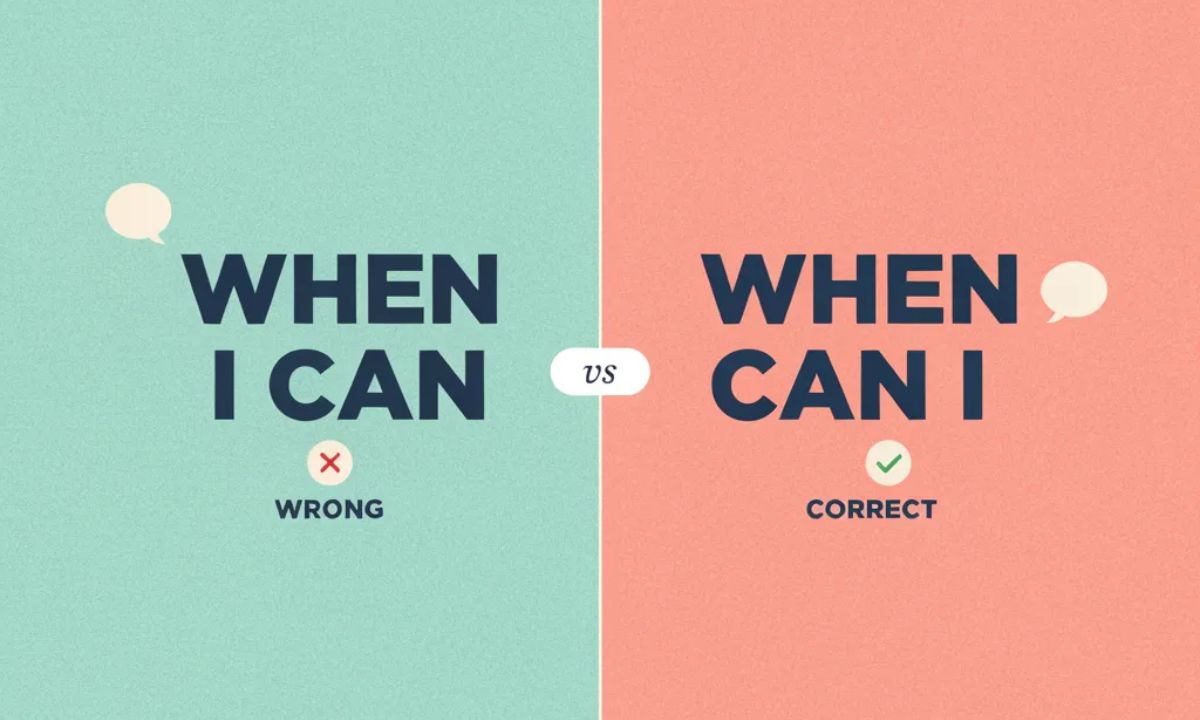
Have you ever wondered whether you should say “When I can” or “When can I”? You are not alone. Many English learners search for this grammar question because both phrases look similar, yet they have different meanings and uses. Using the wrong one can make your sentence sound unnatural or grammatically incorrect.
Simply put, “When I can” is a clause that describes the time when something is possible. In contrast, “When can I” is a direct question that asks about the right or possible time to do something.
Understanding the difference helps you speak and write English more naturally. Whether you are chatting with friends, writing emails, attending school, or speaking at work, knowing when to use each phrase improves your confidence.
Keep reading with us because this guide explains everything in simple English with clear examples, practical tips, and common mistakes to avoid in 2026.
What Is “When I Can or When Can I”?
Simple Definition
When I can is a dependent clause. It means at the time when I am able to do something.
When can I is a question. It asks at what time or under what conditions I am allowed or able to do something.
Meaning
Although these expressions contain the same words, they serve different purposes.
- When I can tells the reader or listener about your ability or availability.
- When can I asks for information about the correct or possible time.
Real-Life Examples
When I can
- I will call you when I can.
- I’ll finish the report when I can.
- I’ll visit my grandparents when I can.
When can I
- When can I leave the office?
- When can I start the project?
- When can I use your laptop?
Who Uses These Expressions?
These phrases are common among:
- English learners
- Students
- Teachers
- Office workers
- Travelers
- Professionals
- Anyone speaking or writing English
Because they appear in daily conversations, emails, and messages, learning the correct usage is important.
Why “When I Can or When Can I” Is Important in 2026
English communication continues to grow in importance in 2026. People use English every day on social media, at work, in online classes, and during international communication. Therefore, using grammar correctly creates a better impression.
Better Communication
Using when I can and when can I correctly helps people understand your message immediately. As a result, conversations become smoother and clearer.
Social Media and Messaging
People frequently write messages like:
- I’ll reply when I can.
- When can I join the meeting?
- I’ll upload the video when I can.
These expressions appear daily on WhatsApp, Instagram, Facebook, LinkedIn, and other platforms.
Professional Writing
Correct grammar matters in business emails and workplace communication.
For example:
❌ I’ll send it when can I.
✅ I’ll send it when I can.
Similarly:
❌ I don’t know when can I start.
✅ I don’t know when I can start.
Academic Writing
Students often confuse these phrases in essays and exams. Learning the difference helps improve writing scores and speaking confidence.
Voice Search Growth
More people now ask virtual assistants questions like:
- When can I renew my passport?
- When can I apply for college?
- When can I travel abroad?
Because voice search is growing, understanding question structures is more useful than ever.
How to Use “When I Can or When Can I”
The easiest way to remember the difference is to ask yourself one question:
Am I asking a question, or am I giving information?
If you are asking a question, use When can I.
If you are giving information, use When I can.
Check Whether You Are Asking
If the sentence needs a question mark, use When can I.
Examples:
- When can I enter?
- When can I pay?
- When can I call you?
Notice that the helping verb can comes before I because it is a question.
Check Whether You Are Giving Information
If you are telling someone about your future action or ability, use When I can.
Examples:
- I’ll help you when I can.
- I’ll answer when I can.
- I’ll travel when I can.
Here, when I can explain the time when something becomes possible.
Use “When I Can” After Another Clause
This phrase usually follows another idea.
Examples:
- I’ll reply when I can.
- I’ll finish the work when I can.
- I’ll visit you when I can.
The sentence is complete because another clause comes first.
Use “When Can I” to Ask for Permission or Time
This phrase starts many everyday questions.
Examples:
- When can I see the doctor?
- When can I submit my assignment?
- When can I receive my order?
- When can I meet you?
The speaker wants information.
Grammar Rule
Question:
When + can + I + verb
Example:
- When can I leave?
Statement:
Main clause + when + I + can + verb
Example:
- I’ll leave when I can.
This simple rule helps you avoid most grammar mistakes.
Where Is “When I Can or When Can I” Used?
These expressions appear in many everyday situations.
At School
Students ask:
- When can I submit my homework?
- When can I take the test?
Teachers reply:
- Submit it when you can.
- Finish it when you can.
At Work
Employees often say:
- I’ll complete the report when I can.
- I’ll respond when I can.
Managers ask:
- When can I expect the final report?
During Travel
Travelers ask questions such as:
- When can I board the plane?
- When can I check into the hotel?
In Daily Conversations
Friends frequently say:
- I’ll call you when I can.
- I’ll visit when I can.
- When can I come over?
- When can I meet you?
Online Communication
Whether you send emails, text messages, or social media replies, these phrases appear regularly.
Examples include:
- I’ll answer when I can.
- When can I join the live session?
- When can I download the file?
- I’ll upload the photos when I can.
Understanding these patterns makes your English sound natural and fluent.
Daily Examples of “When I Can” or “When Can I”
Using these expressions in everyday conversations helps you remember the correct grammar. Here are some common situations where people naturally use when I can or when can I.
Talking to a Friend
When can I come to your house?
This is a question because you are asking for the right time to visit.. Replying to a Message
I’ll reply when I can because I’m busy right now.
Here, you are giving information about when you will respond.
At School
When can I submit my assignment?
Students often ask this question to know the deadline or allowed time.
At Work
I’ll finish the presentation when I can.
This sentence tells someone that you will complete the task as soon as possible.
While Traveling
When can I check into the hotel?
Travelers use this question to ask about the check-in time.
These simple examples show that when can I asks a question, while when I can provides information.
Common Mistakes People Make
Many English learners confuse these two expressions because they contain the same words. However, understanding the grammar makes them much easier to use.
Using “When Can I” in a Statement
❌ I’ll call you when can I.
✅ I’ll call you when I can.
Correction: Use when I can after a main clause.
Using “When I Can” as a Question
❌ When I can leave?
✅ When can I leave?
Correction: Questions require the helping verb before the subject.
Forgetting the Question Mark
❌ When can I start
✅ When can I start?
Correction: Every direct question should end with a question mark.
Mixing Word Order
❌ I don’t know when can I arrive.
✅ I don’t know when I can arrive.
Correction: In indirect questions, use normal statement word order.
Translating Directly from Your Native Language
Many learners translate sentences word for word. English grammar follows different word order, so always check whether your sentence is a question or a statement before choosing the correct phrase.
Difference Between “When I Can” and “When Can I”
| Feature | When I Can | When Can I |
| Sentence Type | Clause | Direct Question |
| Purpose | Gives information | Asks for information |
| Word Order | I + can | Can + I |
| Ends with Question Mark | No | Yes |
| Example | I’ll help when I can. | When can I help? |
The easiest way to remember the difference is this:
When I can = Statement
When can I = Question
Structure:
Question word + auxiliary verb + subject + main verb
For questions beginning with “when can I,” the pattern is:
When + can + I + base verb?
Swap Words for Extra Finesse
Instead of always using “when can I,” try these alternatives depending on the situation.
| Direct | Softer Alternative |
| When can I call you? | When would be a good time to call you? |
| When can I start? | When would you like me to start? |
| When can I visit? | Would it be possible to visit sometime this week? |
| When can I expect a reply? | Could you let me know when I should expect a reply? |
| When can I schedule the meeting? | Would there be a convenient time to schedule the meeting? |
These alternatives sound more collaborative because they consider the other person’s availability instead of focusing only on your own.
Workplace Example
Imagine you’ve completed a training course and are waiting for your manager’s approval.
Too direct
When can I begin working independently?
Professional
Could you let me know when I can begin working independently?
Very polite
Whenever you think I’m ready, I’d appreciate knowing when I can begin working independently..
Test Yourself – Mini Quiz
Choose the correct answer.
Which sentence is a correct direct question?
A. When I can submit the report?
B. When can I submit the report?
C. When can submit I the report?
Answer: B
Which sentence is an indirect question?
A. When can I leave?
B. Could you tell me when I can leave?
C. Can when I leave?
Answer: B
Which sentence sounds the most polite?
A. When can I have the documents?
B. Could you tell me when I can have the documents?
C. I was wondering when I might be able to receive the documents.
Answer: C
Which sentence is grammatically incorrect?
A. Do you know when I can start?
B. When can I start?
C. Do you know when can I start?
Answer: C
Complete the sentence:
Please let me know _________.
A. when can I arrive
B. when I can arrive
Answer: B
Remember: indirect questions do not use inversion.
Subtle Differences: Nuance, Tone, and Formality
Although “when can I” and “when I can” contain the same words, they serve different grammatical purposes and create different impressions.
“When Can I” The Tone of Proactivity
“When can I” is used in direct questions where the speaker actively seeks permission, timing, or opportunity.
Examples:
- When can I start?
- When can I call you?
- When can I apply?
- When can I expect the package?
The tone is:
- Direct
- Clear
- Proactive
- Confident
- Suitable for everyday conversations
This expression works well when you need a straightforward answer.
“When I Can” The Tone of Limitation
“When I can” usually appears inside statements or indirect questions rather than standing alone.
Examples:
- I’ll call you when I can.
- I’ll visit when I can.
- I’m not sure when I can finish the project.
- Could you tell me when I can begin?
Its tone often suggests:
- Uncertainty
- Limited availability
- Dependence on circumstances
- Flexibility
Compare:
When can I call you?
(I’m asking for a suitable time.)
vs.
I’ll call you when I can.
(I’ll call once I’m able, but I don’t know exactly when.)
This subtle distinction is important because “when can I” seeks information, while “when I can” often expresses the speaker’s ability or future intention. Understanding this difference helps you choose the right phrase for both accurate grammar and the tone you want to convey.
Frequently Asked Questions (FAQs)
What is the difference between “When I can” and “When can I”?
When I can is used in statements to describe the time when something becomes possible. When can I is used to ask a direct question about the right or possible time to do something.
Is “When can I” grammatically correct?
Yes. When can I is completely correct when you are asking a question. It follows the standard English question structure with the helping verb before the subject.
Can I use “When I can” by itself?
Usually, no. When I can normally follows another clause, such as “I’ll call you when I can.” It completes the idea rather than standing alone.
Why do English learners confuse these phrases?
The words are the same, but their order changes depending on whether the sentence is a statement or a question. This difference often causes confusion for beginners.
Where is “When can I” commonly used?
People use when can I in schools, workplaces, travel situations, online meetings, customer support, and daily conversations whenever they need to ask about timing or permission.
Is “When I can” common in everyday English?
Yes. Native English speakers use when I can every day in conversations, emails, text messages, and social media to explain when they will complete an action.
Which phrase should I use in formal writing?
Both are correct when used in the right context. Use when can I for direct questions and when I can within statements or indirect questions.
People Also Search For
Is “When I can” correct in English?
Yes. It is correct when used as part of a statement or dependent clause.
Can I say “When can I” in an email?
Yes. It is appropriate in both formal and informal emails when asking about timing or permission.
What grammar rule explains “When I can”?
It follows normal statement word order because it functions as a dependent clause.
Is “When can I” an indirect question?
No. It is a direct question. In indirect questions, the correct form becomes when I can.
How can I remember the difference easily?
Remember this simple rule: Questions use “When can I.” Statements use “When I can.”
Conclusion
Understanding the difference between when I can and when can I is easier than it first appears. Although the phrases contain the same words, they have different purposes. When I can gives information about the time you are able to do something, while when can I asks a direct question about the right or possible time.
As you continue learning English, practice these expressions in everyday conversations, emails, text messages, and workplace communication. The more you use them, the more natural they will become.
In 2026, clear English communication is more valuable than ever because people connect through online meetings, social media, international business, and voice search. Using when I can and when can I correctly will improve your grammar, boost your confidence, and help you communicate more effectively in every situation.
Keep practicing these simple grammar patterns, and you’ll avoid one of the most common English mistakes while speaking and writing with greater accuracy and confidence.