

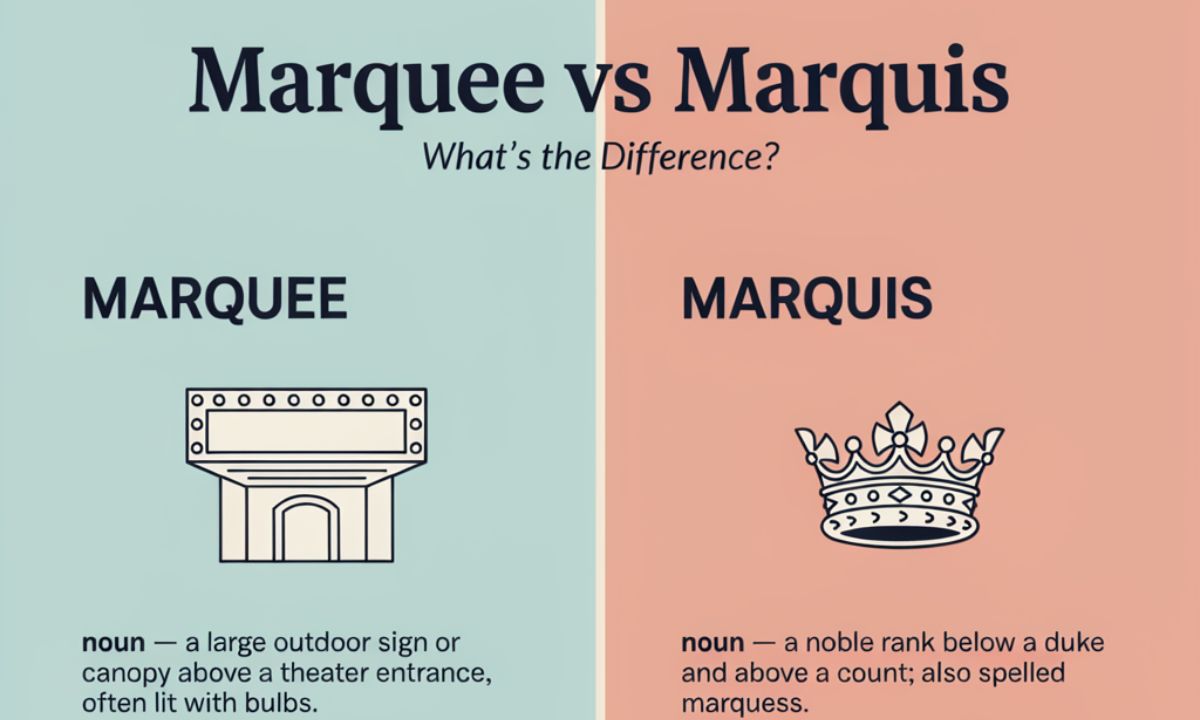
Many English learners confuse marquee vs marquis because the two words look almost identical. However, they have completely different meanings and are never interchangeable. Marquee usually refers to a large tent used for events or, in American English, the canopy above a theater entrance. Marquis, on the other hand, is a noble title that ranks below a duke and above an earl in the British peerage system. Understanding the distinction will help you use both words correctly in writing and conversation.
What Does Marquee Mean?
Marquee
A marquee has two common meanings depending on the variety of English being used.
In British English, a marquee is a large tent designed for outdoor events such as weddings, festivals, trade shows, and corporate gatherings. These temporary structures provide shelter while allowing events to take place in open spaces.
In American English, a marquee is the covered structure or canopy above the entrance of a theater, cinema, hotel, or other public building. It often displays the name of the venue, movie, performance, or special event.
The word can also appear as an adjective, especially in business, entertainment, and sports. A marquee event, marquee player, or marquee attraction refers to something exceptionally important, famous, or capable of drawing large audiences.
The word marquee comes from the French word marquise, which originally referred to a large military tent. Over time, English adopted the term, and its meaning expanded to include event tents and theater canopies.
Examples of Marquee
The couple celebrated their wedding in a beautifully decorated marquee overlooking the lake.
Heavy rain did not interrupt the festival because everyone gathered inside the marquee.
The theater’s glowing marquee displayed the title of the new Broadway musical.
Organizers rented a large marquee to accommodate more than five hundred guests.
What Does Marquis Mean?
Marquis
A marquis is a male noble holding a hereditary rank in several European systems of nobility. In the British peerage, a marquis ranks below a duke and above an earl. Historically, marquises governed border territories known as marches, which required military leadership and administrative authority.
The title has existed for centuries and appears frequently in history books, literature, biographies, and discussions of European aristocracy.
The feminine form of marquis is usually marchioness in British usage. In French contexts, the feminine title is marquise.
The word originates from the Old French marquis, which developed from marche, meaning “frontier” or “borderland.” This historical connection explains why many early marquises were responsible for defending frontier regions.
Examples of Marquis
The Marquis welcomed distinguished guests to his country estate.
The king rewarded the loyal soldier by making him a Marquis.
Historians studied the influence of the Marquis during the medieval period.
The novel follows the political struggles of a young Marquis and his family.
Marquee vs Marquis Key Differences
Although marquee and marquis differ by only one letter, they represent entirely different ideas. One refers to a structure or a high profile attraction, while the other refers to a noble title. Because they are pronounced similarly in some accents, many writers accidentally use one in place of the other. However, choosing the wrong word can completely change the meaning of a sentence.
A simple way to remember the distinction is to think about the context. If you’re discussing events, weddings, theaters, sports, or entertainment, you almost certainly need marquee. If you’re talking about royalty, aristocracy, European history, or noble families, the correct word is marquis.
Another reason for confusion is that both words originated from French. Despite their shared linguistic roots, their meanings evolved in completely different directions. Today, they belong to separate vocabulary categories and should never be treated as synonyms.
Marquee vs Marquis
| Feature | Marquee | Marquis |
| Part of Speech | Noun; sometimes adjective | Noun |
| Meaning | A large event tent, a theater canopy, or something highly important | A male noble ranking below a duke and above an earl |
| Common Contexts | Weddings, festivals, theaters, entertainment, sports, business | History, royalty, aristocracy, literature, genealogy |
| American English | Commonly means the sign or canopy above a theater entrance | Used mainly in historical discussions |
| British English | Commonly means a large temporary tent for outdoor events | Official noble title in the British peerage |
| Can It Be an Adjective? | Yes | No |
| Plural Form | Marquees | Marquises |
| Common Mistake | Using it when referring to a noble title | Using it when referring to a tent or theater sign |
The Core Difference
The easiest way to distinguish these words is by asking yourself what you’re describing.
Use marquee when referring to:
- A temporary event tent
- A theater or cinema canopy
- Something prestigious or headline worthy
Use marquis when referring to:
- A hereditary nobleman
- A historical or royal title
- European aristocracy
The meanings never overlap, so there is no situation where one can replace the other.
American vs. British Usage
Understanding regional differences can make these words even easier to remember.
In British English, marquee almost always refers to a large tent used for weddings, garden parties, exhibitions, festivals, and outdoor celebrations. If someone in the UK says they hired a marquee, they mean they rented a temporary event tent.
In American English, marquee most commonly refers to the illuminated canopy or sign above the entrance of a theater, cinema, or hotel. It displays the names of movies, performances, concerts, or special events. Americans also frequently use marquee as an adjective in phrases such as marquee player, marquee matchup, or marquee event.
By contrast, marquis has virtually the same meaning in both American and British English. It always refers to a noble rank and is primarily encountered in historical writing, biographies, and literature rather than everyday conversation.
Common Mistakes People Make
Because the spellings are nearly identical, many writers accidentally swap these words. Here are some of the most common errors.
❌ The wedding was held in a marquis.
✅ The wedding was held in a marquee.
❌ The movie title appeared on the marquis.
✅ The movie title appeared on the marquee.
❌ The king appointed him as a marquee.
✅ The king appointed him as a marquis.
❌ The marquee inherited his family’s noble title.
✅ The marquis inherited his family’s noble title.
Correct spelling matters because the wrong choice changes the meaning entirely and may confuse your readers.
Etymology: Where Do These Words Come From?
Although marquee and marquis look alike, their histories explain why they have different meanings today.
Marquee entered English through the French word marquise, which originally referred to a large military tent. Over time, the word evolved to describe decorative event tents and later expanded in American English to include the canopy above a theater entrance. More recently, it developed a figurative meaning to describe something outstanding or capable of attracting attention, such as a marquee performer or marquee event.
Marquis comes from the Old French marquis, which itself derives from marche, meaning frontier or borderland. During the Middle Ages, a marquis governed border territories that required military protection. This historical responsibility gave the title considerable prestige, and it eventually became an established rank within European nobility.
Although both words have French origins, centuries of language development have given each one a unique purpose in modern English.
Quick Recap
Before moving on, remember these key points:
- Marquee = a tent, theater canopy, or high profile attraction.
- Marquis = a male noble or aristocratic title.
- Marquee can function as an adjective (marquee event), but marquis cannot.
- In British English, a marquee is usually an event tent, while in American English it often refers to a theater sign.
- Marquis always relates to nobility and has the same core meaning in both American and British English.
By focusing on the context, you’ll know which word to use every time.
Easy Memory Tricks to Never Confuse Them Again
Even though marquee and marquis look similar, a few simple memory tricks can help you remember which one to use.
Think of the Double “EE” in Marquee
The word marquee ends with “ee.” Imagine those two e’s standing for Event and Entertainment. A marquee is commonly associated with event tents, theater entrances, and marquee events that attract large audiences.
Memory Trick:
MarquEE = EvEnts and EntErtainment
If your sentence is about a wedding, concert, festival, movie theater, or sports event, marquee is almost certainly the correct choice.
Think of the “IS” in Marquis
The ending “is” in marquis can remind you of “important status.” A marquis is a person with a noble title, so the word relates to royalty, aristocracy, and history rather than buildings or events.
Memory Trick:
MarquIS = Important Status
Whenever your sentence refers to a nobleman, historical figure, or royal title, choose marquis.
Ask Yourself One Simple Question
Before writing either word, ask:
“Am I talking about a place or a person?”
- If it’s a place, structure, or event, use marquee.
- If it’s a person with a noble title, use marquis.
This quick question prevents most spelling mistakes.
FAQs
Which is correct: marquee or marquis?
Both are correct, but they have different meanings. Marquee refers to a sign or large tent, while Marquis is a noble title.
Is “marquis” a spelling mistake of “marquee”?
No. They are separate words with different origins and meanings.
What does “marquee” mean?
A marquee is a theater sign, a large event tent, or something that attracts attention, such as a marquee player.
What does “marquis” mean?
A marquis is a hereditary nobleman ranked below a duke and above an earl or count.
Can I use “marquis” instead of “marquee”?
No. They are not interchangeable because they refer to completely different things.
How can I remember the difference?
Think of marquee as related to movies, theaters, and tents, while marquis refers to nobility and aristocracy.
Conclusion
Although marquee and marquis look similar, they have completely different meanings and should never be used interchangeably. Marquee refers to a theater sign, a large event tent, or something especially prominent, while marquis is a historical noble title. Understanding this distinction will help you write more accurately and avoid a common spelling mistake.
Whenever you’re unsure, remember the context. If you’re talking about entertainment, events, or something that stands out, marquee is the correct word. If you’re referring to a member of the nobility, use marquis. With this simple rule in mind, you’ll confidently choose the right word every time.