

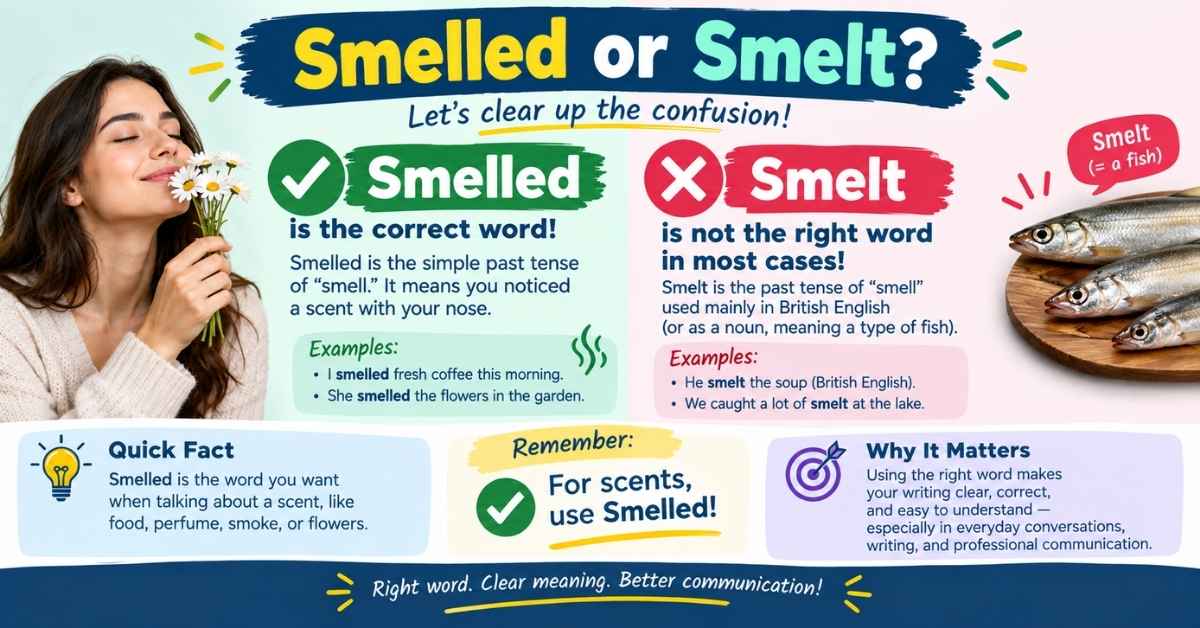
Smelled or smelt are both recognized forms of the past tense and past participle of smell, but your location matters. In American English, “smelled” is the standard and natural choice. In British English, both “smelled” and “smelt” are correct, while Australian English commonly retains smelt as well. Oxford specifically lists smelled as the regular past form and marks smelt as a British English alternative.
So if you’re writing for readers in the United States, the easiest rule is simple:
Use smelled when you’re talking about an odor.
There is one complication worth knowing. Smelt is also a completely separate word for a type of fish and a verb meaning to extract metal from ore through heat. That metalworking verb becomes smelted in the past tense.
Smelled vs. Smelt: Quick Answer
Use this table whenever you’re unsure:
| Situation | Best Form |
|---|---|
| American English | smelled |
| British English | smelled or smelt |
| Australian English | smelt is common; smelled also occurs |
| Past tense of smell | smelled / smelt depending on dialect |
| Past participle of smell | smelled / smelt depending on dialect |
| Extract metal from ore | smelt |
| Past tense of metalworking smelt | smelted |
| Small fish | smelt |
For a U.S. audience, this sentence is the most natural:
I smelled smoke coming from the kitchen.
A British speaker might naturally say:
I smelt smoke coming from the kitchen.
The basic meaning is the same.
Smelled or Smelt Meaning
When smelled and smelt are forms of the verb smell, they normally describe one of two related ideas.
Detecting an Odor
You become aware of a scent through your nose.
I smelled fresh coffee when I entered the house.
British alternative:
I smelt fresh coffee when I entered the house.
Having or Giving Off an Odor
Something has a particular scent.
The room smelled damp.
British alternative:
The room smelt damp.
Cambridge describes smell as both noticing an odor and having a particular quality detectable by the nose. It lists smelled and, specifically for UK usage, smelt as past forms.
That means the smelled or smelt meaning does not normally change when the words are being used as past forms of smell. The main difference is regional preference.
Smelled vs. Smelt at a Glance
Smelled is the regular form because English simply adds -ed:
smell → smelled
Smelt is the shorter -t form retained particularly in British and Australian English:
smell → smelt
A similar regional pattern appears in pairs such as:
- learned / learnt
- dreamed / dreamt
- burned / burnt
- spelled / spelt
Thesaurus.com notes that English preserves both -ed and -t forms for several verbs, although the relative popularity of each form varies.
Is It Smelled or Smelt in American English?
For American English, use smelled.
Examples:
I smelled gas near the stove.
The cookies smelled amazing.
Her coat smelled like smoke.
The dog smelled something behind the fence.
We had smelled the odor before.
Oxford’s American English entry gives smelled as the past form and specifically identifies smelt as a British English alternative. Cambridge likewise marks the odor-related past form smelt as UK usage.
That does not mean an American reader cannot understand:
I smelt smoke.
They almost certainly can.
However, it sounds distinctly British or otherwise regionally marked to many U.S. readers.
For school essays, U.S.-focused websites, professional emails, news-style copy, business writing, and general American content, choose smelled.
Smelled or Smelt UK: Which Is Correct?
If you’re searching smelled or smelt UK, the answer is:
Both are correct.
British English allows:
The kitchen smelled wonderful.
and:
The kitchen smelt wonderful.
Oxford labels smelt as British English also, meaning it is an accepted British alternative rather than the only correct British form.
This is an important distinction because many simplified grammar guides create a false rule:
U.S. = smelled
UK = smelt
The first half is useful.
The second half is too rigid.
British writers can—and do—use smelled.
Smelled or Smelt British English
For smelled or smelt British English, you have two legitimate choices.
Smelt sounds particularly natural and traditionally British:
The room smelt of wood smoke.
She smelt something burning.
His clothes smelt damp.
But smelled remains grammatically correct:
The room smelled of wood smoke.
She smelled something burning.
For a British publication, either form can work unless an editor or house style specifies a preference.
The important editorial principle is consistency. If your article repeatedly uses smelt, avoid switching randomly to smelled without a reason.
Smelled or Smelt Australia
Australian English generally has more in common with British English than American English in this particular verb pattern.
Australian usage commonly retains forms such as:
learnt
spelt
burnt
smelt
Australian language references specifically identify smelt as a common Australian past-tense form of smell. Duolingo’s overview of English dialects similarly notes that an Australian may use smelt where an American normally uses smelled.
So for smelled or smelt Australia, smelt is a natural Australian form.
Example:
I smelt smoke outside.
You may still encounter smelled, particularly because Australian English is exposed heavily to international and American usage. The safest way to describe the distinction is therefore not that smelled is incorrect, but that smelt remains strongly established in Australian English.
What Does Oxford Say About Smelled or Smelt?
If you’re specifically researching smelled or smelt Oxford, Oxford gives a very useful answer.
Its Advanced Learner’s Dictionary lists the verb forms as:
past simple: smelled
past participle: smelled
and then marks:
smelt as British English also for both forms.
Oxford’s American English dictionary similarly gives smelled as the normal past form while identifying smelt as British usage.
That supports the practical rule used throughout this guide:
U.S. audience → smelled
UK audience → smelled or smelt
Past Tense of Smell: Smelled or Smelt?
The simple past describes an action or state completed in the past.
Present:
I smell smoke.
American past:
I smelled smoke.
British/Australian alternative:
I smelt smoke.
Both smelled and smelt can therefore function as the simple past of smell.
Verb Forms
| Grammar Form | U.S. English | British Alternative |
|---|---|---|
| Base form | smell | smell |
| Third-person present | smells | smells |
| Simple past | smelled | smelled / smelt |
| Past participle | smelled | smelled / smelt |
| -ing form | smelling | smelling |
Have You Smelled or Smelt?
This is another high-frequency source of confusion.
The phrase have you smelled or smelt requires the past participle, because have is being used to form the present perfect.
In American English:
Have you smelled this perfume before?
In British English:
Have you smelled this perfume before?
or:
Have you smelt this perfume before?
Both smelled and smelt can function as the past participle of smell. Oxford and Cambridge document both forms, with smelt marked particularly as British.
With Has
American:
She has smelled that fragrance before.
British alternative:
She has smelt that fragrance before.
With Had
American:
We had smelled smoke before the alarm sounded.
British alternative:
We had smelt smoke before the alarm sounded.
For U.S. writing, use:
have smelled
has smelled
had smelled
Smelled or Smelt in a Sentence
The best way to understand smelled or smelt in a sentence is to look at the different ways smell functions.
Detecting an Odor
American:
I smelled gas when I opened the door.
British alternative:
I smelt gas when I opened the door.
Describing an Odor
American:
The soup smelled delicious.
British alternative:
The soup smelt delicious.
Deliberately Using Your Nose
She smelled the flowers before choosing a bouquet.
British alternative:
She smelt the flowers before choosing a bouquet.
With “Smell Like”
American:
The room smelled like fresh paint.
British alternative:
The room smelt like fresh paint.
With “Smell Of”
American:
His jacket smelled of campfire smoke.
British alternative:
His jacket smelt of campfire smoke.
Figurative Meaning
Smell can also be figurative:
The entire deal smelled suspicious.
This does not mean anyone detected a literal odor. It suggests that something seemed questionable.
LEARN MORE: Today’s or Todays
Smelt Has Two Other Important Meanings
The spelling question becomes more interesting because smelt does not always have anything to do with smelling.
Smelt as a Metalworking Verb
To smelt means to obtain metal from ore through intense heating and related processing.
Cambridge describes smelting as obtaining metal from rock by heating it to a very high temperature. Oxford likewise defines smelt as heating and melting ore to obtain the metal it contains.
Examples:
Factories smelt iron ore.
The plant smelts copper.
Early communities learned to smelt metal.
This smelt is a different verb from smell.
Smelt as a Fish
A smelt is also a type of small, silvery fish associated with cold waters.
Cambridge gives the plural as smelt or smelts, while American Heritage identifies smelt as fish of the family Osmeridae.
Example:
They caught smelt through the lake ice.
Here, smelt is a noun, not a verb.
Smelt or Smelted?
This distinction is important.
When smelt means extract metal from ore, its past tense is:
smelted
not:
smelt
and definitely not:
smelled
Oxford lists the metalworking verb forms as:
smelt → smelts → smelted → smelting.
Correct:
The workers smelted the ore yesterday.
Incorrect for this meaning:
The workers smelled the ore yesterday.
The latter sentence would mean that they detected the ore’s odor with their noses.
This gives us three separate patterns:
smell → smelled
American odor usage.
smell → smelt
British/Australian alternative odor usage.
smelt → smelted
metalworking.
How Do You Pronounce Smelled and Smelt?
The words are not pronounced exactly the same.
Smelled ends with a /d/ sound.
It sounds roughly like:
smelld
Smelt ends with a clear /t/ sound and rhymes with belt.
Oxford gives smelled as /smeld/ and smelt as /smelt/.
That sound difference mirrors their spelling:
smell + ed → smelled
smell + t → smelt
Is Smelt Old-Fashioned?
Not in British and Australian English.
Calling smelt simply “old-fashioned” gives U.S. readers the wrong impression.
It may sound old-fashioned or unusually literary to an American ear, because smelled dominates contemporary U.S. usage.
But smelt remains an established modern form in British English and occurs naturally in Australian English. Oxford, Cambridge and Collins all continue to recognize the odor-related form.
So context matters.
Common Smelled vs. Smelt Mistakes
Mistake 1: Saying Smelt Is Incorrect
Wrong:
Smelt isn’t a real past tense of smell.
Correct:
Smelt is an accepted past-tense and past-participle form, particularly in British English.
Mistake 2: Saying British English Cannot Use Smelled
British English allows both forms.
Mistake 3: Using Smelt for Odors in U.S.-Focused Copy Without a Reason
It is understandable, but smelled sounds more natural to an American audience.
Mistake 4: Writing “Have Smell”
Incorrect:
I have smell that perfume before.
Correct:
I have smelled that perfume before.
British alternative:
I have smelt that perfume before.
Mistake 5: Using Smelt as the Past of Metalworking Smelt
Incorrect:
They smelt iron yesterday.
when you specifically intend past-tense metal processing in standard contemporary usage.
Better:
They smelted iron yesterday.
Mistake 6: Forgetting the Fish Meaning
In:
We caught several smelt
the word is a fish noun.
It has nothing to do with odor.
Should You Use Smelled or Smelt in Formal Writing?
For an American audience, use smelled.
It fits naturally in:
- academic papers,
- business documents,
- news articles,
- professional emails,
- school assignments,
- reports,
- website content,
- U.S.-focused fiction and nonfiction.
For a British publication, smelled or smelt can both be acceptable.
For Australian writing, smelt remains natural, although individual publishers may follow their own style conventions.
When writing internationally, smelled has one practical advantage: it is standard in the United States and also accepted in British English. This makes it the less regionally marked choice for many global audiences.
LEARN MORE: Repore or Rapport
Can You Mix Smelled and Smelt?
Grammatically, a British writer could use both because both forms are valid.
Stylistically, unnecessary switching can make the writing look inconsistent.
For example:
The kitchen smelled pleasant in the morning but smelt awful that evening.
This is understandable.
But stylistically, choose:
The kitchen smelled pleasant in the morning but smelled awful that evening.
or, in a consistent British style:
The kitchen smelt pleasant in the morning but smelt awful that evening.
Consistency makes editing cleaner.
Easy Way to Remember Smelled vs. Smelt
For American writers, remember:
USA = smelled
For British English:
UK = smelled or smelt
For Australian English:
smelt remains common
Then remember the two extra meanings:
fish = smelt
metal processing = smelt → smelted
That one framework solves almost every version of this spelling question.
Frequently Asked Questions
Is It Smelled or Smelt?
Both can be correct past forms of “smell.” Use smelled in American English. British English accepts smelled and smelt.
Is Smelt British English?
Yes, smelt is particularly associated with British English when it is the past tense or past participle of smell. Collins labels this use “mainly British.”
Is Smelled Correct in British English?
Yes. British English does not require smelt. Both forms are accepted.
Do Americans Say Smelt?
American speakers overwhelmingly favor smelled for the odor meaning. Americans still use smelt for the fish and the metalworking verb, and dictionaries may recognize the past-of-smell form even though it is regionally marked.
Is It Have You Smelled or Smelt?
For U.S. English:
Have you smelled it?
For British English:
Have you smelled it?
or:
Have you smelt it?
Both smelled and smelt can act as past participles.
What Is the Difference Between Smelled and Smelt?
When both refer to odor, the main difference is regional usage, not meaning.
Smelled is standard American English.
Smelt is an established British and Australian form.
What Does Smelt Mean?
Smelt can mean:
- past tense/past participle of smell in British and related varieties;
- to process ore to obtain metal;
- a small fish.
What Is the Past Tense of Smelt in Metalworking?
The past tense is smelted.
Example:
The company smelted copper at the plant.
Is Smelt Used in Australia?
Yes. Australian English commonly retains smelt along with other -t forms such as learnt, spelt, and burnt.
Is It “It Smelled” or “It Smelt”?
For American English:
It smelled strange.
For British English:
It smelled strange and It smelt strange are both possible.
Which Form Should I Use on a U.S. Website?
Use smelled whenever you mean the past tense or past participle of smell. It matches standard American usage and removes unnecessary regional distraction.
Final Answer: Smelled or Smelt?
If you’re still deciding between smelled or smelt, use smelled for American English. It is the standard U.S. past tense and past participle of smell.
In British English, both smelled and smelt are correct, while smelt remains common in Australian English.
Remember that smelt has two additional meanings: it can name a small fish, or it can mean extracting metal from ore. When smelt is the metalworking verb, its past tense is smelted.
The simplest rule for your U.S. audience is:
Odor in the past → smelled.
British/Australian alternative → smelt.
Metal processing → smelt / smelted.
Small fish → smelt.