

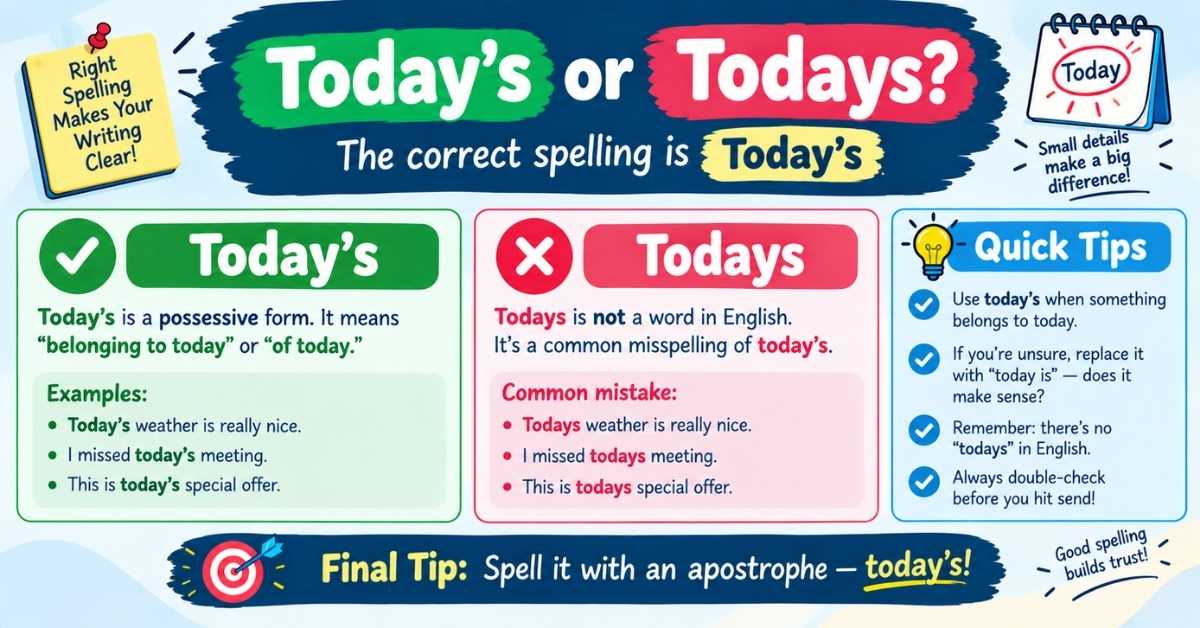
Today’s or todays—which form should you use? In standard everyday writing, today’s is usually correct when something relates to the present day, as in today’s date, today’s weather, or today’s meeting.
It can also contract today is or today has. Todays without an apostrophe is a rare plural used mainly in poetic or philosophical writing.
Today’s or Todays: Quick Answer
| Form | Use | Example |
|---|---|---|
| today’s | Possessive/association | Today’s meeting starts at noon. |
| today’s | Contraction of today is | Today’s a good day to begin. |
| today’s | Contraction of today has | Today’s been unusually busy. |
| todays | Rare plural of today | Our todays shape our tomorrows. |
| todays’ | Extremely rare plural possessive; almost never intended | The todays’ pressures… (possible but awkward) |
For ordinary emails, articles, assignments, and captions, if a noun follows—date, meeting, weather, agenda—you almost certainly need today’s.
Three Meanings You Need to Separate
Today’s as a possessive
Add ’s to the singular noun today when something belongs to, occurs on, or is associated with the present day.
- today’s date
- today’s weather
- today’s meeting
- today’s agenda
- today’s newspaper
- today’s special
The relationship is not always literal ownership. The weather does not “belong” to a day in the way a book belongs to a person. English possessives also express time and association: the weather for today → today’s weather.
Today’s meaning “today is”
The apostrophe can mark omitted letters. Today’s may shorten today is:
- Today’s Friday. = Today is Friday.
- Today’s the deadline. = Today is the deadline.
- Today’s a perfect day for a walk. = Today is a perfect day for a walk.
This contraction is natural in conversation and informal writing. In highly formal prose, spelling out today is may read more smoothly.
Today’s meaning “today has”
Today’s can also shorten today has, normally before a past participle:
- Today’s been difficult. = Today has been difficult.
- Today’s brought several surprises. = Today has brought several surprises.
- Today’s gone better than expected. = Today has gone better than expected.
Context identifies the meaning. If today’s is followed by a noun, it is usually possessive. If it is followed by an adjective, noun complement, or participle, it may be a contraction.
Today’s Date or Todays Date?
Write today’s date with an apostrophe.
- Correct: What is today’s date?
- Incorrect: What is todays date?
The phrase means the date associated with today. In U.S. business writing, you might write: “Please enter today’s date in MM/DD/YYYY format.”
Today’s Weather or Todays Weather?
Write today’s weather.
- Correct: Today’s weather will be warmer.
- Incorrect: Todays weather will be warmer.
The same pattern applies to today’s forecast, today’s temperature, and today’s rainfall.
Today’s Meeting or Todays Meeting?
Write today’s meeting with an apostrophe.
- Correct: Please bring the report to today’s meeting.
- Incorrect: Please bring the report to todays meeting.
Other workplace examples include today’s agenda, today’s deadline, today’s presentation, and today’s tasks.
Today’s or Todays Meaning
The phrase today’s or todays meaning involves two different grammatical forms:
- today’s: something associated with today, or a contraction of today is/today has
- todays: multiple present days, a rare plural used for stylistic effect
Example of the rare plural:
We build our future from many yesterdays and todays.
This is grammatical when the writer deliberately treats each present day as a countable “today.” It is unusual in ordinary prose.
What About Todays’?
In nearly every everyday sentence, todays’ is wrong. Writers usually place the apostrophe after s because they mistakenly treat today as a regular plural possessive.
- Wrong for normal use: Todays’ meeting was canceled.
- Correct: Today’s meeting was canceled.
Technically, if a writer first uses the rare plural todays and then makes that plural possessive, todays’ can be constructed:
The many todays’ small choices shape the future.
That sentence is grammatical in a highly stylized sense but awkward. A clearer revision is: The small choices we make each day shape the future. For practical writing, treat todays’ as a warning sign and revise it.
The Two-Step Apostrophe Test
Test 1: Expand the contraction
Replace today’s with today is or today has.
- Today’s the deadline → Today is the deadline. ✓
- Today’s been productive → Today has been productive. ✓
- Today’s meeting → Today is meeting. ✗
If the expansion works, today’s is a contraction.
Test 2: Rewrite with “for today”
If the contraction test fails, see whether the phrase means for today or associated with today.
- today’s meeting → the meeting for today ✓
- today’s weather → the weather for today ✓
If so, use the possessive today’s.
Common Examples and Corrections
| Incorrect | Correct |
|---|---|
| Todays date is September 21. | Today’s date is September 21. |
| Todays weather looks clear. | Today’s weather looks clear. |
| Do not miss todays meeting. | Do not miss today’s meeting. |
| Todays the final day. | Today’s the final day. |
| Todays been exhausting. | Today’s been exhausting. |
| I will finish today’s. | I will finish today. |
The last correction matters: do not add ’s when today stands alone as a time expression.
- Correct: I have a meeting today.
- Correct: Today’s meeting starts at two.
Headlines, Captions, and Informal Writing
You may see todays in captions, usernames, channel names, hashtags, or compressed headlines. Some creators omit punctuation deliberately; others simply make a typo. Neither practice changes the standard rule.
Use today’s in edited headlines:
- Today’s Top Stories
- Today’s Weather Forecast
- Today’s Special
Preserve an official brand or account name if it intentionally uses Todays, but do not copy that styling into ordinary sentences.
LEARN MORE: Genious or Genius
American and British English
American and British English use the same apostrophe rules here. Both write today’s date, today’s weather, and today’s meeting. There is no regional spelling variation.
A Five-Second Proofreading Check
- Search for todays.
- If the word modifies date, weather, meeting, agenda, news, or another noun, change it to today’s.
- Search for todays’ and revise almost every occurrence.
- Check whether today’s can expand to today is or today has.
- Remove the apostrophe when today stands alone: “We will meet today.”
- Review headlines, graphics, filenames, alt text, and calendar invitations.
Quick Practice Test
Choose the correct form.
- What is today’s / todays date?
- Today’s / Todays been a productive day.
- Please attend today’s / todays meeting.
- I will send the document today / today’s.
- Poetic: Our todays / today’s become our yesterdays.
Answers: 1. today’s; 2. Today’s; 3. today’s; 4. today; 5. todays.
Frequently Asked Questions
Is it today’s or todays?
Use today’s for something associated with today or as a contraction of today is/today has. Use todays only as a rare plural.
Does today’s need an apostrophe?
Yes, when it is possessive or a contraction. No apostrophe is needed when today stands alone: “I called today.”
Is it today’s date or todays date?
Today’s date is correct.
Is it today’s weather or todays weather?
Today’s weather is correct because the phrase means the weather associated with today.
Is it today’s meeting or todays meeting?
Write today’s meeting with an apostrophe.
Can today’s mean today is?
Yes. “Today’s Monday” means “Today is Monday.”
Can today’s mean today has?
Yes. “Today’s been busy” means “Today has been busy.”
Is todays a real word?
It can be a rare plural of today in poetic or philosophical writing. In ordinary prose, it is usually a missing-apostrophe error.
Is todays’ correct?
It is almost never the intended form. It is theoretically possible as the possessive of the rare plural todays, but rewriting the sentence is usually clearer.
Final Verdict
In today’s vs. todays, use today’s for today’s date, today’s weather, today’s meeting, and contractions meaning today is or today has. Use todays only for a deliberate, rare plural, and avoid todays’ in normal writing.