

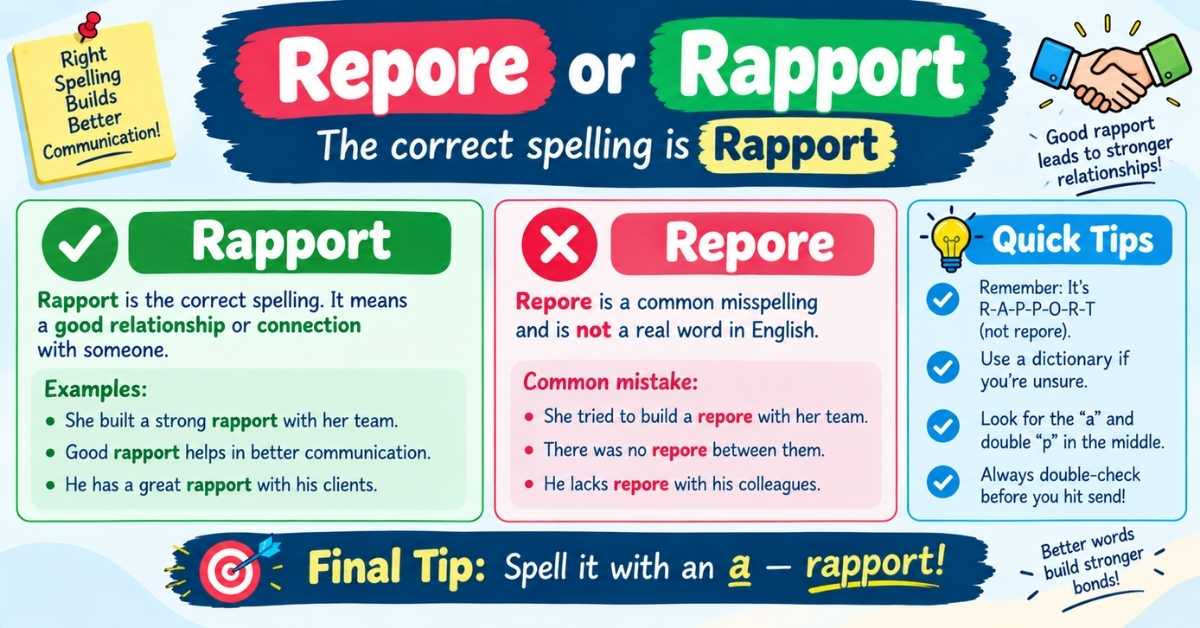
Repore or rapport—which is correct? Rapport is the correct spelling when you mean a friendly, harmonious connection built on mutual understanding. Repore is a common phonetic misspelling, probably because rapport sounds roughly like “ruh-PORE” and its final t is silent.
If you are fixing a sentence now, write rapport:
- Correct: “She quickly built rapport with the new client.”
- Incorrect: “She quickly built repore with the new client.”
The quick comparison
| Form | Status | Meaning |
|---|---|---|
| rapport | Correct | A friendly, mutually understanding relationship |
| repore | Incorrect in this context | A misspelling based on how rapport sounds |
| report | A different word | A written or spoken account; also, to give information |
The standard spelling is rapport in both American and British English. Merriam-Webster defines it as a friendly, harmonious relationship characterized by agreement, mutual understanding, or empathy that makes communication easier. Merriam-Webster and Dictionary.com also document its pronunciation, origin, and relationship-focused meaning.
Why rapport sounds like “repore”
In American English, rapport is commonly pronounced ruh-PORE or ra-PORE. The final t is not pronounced. That mismatch between sound and spelling is why people often type repore, repor, or rapore.
English borrowed rapport from French, and it kept the French-looking spelling. You do not need to know French to use it correctly; just remember this:
Rapport ends in -port on the page, even though it ends in “pore” to the ear.
The stress falls on the second syllable: ruh-PORE. It does not rhyme with the usual pronunciation of report, which begins “ree-” and has a pronounced final t.
What does rapport mean?
Rapport is a comfortable, cooperative connection in which people understand one another and communicate easily. It can develop between friends, colleagues, a teacher and student, a clinician and patient, or a salesperson and customer.
Having rapport does not mean two people agree about everything. It means the interaction feels open enough for honest, productive communication.
Examples:
- “The manager has a strong rapport with her team.”
- “A calm introduction helped the nurse establish rapport with the patient.”
- “The interviewer and candidate developed an easy rapport.”
- “Students participate more freely when they have rapport with their instructor.”
In practice, rapport often shows up as ease, attention, mutual respect, and a sense that the other person is listening. Education practitioners likewise connect genuine rapport with students feeling seen, respected, and supported—not merely entertained. See the experience-led discussions from Edutopia and Faculty Focus.
Good repore or rapport? Use “good rapport”
If you are deciding between good repore or rapport, the correct phrase is good rapport.
- Correct: “I have a good rapport with my supervisor.”
- Correct: “The counselor established good rapport with the family.”
- Incorrect: “We developed a good repore.”
The same rule applies to strong rapport, easy rapport, instant rapport, and build rapport. The spelling never changes to match the way the word sounds.
How to use rapport naturally
Rapport is a noun. The most natural combinations are:
- build rapport
- develop rapport
- establish rapport
- create rapport
- have rapport with someone
- a good/strong/easy rapport
- a lack of rapport
Rapport with vs. rapport between
Use rapport with when the sentence centers on one person’s connection to another person or group:
- “He built rapport with the audience.”
- “The physician has excellent rapport with patients.”
Use rapport between when both sides of the relationship are presented equally:
- “There was an immediate rapport between the coach and the athlete.”
- “Trust improved the rapport between the two departments.”
Both constructions are correct. Choose the one that matches the sentence’s point of view.
Repore vs. rapport: why only one belongs in formal writing
In the comparison repore vs. rapport, only rapport is the standard English word for a harmonious relationship. Spell-checkers may flag repore, but relying on software alone is risky because names, product terms, or nearby words can distract from the error.
A useful editing test is to replace the word temporarily with connection:
- “She has a good connection with clients.”
- Therefore: “She has good rapport with clients.”
If connection fits the intended meaning, rapport is probably the word you need.
Rapport vs. report
These are separate words, not spelling variants.
| Word | Pronunciation | Meaning | Example |
|---|---|---|---|
| rapport | ruh-PORE | A harmonious connection | “They built rapport.” |
| report | ree-PORT | An account or document; to provide information | “They submitted a report.” |
Compare:
- “The consultant built rapport before presenting the report.”
- “Please report the issue to a manager who has good rapport with the team.”
The shared letters and related linguistic history can make these words look connected, but their modern meanings and pronunciations are distinct.
Is rapport the same as trust, empathy, or a relationship?
Not exactly. The ideas overlap, but each describes something different.
| Term | Core idea | Relationship to rapport |
|---|---|---|
| Rapport | Ease and mutual understanding in interaction | The overall quality of connection |
| Trust | Confidence that someone is reliable, honest, or safe | Can deepen rapport over time |
| Empathy | Understanding another person’s feelings or perspective | Often helps create rapport |
| Relationship | The broader connection between people | May contain strong, weak, or no rapport |
| Chemistry | A felt, sometimes immediate compatibility | Informal and less precise than rapport |
You can have quick conversational rapport with someone you have just met, while deep trust usually requires evidence over time. Conversely, two long-term colleagues may trust each other’s competence but have little personal rapport.
How to build genuine rapport
Rapport is not a script, a compliment formula, or a way to manipulate someone into agreement. Forced small talk often feels forced because the speaker is performing interest instead of paying attention.
Use this four-part framework:
- Listen: Give the person room to finish. Ask a relevant follow-up instead of preparing your next pitch.
- Notice: Pick up on priorities, word choice, pace, and concerns. Do not imitate mannerisms theatrically.
- Respond: Reflect the substance of what you heard. A specific response—“You need the handoff to be predictable”—shows more understanding than “I totally get it.”
- Follow through: Remember the detail, keep the promise, or return with the requested answer. Reliability turns a pleasant exchange into durable rapport.
What weakens rapport
- Pretending to share an interest
- Using someone’s name unnaturally often
- Asking personal questions too soon
- Mirroring body language mechanically
- Dominating the conversation
- Treating agreement as the only acceptable response
- Forgetting a concern after claiming to understand it
- Using warmth to disguise pressure
The practical lesson is simple: rapport grows when people feel understood, respected, and free to respond honestly.
Examples across common situations
At work
“Regular one-to-one conversations helped the new director build rapport with the team.”
In sales
“The representative established rapport by asking about the client’s workflow before recommending a product.”
In a job interview
“The candidate developed a natural rapport with the panel without becoming overly casual.”
In healthcare
“The clinician slowed down, explained the next step, and built rapport with the anxious patient.”
In education
“The teacher’s consistent follow-through strengthened her rapport with students.”
In everyday conversation
“Although they had just met, they quickly found an easy rapport.”
These examples share one pattern: rapport is demonstrated through the quality of interaction, not claimed as a personality trait.
LEARN MORE: Today’s or Todays
A spelling trick that sticks
Picture a port where two people meet and exchange ideas:
RAP + PORT = RAPPORT
It is not the word’s literal definition, but it is an effective visual reminder. Keep both p letters and finish with -port:
- ra + p + port
- rapport
The last t stays on the page, even when it disappears in speech.
Common mistakes to correct
| Incorrect | Correct |
|---|---|
| “We have a good repore.” | “We have a good rapport.” |
| “She built report with the client.” | “She built rapport with the client.” |
| “He has rapport to his coworkers.” | “He has rapport with his coworkers.” |
| “The teams have a strong repore.” | “The teams have a strong rapport.” |
| “Her rapport skills are fake.” | “Her attempts to build rapport feel forced.” |
The final rewrite is more precise because rapport is a relationship quality, not usually a standalone “skill.” Listening, questioning, empathy, and follow-through are the skills that help create it.
A five-second proofreading check
Before sending your sentence, ask:
- Do I mean a comfortable, mutually understanding connection?
- If yes, did I write rapport with two p’s and a final t?
- If I mean a document or an account, do I need report instead?
That check catches nearly every common version of this mistake.
Frequently asked questions
Is it repore or rapport?
Rapport is correct. Repore is a common misspelling based on pronunciation.
Is repore a word?
In standard English usage for a harmonious relationship, no—use rapport. Repore may appear as a name or nonstandard term in other contexts, but it is not the spelling you need here.
How do you pronounce rapport?
Say ruh-PORE or ra-PORE, with stress on the second syllable. The final t is silent.
Is “good rapport” correct?
Yes. “We have good rapport” and “I have a good rapport with my manager” are both natural constructions.
Can you say “rapport with someone”?
Yes. Rapport with is standard: “The coach has strong rapport with the players.” Use rapport between when emphasizing both sides: “There is rapport between the coach and the players.”
What is the plural of rapport?
The plural rapports exists, but it is uncommon. English speakers usually use the singular or restructure the sentence: “She developed rapport with several teams” sounds more natural than “She developed several rapports.”
Is the spelling different in the United States and the United Kingdom?
No. Rapport is the standard spelling in both American and British English.
What does “build rapport” mean?
It means developing a comfortable, cooperative connection that makes communication easier. Genuine rapport usually grows through attention, respect, relevant questions, and reliable follow-through.
Is rapport formal or informal?
It is a standard, slightly formal noun that is common in workplace, education, healthcare, counseling, sales, and interview contexts. It also works in everyday conversation.
Editorial takeaway
When the choice is repore or rapport, write rapport. Remember: it sounds like “ruh-PORE,” but it keeps the written ending -port. For natural usage, write build rapport, good rapport, or rapport with someone.