

You know that jumpy, nervous energy a cat gets right before it bolts out of a room? There’s a word for that. And if you’ve ever typed it out, you’ve probably paused, wondering whether it’s skiddish or skittish. That tiny hesitation happens more often than you’d think. It sends a steady stream of curious writers straight to search engines every day.
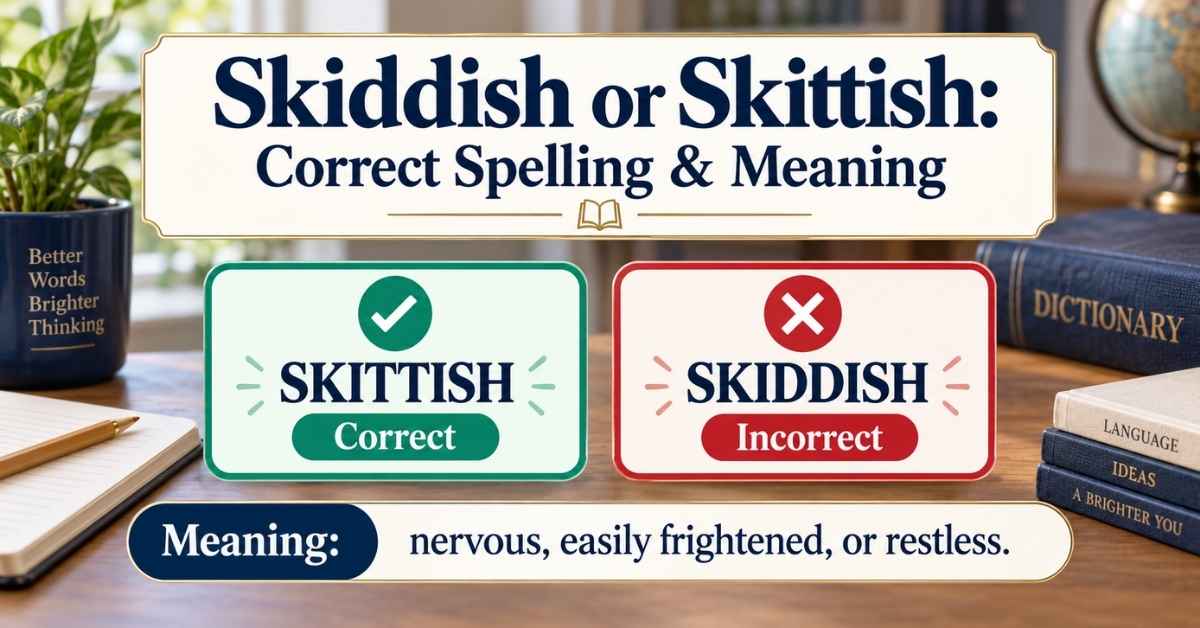
Let’s answer it right away: the correct spelling is skittish not skiddish. No standard English dictionary lists “skiddish.” Still, the two words sound nearly identical when spoken, which is exactly why the confusion exists.
In this article, we’ll cover the real meaning of skittish. We’ll also explain why “skiddish” trips so many people up, plus share a few simple tricks to lock in the right spelling for good.
Skiddish vs Skittish: The Quick Answer
If you take away just one thing from this article, let it be this: skittish is correct, skiddish is not.
Here’s a simple breakdown to settle the question once and for all.
| Spelling | Correct? | Notes |
|---|---|---|
| Skittish | ✅ Yes | Standard, dictionary-recognized spelling |
| Skiddish | ❌ No | Common misspelling based on pronunciation |
There’s no regional variation here, either. Unlike some words that shift between American and British English, skittish stays the same everywhere.
Why Do People Write “Skiddish” Instead of “Skittish”?
This isn’t just a random typo pattern. A few specific reasons explain why “skiddish” shows up so often:
- Phonetic confusion — Spoken quickly, the double “t” in “skittish” can sound almost like a soft “d.” Casual speech blurs the two even more.
- Association with the word “skid” — “Skid” is a familiar word, so some writers unconsciously borrow its spelling for a word that sounds similar but comes from a different root entirely.
- Uncommon word, less repetition — Most people rarely write “skittish.” Without regular use, the correct spelling never gets reinforced the way common words do.
- Autocorrect and typing speed — One accidental keystroke swap between “t” and “d” is all it takes. A quick read-through often misses it.
None of these reasons make “skiddish” correct. They just explain why it’s such a persistent, understandable mix-up.
What Does “Skittish” Actually Mean?
At its core, skittish describes someone or something that startles easily, feels nervous, or reacts with sudden, jumpy energy. People often link it to animals, but it applies just as naturally to people and even situations.
Here’s how the word typically shows up in everyday use:
- Animals — Horses, cats, and other animals that spook at sudden sounds or movements often earn the label skittish.
- People — Someone who feels anxious, hesitant, or easily unsettled in social or high-pressure situations counts as skittish too.
- Markets and situations — In finance, people call an unpredictable, nervous market “skittish” when it reacts sharply to news or uncertainty.
- Behavior in general — Any nervous, hesitant behavior, or a tendency to shy away from things, fits this word.
So while people often link it to animals first, skittish really points to a broader pattern: nervous, easily startled behavior, wherever it shows up.
Where Does the Word “Skittish” Come From?
Skittish traces back to Middle English, likely from the word “skit,” which once described a sudden, quick movement. Over time, it grew into an adjective for exactly that kind of jumpy, unpredictable energy — the sudden dart of a nervous animal or the quick, hesitant reaction of an anxious person.
That history also explains why “skiddish” feels like it could be right. “Skid” and “skit” sound close enough that people tangle them together, even though they come from completely different word families.
How to Use “Skittish” Correctly in a Sentence
Skittish shows up across several contexts. Here are a few natural examples to see how it works in practice:
- The horse grew skittish the moment it heard the thunder in the distance.
- She felt skittish about signing the contract without reading it twice.
- Investors turned skittish after the surprise announcement, and the market dipped sharply.
- The rescue dog stayed skittish around strangers for the first few months.
Notice the pattern: each sentence carries a sense of nervous energy or hesitation, whether it’s an animal, a person, or an entire market reacting to uncertainty.
Skittish vs Similar Words
It also helps to see how skittish compares to a few related words people sometimes swap in by mistake, even though the meanings differ slightly.
- Skittish vs. nervous — Nervous covers a broader, ongoing anxiety. Skittish specifically points to a tendency toward sudden, startled reactions.
- Skittish vs. jumpy — Jumpy sits very close in meaning and works well casually, but skittish carries a slightly more literary, descriptive tone.
- Skittish vs. timid — Timid suggests a general lack of confidence or boldness. Skittish focuses more on reactive, easily startled behavior in the moment.
- Skittish vs. flighty — Flighty suggests unpredictability or a tendency to change one’s mind quickly. Skittish stays focused on nervous, startled reactions specifically.
Common LSI Keywords Related to Skittish
If you’re researching this word for writing or just curious about related terms, here are a few commonly searched alongside “skittish”:
- Nervous
- Jumpy
- Easily spooked
- Anxious
- Timid
- Flighty
- Edgy
- Jittery
Each of these overlaps with skittish in meaning. But skittish specifically emphasizes that sudden, reactive quality, rather than general anxiety or shyness.
Memory Tricks to Avoid Misspelling It
If “skiddish” keeps slipping into your writing, try these simple tricks to lock in the correct spelling:
- Remember that skittish has a double “t,” just like “kitten” does. Kittens are a classic example of skittish behavior, so the connection sticks easily.
- Say the word slowly (skit-tish) instead of quickly. This helps your brain register the “t” sound clearly, instead of blending it into a “d.”
- Run it through a spell-checker a couple of times. Watching “skiddish” get flagged repeatedly locks in the correct spelling faster than memorizing a rule.
LEARN MORE: Discard or Disgard
Is “Skiddish” Ever Acceptable to Use?
Not in formal writing, professional emails, academic papers, or anything meant for publication. No standard dictionary lists it, and spell-checkers almost always flag it as an error.
That said, a quick text message between friends won’t cause any real harm if the wrong spelling slips through. The goal is simple: know the correct form so it never ends up in something more permanent, like an article, resume, or business document.
FAQs About Skiddish or Skittish
Q: Is it skiddish or skittish? A: It’s always “skittish.” “Skiddish” is a common misspelling based on how the word sounds when spoken quickly, and no standard dictionary recognizes it.
Q: What does skittish mean? A: It means easily startled, nervous, or prone to sudden jumpy reactions. People often use it to describe animals, anxious people, or unpredictable situations like a nervous market.
Q: Why do people misspell skittish as skiddish? A: It usually comes down to how similar the words sound out loud, plus an unconscious link to the more familiar word “skid.”
Q: Can skittish describe something other than animals? A: Yes. It works well for people who feel anxious or hesitant. It also fits markets, situations, or behavior that reacts nervously to uncertainty.
Q: What’s a good synonym for skittish? A: Jumpy, nervous, easily spooked, and jittery all work as close alternatives, depending on the tone you want.
Q: Does skittish have a British or American spelling variation? A: No. Unlike some words that differ across English dialects, skittish keeps one universal spelling everywhere.
Final Thoughts
So, is it skiddish or skittish? By now, the answer should feel obvious: skittish is correct, and skiddish, while an understandable mix-up, simply isn’t a real word. You now know where the confusion comes from, what the word actually means, and a couple of easy tricks to remember the spelling. That split-second hesitation shouldn’t happen again next time you sit down to write.
If this cleared things up, check out other commonly confused word pairs too, like “discard vs disgard” or “reinforce vs reenforce.” They follow the same kind of pattern, and they trip people up just as easily without a quick refresher.