

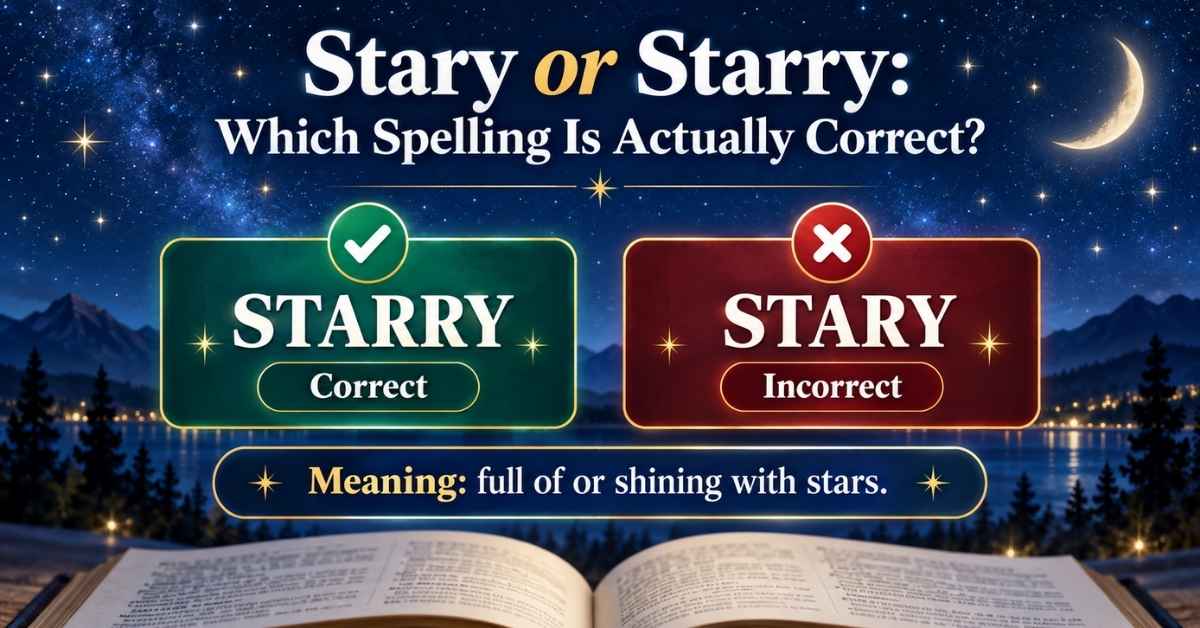
Picture a clear night sky, packed with tiny points of light stretching in every direction. You want to describe it, so you start typing. Then you pause. Is it a stary or starry one? That small hesitation trips up more writers than you’d expect, and it sends plenty of curious people straight to a search bar.
Here’s the quick answer: the correct spelling is “starry,” not “stary.” No standard English dictionary recognizes “stary” as a word. Still, the mix-up makes total sense once you look at how the word gets built and how easily a letter slips through during a quick typing session.
This article breaks down the real meaning of starry, explains exactly why “stary” shows up so often, and covers the famous phrase “starry night” along the way. By the end, you won’t second-guess the spelling again.
Stary vs Starry: The Quick Answer
If you remember just one thing here, make it this: starry is correct, stary is not.
Here’s a simple breakdown to settle it for good.
| Spelling | Correct? | Notes |
|---|---|---|
| Starry | ✅ Yes | Standard, dictionary-approved spelling |
| Stary | ❌ No | Common misspelling, missing a letter |
No regional spelling difference exists here either, unlike words such as “color” versus “colour.” Starry stays the same across American, British, and every other form of English.
Why Do People Write “Stary” Instead of “Starry”?
This slip-up isn’t random. A few clear reasons explain why “stary” shows up so often:
- Dropped letter during typing — Starry doubles the “r,” and fast typists often skip that second letter without noticing.
- Confusion with the word “stare” — Since “stare” already looks and sounds similar, some writers borrow its spelling pattern by accident.
- Autocorrect gaps — Some spell-checkers catch “stary” instantly, but others miss it entirely, especially on older devices or basic text fields.
- Visual assumption — The word “star” only has one “r,” so people sometimes assume the adjective form keeps that same single-letter pattern.
None of these reasons make “stary” correct. They just explain why so many people type it without noticing.
What Does “Starry” Actually Mean?
At its core, starry describes something filled with, resembling, or reminiscent of stars. Most often, people use it to describe the night sky, but the word stretches into a few other contexts too.
Here’s how starry typically appears:
- The night sky — A “starry sky” or “starry night” refers to a clear sky packed with visible stars.
- Eyes and expressions — People describe someone as “starry-eyed” when they look full of wonder, excitement, or idealistic hope.
- Decor and design — Starry patterns show up often in art, fabric, and decorations meant to mimic the look of a night sky.
- Atmosphere and mood — Writers use starry to set a magical, dreamy, or romantic tone in fiction and poetry.
So while the night sky remains the most common use, starry carries a broader sense of sparkle, wonder, and light wherever it appears.
“Starry Night”: Where the Phrase Comes From
The phrase “starry night” describes a clear evening sky filled with visible stars, but it also carries extra weight thanks to Vincent van Gogh’s famous 1889 painting, “The Starry Night.” That artwork turned the phrase into something people instantly recognize, even outside of astronomy or casual weather talk.
Because of the painting’s fame, “stary night” versus “starry night” becomes one of the most searched versions of this spelling question. If you’re writing about the artwork, the phrase, or just an actual sky full of stars, “starry night” is always the correct form.
How to Use “Starry” Correctly in a Sentence
Starry works across a few different contexts. Here are some natural examples to see it in action:
- The campers lay back and stared up at the starry sky for hours.
- She walked into the gallery, starry-eyed at the sight of van Gogh’s masterpiece.
- The wedding venue used starry string lights to create a magical evening atmosphere.
- He described the desert night as the clearest, most starry sky he’d ever seen.
Notice how the word almost always connects to light, wonder, or a scene packed with stars, whether real or decorative.
Starry vs Similar Words
A few related words sometimes get mixed up with starry, even though the meanings shift slightly.
- Starry vs. starlit — Starlit specifically means lit by starlight, while starry more broadly means filled with or resembling stars.
- Starry vs. stellar — Stellar technically relates to stars in an astronomical sense, but people often use it casually to mean “excellent” or “outstanding.”
- Starry vs. celestial — Celestial covers anything related to the sky or universe broadly, including the moon and planets, while starry focuses specifically on stars.
- Starry vs. sparkling — Sparkling describes flashes of light in general, while starry ties that sparkle specifically to a star-like pattern or setting.
Common LSI Keywords Related to Starry
If you’re researching this topic for writing or SEO purposes, here are related terms often searched alongside “starry”:
- Starry night
- Starry sky
- Starlit
- Star-filled
- Starry-eyed
- Night sky
- Celestial
- Twinkling stars
These terms naturally overlap with starry and help paint the full picture of what the word evokes.
Memory Tricks to Avoid Misspelling It
Try these simple tricks if “stary” keeps sneaking into your writing:
- Break the word into two parts: “star” plus “ry,” then double-check that second “r” before the ending.
- Compare it to similar double-letter adjectives like “furry” or “starry,” which both keep two of the same letter before the “y.”
- Type the sentence into a spell-checker once. Seeing “stary” flagged repeatedly trains your brain to catch it before you hit publish.
LEARN MORE: Skiddish or Skittish
Is “Stary” Ever Acceptable to Use?
Not in formal writing, professional content, essays, or anything meant for an audience. No dictionary recognizes it, and most spell-checkers flag it right away.
That said, a quick note to yourself or a casual text won’t cause any harm if a typo slips through occasionally. The real goal is knowing the correct spelling so it never shows up in a blog post, resume, or published piece of writing.
FAQs About Stary or Starry
Q: Is it stary or starry? A: It’s always “starry.” “Stary” is a common misspelling, usually caused by dropping the second “r,” and no standard dictionary lists it as a word.
Q: What does starry mean? A: It means filled with, resembling, or full of stars, most often used to describe a clear night sky packed with visible stars.
Q: Is it “stary night” or “starry night”? A: The correct phrase is always “starry night,” whether you’re describing an actual sky or referring to Van Gogh’s famous painting.
Q: Why do people misspell starry as stary? A: Most people simply drop the second “r” while typing quickly, or they mistakenly borrow the spelling pattern from the word “stare.”
Q: What’s a good synonym for starry? A: Starlit, star-filled, and twinkling all work well as close alternatives, depending on the tone and context.
Q: Does starry have different spellings in British and American English? A: No. Starry keeps one universal spelling across every major English dialect.
Final Thoughts
So, is it stary or starry? The answer stays simple: starry is correct, and stary, while an easy typo to make, isn’t a recognized word. You now know the real meaning behind starry, why the mix-up with “stary” happens so often, and how the phrase “starry night” earned its lasting fame. That moment of hesitation shouldn’t slow you down again next time you’re describing a sky full of stars.
If this cleared things up, check out other commonly confused word pairs too, like “skittish vs skiddish” or “discard vs disgard.” They follow the same kind of pattern, and they catch even careful writers off guard without a quick refresher.