

Picture this: you’re halfway through writing an email, you type the word out, stare at it for a second too long, and suddenly it doesn’t look like a real word anymore. Is it “discard,” or is it “disgard”? That split-second hesitation is more common than you’d think, and it sends a surprising number of people straight to Google every day.
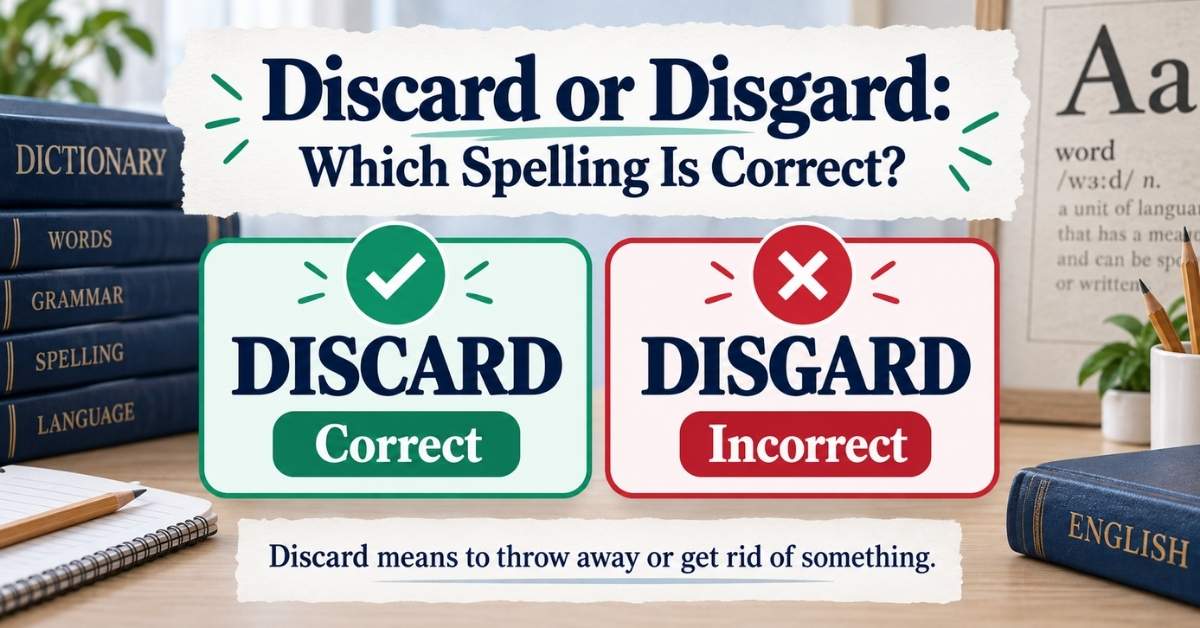
Let’s clear it up right away: the correct spelling is “discard,” not “disgard.” Disgard is a misspelling, plain and simple — it’s not recognized in any major English dictionary. But the fact that so many people type it, search for it, and second-guess themselves says something interesting about how English words are built, and that’s worth digging into.
In this article, we’ll break down the real meaning of discard, explain exactly why “disgard” trips people up, and give you a few tricks so you never have to pause and Google it again.
Discard vs Disgard: The Quick Answer
If you only remember one thing from this article, make it this: discard is correct, disgard is not.
Here’s a simple side-by-side to settle it for good.
| Spelling | Correct? | Notes |
|---|---|---|
| Discard | ✅ Yes | Standard, dictionary-approved spelling |
| Disgard | ❌ No | Common misspelling, not in any major dictionary |
There’s no hidden exception here, no regional variation, no British-versus-American spelling split like you’d see with “color” and “colour.” Discard is simply the one and only accepted form.
Why Do People Write “Disgard” Instead?
This mix-up isn’t random. It usually comes down to one (or more) of these reasons:
- Sound confusion — The “c” in “discard” is pronounced like a hard “k” sound, and some people’s brains automatically reach for a “g” because it feels visually or phonetically similar.
- Autocorrect drift — On mobile keyboards, a stray tap near the “g” key instead of “c” can slip through unnoticed, especially when typing fast.
- Analogy with other words — English is full of words where “g” and soft sounds pair together (like “gist” or “gel”), so some writers subconsciously borrow that pattern where it doesn’t belong.
- Simple unfamiliarity — For non-native English speakers or younger writers, “discard” isn’t always a word used in daily conversation, so the spelling hasn’t been reinforced through repetition.
None of these reasons make “disgard” acceptable in formal writing, but they do explain why the error is so persistent.
What Does “Discard” Actually Mean?
At its core, discard means to get rid of something you no longer need, want, or find useful. It’s a verb most people learn early on, but it carries a bit more nuance than just “throw away.”
Here’s how it typically shows up:
- Physical objects — throwing away trash, old clothes, or broken items.
- Ideas or plans — abandoning a strategy that isn’t working.
- Card games — placing an unwanted card face-down, as in Uno or Rummy.
- Relationships or habits — letting go of behaviors, beliefs, or connections that no longer serve you.
So while “throw away” is the simplest way to think about it, discard often implies a bit more intention — you’re actively choosing to remove something, not just carelessly tossing it aside.
Discard as a Noun
Discard doesn’t just work as a verb. It can also function as a noun, referring to the item that’s been gotten rid of.
For example: “The tailor’s discards piled up quickly, since only perfect fabric made it into the final design.”
This noun form is especially common in manufacturing, card games, and recycling contexts, where “discards” refers to a pile or category of rejected items.
How to Use “Discard” Correctly in a Sentence
Since discard is a flexible word, here are a few natural examples across different contexts:
- She decided to discard the old photos that no longer meant anything to her.
- In poker, players often discard weaker cards early in the round.
- The recycling plant sorts discarded materials by type before processing them.
- He discarded his original business plan after realizing the market had shifted.
Notice how in each case, something is being deliberately let go of — not lost, not misplaced, but consciously removed.
Discard vs Similar Words
It also helps to compare discard with a few words people sometimes use interchangeably, even though the meanings shift slightly.
- Discard vs. dispose — Dispose often implies a formal or careful process (like disposing of hazardous waste), while discard can be more casual.
- Discard vs. abandon — Abandon usually carries emotional weight, suggesting something was left behind, sometimes with a sense of neglect or urgency. Discard is more neutral.
- Discard vs. discard pile (gaming term) — In games, the “discard pile” is a specific, fixed term referring to where used or unwanted cards go, so it’s always spelled with a “c,” never a “g.”
- Discard vs. reject — Reject implies refusal or disapproval, often before something is even used. Discard implies removal after something has already served its purpose (or failed to).
LEARN MORE: Reinforce Meaning Explained
Common LSI Keywords Related to Discard
If you’re researching this topic for writing, SEO, or just general curiosity, here are related terms often searched alongside “discard”:
- Throw away
- Get rid of
- Dispose of
- Toss out
- Abandon
- Eliminate
- Scrap
- Cast aside
Each of these can work as a substitute in casual writing, but “discard” tends to sound slightly more formal and intentional than something like “toss out.”
Memory Tricks to Avoid Misspelling It
If “disgard” keeps sneaking into your writing, try one of these simple tricks:
- Think of the word “card.” A discard pile in card games is literally made of cards — and both words share that “card” spelling.
- Remember that “dis-” is a common prefix meaning “away” or “apart” (like dismiss, distract, disconnect), and it’s almost always followed by a hard “c” sound in similar words, not a “g.”
- Run it through a spell-checker once. After seeing it flagged and corrected a couple of times, the correct spelling tends to stick.
Is “Disgard” Ever Acceptable?
Not in formal writing, academic work, resumes, or professional communication. It won’t appear in dictionaries, and most grammar and spell-check tools will flag it immediately.
That said, informal texting or quick notes to yourself obviously won’t cause any real harm if a typo slips through. The key is knowing the correct form so it doesn’t show up in anything that matters — emails, essays, articles, or official documents.
FAQs About Discard or Disgard
Q: Is it discard or disgard?
A: It’s always “discard.” “Disgard” is a common misspelling and isn’t recognized in standard English dictionaries.
Q: What does discard mean in simple terms?
A: It means to get rid of, throw away, or let go of something you no longer need or want.
Q: Why do so many people misspell discard as disgard?
A: It usually comes down to sound confusion between “c” and “g,” typing errors, or unfamiliarity with the word in everyday use.
Q: Can discard be used as a noun?
A: Yes. As a noun, “discard” (or “discards”) refers to items that have been thrown away or set aside, often used in manufacturing, recycling, and card games.
Q: What’s a good synonym for discard?
A: Dispose of, toss out, get rid of, and abandon are all common alternatives, depending on the tone you’re going for.
Q: Is “disgard” used in any dialect or regional spelling?
A: No. Unlike words with British versus American spelling differences, “discard” has one universally accepted spelling across all English-speaking regions.
Final Thoughts
So, is it discard or disgard? At this point, the answer should be crystal clear: discard is correct, and disgard simply isn’t a recognized word, no matter how natural it might feel to type. Now that you know the meaning, common uses, and the simple memory tricks to lock in the spelling, that split-second hesitation shouldn’t happen again.
If you enjoyed clearing up this mix-up, you might also want to check out other commonly confused word pairs, like “reinforce vs reenforce” or “dispose vs disperse” — they follow similar patterns and are just as easy to get wrong without a quick refresher.