

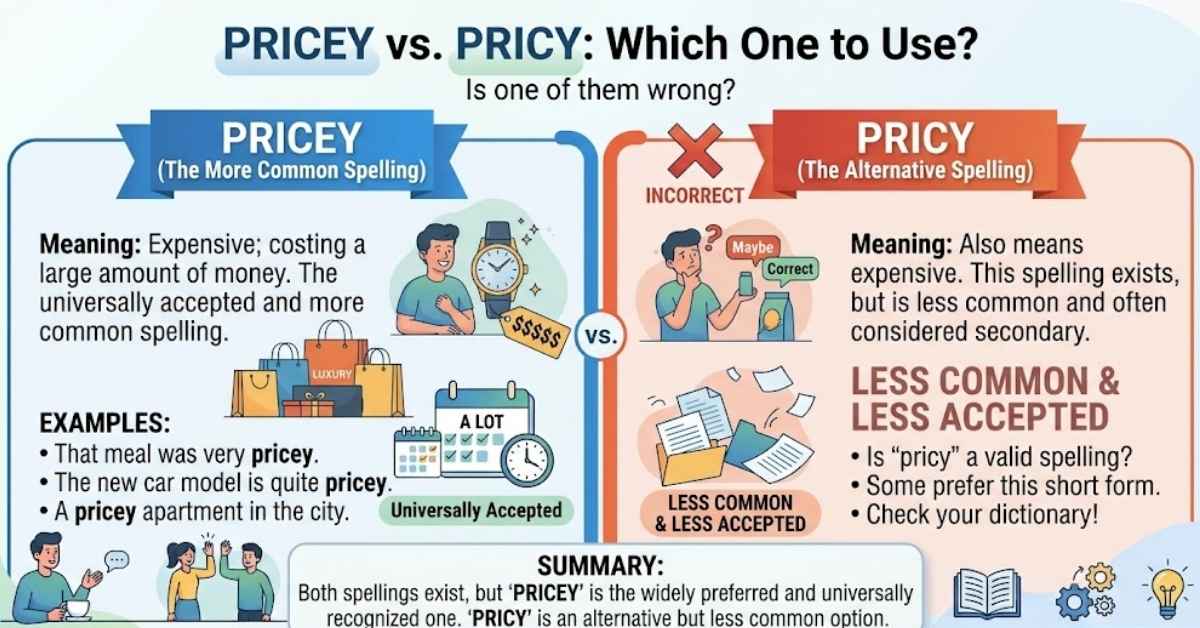
Pricey or pricy? If you have stopped while writing because you cannot decide which spelling to use, the good news is that both forms are accepted English spellings. Pricey is the more familiar and widely recognized form, while pricy is an established alternative spelling with the same basic meaning: expensive. Cambridge Dictionary explicitly lists pricy as an alternative spelling of pricey, and Collins also identifies pricy as an alternative form.
For most U.S. readers, pricey is the safest everyday choice because it is the spelling people are more likely to recognize immediately. But writing pricy does not automatically mean you have made a spelling error. Dictionary.com also lists pricy as a variation of pricey.
Pricey or Pricy: Which Is Correct?
Both pricey and pricy are correct spellings.
They are two spellings of the same informal adjective meaning expensive or, depending on context, more expensive than expected or than the speaker considers reasonable.
| Spelling | Status | Meaning | General recommendation |
|---|---|---|---|
| pricey | Standard, widely familiar | Expensive | Best default choice |
| pricy | Accepted variant | Expensive | Correct, but less familiar |
| expensive | Standard adjective | Costing a lot | Best for neutral/formal writing |
| costly | Standard adjective | Expensive or involving significant cost | Often more formal |
So if someone asks “which is correct, pricey or pricy?”, the most accurate answer is:
Both are correct, but “pricey” is the more familiar spelling.
This is an important distinction because some online grammar articles incorrectly present pricy as simply wrong. Current dictionary evidence does not support that absolute claim.
Is It Pricey or Pricy?
If you are choosing between the two for everyday American English, pricey is usually the better default.
For example:
That restaurant is pricey.
The hotel was surprisingly pricey.
This laptop is a little pricey.
You could replace pricey with pricy in these sentences without changing the basic meaning:
That restaurant is pricy.
The hotel was surprisingly pricy.
This laptop is a little pricy.
The spelling changes, but the meaning does not.
Cambridge defines pricey as an informal adjective meaning expensive and lists pricy as an alternative spelling.
Pricey or Pricy Meaning
Both pricey and pricy mean expensive.
They are commonly used when something costs a relatively large amount of money or seems more expensive than the speaker expected.
For example:
That new phone is pricey.
This means the phone is expensive.
The restaurant is a little pricy.
This also means the restaurant is expensive.
The word can sometimes communicate more than a simple statement about price. It can suggest that the speaker feels the cost is higher than desirable, expected, or reasonable.
Dictionary.com describes pricey as “expensive or unduly expensive” and notes that whether something feels pricey can depend on the person’s budget and expectations.
What Does “Pricey” Mean?
Pricey is an informal adjective meaning expensive.
Examples:
That’s a pricey car.
The hotel is quite pricey.
We found a less pricey option.
The tickets were too pricey for our budget.
It can describe almost anything with a monetary cost:
- products
- services
- restaurants
- hotels
- homes
- cars
- electronics
- clothing
- vacations
- tickets
- repairs
- subscriptions
What Does “Pricy” Mean?
Pricy means essentially the same thing as pricey: expensive.
It is an established variant spelling, not a separate word with a different meaning.
Collins specifically identifies pricy in American English as an informal alternative spelling of pricey.
For example:
The apartment is pricy.
has the same basic meaning as:
The apartment is pricey.
The difference is primarily spelling preference and familiarity, not meaning.
Why Does “Pricey” Look More Natural?
The spelling pricey keeps the e from price:
price → pricey
That spelling is highly familiar to modern English readers.
But English spelling does not always follow a single perfectly predictable rule when a suffix is added. The existence of pricy demonstrates that more than one spelling developed and became established.
So it is better not to tell learners that:
“price + y must always equal pricey.”
That would be an overly rigid rule.
The more useful fact is simply that pricey is the more familiar modern form, while pricy is also recognized by major dictionaries. Cambridge explicitly lists both.
Is “Pricy” a Real Word?
Yes.
Pricy is a real English word and an accepted variant spelling of pricey.
Dictionary.com defines pricy by directing readers to pricey, while Collins describes it as an alternative spelling.
This means that seeing pricy in a published sentence does not automatically indicate a spelling mistake.
For example:
The new equipment is pricy, but it should last for years.
The sentence is grammatically acceptable.
However, if your goal is to use the spelling most readers expect, pricey remains the practical default.
Why Do People Spell It “Pricy”?
There is a simple reason: pricy follows an intuitive spelling pattern.
The base word is:
price
and the adjective-forming suffix is:
-y
Some writers naturally simplify the spelling:
price → pricy
Others retain the e:
price → pricey
Both forms have become established in English.
This is why a person can write pricy without necessarily demonstrating poor spelling. The form is dictionary-recognized.
Pricey vs. Pricy in American English
For a U.S. audience, pricey is generally the more familiar spelling.
Dictionary.com labels pricey as American and separately lists pricy as an American variation.
Cambridge gives U.S. pronunciation for pricey and identifies pricy as an alternative.
So an American writer could legitimately write:
The concert tickets are pricey.
or:
The concert tickets are pricy.
But if you are writing for a broad audience and simply want the spelling most readers will recognize immediately, pricey is the more practical choice.
Pricey or Pricy in Formal Writing
There is another issue besides spelling: register.
Both words are generally treated as informal adjectives by major dictionaries. Cambridge labels pricey informal and Collins labels pricy informal.
That means the bigger question in a formal document may not be:
Pricey or pricy?
Instead, it may be:
Should I use either word at all?
For example, in an academic paper, financial report, legal document, or highly formal business report, you might prefer:
- expensive
- costly
- high-priced
- higher-cost
- increased in price
- more expensive
Compare:
The project used a pricey software package.
with:
The project used an expensive software package.
The second sentence is more neutral and formal.
That does not make pricey grammatically wrong. It is a question of tone and register.
When Should You Use “Pricey”?
Use pricey when you want a natural, conversational way to describe something as expensive.
It works especially well in:
- product reviews
- restaurant reviews
- travel writing
- blogs
- conversations
- casual emails
- consumer advice
- lifestyle articles
- general-interest writing
Examples:
The hotel is beautiful but pricey.
That’s a little pricey for a pair of shoes.
The restaurant is pricey, but the food is excellent.
We wanted a more affordable option because the first package was too pricey.
The word often sounds more personal than the neutral adjective expensive.
When Should You Use “Pricy”?
You can use pricy when you prefer that established spelling or when it fits the style of the publication or organization you are writing for.
For example:
The repair turned out to be surprisingly pricy.
Some of the available models are quite pricy.
The premium plan is a little pricy for small businesses.
The meaning is the same as with pricey.
However, because pricey is more familiar to many readers, it is usually the easier default when you have no particular reason to choose pricy.
Pricey vs. Expensive
Although pricey and expensive are close synonyms, they can create slightly different impressions.
Expensive
Expensive is neutral and straightforward.
The car is expensive.
This primarily states a fact about cost.
Pricey
Pricey is more conversational and can carry the speaker’s personal reaction.
The car is pricey.
This can suggest:
“That costs more than I expected or want to pay.”
Dictionary.com specifically notes this subjective element in its usage discussion of pricey.
Compare:
The restaurant is expensive.
This sounds relatively objective.
The restaurant is pricey.
This can sound more like the speaker’s evaluation.
Neither sentence necessarily tells us whether the restaurant is objectively overpriced. Pricey is often relative to expectations, budget, or comparison.
Pricey Does Not Always Mean “Overpriced”
This is an important semantic distinction.
If you say:
The laptop is pricey.
you are saying that it costs a lot or feels expensive.
You are not necessarily saying it is a bad purchase.
For example:
The camera is pricey, but the image quality is excellent.
Here, pricey describes the cost, while the second clause suggests the speaker believes the product may still offer good value.
Similarly:
The hotel is pricey, but the location is fantastic.
The hotel can be expensive without necessarily being overpriced.
Expensive describes cost. Overpriced additionally suggests that the price is too high for what is being offered.
Pricey vs. Costly
Costly can mean expensive, but it is often more formal than pricey.
Compare:
The repair was pricey.
and:
The repair was costly.
The first sounds conversational.
The second can sound more formal or serious.
Costly can also describe consequences:
The mistake was costly.
Here, the word may refer to serious financial or practical consequences, not simply the sticker price of an item.
Pricey vs. High-Priced
High-priced is another alternative.
They sell high-priced furniture.
This sounds more neutral and descriptive.
Their furniture is pricey.
This sounds more conversational and subjective.
For consumer-facing writing, pricey can feel more natural. For formal or analytical writing, high-priced or expensive may be preferable.
Pricey or Pricy: Examples
Here are examples using both spellings.
Using “pricey”
The hotel was pricey, but the service was excellent.
That restaurant is too pricey for me.
We found a less pricey alternative.
The new phone is surprisingly pricey.
Using “pricy”
The hotel was pricy, but the service was excellent.
That restaurant is too pricy for me.
We found a less pricy alternative.
The new phone is surprisingly pricy.
The basic meaning remains the same.
Pricey or Pricy in a Sentence
Both can function as adjectives before or after a noun.
Before a noun
It is a pricey restaurant.
We stayed at a pricey hotel.
She bought a pricey laptop.
After a linking verb
The restaurant is pricey.
The hotel was pricey.
The laptop seems pricey.
The same grammatical patterns work with pricy:
It is a pricy restaurant.
The hotel was pricy.
The laptop seems pricy.
Pricey Restaurant
Pricey restaurant means a restaurant that is relatively expensive.
Examples:
That’s a pricey restaurant for a casual dinner.
We found a less pricey restaurant nearby.
The restaurant is a little pricey, but the portions are generous.
Notice that pricey does not automatically mean “luxury.” A restaurant can be pricey because of its location, ingredients, reputation, portion prices, or other factors.
Pricey Hotel
The hotel looks beautiful, but it is pricey.
This means the hotel costs a relatively large amount.
A speaker might consider the price worthwhile:
The hotel is pricey, but the ocean view is amazing.
Again, pricey does not automatically mean overpriced.
Pricey Product
It’s a great product, but it’s a little pricey.
This is common consumer language because it communicates both cost and the writer’s reaction to that cost.
For product reviews, pricey often sounds more natural than a formal phrase such as of relatively high monetary cost.
Pricey or Pricy: Pronunciation
Both spellings normally have the same pronunciation.
Cambridge gives the pronunciation of pricey as /ˈpraɪ.si/ in both UK and U.S. English.
The spelling difference therefore does not normally create a pronunciation difference.
This is one reason the two forms can be confusing: they look different but sound the same.
Pricey, Pricier, and Priciest
The adjective has comparative and superlative forms.
Positive
The hotel is pricey.
Comparative
This hotel is pricier than the other one.
Superlative
That was the priciest hotel on our trip.
Cambridge lists pricier and priciest as the forms of pricey.
The pattern is:
pricey → pricier → priciest
The same forms are used with the variant spelling pricy in ordinary usage.
LEARN MORE: Isle vs Aisle
Pricier or More Pricey?
Pricier is the natural comparative form.
Prefer:
This model is pricier than the older one.
rather than:
This model is more pricey than the older one.
“More pricey” can occur and will be understood, but pricier is the concise comparative form.
Correct progression
pricey
pricier
priciest
Examples:
The first hotel was pricey.
The second hotel was pricier.
The resort was the priciest option.
Pricey or Pricy: Common Mistakes
Mistake 1: Saying “pricy is always wrong”
This is too absolute.
Current dictionaries recognize pricy as an alternative spelling.
Mistake 2: Treating the words as different in meaning
They generally have the same meaning.
pricey = expensive
pricy = expensive
Mistake 3: Assuming pricey means overpriced
Not necessarily.
Pricey means expensive or relatively expensive. Overpriced specifically suggests that the price is too high for the value offered.
Mistake 4: Using “pricey” when formal precision is needed
In a financial or academic document, expensive, costly, or high-priced may communicate more neutrally.
Mistake 5: Writing “more pricey” automatically
Use pricier in most ordinary comparisons.
This option is pricier.
Which Is Better for a U.S. Audience?
For most general U.S. writing, choose pricey.
That recommendation is about familiarity, not grammatical correctness.
A reader is unlikely to misunderstand pricy, but pricey is the spelling most people will recognize without hesitation.
This makes pricey a practical choice for:
- websites
- blog posts
- product reviews
- general articles
- consumer content
- emails
- social media
- everyday writing
If a company, publication, dictionary, or house style specifically uses pricy, there is no need to “correct” it simply because the spelling lacks the e.
Should You Use “Pricey” in SEO Content?
For general U.S.-focused SEO content, pricey is usually the more recognizable target spelling.
However, there is no reason to force pricy into every paragraph merely because it is a related keyword.
A natural article can mention both:
Pricey and pricy are accepted spellings, but pricey is the more familiar form.
That covers the search intent without keyword stuffing.
For SEO, semantic completeness is more useful than repeating the exact keyword excessively.
Relevant natural terms include:
- expensive
- cost
- high-priced
- costly
- affordable
- price
- value
- adjective
- spelling
- variant
- informal
- comparative
- superlative
Pricey vs. Pricy Quick Reference
| Question | Answer |
|---|---|
| Is pricey correct? | Yes |
| Is pricy correct? | Yes |
| Do they mean the same thing? | Generally, yes |
| Which is more familiar? | Pricey |
| Which should most U.S. writers choose? | Pricey is the practical default |
| Is pricy a misspelling? | Not necessarily; dictionaries recognize it as a variant |
| Is pricey formal? | It is generally considered informal |
| What does pricey mean? | Expensive |
| Comparative form | pricier |
| Superlative form | priciest |
| Opposite | Cheap/inexpensive |
| More formal alternative | Expensive/costly/high-priced |
Frequently Asked Questions
Is it pricey or pricy?
Both are correct. Pricey is the more familiar spelling, while pricy is an accepted alternative spelling.
Which is correct, pricey or pricy?
Both are dictionary-recognized spellings of the adjective meaning expensive. For general U.S. writing, pricey is usually the safer and more familiar choice.
How do you spell pricey or pricy?
You can spell the word pricey or pricy. Both forms are established, although pricey is more familiar.
Is pricy a word?
Yes. Pricy is an established alternative spelling of pricey. Collins and Cambridge both recognize the form.
Is pricey a word?
Yes. Pricey is an informal adjective meaning expensive.
Does pricey mean expensive?
Yes. Pricey means expensive or relatively expensive.
Does pricy mean expensive?
Yes. Pricy has essentially the same meaning as pricey.
Is pricey more correct than pricy?
Not in the sense that pricy is grammatically wrong. Both are recognized. Pricey is simply the more familiar spelling for most readers.
Is pricy an American spelling?
Yes. Dictionary.com identifies pricy as an American variation, and Collins provides an American English entry for it.
Is pricey informal?
Yes. Cambridge labels pricey as informal.
Can I use pricey in formal writing?
You can, but expensive or costly may be more appropriate when a formal, neutral tone is important.
Is “more pricey” correct?
It can be understood and is used, but pricier is the standard concise comparative form.
Is “priciest” correct?
Yes.
That was the priciest option.
Cambridge lists priciest as the superlative form.
What is the opposite of pricey?
Common opposites include cheap, inexpensive, and affordable, depending on the intended meaning.
Does pricey mean overpriced?
Not necessarily. Pricey means expensive or relatively expensive. Overpriced adds the judgment that something costs more than it is worth.
Can I say “a pricey restaurant”?
Yes.
We went to a pricey restaurant downtown.
Can I say “a pricy restaurant”?
Yes.
We went to a pricy restaurant downtown.
Both are understandable and grammatically acceptable.
Which spelling should I use on a website?
For a broad U.S. audience, pricey is the practical default because it is more familiar. If your brand or publication uses pricy, that spelling is also legitimate.
Final Answer: Pricey or Pricy?
If you’re wondering “is it pricey or pricy?”, the most accurate answer is:
Both are correct.
Pricey is the more familiar spelling and is usually the best default for general U.S. writing. Pricy is an accepted alternative spelling with the same basic meaning.
Both mean expensive:
The hotel is pricey.
The hotel is pricy.
There is no meaningful difference in meaning between those two sentences.
If you’re writing a general article, email, review, or website and want the form most readers will immediately recognize, choose pricey.
If you encounter pricy, however, don’t automatically mark it as a spelling mistake. Major dictionaries recognize it as a legitimate variant.
For formal writing, the more important consideration is often register: because pricey and pricy are informal, expensive, costly, or high-priced may sometimes be a better stylistic choice.
The easiest rule to remember is:
Pricey = familiar default Pricy = accepted variant Both = expensive