

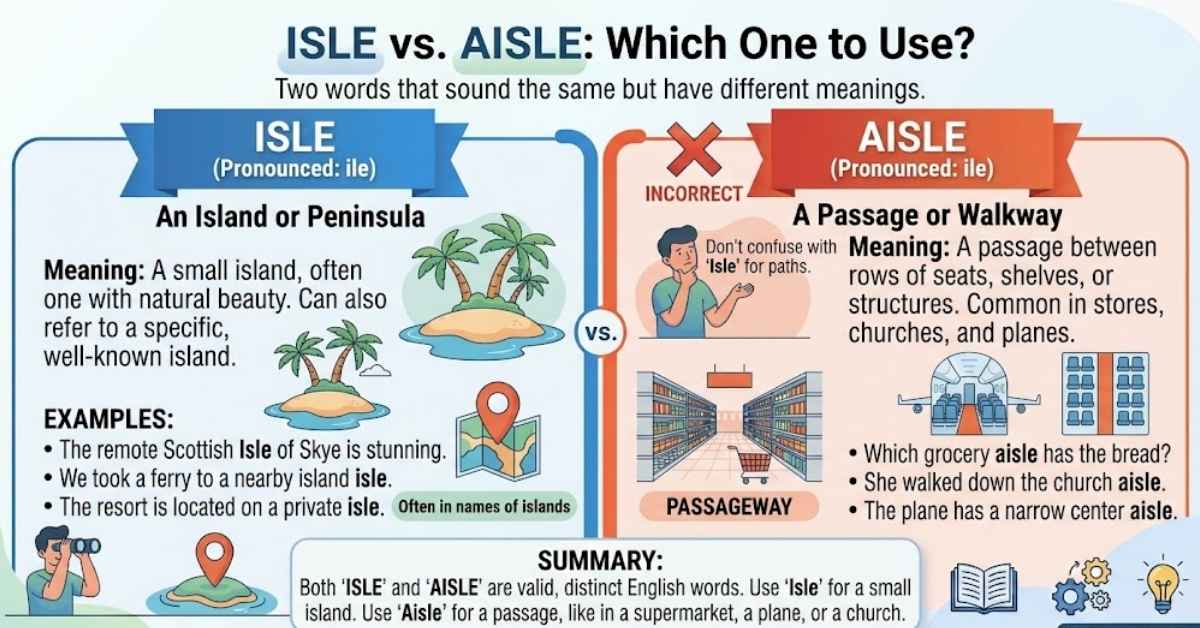
Isle vs aisle can be confusing because these two words sound exactly the same in standard American English, but they have completely different meanings. Aisle means a passage or walkway between rows of seats, shelves, or other objects, while isle means an island, often one described as small, literary, or part of a place name. Both are correct English words; the right choice depends entirely on the context. Cambridge lists both words with the pronunciation /aɪl/ in U.S. English, making them homophones.
The easiest rule is simple: aisle = walkway; isle = island. So you walk down the aisle at a wedding, find cereal in a grocery aisle, and travel to a tropical isle.
Isle vs Aisle at a Glance
| Word | Definition | Pronunciation | Common Context | Example |
|---|---|---|---|---|
| aisle | A passage or walkway between rows | /aɪl/ | Stores, airplanes, churches, theaters | Please keep the aisle clear. |
| isle | An island, often a small or named island | /aɪl/ | Geography, travel, literature | They visited a tropical isle. |
Both words are nouns, and both are legitimate English words. The problem is not deciding which spelling is “correct” in general. The problem is choosing the correct word for the meaning you intend.
What Does Aisle Mean?
Aisle is a noun for a passage or walkway that runs between rows of seats, shelves, merchandise, or other sections.
You commonly find aisles in:
- supermarkets
- grocery stores
- airplanes
- churches
- theaters
- classrooms
- libraries
- auditoriums
- buses and trains
- retail stores
Cambridge defines an aisle as a long, narrow space between rows of seats or between rows of shelves in a store. Collins similarly defines it as a passage between seating areas or merchandise rows.
Examples of Aisle
- Please keep the aisle clear.
- The cereal is in the fourth aisle.
- I chose an aisle seat on the flight.
- The bride walked down the aisle.
- The theater has a wide center aisle.
- A shopping cart was blocking the aisle.
The central idea is movement through a passage.
If you can imagine people walking through the space, aisle is usually the word you need.
Aisle in a Grocery Store
One of the most common American-English uses is grocery aisle.
A grocery store contains rows of shelves. The spaces between those rows allow customers to walk around and shop.
For example:
I found the pasta in the third aisle.
Here, aisle means the passage between the shelves.
Correct and incorrect
Correct: The cereal is in the breakfast aisle.
Incorrect: The cereal is in the breakfast isle.
The second sentence uses a real English word, but isle means an island, so it does not fit the context.
This is why these mistakes can be tricky: you are not necessarily creating a meaningless spelling. You are selecting the wrong real word.
Aisle on an Airplane
On an airplane, the walkway between rows of seats is an aisle.
That gives us several common expressions:
- aisle seat
- airplane aisle
- center aisle
- aisle seat passenger
- walk down the aisle
For example:
I requested an aisle seat because I wanted easier access to the restroom.
An aisle seat is a seat beside the passageway. Cambridge specifically uses aisle seat for a seat next to the space passengers walk along.
So:
airplane aisle ✅ aisle seat ✅ airplane isle ❌ when you mean the walkway
Aisle at a Wedding
If you’re talking about the passage between rows of chairs or pews at a wedding, the correct word is aisle.
The familiar expression is:
The bride walked down the aisle.
Not:
The bride walked down the isle.
The expression “walk down the aisle” can also refer more broadly to getting married. Collins lists this as an established expression.
There is one amusing exception in meaning: if someone is literally walking across an island, isle could be correct. For example:
The wedding took place on a remote isle.
Here, isle refers to the island where the wedding occurred. The passage inside the venue would still be the aisle.
What Does Isle Mean?
Isle is a noun meaning island. Dictionaries commonly associate it with a small island, literary language, or geographical names. Cambridge describes isle as an island and notes its use especially in place names.
Collins likewise defines isle as an island and notes that it is often used in island names or literary English.
Examples include:
- a tropical isle
- a remote isle
- a rocky isle
- a peaceful isle
- a tiny isle
- the Isle of Man
- the Isle of Wight
- the British Isles
For example:
They spent a week on a beautiful tropical isle.
Here, isle simply means an island.
Is an Isle Always a Small Island?
Not necessarily in a strict geographic sense.
Many dictionaries describe an isle as an island, especially a small one. However, “small” should not be treated as a precise scientific measurement that determines whether a piece of land qualifies as an isle.
The word also has a literary, descriptive, and place-name flavor.
For example:
The ship approached a distant isle.
The writer may choose isle instead of island because it sounds more geographic, scenic, traditional, or literary.
Cambridge labels the word as literary in its main English entry and highlights its use in place names.
So a useful everyday rule is:
island = ordinary, general word isle = island, often with a literary, geographic, or traditional flavor
Isle vs Island: Are They the Same?
Isle means island, but the two words are not identical in style or frequency.
Compare:
We visited an island.
This is the most ordinary way to describe the destination.
We visited a beautiful isle.
This is grammatically correct but may sound more literary or picturesque.
You are more likely to encounter isle in geographical names, literature, travel writing, historical references, and expressions such as the British Isles or the Isle of Man.
The choice often depends on tone as much as literal meaning.
Isle vs Aisle Pronunciation
The pronunciation is one of the biggest reasons people confuse these words.
In standard American English, both are pronounced:
/aɪl/
Cambridge gives the U.S. pronunciation of both isle and aisle as /aɪl/.
They sound like “I’ll” in ordinary speech.
So:
isle → /aɪl/ aisle → /aɪl/
This means they are homophones.
A homophone is a word that sounds the same as another word but has a different spelling and meaning.
That is why you cannot reliably determine the spelling just by hearing someone say the word.
If someone says:
“I left my bag in the aisle.”
You know which spelling to use because of the meaning, not because the pronunciation sounds different.
Isle, Aisle, and “I’ll”
There is a third word worth remembering: I’ll.
These three forms can sound alike:
| Word | Meaning | Example |
|---|---|---|
| aisle | Passage or walkway | The cart is blocking the aisle. |
| isle | Island | They sailed toward the isle. |
| I’ll | Contraction of “I will” | I’ll call you later. |
For example:
I’ll meet you near the aisle.
Here, I’ll means “I will,” while aisle means a passage.
Another example:
I’ll visit the isle tomorrow.
The pronunciation remains similar, but the meanings are completely different.
This is an excellent reminder that English spelling often carries information that pronunciation alone does not provide.
Isle vs Aisle Definition and Meaning
If you searched for isle vs aisle definition, the difference can be reduced to two definitions:
Aisle definition
Aisle means a passage or walkway between rows of seats, shelves, merchandise, or similar structures.
Examples:
- airplane aisle
- grocery aisle
- theater aisle
- church aisle
- aisle seat
Isle definition
Isle means an island, especially an island described as small, literary, scenic, or appearing in a geographical name.
Examples:
- tropical isle
- remote isle
- rocky isle
- Isle of Man
- Isle of Wight
Therefore:
Aisle = passage. Isle = island.
That is the core isle vs aisle meaning.
Common Isle vs Aisle Mistakes
Because the two words sound identical, certain mistakes appear repeatedly.
1. “Wedding isle” vs “wedding aisle”
Correct: The bride walked down the aisle.
Incorrect for the passage: The bride walked down the isle.
A wedding venue has an aisle between the seats.
2. “Grocery isle” vs “grocery aisle”
Correct: The milk is in the dairy aisle.
Incorrect: The milk is in the dairy isle.
A grocery store has aisles, not islands.
3. “Isle seat” vs “aisle seat”
Correct: I booked an aisle seat.
Incorrect: I booked an isle seat.
The seat is next to the walkway on a plane, train, bus, or theater.
4. “Tropical aisle” vs “tropical isle”
Correct: They stayed on a tropical isle.
Incorrect when referring to an island: They stayed on a tropical aisle.
A tropical isle is an island.
5. “Walk down the isle” vs “walk down the aisle”
Correct: They walked down the aisle.
The phrase usually refers to moving along the passage in a wedding venue and can also mean getting married.
A Simple Trick to Remember Isle vs Aisle
You don’t need a complicated mnemonic.
Use the replacement test.
Test 1: Can you replace it with “walkway”?
If yes, choose aisle.
The boxes are blocking the aisle.
Replace it:
The boxes are blocking the walkway.
That works.
Test 2: Can you replace it with “island”?
If yes, choose isle.
They sailed toward a distant isle.
Replace it:
They sailed toward a distant island.
That works.
So remember:
Walkway → aisle
Island → isle
This is more reliable than trying to remember which letters are silent.
Another Memory Trick: Isle = Island
A useful visual association is:
ISLE → ISLAND
If your sentence is about land surrounded by water, think isle.
For example:
They discovered a small isle.
Think:
They discovered a small island.
For a walkway, think:
AISLE → ACCESS
An aisle gives people a route through rows of seats or shelves.
The two-word rule is enough for most everyday situations:
Aisle = a place you walk through. Isle = a piece of land surrounded by water.
Isle vs Aisle Examples
The fastest way to make the distinction automatic is to see both words used naturally.
Aisle examples
- Please don’t leave your bags in the aisle.
- I found the bread in the fifth aisle.
- She requested an aisle seat.
- The flight attendant walked down the aisle.
- The bride smiled as she walked down the aisle.
- The theater has a center aisle.
- Keep the emergency aisle clear.
- The children walked quietly down the school aisle.
Isle examples
- They sailed toward a beautiful isle.
- The tiny isle was surrounded by clear water.
- The novel takes place on a remote isle.
- We could see the rocky isle from the boat.
- They dreamed of living on a tropical isle.
- The ship passed several uninhabited isles.
- The historic isle attracts visitors every year.
- Birds nested on the isolated isle.
Side-by-Side Isle vs Aisle Examples
| Aisle | Isle |
|---|---|
| We walked through the grocery aisle. | We sailed to a tropical isle. |
| Please keep the airplane aisle clear. | The tiny isle was uninhabited. |
| She chose an aisle seat. | They explored a remote isle. |
| The bride walked down the aisle. | The boat passed the rocky isle. |
| The books are in the next aisle. | The lighthouse stood on the isle. |
| The theater aisle was crowded. | The peaceful isle attracted tourists. |
Notice how the context immediately determines the spelling.
Why Are Isle and Aisle So Confusing?
There are three main reasons.
1. They are homophones
The words are normally pronounced the same way: /aɪl/.
2. Their spellings are extremely similar
They differ visually by only one letter:
isle
aisle
3. Both are real words
This is what makes the mistake particularly deceptive.
If you write:
The bride walked down the isle.
You haven’t invented a nonexistent spelling. Isle is a real word. It simply means an island, so it does not express the intended meaning.
That makes context especially important.
Why Do the Spellings Look So Similar?
The modern similarity between isle and aisle can be misleading.
Their histories are not simply a case of one being the plural or alternate spelling of the other. Collins explains that isle comes through French from Latin insula, associated with an island. Its entry for aisle traces that word through French aile, related to the idea of a wing or side section of a building, with its spelling later influenced by confusion with isle.
That history helps explain an interesting feature of English:
Two words can end up looking and sounding similar even though their meanings and historical roots are different.
So don’t assume that aisle means “a type of isle.” It does not.
Is “Isle” More Common Than “Island”?
In everyday American English, island is generally the more natural general-purpose word.
You might say:
We visited an island in the Caribbean.
That is completely ordinary.
Isle can sound more literary, descriptive, traditional, or geographic:
We visited a beautiful Caribbean isle.
Cambridge labels isle as literary in its main entry, while Collins notes its use in literary English and place names.
However, isle is still a standard English word. It is not an incorrect or outdated spelling of island.
Common Expressions With Aisle
Some expressions make the correct spelling easy to recognize.
Aisle seat
A seat beside a passage.
I always request an aisle seat when I fly.
Walk down the aisle
Literally, walk along the passage in a wedding venue; figuratively, get married.
They are planning to walk down the aisle next spring.
Grocery aisle
A passage between store shelves.
The snacks are in the next grocery aisle.
Across the aisle
This can refer figuratively to people or groups on another side, including the established U.S. political expression “across the aisle.” Dictionary.com records this figurative use for political parties.
LEARN MORE: Capital vs Capitol
Common Expressions With Isle
Tropical isle
They spent their vacation on a peaceful tropical isle.
Remote isle
The story takes place on a remote isle.
British Isles
A well-established geographical name.
Isle of Man
A proper geographical name for an island in the Irish Sea.
Isle of Wight
Another established island name.
When Isle is part of a proper name, it is capitalized.
Quick Decision Framework
When you’re unsure, don’t think about the spelling first.
Ask:
What am I describing?
A passage?
Use aisle.
The cart is blocking the aisle.
A seat next to a passage?
Use aisle.
I prefer an aisle seat.
A supermarket passage?
Use aisle.
The cereal is in aisle six.
A wedding passage?
Use aisle.
She walked down the aisle.
An island?
Use isle.
They visited a remote isle.
A named island?
Use Isle if that is part of the official name.
They visited the Isle of Man.
This approach works because meaning determines spelling.
Frequently Asked Questions
Is isle or aisle correct?
Both are correct English words, but they have different meanings. Aisle means a passage or walkway between rows, while isle means an island. The correct choice depends on your sentence.
What is the isle vs aisle definition?
An aisle is a passage between rows of seats, shelves, or other objects. An isle is an island, often one described as small or used in a literary or geographical context.
What is the isle vs aisle meaning?
The simplest meaning difference is:
Aisle = walkway or passage
Isle = island
For example, you walk through an aisle but travel to an isle.
How is isle pronounced?
In standard American English, isle is pronounced /aɪl/. Cambridge gives the U.S. pronunciation as /aɪl/.
How is aisle pronounced?
Aisle is also pronounced /aɪl/ in standard American English. The spelling is not pronounced the way the letters “ai” might suggest in some other English words.
Are isle and aisle pronounced the same?
Yes. Isle and aisle are homophones because they normally have the same pronunciation but different spellings and meanings.
Is “walk down the isle” or “walk down the aisle” correct?
Walk down the aisle is correct when referring to the passage at a wedding. Isle means an island.
Is it “grocery isle” or “grocery aisle”?
The correct phrase is grocery aisle. A grocery store has walkways between shelves, and those walkways are aisles.
Is it “airplane isle” or “airplane aisle”?
Use airplane aisle when referring to the passage between the seats. A seat next to that passage is an aisle seat.
Is an isle the same as an island?
Yes, isle means island, although it often has a more literary, geographic, or traditional flavor. Dictionaries frequently describe it as an island, especially a small one.
Is “isle” a common word in American English?
It is a standard American-English word, but island is generally the more ordinary everyday term. Isle appears especially in place names, literary writing, geography, and descriptive language.
Are isle and aisle homophones?
Yes. They are normally pronounced /aɪl/ and therefore sound alike even though they have different meanings and spellings.
What is the easiest way to remember isle vs aisle?
Remember:
ISLE = ISLAND
and
AISLE = WALKWAY
If people walk through it, use aisle. If you’re talking about an island, use isle.
Final Takeaway: Isle vs Aisle
The difference between isle and aisle is simple once you focus on meaning instead of sound.
Aisle means a passage or walkway, such as a grocery aisle, airplane aisle, theater aisle, or wedding aisle.
Isle means an island, especially in literary descriptions or geographical names.
They are normally pronounced exactly the same in American English: /aɪl/. That makes them homophones, so pronunciation cannot tell you which spelling to use.
When you’re unsure, use one question:
Do I mean a walkway or an island?
Walkway → aisle. Island → isle.
That single distinction will solve most isle vs aisle spelling and usage questions.