

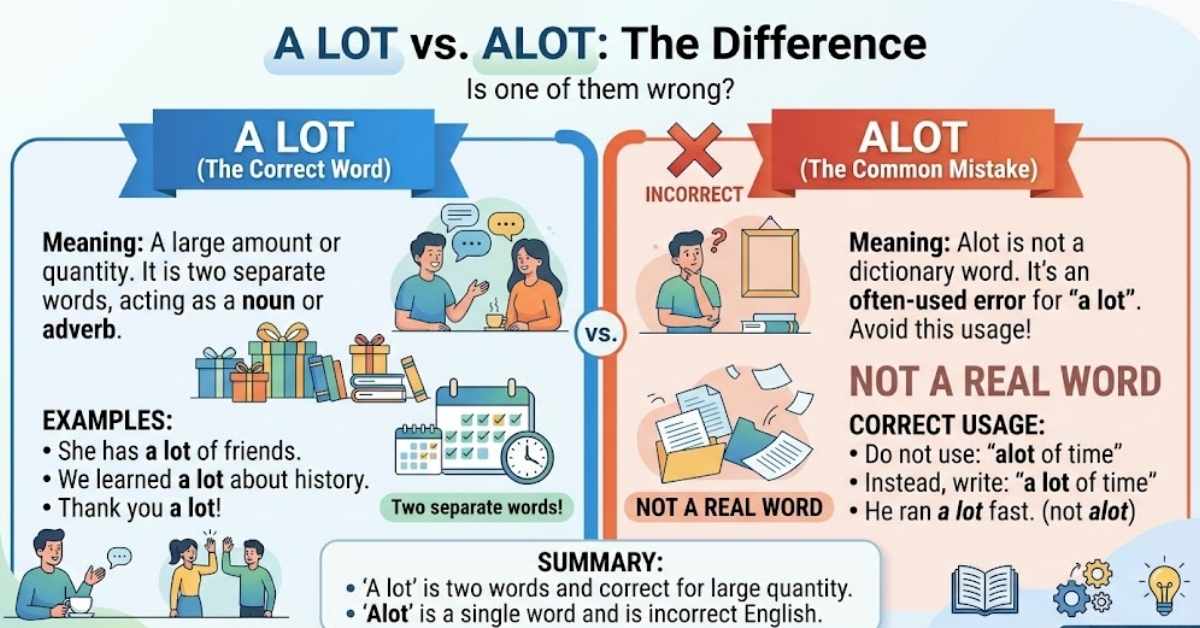
Alot or a lot is a common spelling question, but the answer is simple: a lot is the correct standard spelling when you mean “a large amount,” “a large number,” “very much,” or “frequently.” Alot is a common misspelling created by joining the two words together. If you are writing an email, school assignment, article, text, or professional document in standard U.S. English, write a lot, with a space. Dictionary.com and major grammar references consistently distinguish a lot from the nonstandard alot.
The confusion is understandable because a lot is pronounced naturally as a connected phrase in everyday speech. However, pronunciation does not change its standard written form. There is also a third word worth knowing: allot, which is a real verb meaning “to assign” or “to distribute.”
Alot or A Lot: Which Is Correct?
The correct form is a lot.
- a lot = correct
- alot = nonstandard spelling/misspelling of a lot
- allot = correct word with a different meaning
Quick examples
Correct:
I have a lot of work today.
Incorrect:
I have alot of work today.
Different word:
The manager will allot two hours to each team.
This distinction is especially important because a lot and allot can sound similar in speech, but their meanings and grammatical functions are completely different. Grammarly likewise identifies a lot as the correct two-word spelling and allot as a separate word.
What Does “A Lot” Mean?
The meaning of a lot depends on how it is used in a sentence.
It can mean:
- a large amount
- a large number
- very much
- to a great degree
- frequently
For example:
She has a lot of books.
Here, a lot of means a large number of books.
I like this movie a lot.
The Here, a lot means very much.
He travels a lot.
Here, it means frequently.
Dictionary.com lists a lot as a noun and adverb and gives meanings including a large number or amount and “very much.”
Alot or A Lot Definition
Definition of “a lot”
A lot is a standard English expression used to indicate a large amount, a large number, a considerable degree, or frequent occurrence, depending on the sentence.
Examples:
There are a lot of people here.
We have a lot of time.
She studies a lot.
I miss you a lot.
Definition of “alot”
When people write alot, they generally intend to write a lot. In standard English writing, however, alot is not the standard spelling of this expression.
That means you should correct:
I learned alot today.
to:
I learned a lot today.
This distinction is supported by major grammar and usage resources, including Grammarly, QuillBot, Dictionary.com, and LanguageTool.
How Do You Spell Alot or A Lot?
If you are asking how to spell alot or a lot, spell it:
a lot
There is a space between a and lot.
Correct spelling
a lot
Incorrect standard spelling
alot
Don’t add a hyphen
a-lot ❌
The phrase is written as two separate words, not one word and not a hyphenated word.
A useful proofreading habit is to slow down whenever you type the phrase. Think:
a + lot = a lot
That tiny pause can prevent the error.
Why Is “Alot” So Common?
If alot is incorrect, why do people write it so often?
The main reason is that spoken English does not clearly mark word boundaries.
When someone says:
I like it a lot.
the words flow together naturally. In rapid speech, the phrase can sound almost like a single unit. A writer may then reproduce that sound visually as alot.
The same problem occurs with many other expressions in English. Our brains process familiar speech as connected sound, while writing requires us to decide where one word ends and another begins.
Typing habits can make the problem even more common. Texting, social media, instant messaging, and fast informal writing encourage people to type what they hear rather than stop and check the standard written form.
That does not make alot an accepted alternative spelling.
A Lot or Allot: What Is the Difference?
This is the most important related confusion.
A lot and allot are not different spellings of the same word.
They have different meanings.
| Form | Meaning | Example |
|---|---|---|
| a lot | A large amount/number; very much; frequently | I have a lot of work. |
| alot | Nonstandard spelling of a lot | Avoid alot in standard writing. |
| allot | To assign or distribute | We will allot each person ten minutes. |
A simple meaning test
If you mean many, much, very much, or frequently, use:
a lot
If you mean assign, distribute, or allocate, use:
allot
Compare:
We have a lot of money.
This describes quantity.
We will allot the money to three departments.
This describes distribution.
The two expressions may appear in the same sentence:
We have a lot of money to allot among the departments.
That sentence makes the distinction especially clear.
A Lot or Allot in a Sentence
A lot
She has a lot of experience.
Meaning: she has a large amount of experience.
Allot
The committee will allot each speaker five minutes.
Meaning: the committee will assign five minutes to each speaker.
Both together
We have a lot of tasks, so we need to allot enough time to each one.
The first describes quantity. The second describes assignment.
A Lot in a Sentence
One of the easiest ways to understand a lot is to see how its position changes its meaning.
A lot of + plural countable noun
There are a lot of students in the classroom.
She owns a lot of books.
We received a lot of questions.
Here, a lot of indicates a large number.
A lot of + uncountable noun
We need a lot of information.
He doesn’t have a lot of time.
They spent a lot of money.
Here, a lot of indicates a large amount.
Verb + a lot
I read a lot.
She travels a lot.
They practice a lot.
Here, a lot commonly indicates frequency.
Verb + object + a lot
I like this song a lot.
We enjoyed the trip a lot.
She appreciates your help a lot.
Here, it generally means very much.
I Love You Alot or A Lot?
If you are wondering whether to write:
I love you alot.
or:
I love you a lot.
the standard spelling is:
I love you a lot.
The phrase a lot is functioning as an adverbial expression that intensifies the verb love. It means very much.
Other natural examples include:
I miss you a lot.
I appreciate you a lot.
I care about you a lot.
I think about you a lot.
In each case, keep a and lot separate.
When to Use A Lot
The Use a lot when you want to express quantity, degree, or frequency.
Use “a lot” for a large amount
We have a lot of work to finish.
Use “a lot” for a large number
A lot of people attended the event.
The Use “a lot” for frequency
She exercises a lot.
Use “a lot” for degree
I like the new design a lot.
Use “a lot” for emphasis
This new version is a lot better.
In all of these cases, the spelling remains a lot.
A Lot With Countable and Uncountable Nouns
A particularly useful grammar point is that a lot of works with both countable and uncountable nouns.
Countable nouns
Countable nouns can be counted individually.
Examples:
- people
- books
- cars
- questions
- students
- houses
Examples:
There are a lot of people outside.
She bought a lot of books.
We received a lot of questions.
Uncountable nouns
Uncountable nouns are normally treated as substances, concepts, or quantities rather than individual items.
Examples:
- information
- money
- time
- water
- work
- advice
Examples:
I need a lot of information.
We don’t have a lot of time.
She gave me a lot of advice.
This flexibility is one reason a lot of is so common in everyday English.
A Lot vs. Lots of
Lots of is also correct.
For example:
We have a lot of work.
We have lots of work.
Both sentences mean essentially the same thing.
The main difference is register. Lots of is generally more informal and conversational, while a lot of is neutral and extremely common.
Dictionary.com describes lots as having the same basic quantity meaning as a lot and notes its more informal character.
Compare the forms
| Expression | Standard? | Typical tone |
|---|---|---|
| a lot of | Yes | Neutral/everyday |
| lots of | Yes | Informal |
| alot of | No | Misspelling |
| allot of | No, when meaning quantity | Wrong word |
A Lot With Comparative Adjectives
A useful construction that many basic articles overlook is a lot + comparative adjective or adverb.
Examples:
This computer is a lot faster.
The new version is a lot better.
The test was a lot easier than I expected.
This route is a lot shorter.
The second option is a lot more expensive.
Here, a lot strengthens the comparison.
Compare:
The new model is better.
with:
The new model is a lot better.
The second sentence emphasizes that the difference is substantial.
This is another reason it is useful to understand a lot as more than simply “many.”
A Lot as an Adverb
In sentences such as:
I exercise a lot.
She talks a lot.
We travel a lot.
a lot works adverbially.
It can express frequency or, depending on context, degree.
For example:
I see him a lot.
usually means frequently.
But:
I like him a lot.
means very much.
Context determines the exact interpretation.
A Lot as a Quantity Expression
In:
We have a lot of work.
the expression describes quantity.
It answers a question such as:
How much work?
Answer:
A lot of work.
Similarly:
How many people came?
A lot of people came.
This gives you a practical test for recognizing the quantity use.
Is It Alot or A Lot?
If your question is “Is it alot or a lot?”, the standard answer is:
a lot
Use it as two words.
I learned a lot today.
Not:
I learned alot today.
If you mean “assign” or “distribute,” however, use allot:
The teacher will allot ten minutes for questions.
Alot or A Lot Meaning
The expression a lot can communicate several closely connected meanings.
Large amount
She has a lot of patience.
Large number
There are a lot of options.
Very much
I enjoyed the movie a lot.
Frequently
He visits his grandparents a lot.
To a significant degree
This method is a lot more efficient.
The meaning is determined by the surrounding sentence.
Common Mistakes With Alot
Mistake 1: Joining the words
❌ I have alot of homework.
✅ I have a lot of homework.
Mistake 2: Confusing it with allot
❌ We will a lot ten minutes to each speaker.
✅ We will allot ten minutes to each speaker.
Mistake 3: Using “alot” in professional writing
❌ The company has alot of customers.
✅ The company has a lot of customers.
Mistake 4: Adding a hyphen
❌ I have a-lot of questions.
✅ I have a lot of questions.
Mistake 5: Assuming informal writing changes the spelling
You may see alot in texts, comments, usernames, or social media posts. Frequent online use does not make it the standard spelling.
For edited writing, keep the space.
How to Remember A Lot
Here are several memory tricks.
Think “a + lot”
Break the phrase into its original components:
a + lot = a lot
Use “a whole lot”
Try expanding the phrase:
I have a whole lot of work.
The space becomes obvious.
Compare it with “a little”
You write:
a little
not:
alittle
The same visual pattern can help:
a lot a little
Remember the meaning of “lot”
The noun lot can stand on its own in English.
For example:
a parking lot
a vacant lot
a large lot of land
Since lot is already an independent word, keep the article separate in a lot.
Is “A Lot” Formal or Informal?
A lot is standard English and is extremely common in everyday American English.
However, in highly formal, academic, technical, or professional writing, a more precise expression may sometimes be preferable.
For example:
Instead of:
A lot of participants responded.
you might write:
Many participants responded.
Or:
A large number of participants responded.
Instead of:
The project requires a lot of time.
you might write:
The project requires considerable time.
The choice depends on context. This does not mean a lot is grammatically wrong in formal writing. It means that formal writing sometimes benefits from more specific wording.
A Lot vs. Many vs. Much
These expressions overlap, but they are not interchangeable in every grammatical structure.
A lot of
Works with plural countable and uncountable nouns:
a lot of books
a lot of information
Many
Used with plural countable nouns:
many books
many people
Much
Usually used with uncountable nouns, particularly in questions and negative or formal constructions:
much information
much time
Compare:
I have a lot of friends.
Not:
I have much friends.
And:
I don’t have much time.
I don’t have a lot of time.
Both can be grammatical, although their style and emphasis differ.
A Lot vs. A Great Deal
A great deal can often replace a lot when referring to an uncountable amount.
We spent a lot of money.
We spent a great deal of money.
The second version is generally more formal.
For plural countable nouns, a great deal of does not normally replace a lot of:
a lot of students
not:
a great deal of students
In that case, use:
many students
A Lot in Everyday American English
For a U.S. audience, a lot is an ordinary and highly familiar expression.
You can naturally use it in:
- conversations
- text messages
- emails
- blog posts
- general articles
- workplace communication
- school writing
The question is usually not whether a lot is allowed, but whether a more precise alternative would improve the particular sentence.
A U.S. style guide from the North Orange County Community College District explicitly lists a lot as two words, not alot.
Does British English Spell It “Alot”?
No.
British English does not make alot the standard spelling.
The standard expression remains:
a lot
A British writer may choose lots of, many, much, or a great deal of depending on the context and level of formality, but that does not turn a lot into alot.
Does American English Spell It “Alot”?
No.
American English also uses:
a lot
not:
alot
Dictionary.com specifically labels its a lot entry as American and records alot as a frequent misspelling.
LEARN MORE: Pricey or Pricy
A Lot in Professional Emails
Consider these examples:
Correct
Thank you a lot for your help.
More neutral/professional
Thank you very much for your help.
Both are understandable, but very much may sound more polished in some professional situations.
Another example:
We have a lot of work remaining.
This is grammatically correct. Depending on the context, a more precise version could be:
We have several tasks remaining.
or:
We still have considerable work to complete.
The important distinction is style versus correctness. A lot is standard; alternatives may simply be more precise or formal.
A Practical Editing Test
When proofreading your writing, search for:
alot
Every time you find it, ask whether you intended a lot.
If yes, insert the space.
Then search for:
a lot
and check whether you actually meant allot.
For example:
The manager will a lot ten minutes to each presentation.
This looks wrong because the intended meaning is “assign.”
Correct:
The manager will allot ten minutes to each presentation.
This two-step search is particularly useful when editing a long document.
20 Correct Examples of A Lot
- I have a lot of work today.
- She has a lot of friends.
- We learned a lot from the experience.
- He travels a lot for work.
- I miss my family a lot.
- There is a lot of traffic today.
- They spent a lot of money.
- We need a lot of information.
- She reads a lot.
- I enjoyed the concert a lot.
- There are a lot of reasons to wait.
- He has a lot of patience.
- This option is a lot better.
- The new system is a lot faster.
- We have a lot of time.
- She practices a lot.
- They ask a lot of questions.
- I think about that problem a lot.
- The new route is a lot shorter.
- We have a lot to discuss.
Incorrect and Correct Examples
| Incorrect | Correct |
|---|---|
| I have alot of work. | I have a lot of work. |
| She studies alot. | She studies a lot. |
| I love you alot. | I love you a lot. |
| There are alot of people. | There are a lot of people. |
| He travels alot. | He travels a lot. |
| We need alot of time. | We need a lot of time. |
| It is alot better. | It is a lot better. |
| I learned alot today. | I learned a lot today. |
Frequently Asked Questions
Is “alot” or “a lot” correct?
A lot is correct when you mean a large amount, a large number, very much, or frequently. Alot is a common nonstandard spelling.
How do you write “alot” or “a lot”?
Write a lot as two separate words.
How do you spell “alot” correctly?
If you mean the common expression meaning “a large amount,” spell it a lot. There is a space between a and lot.
When do you use “a lot”?
Use a lot for quantity, degree, or frequency.
We have a lot of work.
She exercises a lot.
What does “a lot” mean?
It can mean a large amount, a large number, very much, or frequently, depending on how it is used.
Is “I love you alot” correct?
No, not in standard English. Write:
I love you a lot.
Is “I love you a lot” correct?
Yes. A lot is the standard spelling and means very much in this sentence.
Is “alot” one word?
When people use alot to mean a lot, it is a nonstandard spelling. The standard expression is written as two words.
Is “a lot” two words?
Yes. A lot consists of two words: the article a and the noun lot.
Is “allot” the same as “a lot”?
No. Allot is a separate verb meaning to assign, distribute, or allocate.
What is the difference between “a lot” and “lots of”?
Both can express a large quantity or number. Lots of is generally more informal.
Can I use “a lot” in professional writing?
Yes. It is standard English. However, in formal or technical writing, a more precise expression such as many, numerous, considerable, or a large number of may sometimes communicate the idea more effectively.
Why do people write “alot”?
The phrase a lot can sound like one connected unit in normal speech, which makes the spelling easy to merge when typing.
Is “a lot” a noun?
It can function as a noun phrase in quantity expressions, although its exact grammatical analysis depends on the sentence. It can also function adverbially.
Is “a lot” an adverb?
It can function as an adverbial expression, particularly in sentences such as:
She travels a lot.
Is “a lot of” correct?
Yes. A lot of can be used before plural countable nouns and singular uncountable nouns.
Is “a-lot” correct?
No. The standard spelling is a lot, with a space and no hyphen.
Final Answer: Alot or A Lot?
When the intended meaning is a large amount, a large number, very much, frequently, or to a significant degree, write a lot.
Alot is not the standard spelling of this expression.
And remember the separate word allot:
a lot = a large amount/number, very much, or frequently
allot = assign or distribute
So if you’re asking “alot or a lot which is correct?”, choose:
A lot
The simplest rule is also the most useful one:
If you mean “many,” “much,” “very much,” or “frequently,” write “a lot.”