

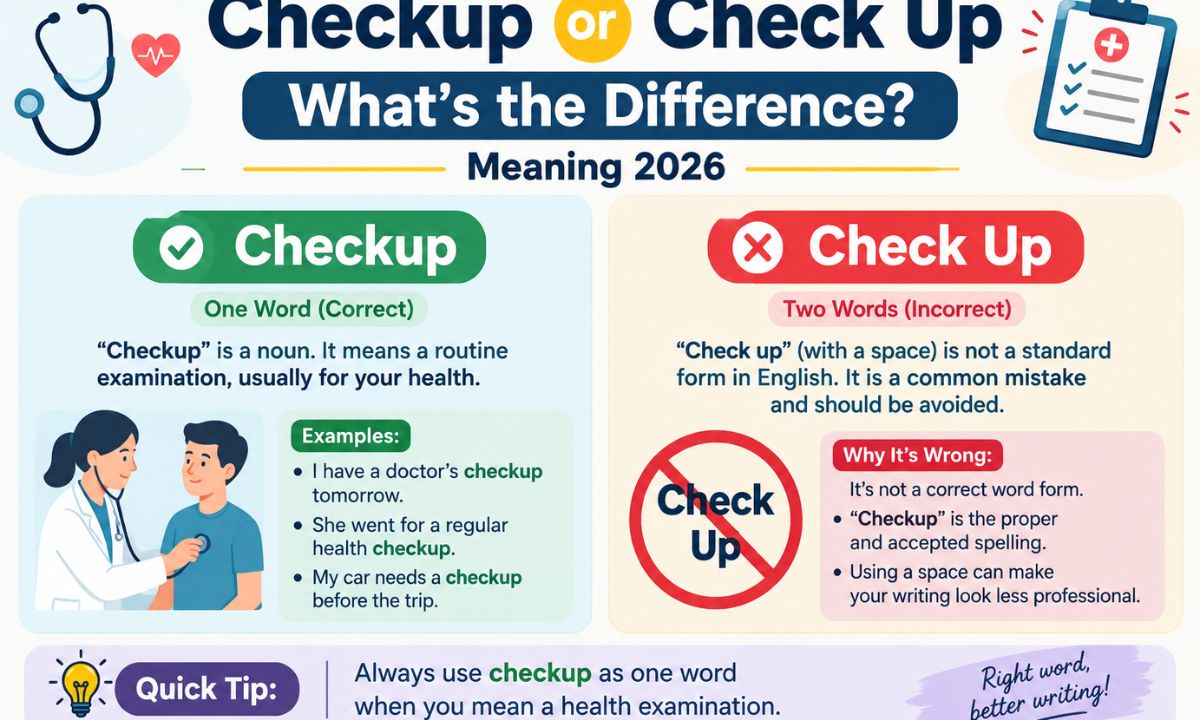
Many English learners and even native speakers wonder whether they should write checkup, check up, or checkup. Since these forms look almost identical, it’s easy to assume they mean the same thing and can be used interchangeably.
However, each form has a different grammatical role, and choosing the wrong one can make your writing look less polished. This confusion appears frequently in emails, medical documents, academic writing, workplace communication, and everyday conversations.
In this guide, you’ll learn the exact difference between checkup, check up, and check-up, discover how each form functions in English grammar, and see plenty of real-world examples that make the distinction easy to understand.
We’ll also explain American and British usage, common mistakes, and simple memory tricks that help you choose the correct form every time. By the end of this article, you’ll know when checkup is the right noun, when check up should be used as a verb, and where the hyphenated checkup fits into modern English.
If you’re looking for a quick answer, here’s the rule:
- Checkup (one word) is a noun.
- Check up (two words) is a verb phrase.
- Check-up (hyphenated) is accepted mainly in British English and in some style guides as a noun or adjective.
Notice how the first sentence uses checkup because it’s the name of an examination. The second uses check up because it’s describing an action.
Once you recognize this grammatical distinction, choosing the correct form becomes straightforward, and your writing immediately sounds more natural and professional.
What Does Checkup Mean? & What Does Check Up Mean?
Although checkup and check up are closely related in meaning, they perform different grammatical functions. Understanding how each one works is the key to using them correctly in both spoken and written English.
Many learners focus only on spelling, but the real difference lies in whether the expression acts as a noun or a verb. Once you understand this distinction, choosing the correct form becomes much easier.
A checkup is the name of an examination, inspection, or evaluation. It usually refers to a medical examination performed by a healthcare professional to assess a person’s overall health, detect possible problems, or monitor an existing condition.
However, the word isn’t limited to medicine. It can also describe inspections of equipment, vehicles, computers, buildings, or other systems that require regular examination
By contrast, check up is a phrasal verb that means to investigate, inspect, verify, monitor, or examine someone or something. Since it expresses an action, it behaves like any other verb and changes according to tense.
You might hear someone say, “The nurse will check up on the patient,” or “I’ll check up on your order tomorrow.” In these examples, check up describes what someone is doing rather than naming an examination.
What Does Check Up Mean as a Verb?
The expression check up is a phrasal verb that means to investigate, inspect, examine, verify, monitor, or make sure that someone or something is doing well. Unlike checkup, which names an examination, check up describes the action of examining or confirming information. Because it functions as a verb, it changes according to tense and follows the normal rules of English grammar.
One of the most common patterns is check up on, which means to visit, observe, or monitor someone or something to ensure everything is satisfactory.
For example:
- The nurse checked up on the patient several times during the night.
- I’ll check up on your application tomorrow.
- Parents often check up on their children before going to bed.
- The supervisor checked up on the new employees during their first week.
In each sentence, check up describes an action rather than naming an object or event.
The verb also appears in situations involving research or verification. Someone might check up on a fact before publishing an article or check up on a delivery to confirm that it arrived safely. In these contexts, the meaning is similar to verify, confirm, or investigate.
What Does Check Up Mean as a Verb?
The expression check up is a phrasal verb that means to investigate, inspect, examine, verify, monitor, or make sure that someone or something is doing well. Unlike checkup, which names an examination, check up describes the action of examining or confirming information. Because it functions as a verb, it changes according to tense and follows the normal rules of English grammar.
One of the most common patterns is check up on, which means to visit, observe, or monitor someone or something to ensure everything is satisfactory.
For example:
- The nurse checked up on the patient several times during the night.
- I’ll check up on your application tomorrow.
- Parents often check up on their children before going to bed.
- The supervisor checked up on the new employees during their first week.
In each sentence, check up describes an action rather than naming an object or event.
The verb also appears in situations involving research or verification. Someone might check up on a fact before publishing an article or check up on a delivery to confirm that it arrived safely. In these contexts, the meaning is similar to verify, confirm, or investigate.
Checkup vs Check Up The Core Grammatical Difference
The biggest difference between checkup and check up has nothing to do with meaning and everything to do with grammar. Many English learners believe the only distinction is spelling, but the real difference is the role each expression plays in a sentence. Once you identify whether you need a noun or a verb, choosing the correct form becomes simple.
A checkup is a countable noun. It names an examination, inspection, or assessment. Since it functions as a noun, it can follow articles such as a, an, and the, appear in plural form, and be modified by adjectives.
Examples:
- I have a checkup scheduled for Friday.
- The doctor performed a complete checkup.
- She attends regular checkups every year.
- My dental checkup lasted thirty minutes.
In each sentence, checkup refers to the examination itself. It behaves like other countable nouns such as meeting, appointment, or inspection.
On the other hand, check up is a phrasal verb. It describes the action of examining, investigating, verifying, or monitoring someone or something. Like every other verb, it changes according to tense and subject.
Examples:
- I’ll check up on the documents this afternoon.
- The nurse checked up on the patient several times.
- They are checking up on the new software.
- We should check up on the weather before traveling.
What Is the Difference Between Checkup and Check Up?
Although checkup and check up share the same basic idea of examining or verifying something, they are not interchangeable because they belong to different parts of speech. This distinction affects sentence structure, grammar, and word choice.
The easiest way to remember the difference is to ask yourself a simple question:
Are you naming an examination, or are you describing an action?
If you’re naming an examination, use checkup.
If you’re describing the act of examining or monitoring, use check up.
Compare these examples:
- I have a health checkup tomorrow.
- The doctor will check up on me tomorrow.
The first sentence refers to the medical appointment itself. The second describes the doctor’s action.
Here are more comparisons:
| Checkup (Noun) | Check Up (Verb) |
| annual checkup | check up on a patient |
| dental checkup | check up on the children |
| eye checkup | check up on the report |
| routine checkup | check up on the equipment |
| complete checkup | check up before making a decision |
Another helpful test is substitution.
Real World Uses of Checkup in Everyday English
The noun checkup appears in many areas of daily life, although people most often associate it with healthcare. Doctors, dentists, optometrists, veterinarians, and other professionals regularly use the term to describe routine examinations that help identify problems before they become serious.
Because preventive care has become increasingly important, the word checkup now appears frequently in hospitals, clinics, insurance documents, and health campaigns around the world.
For example, adults often schedule annual physical checkups even when they feel healthy. Dentists recommend dental checkups every six months to detect cavities and gum disease early.
Eye specialists encourage regular vision checkups to identify changes that may require new glasses or treatment. In each of these situations, checkup refers to the appointment or examination itself rather than the action of examining.
Outside medicine, the word also appears in many professional fields. Mechanics perform vehicle checkups before long trips to ensure a car is safe and reliable. Airline engineers complete aircraft checkups before flights.
Computer technicians carry out system checkups to detect software errors, malware, or hardware failures. Manufacturing companies schedule equipment checkups to reduce downtime and improve workplace safety.
Where Do We Use the Word Checkup Most?
The word checkup is most commonly used in healthcare, where it refers to routine medical examinations designed to monitor a person’s health. Doctors encourage regular checkups because they help detect illnesses early, track ongoing conditions, and provide advice for maintaining good health.
As a result, you’ll frequently encounter the word in clinics, hospitals, pharmacies, insurance forms, and public health campaigns.
Common healthcare examples include:
- annual health checkup
- physical checkup
- dental checkup
- eye checkup
- heart checkup
- prenatal checkup
However, healthcare isn’t the only field where checkup is useful. The word also appears whenever a thorough inspection or evaluation is required.
For example:
- A mechanic performs a vehicle checkup before a long journey.
- An engineer completes a machinery checkup before production begins.
- A financial advisor recommends a financial checkup to review savings and investments.
These examples show that checkup has expanded beyond medicine and now applies to many different types of inspections. Regardless of the setting, the word always functions as a noun, referring to the examination itself rather than the action of checking.
By recognizing these common contexts, you’ll know exactly when checkup is the appropriate choice and avoid confusing it with the verb phrase check up.
Easy Trick to Remember Checkup or Check Up Every Time
Many learners memorize grammar rules but still hesitate when writing checkup or check up. Fortunately, you don’t need to remember complicated explanations every time you write. A simple memory trick can help you choose the correct form within seconds.
Ask yourself one question:
Am I talking about a thing or an action?
If you’re talking about a thing, use checkup.
If you’re talking about an action, use check up.
Think of it this way:
- Checkup = Examination
- Check up = Examine
Let’s test this trick.
Sentence:
“I have a medical tomorrow.”
Can you replace the blank with examination?
Yes.
“I have a medical examination tomorrow.”
Since examination is a noun, the correct answer is checkup.
Noun vs Verb (One Word vs Two Words)
One of the easiest ways to master checkup and check up is by understanding the difference between nouns and verbs. Instead of focusing only on spelling, pay attention to the grammatical role the expression plays in the sentence. This approach works not only for checkup but also for many other English compound words.
A noun names a person, place, thing, event, or idea. In this case, checkup is the name of an examination or inspection. Because it functions as a noun, it can be singular or plural, follow articles, and be modified by adjectives.
Examples:
- The doctor recommended a checkup.
- My annual checkup went well.
- She never misses her dental checkups.
- A complete checkup can detect problems early.
A verb, on the other hand, expresses an action or state. The phrase check up tells us what someone does. It often appears with on to form the expression check up on, meaning to monitor or investigate someone or something.:
Checkup or Check Up: What’s the Difference?
| Term | Part of Speech | When to Use It | Example |
| Checkup | Noun | Use as one word when referring to a medical examination or inspection. | I have a dental checkup tomorrow. |
| Check-up | Noun (hyphenated variant) | An alternative spelling of checkup, more common in British English and some style guides. | She scheduled a yearly check up. |
Which One Is More Common?
- Checkup (one word) is more common in American English.
- Checkup (hyphenated) is more common in British English.
- Both spellings are correct, but it’s best to stay consistent throughout your writing.
FAQs
Is “checkup” or “check-up” correct?
Both are correct; checkup is more common in American English, while check-up is preferred more often in British English.
Is “checkup” one word?
Yes. In American English, checkup is usually written as one word.
Does “check-up” have the same meaning as “checkup”?
Yes. They have the same meaning and both refer to a routine examination.
Which spelling should I use in formal writing?
Use the spelling that matches your chosen English style and stay consistent.
Can I use “checkup” outside of medical contexts?
Yes. Although it most commonly refers to a medical examination, checkup can also describe a routine inspection or review, such as a vehicle or equipment checkup.
Is “check up” (two words) different from “checkup”?
Yes. Check up (two words) is a verb phrase that means to investigate or examine something, while checkup (or check up) is a noun meaning an examination.
Examples:
- The doctor gave me a checkup. ✅ (noun)
- I’ll check up on the results tomorrow. ✅ (verb phrase)
Conclusion
Understanding the difference between checkup and check up is simple once you know that both spellings refer to the same type of routine examination. The main difference is regional preference rather than meaning. In most American English writing, checkup is the standard spelling, while check up appears more frequently in British English and some style guides.
To write clearly and professionally, choose the spelling that matches your audience and use it consistently throughout your document. If you’re also using the verb phrase, remember that check up (two words) means to investigate or examine, whereas checkup or check up functions as a noun. Keeping these distinctions in mind will help you avoid common mistakes and improve the accuracy of your English writing.