

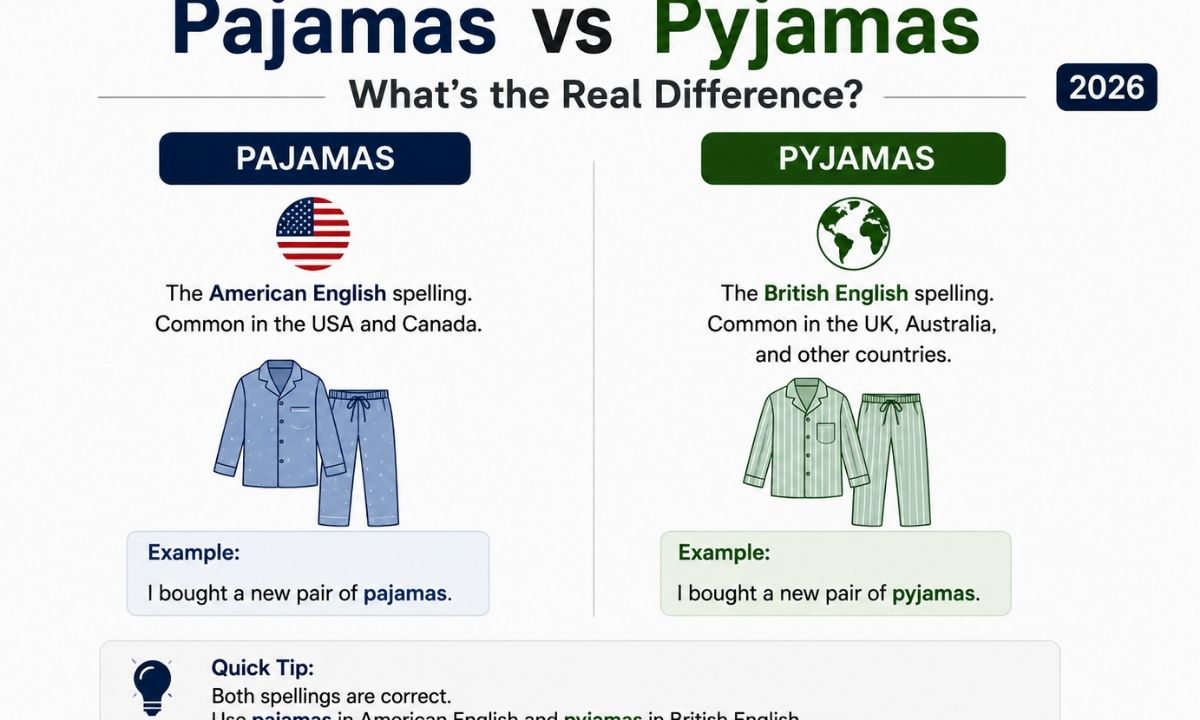
Have you ever seen pajamas vs pyjamas in two diffrent articals? You may wonder whether one spelling is wrong. The good news is that both words are correct.
The difference is mainly based on the type of English you use. Pajamas is the usual spelling in American English, while pyjamas is the usual spelling in British English.
Both words describe clothes people wear for sleeping or relaxing at home. They have the same meaning and almost the same pronunciation.
For example:
- American: I bought new pajamas yesterday.
- British: I bought new pyjamas yesterday.
So, why do two spellings exist? Where did the word come from? Which form should you use in your writing?
This guide explains Pajamas vs Pyjamas in simple language. You will learn their meanings, history, regional use, everyday examples, and the easiest way to remember the difference.
What Do They Mean?
Pajamas and pyjamas mean the same thing.
They usually refer to comfortable clothes worn while sleeping. People can also wear them while relaxing at home.
Common examples include:
- A shirt and trousers
- A matching sleepwear set
- Comfortable night clothes
For example:
I changed into my pajamas before going to bed.
The British version is:
I changed into my pyjamas before going to bed.
The meaning stays exactly the same.
Simple Meaning
In simple words:
Pajamas = sleepwear
Pyjamas = sleepwear
The spelling changes, but the meaning does not.
Where Did the Word Come From?
The word has an interesting history.
Pajama came into English from languages used in South Asia. Its deeper origin connects to the Persian word pāy-jāma, which referred to clothing for the legs.
The term became familiar to English speakers during the period when Britain had strong connections with India.
Over time, English speakers started using the word for loose and comfortable clothing. Eventually, it became closely connected with clothing worn for sleeping.
The spelling then developed differently in different English speaking regions.
A Short History
The basic journey looks like this:
Persian → South Asian languages → English → American and British varieties
This history explains why the word may look slightly unusual compared with many traditional English words.
Why Did the Spelling Change?
English does not have one universal spelling system.
American and British English developed different spelling preferences over time. As a result, some words gained separate forms.
For example:
- pajamas / pyjamas
- color / colour
- favorite / favourite
- center / centre
- theater / theatre
Therefore, pajamas vs pyjamas is part of a much larger pattern.
Pajamas in American English
Pajamas is the normal spelling in American English.
If you are writing for readers in the United States, this is usually the form you should choose.
For example:
- I bought new pajamas.
- My pajamas are in the bedroom.
- These pajamas are very comfortable.
- She changed into her pajamas.
- I forgot to pack my pajamas.
American stores also commonly use pajamas in product names.
You may see phrases such as:
- Pajama set
- Pajama pants
- Pajama shorts
- Kids’ pajamas
- Winter pajamas
- Matching pajamas
Common American Use
Americans often use the word in relaxed conversation.
For example:
Person A: Are you ready to go?
Person B: Not yet. I’m still in my pajamas.
Here, the speaker simply means they are still wearing their sleep clothes.
Another common sentence is:
“It’s too early. I’m going back to bed in my pajamas.”
The word feels completely normal in casual American English.
Pyjamas in British English
Pyjamas is the usual spelling in British English.
People in the United Kingdom commonly write:
- I bought new pyjamas.
- Where are my pyjamas?
- These pyjamas are soft.
- She changed into her pyjamas.
- I forgot to pack my pyjamas.
The pronunciation is very similar to the American form.
British Examples
Imagine a child getting ready for bed.
A parent might say:
“Put your pyjamas on.”
Another example could be:
“Have you packed your pyjamas?”
These sentences sound natural in British English.
The same sentences would normally use pajamas in American English.
Pajamas vs Pyjamas
The easiest way to understand the difference is to remember one simple rule:
Pajamas = American English
Pyjamas = British English
That is the main difference.
| Feature | Pajamas | Pyjamas |
| Meaning | Sleepwear | Sleepwear |
| Main variety | American English | British English |
| Pronunciation | Similar | Similar |
| Meaning change | No | No |
| Common US spelling | Yes | No |
| Common UK spelling | No | Yes |
Which One Should You Use?
Choose the spelling based on your audience.
If your website targets people in the United States, use pajamas.
If your website targets people in the United Kingdom, use pyjamas.
For general international writing, either form can work. However, staying consistent throughout the article is important.
Regional Spelling
English speakers in different countries may prefer different forms.
United States
Pajamas is the standard spelling.
Example:
I need comfortable pajamas for winter.
United Kingdom
Pyjamas is the standard spelling.
Example:
I need comfortable pyjamas for winter.
Australia
Australian English generally follows the British spelling:
I bought new pyjamas.
New Zealand
New Zealand English also commonly uses:
pyjamas
Canada
Canadian English can show both American and British influences. However, pajamas is widely used.
The important point is that regional preference does not change the meaning.
Is the Pronunciation Different?
Not in any important way.
Most speakers pronounce pajamas and pyjamas almost identically.
The difference becomes noticeable mainly when you see the word written.
This makes the spelling easier to confuse. Someone might hear the word many times before realizing that different regions spell it differently.
Why Does This Matter?
It matters when you write.
For example, a British website that suddenly changes from pyjamas to pajamas may look inconsistent.
Likewise, an American article that uses pyjamas throughout may look unusual to American readers.
Therefore, choose one spelling and use it consistently.
Everyday Uses
People use both forms in many everyday situations.
At Home
I’m going to put my pajamas on.
Or:
I’m going to put my pyjamas on.
Before Bed
It’s time to put on your pajamas.
Or:
It’s time to put on your pyjamas.
Shopping
I need a new pair of pajamas.
Or:
I need a new pair of pyjamas.
Traveling
Did you pack your pajamas?
Or:
Did you pack your pyjamas?
Family Conversations
Your pajamas are on the bed.
Or:
Your pyjamas are on the bed.
These examples show that the difference is very simple. The sentence structure and meaning stay the same.
Common Phrases
The word appears in several familiar expressions.
Pajama Party
A pajama party is a casual gathering where people, especially children or teenagers, wear sleepwear.
Example:
We’re having a pajama party this weekend.
British English can use:
We’re having a pyjama party this weekend.
Pajama Set
A pajama set usually means matching sleepwear.
Example:
She bought a new pajama set.
British English:
She bought a new pyjama set.
Pajama Pants
This phrase usually describes loose trousers designed for sleeping or relaxing.
Example:
I like wearing pajama pants at home.
The British spelling becomes:
I like wearing pyjama trousers at home.
In Pop Culture
Pajamas and pyjamas often appear in movies, television programs, books, advertisements, and online content.
A character wearing sleepwear can quickly show that they are at home, getting ready for bed, or enjoying a relaxed morning.
Children’s stories also frequently show characters changing into pajamas before bedtime.
The word is also common in online shopping. Clothing websites may use phrases such as:
- Cotton pajamas
- Satin pajamas
- Children’s pajamas
- Matching pajamas
- Winter pajamas
British websites may use pyjamas in the same product descriptions.
Social Media Use
People sometimes mention pajamas when talking about lazy mornings, movie nights, or staying home.
For example:
Weekend plans: pajamas and movies.
Another person might write:
Sunday morning in my pyjamas.
These informal uses are easy to understand because the word has become a familiar part of everyday English.
Common Mistakes
Many learners think pajamas and pyjamas have different meanings. They do not.
Another common mistake is thinking that one spelling is always correct.
That is also incorrect.
Mistake: Calling One Wrong
❌ Pyjamas is always wrong.
This is incorrect because pyjamas is standard British English.
Mistake: Mixing Styles
An article may begin with pajamas and later switch to pyjamas without a reason.
This can make the writing look inconsistent.
Mistake: Thinking the Meaning Changes
The spelling does not create a new type of clothing.
Both words refer to sleepwear.
How to Remember the Difference
A simple memory trick can help.
Think:
P = Pajamas = USA
Y = Pyjamas = UK
You do not need to memorize a long grammar rule.
Just remember the regional connection.
Easy Rule
If you write American English → pajamas
If you write British English → pyjamas
That is enough for most situations.
Pajamas vs Pyjamas for SEO
The spelling can also matter for online content.
Searchers in different regions may type different versions into Google. American users are more likely to search for pajamas, while British users commonly search for pyjamas.
Therefore, your target audience should influence your primary spelling.
For an American audience, use pajamas naturally throughout the article.
For a British audience, use pyjamas naturally.
However, mentioning both spellings can help when your article specifically explains the difference.
Keep Your Content Natural
Do not repeat the keyword unnaturally just to increase keyword density.
Instead, use related terms naturally, such as:
- sleepwear
- night clothes
- bedtime clothes
- pajama set
- pyjama set
- sleeping clothes
This makes the article easier to read while still covering the topic clearly.
Quick Comparison
Here is the easiest summary:
Pajamas is the American spelling.
Pyjamas is the British spelling.
Both mean sleepwear.
Both are correct.
Neither spelling changes the meaning.
The main difference is regional English.
Our Vision
Our vision is to make confusing English words and spelling differences easy to understand. We explain language rules with simple definitions, real examples, and everyday conversations so readers can write with confidence.
FAQs Pajamas vs Pyjamas
Which is correct pajamas or pyjamas?
Both are correct. Pajamas is common in American English, while pyjamas is standard in British English.
Why do Americans spell it pajamas?
American English developed its own spelling conventions. As a result, pajamas became the standard American form.
Is pyjamas used in America?
Yes, Americans understand pyjamas, but pajamas is much more common in American writing.
Does the spelling change the meaning?
No. Both spellings describe the same type of sleepwear. Only the regional spelling differs.
Which spelling should I use for a website?
Use pajamas for an American audience and pyjamas for a British audience. Most importantly, keep your spelling consistent.
Are pajamas and sleepwear the same thing?
Not exactly. Pajamas are one type of sleepwear, while sleepwear is a broader term that can include robes, nightgowns, pajamas, and other bedtime clothes.
Conclusion
The difference between pajamas and pyjamas is simple. They are two spellings of the same word.
Use pajamas when following American English. Use pyjamas when following British English.
Both words describe comfortable clothing worn for sleeping or relaxing. Their meaning, pronunciation, and everyday use remain almost the same.
The word also has an interesting history connected to Persian and South Asian languages. Over time, it became part of English and developed different spellings in different regions.
So, the next time you see pajamas or pyjamas, remember: the spelling changes, but the meaning stays the same.