

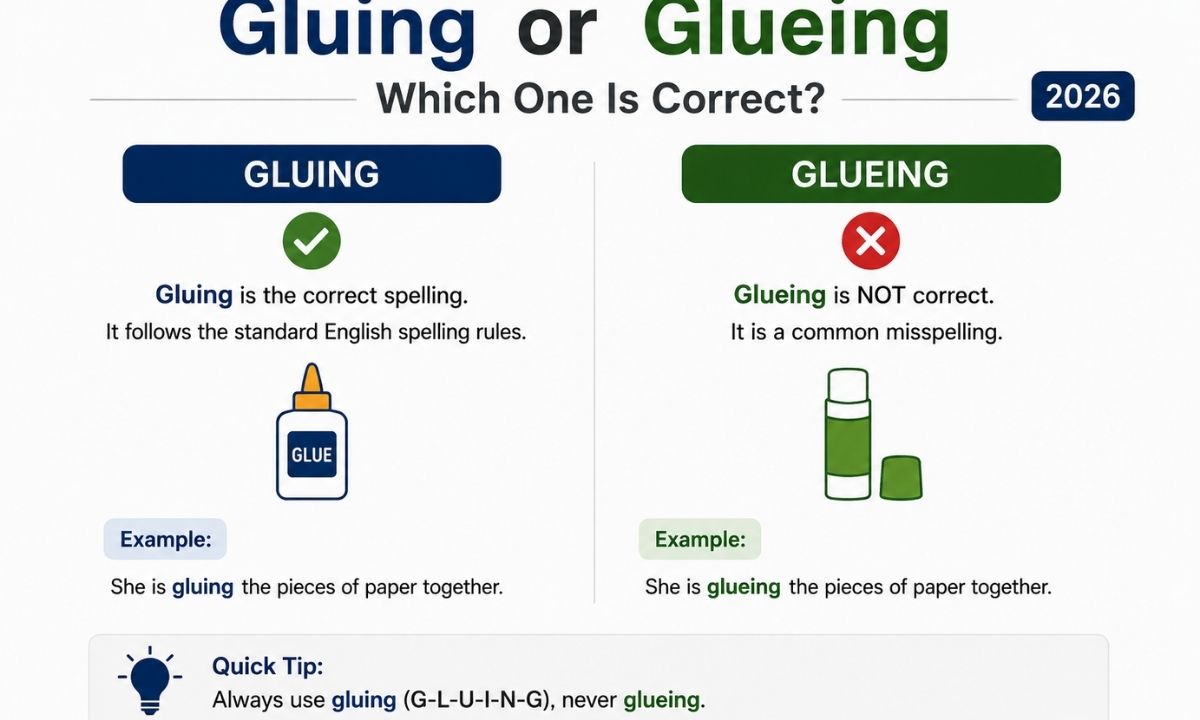
Gluing or Glueing forms look reasonable because the verb comes from the noun glue, and learners may naturally think that adding -ing simply produces glueing. However, standard English uses gluing as the preferred spelling.
The difference comes from a simple spelling rule involving the final e. When you add -ing to glue, the word normally becomes gluing, not glueing. The change may seem small, yet it matters in school assignments, professional writing, websites, product descriptions, and other forms of communication.
For example:
She is gluing the pieces together.
This sentence uses the standard spelling.
On the other hand:
She is glueing the pieces together.
Many readers may recognize the intended meaning, but glueing does not represent the standard modern spelling used in most edited English.
In this guide, you will learn why gluing is correct, why people continue to write glueing, how the spelling rule works, and how to avoid this mistake in your own writing.
What Do Gluing and Glueing Mean?
Before discussing spelling, it helps to understand the meaning of the word.
Gluing is the present participle or gerund form of the verb glue. The verb glue means to attach something to another surface or object with glue.
For example:
- She is gluing the paper to the cardboard.
- He spent the afternoon gluing the model together.
- We are gluing the broken pieces.
- The children enjoyed gluing pictures into their notebooks.
In each example, gluing describes the action of attaching something with adhesive.
What Does “Glue” Mean?
As a verb, glue means to join or attach things using a sticky substance.
For example:
Please glue the label onto the box.
The noun glue refers to the adhesive itself:
We need some glue for this project.
When we turn the verb into its -ing form, standard spelling gives us:
glue → gluing
Not:
glue → glueing
Why Does “Glueing” Look Correct?
The spelling glueing looks logical because English often adds -ing directly to a base word.
For example:
- play → playing
- read → reading
- clean → cleaning
- paint → painting
Because glue already ends in e, some writers simply add -ing and produce glueing. However, spelling conventions do not always work through simple addition.
The final e changes the spelling in this case.
Therefore, the standard form is:
gluing
The Simple Spelling Rule Behind Gluing
The easiest way to understand gluing involves the spelling rule for verbs ending in a silent e.
In many English verbs, we drop the final e before adding -ing.
Consider these examples:
- make → making
- take → taking
- write → writing
- dance → dancing
- use → using
- move → moving
The same basic pattern applies to glue:
glue + ing → gluing
The final e disappears before -ing.
Why Doesn’t “Gluing” Become “Gluing” With a Double E?
The spelling can look unusual because glue ends with the letters ue. When the final e disappears, the remaining form becomes:
glu + ing = gluing
The word keeps the u, but it does not keep the final e.
That gives us:
Correct: gluing
Usually considered nonstandard: glueing
Compare Similar Verbs
Looking at other verbs can make the pattern easier to remember.
| Base Verb | Correct -ing Form |
| glue | gluing |
| use | using |
| make | making |
| write | writing |
| bake | baking |
| hope | hoping |
| move | moving |
However, English spelling contains exceptions and special cases, so you should not apply the rule blindly to every verb.
For glue, though, the standard spelling is straightforward:
gluing
What About Verbs Ending in “ee”?
Some verbs keep their final letters when they take -ing.
For example:
- see → seeing
- agree → agreeing
- free → freeing
This happens because these words end in ee, not a single silent e in the same pattern as glue.
Therefore, gluing follows a different spelling pattern from seeing or agreeing.
Gluing vs Glueing Meaning, Usage and Key Differences
The biggest difference between gluing and glueing involves spelling rather than meaning.
Both forms attempt to represent the same action: attaching something with glue. However, gluing is the standard spelling you should normally use in modern English.
| Word | Status | Meaning | Example |
| Gluing | Standard spelling | Attaching something with glue | She is gluing the pieces together. |
| Glueing | Nonstandard spelling in most edited English | Intended to mean the same action | She is glueing the pieces together. |
Gluing Is the Preferred Form
Use gluing in:
- Academic writing
- Websites
- Blog posts
- Business documents
- School assignments
- Product descriptions
- Instructions
- Professional communication
For example:
The students are gluing colored paper onto the poster.
This spelling looks natural and follows the standard spelling pattern.
Why “Glueing” Creates Confusion
The form glueing feels intuitive because it preserves the complete spelling of glue.
However, English spelling often changes when a suffix begins with a vowel.
That is why you should not always add -ing mechanically to the entire base word.
For example:
write → writing
rather than:
writeing
Similarly:
glue → gluing
rather than:
glueing
Is There Any Difference in Meaning?
No meaningful difference exists between the intended meanings.
If someone writes glueing, readers generally understand that they mean gluing. The issue concerns standard spelling, not a different definition.
Therefore, if your goal involves clear and polished English, choose gluing.
Gluing in Different Contexts
You can use gluing in many situations.
Crafts:
Mia is gluing stars onto the card.
Woodworking:
The carpenter is gluing the wooden pieces together.
School projects:
The students are gluing pictures onto their posters.
Repairs:
He is gluing the broken handle back into place.
Model making:
They spent an hour gluing the small parts together.
In every case, gluing works naturally.
Real World Examples of Gluing Used Correctly
Seeing the correct spelling in different sentences can make the rule easier to remember.
Example: Children’s Activity
The children were gluing pictures into their notebooks.
The past progressive construction uses gluing correctly.
Example: Instructions
Start by gluing the two pieces together.
Here, gluing follows the preposition like structure after by.
Example: Product Description
This adhesive works well for gluing paper, cardboard, and lightweight materials.
The spelling remains unchanged regardless of the context.
Example: Negative Sentence
The paper is not gluing properly because the surface is wet.
The negative construction still requires gluing.
Example: Question
Are you gluing the pieces together now?
The question uses the same standard form.
Example: General Statement
Careful gluing can improve the final appearance of a craft project.
Here, gluing functions as a noun like gerund.
A Quick Correction Exercise
Consider these sentences:
She is glueing the paper.
The standard form is:
She is gluing the paper.
Another example:
We spent the afternoon glueing the model.
Correct it to:
We spent the afternoon gluing the model.
This small editing habit can help you recognize the preferred spelling quickly.
Why Do People Keep Writing Glueing? (And How to Stop)
If gluing is the standard spelling, why does glueing appear so often?
The main reason involves visual logic.
When people see the word glue, they may naturally add -ing without changing anything:
glue + ing = glueing
That approach seems reasonable, especially for learners who have not encountered the spelling rule.
Reason: The Base Word Looks Complete
The word glue already looks complete. Removing the final e can feel strange.
For example:
glue → gluing
Some writers may initially wonder why the e disappears.
However, the spelling follows the same general pattern found in many verbs ending in silent e.
Reason: Pronunciation Can Cause Confusion
The pronunciation does not provide a strong visual clue.
Both gluing and glueing may lead readers toward the same intended pronunciation. Because the spoken forms do not clearly expose the spelling difference, people may choose the form that looks familiar.
Reason: People Follow the “Add -ing” Pattern
Learners often memorize a simple rule:
“Add -ing to the verb.”
That rule works for many words:
- jump → jumping
- walk → walking
- cook → cooking
However, verbs ending in silent e require a spelling adjustment.
Therefore:
make → making
and:
glue → gluing
How to Stop Making the Mistake
The easiest solution involves memorizing one short pair:
Glue → Gluing
You can also connect it with similar examples:
Use → Using
Move → Moving
Write → Writing
Glue → Gluing
When proofreading, search specifically for glueing. If you find it, check whether you intended the verb glue. In standard modern English, gluing will usually be the form you need.
Does “Glueing” Appear Online?
Yes. You may still encounter glueing on websites, social media, informal writing, user-generated content, or older material.
Its appearance does not automatically make it the preferred spelling.
Online content contains many spelling variations, so frequency alone does not determine whether a form represents standard edited English.
For professional content, gluing remains the safer choice.
FAQs Gluing or Glueing
Is “glueing” ever correct?
Gluing is the standard spelling for the present participle of glue. You may encounter glueing, but most modern edited English prefers gluing.
Why do people still write “glueing”?
People often write glueing because they add -ing directly to glue. The spelling looks logical, even though standard usage drops the final e.
Does the correct spelling matter for online content?
Yes. Using gluing helps your content look polished and professional. Correct spelling also improves readability and can strengthen the overall quality of web content.
Is “glueing” the British English spelling?
No. Gluing works as the standard spelling in both British and American English. Glueing is not simply the British version of the word.
How do I remember to use “gluing” correctly?
Remember this simple pair: glue → gluing. Think of the rule for verbs ending in silent e: the final e usually disappears before -ing.
Our Vision
Our vision is to make confusing English words simple through accurate explanations, practical examples, clear comparisons, and easy to remember grammar and spelling rules. We aim to help readers write confidently with language guides that remain useful, accessible, and easy to understand.