

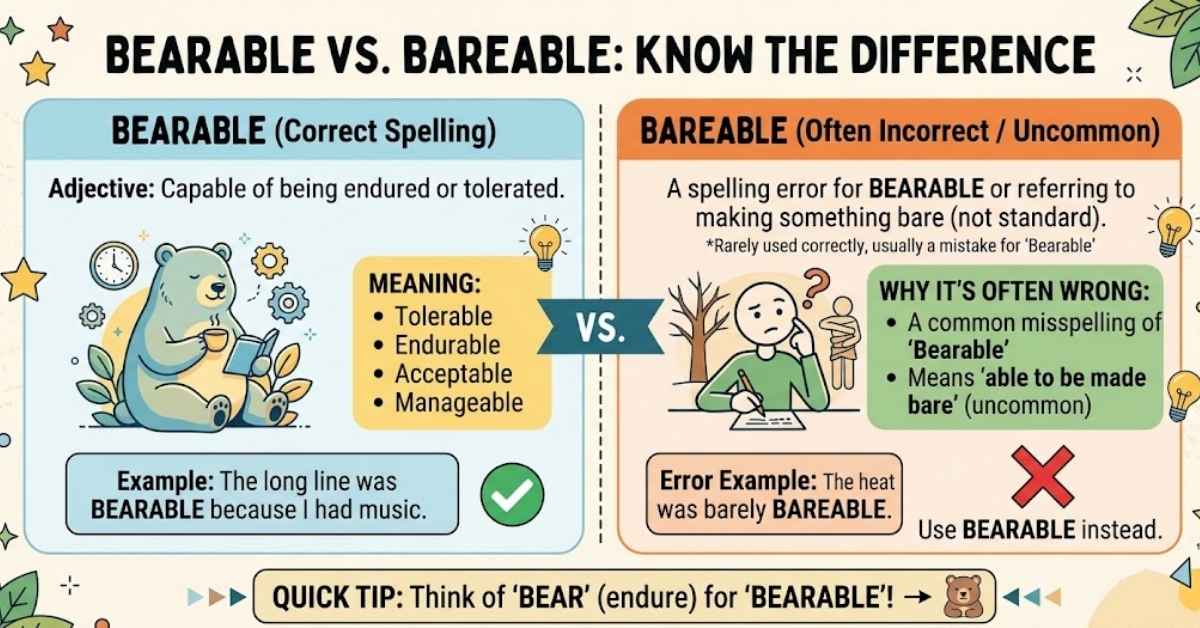
Bearable vs bareable is an easy spelling question to get stuck on because bear and bare sound the same in standard English. But when you mean “able to be endured, tolerated, or dealt with,” the correct spelling is bearable. Bareable is generally a misspelling in modern standard English.
The reason becomes much easier to remember when you look at the root:
If you can bear it, it is bearable.
Cambridge defines bearable as something unpleasant that you can accept or deal with, while Oxford similarly describes it as something a person or thing can accept or deal with.
So write:
- The pain was bearable. ✅
- The heat was bearable. ✅
- The workload was barely bearable. ✅
Not:
- The pain was bareable. ❌
- The heat was bareable. ❌
Bearable vs Bareable at a Glance
| Word | Standard spelling? | Meaning | Example |
|---|---|---|---|
| bearable | Yes | Able to be endured or tolerated | The pain was bearable. |
| bareable | No, for this meaning | Usually a misspelling of bearable | The pain was bareable. ❌ |
| bear | Yes | To endure, carry, support, or tolerate | I can’t bear the noise. |
| bare | Yes | Uncovered, exposed, empty, or minimal | He walked with bare feet. |
There is no U.S.-versus-U.K. spelling difference here. Bearable is the standard spelling in both American and British English.
What Does “Bearable” Mean?
Bearable is an adjective meaning capable of being endured, tolerated, accepted, or dealt with.
It usually describes something that is unpleasant or difficult but not impossible to handle.
That distinction matters.
If you say:
The heat was bearable.
you are not saying the heat was pleasant.
You are saying:
The heat was difficult, but I could still tolerate it.
Cambridge gives the same basic sense, describing a bearable unpleasant situation as one that can be accepted or dealt with.
Examples of bearable
- The pain was bearable after a few hours.
- The traffic was annoying but bearable.
- The noise became bearable after the windows were closed.
- The long wait was bearable because I had a book.
- The summer heat became more bearable after sunset.
- Her support made the difficult situation more bearable.
The word works for both physical and emotional experiences.
Why Is “Bearable” Spelled With “Bear”?
This is the key to remembering the spelling.
The relevant bear is not the animal.
It is the verb bear, which can mean to carry, endure, tolerate, support, or withstand something.
Consider these sentences:
I can’t bear the pain.
I can’t bear the noise.
She had to bear the responsibility.
We can bear the cost.
The same root appears in:
The pain is bearable.
The historical formation is essentially bear + -able, with the adjective meaning something that can be borne or endured. Etymonline dates bearable to the mid-15th century and identifies its formation from bear + -able. Dictionary.com likewise gives its origin as bear + -able.
So the useful connection is:
bear → endure → bearable
Not:
bare → bareable
What Does “Bare” Mean?
Bare is a perfectly good English word, but it has a completely different meaning.
It commonly means:
- uncovered
- exposed
- without clothing
- empty
- lacking decoration
- reduced to the minimum
Examples include:
- bare feet
- bare hands
- bare walls
- bare branches
- bare skin
- the bare minimum
- bare facts
For example:
The room had bare walls.
Here, bare means the walls had little or nothing covering or decorating them.
That has nothing to do with tolerating pain, stress, heat, or difficulty.
This is why:
❌ The pain was bareable.
doesn’t work as the standard spelling for “able to be endured.”
The intended root is bear, not bare.
Is “Bareable” a Real Word?
For ordinary modern U.S. English, bareable is not the standard spelling when you mean “able to be endured.”
That is the important practical answer.
Major dictionaries establish bearable as the adjective meaning endurable or tolerable. Cambridge, Oxford, Collins, and Dictionary.com all recognize bearable in this sense.
You may occasionally encounter unusual spellings such as bareable online or in historical material. Some modern competitors acknowledge that such appearances exist.
That does not make it the appropriate spelling for normal contemporary writing.
If you’re writing:
- an email
- a school assignment
- an essay
- a report
- an article
- a résumé
- a professional document
- a social media post
use bearable when you mean “able to be endured.”
Why Do People Spell “Bearable” as “Bareable”?
The mistake is understandable because the two root words are homophones.
Bear and bare sound alike
In standard English pronunciation:
bear and bare have the same pronunciation.
That means spoken English does not give you a reliable spelling clue.
If someone says:
“The pain was bearable.”
you hear the sound, but you don’t see whether the writer used bear or bare.
The spelling therefore has to come from meaning and word history, not sound.
“Bare” also looks familiar
There is another psychological reason for the mistake.
People see common expressions such as:
- bare feet
- bare hands
- bare skin
- bare minimum
Because bare is visually familiar, bareable can look surprisingly plausible.
But familiar does not mean correct.
English spelling frequently contains these traps:
- bear / bare
- their / there / they’re
- right / write
- to / too / two
- principle / principal
The solution is to connect the spelling to the meaning of the root word.
Why “Bare + Able” Doesn’t Produce “Bareable”
At first glance, the incorrect spelling seems logical.
English has many words formed with -able:
- read → readable
- enjoy → enjoyable
- accept → acceptable
- understand → understandable
So a writer may unconsciously reason:
bare + able = bareable
But word formation is not simply a matter of attaching a suffix whenever the result looks plausible.
The established English adjective for something that can be endured is:
bearable
Its meaning comes from the verb bear in the sense of endure or tolerate.
How to Use “Bearable” Correctly
Bearable pain
The pain was severe at first but became bearable later.
Here, bearable means the pain could still be tolerated.
Bearable heat
The temperature became bearable after sunset.
This does not mean the weather became comfortable. It means it became easier to tolerate.
Bearable noise
With the windows closed, the construction noise was bearable.
Bearable workload
Hiring another employee made the workload more bearable.
The Bearable waiting time
The two-hour wait was bearable because we had somewhere comfortable to sit.
Bearable emotional experience
Talking with friends made the difficult week more bearable.
Oxford provides examples involving dull work, money making life more bearable, and camaraderie making tedious work just bearable.
Can You Describe a Person as “Bearable”?
Yes, but the meaning is usually different from strong praise.
If someone says:
He’s bearable.
they may mean:
“I can tolerate being around him.”
Depending on context, it can sound humorous, sarcastic, or faintly critical.
Compare:
She’s pleasant.
This is clearly positive.
She’s bearable.
This suggests that being around her is manageable, but it does not necessarily sound enthusiastic.
So bearable can describe a person, but the context and tone matter.
Common Phrases With “Bearable”
Some combinations occur naturally in everyday English.
Barely bearable
Barely bearable means something is only just tolerable.
The noise was barely bearable.
This means the noise was extremely unpleasant and was close to becoming unbearable.
More bearable
The long journey became more bearable after we stopped for lunch.
Less bearable
The heat became less bearable as the afternoon continued.
Make life bearable
Her sense of humor helped make life more bearable.
Become bearable
The pain gradually became bearable.
Make something more bearable
Listening to music made the long commute more bearable.
These phrases are particularly useful because they show how bearable functions naturally in real sentences rather than merely giving dictionary definitions.
Bearable vs Tolerable vs Manageable
These words overlap, but they are not always interchangeable.
Bearable
Focuses on whether something can be endured or tolerated.
The pain was bearable.
Tolerable
Often sounds slightly more formal and emphasizes that something is acceptable despite being unpleasant.
The conditions were tolerable.
Oxford defines tolerable in one sense as something that can be accepted or borne, with bearable as a synonym.
Manageable
Focuses more on whether something can be handled successfully.
The workload was manageable.
A difficult workload can be manageable even if it is not particularly pleasant.
Endurable
Means capable of being endured and is often more formal or literary.
So:
The pain was bearable.
sounds natural in everyday English.
The pain was tolerable.
sounds somewhat more clinical or formal.
The workload was manageable.
focuses more on the ability to handle the workload.
Bearable vs Unbearable
The most direct opposite of bearable is unbearable.
| Word | Meaning |
|---|---|
| bearable | Able to be endured |
| unbearable | Too difficult, painful, unpleasant, or annoying to endure |
Compare:
The heat was bearable.
with:
The heat was unbearable.
The difference is essentially whether the experience remains within the person’s ability to tolerate it.
Cambridge lists unbearable as the opposite of bearable.
Is “Barely Bearable” Correct?
Yes.
Barely bearable is completely natural English.
It means something is only just tolerable.
For example:
The pain was barely bearable.
The heat was barely bearable without air conditioning.
The noise became barely bearable after midnight.
Notice the spelling:
barely bearable
The first word is barely, from bare.
The second is bearable, from bear.
That combination can look confusing precisely because it puts the two similar-looking roots next to each other.
But the meanings are completely different.
Bearable Pronunciation
In American English, bearable is pronounced approximately:
/ˈber.ə.bəl/
Cambridge gives the U.S. pronunciation as /ˈber.ə.bəl/, while Oxford’s American dictionary gives /ˈbɛrəbl/.
The pronunciation is one reason the spelling causes trouble.
Bear and bare sound alike, so hearing the word does not tell you which spelling to choose.
That is why the safest strategy is:
Think about the root meaning, not the sound.
Bearable: Word Family
Knowing related forms can make the spelling easier to remember.
Bear
Verb:
I can’t bear the noise.
Bearable
Adjective:
The noise is bearable.
Bearably
Adverb:
The weather remained bearably warm.
Cambridge identifies bearably as the adverb meaning “in a way that is bearable.”
Bearableness
Noun:
The bearableness of the conditions varied from person to person.
This form is much less common than bearable and bearably, but it illustrates the word family.
Unbearable
Opposite adjective:
The noise became unbearable.
This entire family points back to the same underlying idea:
bear → endure → bearable
Is There a British vs American Difference?
No spelling difference exists here.
American English:
bearable
British English:
bearable
The pronunciation can vary slightly by accent, but the spelling remains the same. Oxford provides American pronunciation information while Cambridge provides both U.S. and U.K. pronunciation information.
So if you’re writing for a U.S. audience, there is no reason to choose bareable as an American variation.
Common Mistakes With Bearable and Bareable
Mistake 1
❌ The pain was bareable.
✅ The pain was bearable.
Mistake 2
❌ The heat became more bareable.
✅ The heat became more bearable.
Mistake 3
❌ The workload was barely bareable.
✅ The workload was barely bearable.
Mistake 4
❌ The noise was no longer bareable.
✅ The noise was no longer bearable.
Mistake 5
❌ The situation became bareable with support.
✅ The situation became bearable with support.
In every example, the meaning is “possible to endure,” so the correct root is bear.
Why Spell-Check Isn’t Always Enough
This spelling problem illustrates an important limitation of automated proofreading.
A spell-checker can often identify a word that is completely unknown or obviously misspelled.
But bearable is a real word and bare is also a real word.
A contextual system may therefore need to understand the sentence rather than simply recognize individual words.
Consider:
The pain was bareable.
The intended word is almost certainly bearable, but the error is related to word formation and spelling rather than a random string of letters.
That is why knowing the root relationship is more dependable than blindly trusting autocorrect.
The Fastest Way to Remember Bearable
Forget a complicated spelling trick.
Remember this:
If you can BEAR it, it’s BEARABLE.
For example:
I can bear the pain. The pain is bearable.
I can bear the delay. The delay is bearable.
I can’t bear the noise. The noise is unbearable.
This works because it connects the adjective directly to its root verb.
Meanwhile:
bare = uncovered
Think:
- bare feet
- bare walls
- bare hands
- bare branches
That gives you two separate mental categories:
BEAR → endure
BARE → uncovered
LEARN MORE: Ironically vs Unironically
Quick Practice: Bearable or Bareable?
Choose the correct spelling.
1. The pain was difficult but __.
A. bareable B. bearable
2. The summer heat became more __ after sunset.
A. bearable B. bareable
3. The workload was barely __.
A. bareable B. bearable
4. Her support made the situation more __.
A. bearable B. bareable
5. Which spelling is standard when you mean “able to be endured”?
A. bareable B. bearable
6. Which word means uncovered?
A. bear B. bare
The pattern should now be obvious:
If the sentence is about enduring something, use bearable.
Frequently Asked Questions
Is it bearable or bareable?
Bearable is the correct standard spelling when you mean “able to be endured, tolerated, or dealt with.” Bareable is generally a misspelling in this context.
Is bareable a word?
Bareable is not the standard modern English spelling for the meaning “able to be endured.” Use bearable in ordinary U.S. and British English.
Why is bearable spelled with “bear”?
Because it comes from the verb bear, meaning to carry, endure, tolerate, or withstand, plus the suffix -able.
What does bearable mean?
Bearable means something is difficult, unpleasant, painful, or uncomfortable but can still be endured or tolerated.
Is bearable an adjective?
Yes. Bearable is an adjective.
For example:
The pain was bearable.
What is the opposite of bearable?
The common opposite is unbearable, meaning too difficult, painful, unpleasant, or annoying to endure.
Is “barely bearable” correct?
Yes. Barely bearable means something is only just tolerable.
The noise was barely bearable.
Is “more bearable” correct?
Yes.
The situation became more bearable after we found a solution.
What is another word for bearable?
Depending on context, synonyms include tolerable, endurable, manageable, acceptable, and supportable. Cambridge lists supportable and tolerable among related terms.
Is bearable the same in American and British English?
Yes. The spelling bearable is standard in both. Pronunciation can vary by accent, but there is no alternative U.S. spelling bareable.
Can you say “a bearable person”?
Yes, grammatically. However, describing someone as bearable often means they are tolerable rather than especially pleasant, so the tone can be humorous or mildly negative.
Final Verdict: Bearable vs Bareable
The answer is straightforward:
BEARABLE = correct
BAREABLE = not the standard spelling for “able to be endured”
The reason is the root:
bear = endure, tolerate, withstand
Therefore:
bear + able = bearable
By contrast:
bare = uncovered, exposed, or minimal
So when you’re describing pain, stress, heat, noise, pressure, work, waiting, or a difficult situation that can still be tolerated, choose bearable.
The one rule worth remembering is:
If you can bear it, it’s bearable.
Once that connection clicks, bearable vs bareable stops being a spelling trap and becomes a simple matter of meaning.