

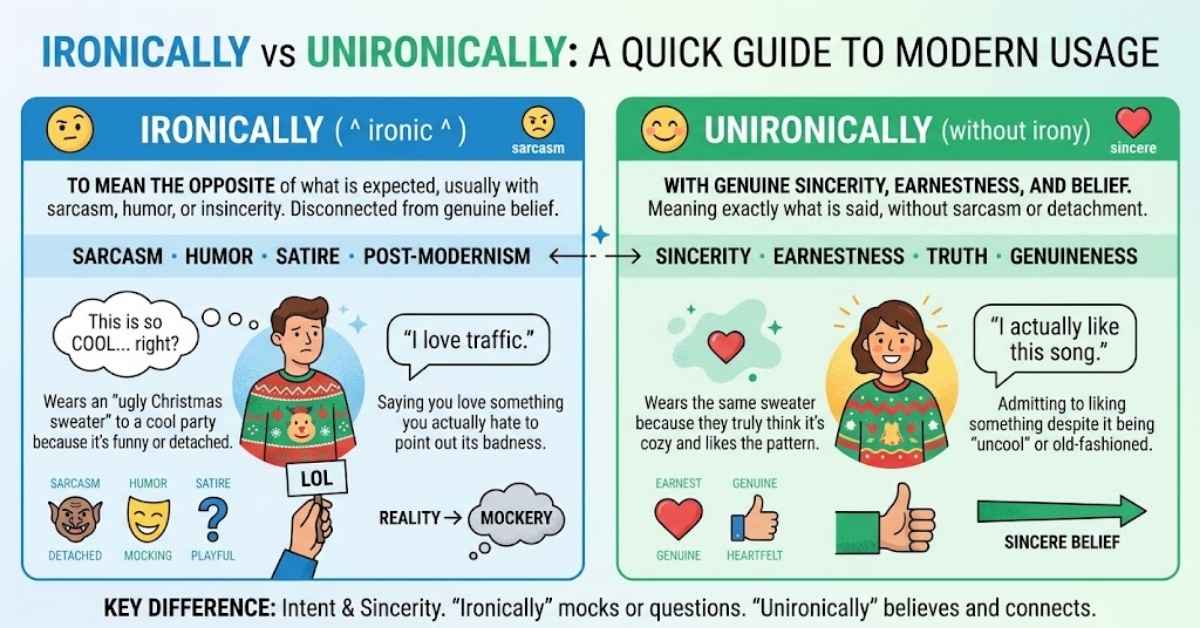
Your friend wears a band shirt “ironically.” Then you catch them humming every song on the album. So were they joking, or do they actually love the band?
That confusion is exactly why ironically vs unironically is such a popular search. Here is the quick answer. “Ironically” describes something done or said in a way that signals the opposite of its surface meaning, or an outcome that is the reverse of what you would expect. “Unironically” means the person is completely sincere, with no joke, twist, or hidden meaning behind it.
Let’s look at what each word means, how people use them online, and how to avoid the most common mistakes.
Ironically vs Unironically Meaning
Both words come from “irony,” so it helps to start there. Irony is the gap between what seems true and what is actually true.
What Does “Ironically” Mean?
“Ironically” is an adverb. People use it in two main ways:
- For a surprising reversal. The result is the opposite of what anyone expected. Example: “Ironically, the fire station burned down.”
- For a playful or mocking tone. The speaker says one thing but means another. Example: “Great weather,” he said ironically, as rain soaked the picnic.
The first use describes events. The second describes how someone speaks or acts.
What Does “Unironically” Mean?
“Unironically” is the flip side. It tells you that someone means exactly what they say. There is no wink, no sarcasm, and no layered joke.
Here is a simple example: “I unironically love pineapple on pizza.” The speaker is not teasing anyone. They really do enjoy it.
The word has grown more common online, mostly because internet humor makes sincerity hard to read. As a result, people now add “unironically” to prove they’re serious.
Ironically or Unironically: How to Choose
When you’re deciding between ironically or unironically, ask one question: is there a gap between the surface and the truth?
- If yes, use “ironically.”
- If no, and you want to stress sincerity, use “unironically.”
Here is a quick comparison.
| Feature | Ironically | Unironically |
|---|---|---|
| Core idea | Opposite or unexpected meaning | Genuine, sincere meaning |
| Tone | Playful, sarcastic, or surprising | Honest and straightforward |
| Common setting | Writing, speeches, memes | Social media, casual speech |
| Example | “Ironically, the dentist has bad teeth.” | “I unironically think dentists are heroes.” |
Ironically vs Unironically Funny: Why the Internet Loves Both
Online culture is the main reason people search for ironically vs unironically funny. Memes thrive on the space between a joke and a real opinion.
The “Ironic Enjoyment” Effect
Many people like things “ironically.” They watch a campy movie, wear a goofy sweater, or listen to a cheesy song because it feels funny to them. The enjoyment comes with a layer of distance.
Then things get complicated. After a while, the person may start liking the thing for real. Fans call this moment “going from ironic to unironic.”
Why Sincerity Became the Punchline
Sometimes the funniest move is to be completely serious. When someone says, “I unironically believe socks with sandals are peak fashion,” the humor comes from the commitment. Because everyone expects a joke, the sincerity itself becomes the joke.
That layered effect is one reason these words show up so often in memes and comment sections.
Ironically vs Unironically Examples
Examples make the difference easier to see. Here are a few of each.
Using “ironically”:
- “Ironically, the marathon runner tripped on the finish line banner.”
- “She said ‘nice parking’ ironically when he hit the curb.”
- “The author of the book on time management finished it three years late.”
Using “unironically”:
- “I unironically cry at every dog adoption video.”
- “He unironically owns six different air fryers.”
- “We unironically enjoyed the school play more than the movie.”
Notice the pattern. The “ironically” lines contain a twist or a hidden joke. In contrast, the “unironically” lines contain a real feeling or opinion.
Is “Ironically” Used Correctly? A Common Mistake
Many people use “ironically” when they simply mean “coincidentally.” This habit annoys some grammar fans, so it’s worth knowing.
A coincidence is two events that happen at the same time with no connection. Irony requires a contrast or a reversal.
- Coincidence: “We both wore blue today.”
- Irony: “The fire safety instructor accidentally set off the alarm.”
Most dictionaries now accept broader uses of “ironically.” Even so, if you want your writing to feel precise, save it for real reversals and contrasts.
LEARN MORE: Lite vs Light
Tips for Using Each Word Well
A few habits will help you sound natural:
- Check for a twist. If nothing is unexpected, “ironically” probably doesn’t fit.
- Use “unironically” sparingly. Overuse makes it lose its punch.
- Match your audience. Formal writing prefers “ironically” for true reversals, while “unironically” suits casual, online talk.
- Watch your tone in text. Sarcasm is hard to read without a voice, so a clear word can save you from confusion.
Frequently Asked Questions
What is the difference between ironically and unironically?
“Ironically” signals an opposite or unexpected meaning, or a playful tone. “Unironically” signals complete sincerity with no hidden joke.
Is “unironically” a real word?
Yes. It is a legitimate adverb that means “in a sincere way, without irony.” It has become much more popular because of internet culture.
Can you do something ironically and unironically at the same time?
Yes, in a sense. Many people start enjoying something as a joke and then grow to like it for real. This shift is common with music, fashion, and old TV shows.
Is it wrong to use “ironically” for a coincidence?
Strict grammar fans say yes, because irony needs a contrast. However, many modern dictionaries accept looser uses. For clear writing, stick to real reversals.
Why do people say “unironically” so often?
Online humor makes tone hard to read. So people add “unironically” to show they are serious, and the word often becomes part of the joke.
Is “ironically” the same as “sarcastically”?
Not exactly. Sarcasm is a sharp or mocking remark meant to hurt or tease. Irony is wider and includes situations, outcomes, and tone.
Which word should I use in formal writing?
Use “ironically” for genuine reversals. In formal writing, “unironically” can feel too casual, so consider words like “sincerely” or “genuinely” instead.
Conclusion
The ironically vs unironically question comes down to one idea: is there a gap between what is said and what is meant? “Ironically” points to a twist, an opposite, or a playful tone. “Unironically” tells your reader you mean every word.
Keep the two words in your toolbox, and you’ll write with more clarity and more personality. Whether you choose ironically or unironically, the key is to match the word to your real intent.
If you enjoyed this breakdown, explore our other guides on commonly confused words. A few minutes of practice can make your writing sharper and funnier.