

You’ve seen it on a beer can, a snack bag, and a phone app. Sometimes it says “light,” and sometimes it says “lite.” So which one is right?
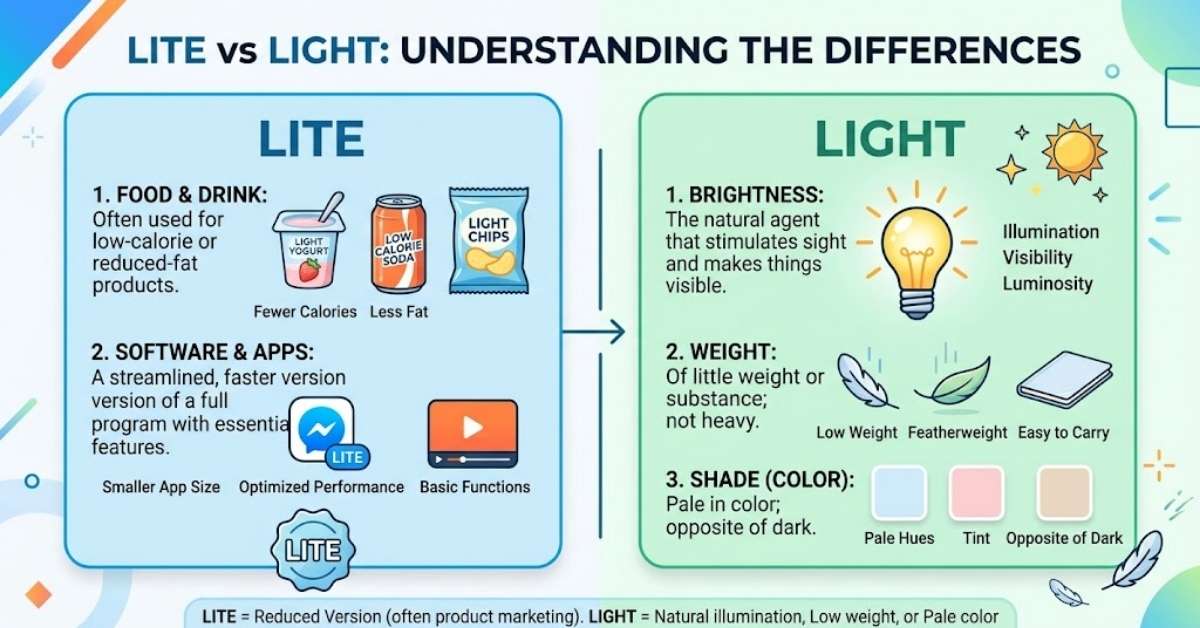
Here is the short answer to lite vs light. “Light” is the standard English word and works in every situation. “Lite” is an informal, simplified spelling, mostly used in marketing to suggest less fat, fewer calories, or a stripped-down version of something. Both are pronounced exactly the same way.
Let’s break down what each word means, how to say it, and when to use it.
Lite vs Light Meaning and Definition
Start with the standard word. “Light” is one of the most flexible words in English, and it works as a noun, an adjective, and a verb.
Light: The Standard Definition
Here are the main meanings of “light”:
- Noun: the brightness that lets us see, as in “The light from the window woke me up.”
- Adjective (weight): not heavy, as in “This backpack is surprisingly light.”
- Adjective (color): pale, as in “She painted the walls a light blue.”
- Adjective (amount or intensity): gentle or minor, as in “We had a light dinner.”
- Verb: to ignite or illuminate, as in “Please light the candles.”
That range is why “light” appears in so many everyday phrases. Think of “light rain,” “light reading,” and “light a fire.”
Lite: The Informal Variant
“Lite” is a respelling of “light.” Dictionaries list it as a variant, and they mark it as informal or nonstandard. It mainly means “lower in calories, fat, or sugar,” or “simpler and less rich than the original.”
You rarely see “lite” in ordinary writing. Instead, brands use it because it looks short, modern, and catchy. Miller Lite helped popularize the spelling in the 1970s, and many products have copied it since.
Lite vs Light Pronunciation
This part is easy. Both words rhyme with “bite” and “night.” The pronunciation is /laɪt/ for both.
That means you can’t hear the difference in conversation. The only difference shows up in writing. So if someone says, “I’ll take the lite option,” you only know the spelling if you see it on the label.
When to Use Lite vs Light
Knowing when to use lite vs light comes down to context. Here is a simple rule: use “light” unless you’re writing a brand name, a product label, or a casual marketing phrase.
Use “Light” When You’re Writing Normally
Choose “light” in essays, emails, reports, articles, and everyday messages. It is correct everywhere. Because it is the standard spelling, it will never look like a mistake.
Use “light” for:
- Brightness and illumination
- Weight and heaviness
- Pale colors
- Gentle or mild things
- Lighting something on fire
Use “Lite” for Brand Names and Marketing
“Lite” is acceptable when it’s part of a name or a product claim. In those cases, you’re following the brand’s style rather than standard spelling rules.
Good places to use “lite”:
- Proper names, such as Miller Lite
- Software versions, such as a “Lite” edition of an app
- Informal marketing copy, where a playful tone is the goal
If you’re unsure, go with “light.” No editor will ever correct it.
Lite vs Light Examples
Examples make the difference easier to remember. Here are a few side by side.
Correct uses of “light”:
- “I’ll leave a light on in the hallway.”
- “That suitcase is really light.”
- “She wore a light jacket to the picnic.”
- “Can you light the grill?”
Common uses of “lite”:
- “He ordered a lite beer.”
- “I downloaded the Lite version of the app.”
- “This is a lite yogurt with half the sugar.”
Notice that the “lite” examples all involve products or food. That pattern is no accident. Marketers use “lite” to signal a reduced or simplified version.
Lite vs Light Weight: Which Is Correct?
People often search for lite vs light weight, so let’s clear this up. The standard word for something that doesn’t weigh much is “lightweight,” written as one word. You can also write it as “light weight” when “light” simply describes the weight, as in “a light weight for beginners.”
“Litewight” and “lite weight” are not standard spellings. You may spot them on product pages, but they aren’t correct in formal writing.
Software is a special case. A “lite” app is not necessarily light in weight, but it is smaller and simpler than the full version. Because of that, tech companies often use “Lite” as a label. Facebook Lite is a well-known example.
“Light” and “Lite” on Food Labels
Food packaging is where most people run into this question. In the United States, the FDA treats “lite” the same as “light” for nutrient claims. Both terms follow the same rules.
In general, a food labeled “light” must meet one of these standards:
- It has at least one-third fewer calories than the regular version.
- It has at least half the fat of the regular version, if the original gets most of its calories from fat.
Rules differ by country, so always check the nutrition panel. The label gives you the real numbers, while “lite” only gives you a hint.
Also, “light” can describe more than nutrition. For example, “light olive oil” refers to flavor and color, not calories. That surprises a lot of shoppers.
LEARN MORE: Carat vs Caret vs Karat
Quick Comparison: Lite vs Light
| Feature | Light | Lite |
|---|---|---|
| Status | Standard spelling | Informal variant |
| Pronunciation | /laɪt/ | /laɪt/ |
| Best for | All general writing | Brand names, labels, casual marketing |
| Meanings | Many (brightness, weight, color, ignite) | Mainly “reduced” or “simplified” |
| Safe in formal writing? | Yes | No |
Tips to Remember the Difference
A few simple habits will keep you out of trouble:
- Default to “light.” It is always correct.
- Use “lite” only with a reason. A brand name or a deliberate casual tone counts.
- Check the label, not the spelling. Nutrition facts matter more than a catchy word.
- Keep your audience in mind. A formal report calls for “light,” while an ad can get away with “lite.”
Frequently Asked Questions
Is “lite” a real word?
Yes, but it is informal. Dictionaries include it as a variant of “light,” mainly in the sense of “lower in calories.” However, most style guides advise against it in formal writing.
What is the difference between lite and light?
The two words sound identical. “Light” is the standard spelling with many meanings. “Lite” is a shortened, informal spelling that mostly signals a reduced or simplified product.
How do you pronounce lite vs light?
Both are pronounced /laɪt/, so they rhyme with “night.” You can’t tell them apart by sound.
Can I use “lite” in an essay or business email?
It is best to avoid it. Use “light” instead, unless you’re quoting a brand name such as Miller Lite.
Does “lite” mean healthier?
Not always. “Lite” or “light” suggests a reduction compared to the original, but the reduction may be small. Read the nutrition label before you decide.
Is “lite weight” correct?
No. Write “lightweight” as one word, or “light weight” if you’re describing a literal weight.
Why do companies spell it “lite”?
The spelling is short, memorable, and easy to trademark. It also feels modern and playful, which helps sell products.
Conclusion
The lite vs light question has a simple answer. “Light” is the correct, standard choice for nearly everything you write. “Lite” is a casual shortcut that belongs mainly on labels, brand names, and software editions.
Remember that the two words sound the same, so spelling is the only thing that changes. When in doubt, pick “light” and move on with confidence.
If you found this guide helpful, explore our other articles on commonly confused words. Brushing up on a few at a time makes your writing sharper and more polished.