

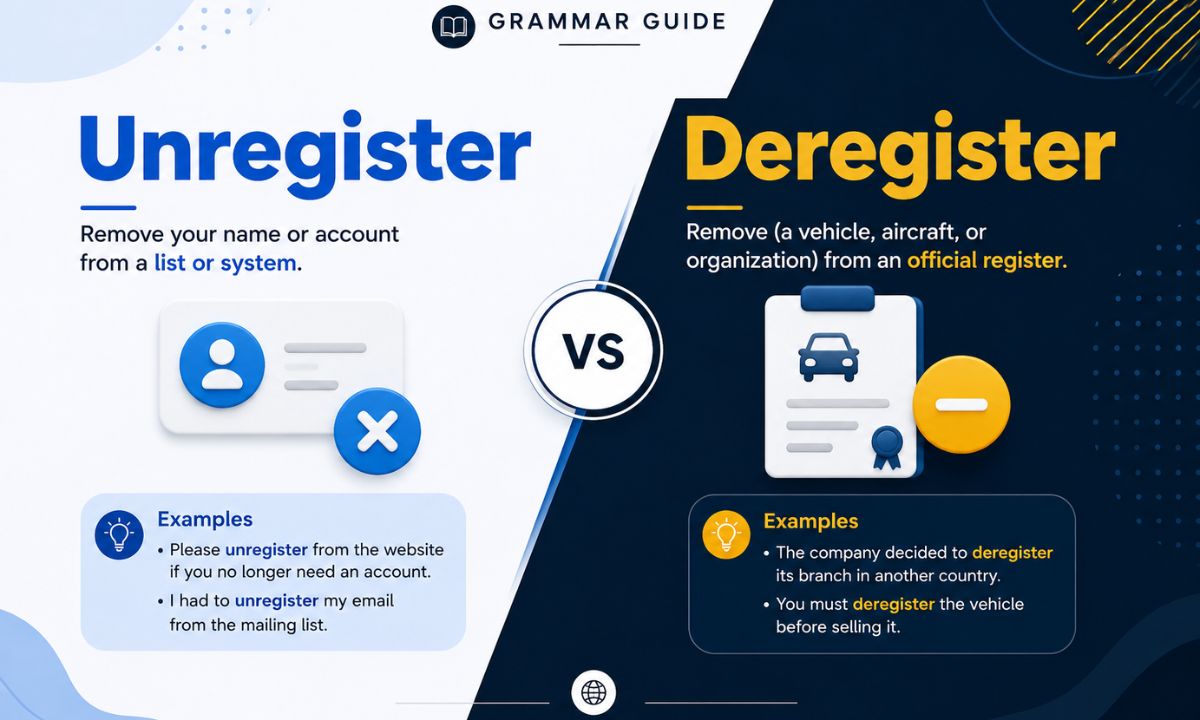
Have you ever wondered whether you should use unregister vs deregister? Although both words describe removing something from a register or official record, they are not always interchangeable. Their meanings overlap, but the preferred choice often depends on the context, such as technology, software, legal documents, government records, or everyday English.
This comprehensive guide explains the difference between unregister vs deregister, explores their origins, compares their usage across different industries, provides practical examples, highlights common mistakes, and answers the most frequently asked questions. By the end, you’ll know exactly which word to choose in every situation.
What Does Unregister Mean?
The verb unregister means to remove a person, object, account, device, or record from a register, list, or database. It is formed by adding the prefix un, meaning “reverse” or “remove,” to the word register.
In everyday English, unregister usually refers to undoing a previous registration. It often appears in technology, online services, education, healthcare, and membership systems.
Simple Definition
Unregister = To remove from a registered list or system.
The action can be voluntary, automatic, or performed by an administrator.
Common Situations Where “Unregister” Is Used
- Removing a phone number from an application
- Leaving a mailing list
- Cancelling event registration
- Removing a student from a course
- Unlinking licensed software from a computer
Examples
- I need to unregister my old laptop before selling it.
- The administrator unregistered the inactive user accounts.
Notice that these examples involve removing something from an existing system rather than ending its legal existence.
How “Unregister” Is Commonly Used Today
Modern English strongly associates unregister with digital technology.
As more services move online, users regularly unregister:
- smartphones
- tablets
- software licenses
- gaming consoles
- smart TVs
For example, if you replace your computer, software companies often ask you to unregister the old device before activating a new one.
Similarly, streaming services may require users to unregister unused devices when they reach the maximum device limit.
Because technology has become part of daily life, unregister has become increasingly common in user manuals, help centers, and software documentation.
Is “Unregister” an Official Word?
Yes.
Unregister is a fully recognized English verb used by dictionaries and professional style guides. Although some people assume it is informal, it appears regularly in official documentation, technical manuals, educational institutions, and government websites.
Its popularity has grown significantly with the expansion of digital services, cloud computing, and online registrations.
Today, it is considered standard English.
Common Expressions with “Unregister”
You may encounter phrases like:
- unregister a device
- unregister a phone
- unregister a computer
- unregister an application
- unregister an account
- unregister an email address
These combinations sound natural because they involve removing access rather than ending a legal registration.
What Does Deregister Mean?
While unregister is widely used in technology and everyday systems, deregister carries a more formal tone. It refers to officially removing a person, company, vehicle, organization, property, or other legally recognized entity from an official register maintained by a government or regulatory authority.
In many countries, deregister is the standard term used in legal, administrative, financial, and regulatory documents. Businesses may deregister after closing operations, vehicle owners may deregister a car before exporting it, and organizations may deregister with government agencies when they no longer meet legal requirements.
Although both words involve removal from a register, deregister is more closely associated with formal procedures and official records rather than everyday digital services.
Unregister vs Deregister
Although unregister and deregister both describe removing something from a register or official list, they are not always interchangeable. The main difference lies in the context and the level of formality.
In general:
- Unregister is more common in technology, software, websites, memberships, and everyday situations.
- Deregister is preferred in legal, government, corporate, taxation, healthcare, and regulatory contexts.
Think of it this way:
- If you’re removing a device, account, or subscription, unregister is usually the better choice.
- If you’re removing a business, vehicle, company, trademark, or official registration, deregister is normally the correct term.
Quick Comparison Unregister vs Deregister
| Feature | Unregister | Deregister |
| Meaning | Remove from a system or register | Officially remove from a legal or government register |
| Tone | Everyday and technical | Formal and legal |
| Common Contexts | Software, apps, websites, online accounts | Companies, vehicles, taxes, trademarks, organizations |
| Used by | IT professionals, software companies, websites | Governments, lawyers, regulators, businesses |
| Common in | User guides and technical manuals | Official documents and legal paperwork |
At a Glance
| Situation | Best Choice |
| Remove a computer from your Microsoft account | Unregister |
| Remove a company from the business register | Deregister |
| Cancel a webinar registration | Unregister |
| Remove a vehicle from official records | Deregister |
| Disconnect a printer from a network | Unregister |
| Cancel VAT registration | Deregister |
This distinction may seem small, but using the appropriate word makes your writing more accurate and professional.
Understanding the Difference of Unregister vs DeregisterThrough Real Life Examples
Sometimes, definitions alone aren’t enough. Looking at real situations makes the distinction much easier.
Technology
✅ Correct:
- Unregister your phone before resetting it.
- Please unregister this printer from the network.
- The software automatically unregisters inactive devices.
- Users must unregister old licenses before activating a new one.
❌ Less Natural:
- Deregister your Netflix account.
- Deregister your mobile app.
- Deregister your laptop from Windows.
Although these sentences are understandable, native English speakers generally prefer unregister for digital systems.
Business
✅ Correct:
- The owners decided to deregister the company after closing the business.
- Thousands of inactive businesses were deregistered last year.
- The organization deregistered its charity status.
Here, deregister sounds much more professional because the action involves government records.
Vehicles
Vehicle registration provides another clear example.
If you permanently export or scrap a car, government authorities often require you to deregister the vehicle.
Examples:
- The vehicle must be deregistered before export.
- He deregistered his motorcycle after selling it overseas.
- The transport department deregistered the damaged vehicle.
Using unregister in these examples would sound unusual in most official documents.
Education
Educational institutions often use unregister when students leave courses.
Examples:
- Students can unregister before the deadline.
- Please unregister from the workshop if you cannot attend.
- She forgot to unregister from the online training session.
Some universities may instead use withdraw, depending on institutional policies.
Healthcare
Healthcare uses both terms, depending on the situation.
Examples:
- Patients may unregister from one medical practice before joining another.
- The clinic deregistered after failing regulatory inspections.
- The hospital deregistered its laboratory license.
Notice how patient records typically use unregister, while legal licensing often requires deregister.
Software Development
Developers frequently encounter these terms.
Common examples include:
- unregister callback
- unregister event listener
- unregister service
- unregister component
- unregister object
Programming languages, operating systems, and APIs often use unregister because they’re referring to removing components from software systems rather than government records.
For instance:
The application unregisters the service when it shuts down.
This wording is standard in technical documentation.
Why Do People Confuse These Words Unregister vs Deregister?
There are several reasons why writers mix up unregister vs deregister.
They Describe Similar Actions
Both words involve removing something from a register.
Because of this shared meaning, many people assume they are perfect synonyms.
In reality, they overlap but are used differently depending on context.
Different Industries Prefer Different Terms
Software companies often say:
- unregister device
- unregister account
Government agencies usually write:
- deregister company
- deregister vehicle
- deregister trademark
Someone working in one industry may naturally use the term they’re most familiar with.
Regional English Differences between Unregister vs Deregister
British English tends to use deregister more frequently in legal and healthcare contexts.
American English often prefers unregister in technical and everyday communication.
Neither version is inherently wrong, but choosing the word that matches your audience improves clarity.
Dictionaries Show Similar Definitions
Many dictionaries define both words using phrases such as:
remove from a register
While technically accurate, this simplified definition doesn’t explain how the words are actually used by native speakers in professional settings.
Understanding usage is often more valuable than memorizing dictionary definitions.
A Simple Rule to Remember of Unregister vs Deregister
If the action involves software, websites, accounts, devices, memberships, or online systems, choose unregister.
If the action involves government records, companies, taxation, vehicles, licenses, trademarks, or legal status, choose deregister.
Following this guideline will help you sound more natural and precise in nearly every situation.
Usage Across Different Industries
Although the difference between unregister and deregister may appear subtle, each industry has developed its own preferred terminology. Understanding these conventions helps you write naturally and communicate more effectively.
Legal and Government Contexts
Legal documents almost always prefer deregister because the action involves an official authority rather than a private system.
Typical examples include:
- Deregister a trademark
- Deregister a vehicle
- Deregister a property
- Deregister a taxpayer
Example sentences
- The company was deregistered after failing to submit annual reports.
- You must deregister the vehicle before exporting it.
- The government deregistered several inactive organizations.
In legal writing, using unregister instead of deregister can make the text sound less professional.
Business and Corporate Usage
Businesses often deal with official registrations, making deregister the preferred choice.
Examples include:
- Deregistering a limited company
- Deregistering for VAT
- Deregistering a business name
- Deregistering a partnership
- Deregistering a nonprofit organization
However, businesses may still use unregister internally for software systems.
For example:
- Employees must unregister unused devices.
- Please unregister your conference attendance if your plans change.
This shows that even within one organization, both words may appear depending on the situation.
Education
Educational institutions mostly use unregister when students remove themselves from classes, events, or online learning platforms.
Examples:
- Unregister from a course.
- Unregister from the seminar.
- Unregister your student account.
- Unregister from the examination portal.
Some universities instead use words like withdraw, drop, or cancel enrollment, but unregister remains common in many online systems.
Healthcare
Healthcare is one of the few fields where both words regularly appear.
Unregister
Usually refers to patients.
Examples:
- Unregister from a medical practice.
- Unregister a patient account.
- Patients may unregister before moving to another clinic.
Deregister
Usually refers to institutions, licenses, or healthcare providers.
Examples:
- The regulator deregistered the hospital.
- The clinic was deregistered after losing its license.
- The laboratory voluntarily deregistered.
Again, the difference depends on whether the action affects an individual system or an official legal record.
Financial and Tax Contexts
Government tax agencies typically use deregister.
Examples include:
- Deregister for VAT.
- Deregister your GST account.
- Deregister a taxpayer.
- Deregister a tax entity.
These actions involve formal legal records, making deregister the standard choice.
Grammar and Word Formation
Both unregister and deregister are verbs formed by adding prefixes to the base word register.
Register
The word register can function as both a noun and a verb.
As a verb, it means:
- to record officially
- to enroll
- to enter into a list
- to document
Examples:
- Register a vehicle.
- Register for classes.
- Register an account.
The Prefix “Un-“
The prefix un- generally means:
- reverse
- remove
- undo
Examples include:
- unlock
- untie
- unzip
- unplug
- uninstall
Following this pattern:
Register → Unregister
means to reverse the act of registration.
The Prefix “De-“
The prefix de- often means:
- remove
- reduce
- eliminate
- reverse an official process
Examples include:
- deactivate
- decentralize
- deregulate
- declassify
- devalue
So:
Register → Deregister
suggests removing something from an official register or legal status.
Common Mistakes Writers Make
Even experienced writers occasionally misuse these terms.
Mistake : Assuming They’re Always Identical
Many people believe both words can replace each other anywhere.
Example:
❌ Please deregister your Zoom account.
A more natural choice would be:
✅ Please unregister your Zoom account
Mistake : Using Unregister in Legal Documents
Example:
❌ The company unregistered its corporate status.
Better:
✅ The company deregistered its corporate status.
Mistake : Ignoring Audience Expectations
Technical readers expect terminology common in software documentation.
Legal readers expect terminology used in regulations.
Matching your audience makes your writing more credible.
Mistake : Overusing One Word Everywhere
Some writers learn only one version and apply it universally.
Instead, remember:
- Technology → unregister
- Government → deregister
This simple habit prevents most mistakes exact context.
Regional Variations
Although both unregister and deregister are accepted English words, their popularity varies across different English-speaking countries. Understanding these regional preferences can make your writing sound more natural to your target audience.
American English
In the United States, unregister is generally more common in everyday communication, especially in technology, software, education, and online services.
Examples include:
- Unregister your device.
- Unregister from the course.
- Unregister your account before deleting it.
- Unregister the application.
Legal documents in the U.S. may still use deregister, but outside official contexts, unregister is often the preferred choice.
British English
British English uses deregister more frequently, particularly in legal, healthcare, transportation, and government related writing.
Examples include:
- Deregister a vehicle.
- Deregister a company.
- Deregister a patient from a medical practice.
- Deregister a charity.
However, British software companies still commonly use unregister when referring to devices, software licenses, or online accounts.
Frequently Asked Questions
Is it deregister or unregister?
Unregister is more common for software, devices, online accounts, and memberships, while deregister is typically used for companies, vehicles, licenses, taxes, and other official government records.
What is the meaning of unregister?
Unregister means removing someone or something from a list, database, or registration system. It often refers to cancelling or reversing a previous registration without necessarily affecting any legal status.
Example:
- Please unregister your old smartphone before activating a new one.
What does it mean to deregister something?
To deregister something means to officially remove it from a legal or government register. This action is usually performed through a regulatory authority or official organization.
Example:
- The company chose to deregister after permanently closing its business.
Can unregister and deregister be used interchangeably?
Sometimes, but not always.
In informal conversation, people may understand either word. However, in professional writing, using the correct term improves clarity and accuracy.
As a general rule:
- Technology → unregister
- Legal or official matters → deregister
It is considered standard English in both British and international legal writing.
Final Thoughts
Although unregister and deregister both involve removing something from a register, they are not perfect synonyms. The difference lies mainly in context. Unregister is commonly used in technology, software, online services, education, and membership systems, where the goal is to remove access or cancel a registration.
Deregister, on the other hand, is the preferred choice for legal, governmental, corporate, healthcare, and regulatory matters involving official records or recognized legal status.
By understanding this distinction, you can write with greater precision and confidence. Whether you’re preparing technical documentation, drafting business content, or writing everyday English, selecting the appropriate term will make your communication clearer, more professional, and more natural for your audience.