

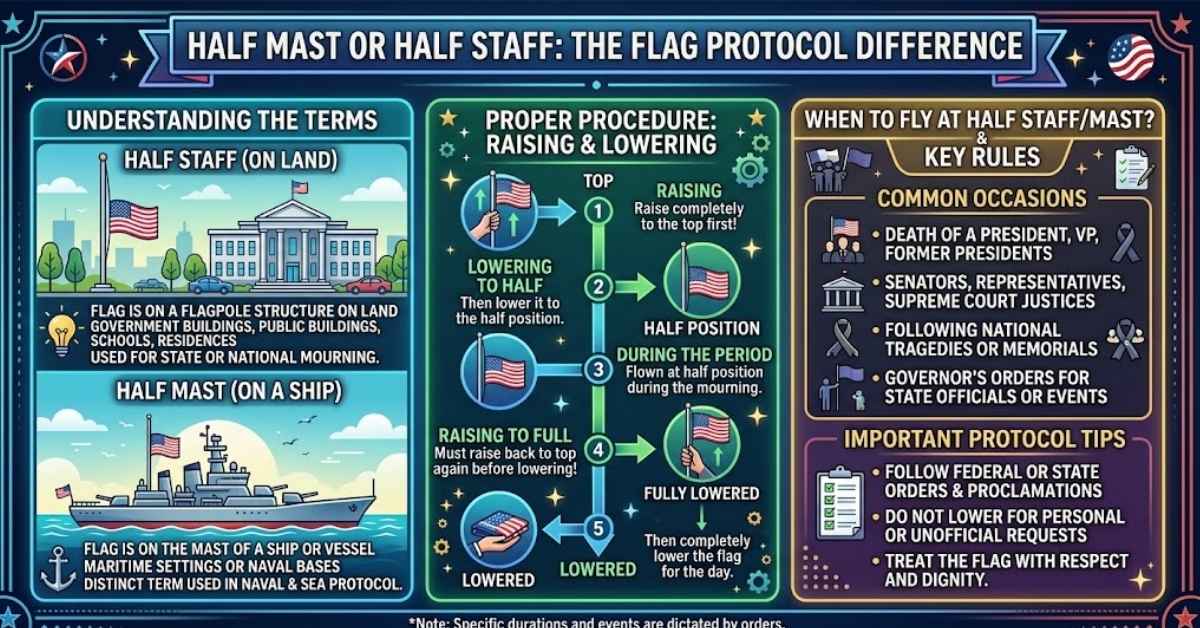
Half mast or half staff? In U.S. English, half-staff is the standard term used for a flag displayed on land, especially in official and government contexts. Half-mast is traditionally associated with flags on ships and in naval settings. But there is an important nuance: half-mast is also an established American-English expression and is widely understood outside strictly nautical contexts.
So, if you’re writing about an American flag outside a school, courthouse, business, or home, half-staff is the safest and most precise U.S. choice. If you’re writing about a flag aboard a ship, half-mast is the traditional nautical term.
The distinction becomes clearer once you separate official U.S. terminology, naval usage, and everyday English.
Half Mast or Half Staff: Which One Is Correct?
Both half-staff and half-mast describe a flag that has been lowered from its normal position, usually as a sign of mourning, remembrance, or respect.
In the United States, however, the preferred term depends on context.
| Term | Typical U.S. context | Best choice |
|---|---|---|
| Half-staff | Land, buildings, schools, homes, government property | Standard U.S. term |
| Half-mast | Ships, vessels, naval and maritime settings | Traditional nautical term |
| Half-mast in general American English | Everyday speech and writing | Understandable and established |
| Half-mass | Informal misspelling | Avoid |
The easiest rule is:
Land → half-staff. Ship or naval context → half-mast.
But don’t mistake that useful shortcut for an absolute grammar rule. American dictionaries recognize half-mast, and U.S. government information can use both expressions.
Half-Staff vs. Half-Mast: What’s the Difference?
The difference comes largely from the object supporting the flag.
A staff is a pole or support from which a flag can be displayed. A mast is traditionally associated with a ship or other maritime structure.
That is why American usage developed a contextual distinction:
- A flag outside City Hall is normally described as being at half-staff.
- A flag aboard a naval vessel may be described as being at half-mast.
- A flag outside a school is normally at half-staff.
- A flag on a ship is traditionally at half-mast.
The physical gesture is essentially the same: the flag is lowered from its normal position as a visible sign of mourning or respect.
The U.S. Navy’s style guidance makes the distinction particularly clear by specifying half-mast for ships and naval stations ashore and half-staff elsewhere.
Why Is “Half-Staff” the Standard U.S. Term?
There is a very strong reason half-staff is the safest term in formal American writing: U.S. federal law uses it.
Under 4 U.S.C. § 7, the U.S. Flag Code defines “half-staff” as the position of the flag when it is one-half the distance between the top and bottom of the staff.
That wording matters when you’re writing:
- a government announcement
- a school notice
- a workplace communication
- a formal report
- a news article
- a memorial statement
- an explanation of U.S. flag protocol
If your goal is precise U.S. usage, half-staff is therefore the natural default.
However, federal terminology does not erase the English word half-mast. The two expressions have a longer linguistic history, and reputable dictionaries recognize their relationship.
Is “Half-Mast” Wrong in the United States?
No.
This is one of the most important points to understand.
It would be too strong to say that Americans must never use half-mast on land.
American dictionaries recognize half-mast, and the U.S. government’s own USAGov website uses the wording “half-staff or at half-mast” when explaining when the American flag is lowered during mourning.
So there are three different levels to consider:
1. Formal U.S. terminology
Half-staff is the safest choice.
2. Naval or maritime terminology
Half-mast is the traditional choice.
3. General American English
Both expressions can be encountered and understood.
This distinction explains why you may see an American newspaper, website, or speaker use half-mast even when the flag is not literally aboard a ship.
If you’re being graded on American usage or writing for a formal U.S. audience, choose half-staff for a land-based flag.
When Should You Use “Half-Staff”?
Use half-staff when you’re describing a flag displayed on land in an American context.
Examples include:
- a flag outside a government building
- a school flagpole
- a flag at a courthouse
- a flag outside a business
- a residential flagpole
- a flag at a memorial
- a flag at a cemetery
- a flag on federal property
Examples
Correct and natural U.S. usage:
The American flag was lowered to half-staff after the governor issued the proclamation.
Flags at the courthouse were flying at half-staff.
The school lowered its flag to half-staff in remembrance of the fallen service members.
The U.S. flag remained at half-staff throughout the mourning period.
If you’re writing about an American flag on a stationary pole, half-staff should usually be your first choice.
When Should You Use “Half-Mast”?
Use half-mast when the context is specifically nautical, maritime, or naval.
For example:
The ship’s flag was lowered to half-mast.
The naval vessel flew its colors at half-mast.
The flags aboard the fleet were displayed at half-mast.
This is where the word mast makes intuitive sense: the flag is associated with the mast of a vessel.
There is also a broader international dimension. In many English-speaking countries outside the United States, half-mast is the normal expression for a flag lowered in mourning, whether the flag is on land or at sea.
So a British, Australian, or other international source may use half-mast where an American government source would normally use half-staff.
What Does the U.S. Flag Code Say About Half-Staff?
The U.S. Flag Code, found in Title 4 of the United States Code, provides the formal framework for displaying the American flag.
Section 7 describes circumstances in which the flag is flown at half-staff and specifies how the flag should be raised and lowered.
The statute also gives a precise definition of the term half-staff.
It is not simply “somewhere lower than the top.” The statutory definition places the flag one-half the distance between the top and bottom of the staff.
That is why formal explanations of American flag protocol normally use half-staff rather than half-mast.
How Do You Properly Lower a Flag to Half-Staff?
The procedure has an easily missed detail.
When a flag is to be displayed at half-staff, it should first be raised to the peak. It is then lowered to the half-staff position.
At the end of the day’s display, the flag is again raised to the peak before being lowered completely.
In simple steps:
- Raise the flag to the top.
- Pause briefly.
- Lower it to the half-staff position.
- Keep it there for the designated period.
- Before taking it down, raise it to the peak again.
- Lower it completely.
This is one reason simply pulling a flag halfway down the pole without first raising it fully does not accurately follow the prescribed procedure.
Why Are Flags Flown at Half-Staff?
A flag at half-staff is generally a public symbol of mourning, respect, remembrance, or national grief.
In the United States, half-staff displays can occur after:
- the death of certain government officials
- the death of members of the Armed Forces
- the death of first responders in circumstances covered by the relevant rules
- national tragedies
- designated memorial observances
- presidential proclamations
- state-level proclamations
The sight of a lowered flag communicates something without words: the occasion is one of remembrance or mourning.
That’s why wording matters. Saying “the flag was at half-staff” isn’t merely describing its height; it can also identify the ceremonial significance of the display.
Half-Staff on Memorial Day
Memorial Day is one of the clearest examples of U.S. half-staff protocol.
The American flag is displayed at half-staff until noon on Memorial Day and then raised to full height.
That change is intentional.
The first part of the day is associated with remembrance of Americans who died in military service. At noon, the flag is raised for the remainder of the day.
So if you see an American flag at half-staff on Memorial Day morning and later notice that it has been raised, that does not mean someone forgot the observance.
The change at noon is part of the prescribed tradition.
Half-Staff vs. Half-Mast Examples
Seeing the expressions in real sentences makes the distinction easier.
Land-based U.S. flag
The flags outside the courthouse were lowered to half-staff.
School
The principal ordered the school flag to remain at half-staff through the memorial service.
Private home
We lowered our American flag to half-staff in remembrance of the victims.
Naval vessel
The captain ordered the ship’s flag to half-mast.
Maritime setting
The flags aboard the vessels were flying at half-mast.
General American writing
Flags were lowered to half-mast in mourning.
That final sentence can be understood in American English, even though half-staff would generally be the more precise choice for formal U.S. land-based usage.
What About “Half Mast” Without the Hyphen?
When used as a noun or fixed expression, the conventional forms are half-mast and half-staff.
Examples:
- at half-staff
- at half-mast
- flag flown at half-staff
- flag flown at half-mast
- lowered to half-staff
- lowered to half-mast
The hyphen helps show that the two words function together as a compound term.
You’ll sometimes see the expressions written without a hyphen in informal text, but half-staff and half-mast are the cleanest forms for polished writing.
Is “Half Mass” Correct?
No.
Half mass is generally a misspelling of half-mast or half-staff when someone is talking about a lowered flag.
This confusion is understandable because mast, mass, and staff can sound similar when spoken quickly.
But if you’re writing about a flag being lowered in mourning, use:
half-staff — standard U.S. land usage
or
half-mast — traditional nautical usage and an established general expression.
Don’t write half mass unless the words genuinely refer to something involving mass in another context.
Half Mast or Half Staff: An Easy Memory Trick
Use this simple association:
Staff → stationary land pole
Mast → maritime vessel
Think:
Staff = land Mast = marine
It isn’t a complete description of every use of the words, but it’s an excellent shortcut for choosing the appropriate term in ordinary U.S. writing.
If you’re writing about the American flag outside a building, choose half-staff.
If you’re writing about a flag aboard a ship, choose half-mast.
LEARN MORE: Recieved or Received?
Common Mistakes to Avoid
Mistake 1: Saying “half-mast is always wrong in America”
Too absolute.
Half-mast is an established American-English expression, and reputable U.S. sources recognize it.
Mistake 2: Saying the two terms are completely identical
Also too simple.
The U.S. Flag Code uses half-staff, while naval terminology distinguishes half-mast for ships and naval stations.
Mistake 3: Assuming every lowered flag is literally halfway down
The formal U.S. Flag Code gives a specific definition of half-staff, and the raising/lowering procedure also matters.
Mistake 4: Writing “half mass”
That’s normally a spelling error when referring to flag protocol.
Mistake 5: Ignoring the audience
If you’re writing for a U.S. government, school, business, or formal publication, half-staff is generally the better choice for a land-based flag.
If you’re writing about a ship, half-mast is the natural nautical term.
Mistake 6: Treating ordinary speech like statutory language
A person saying “the flag is at half-mast” isn’t necessarily making a serious English mistake. Everyday language is broader than the terminology used in a particular statute or institutional style guide.
Half Mast or Half Staff: Quick Answer
If you only need the answer, remember this:
In U.S. English, use “half-staff” for a flag on land and “half-mast” for a ship or naval context.
But half-mast is not simply “wrong” in American English. It is a recognized expression, and U.S. government information can use both terms.
For formal U.S. writing, half-staff is the safer and more precise choice for a land-based flag.
Frequently Asked Questions
Is it half mast or half staff?
In U.S. usage, half-staff is normally preferred for a flag displayed on land, while half-mast is traditionally used for a flag aboard a ship or in a naval context.
Is “half-mast” incorrect in the United States?
No. Half-mast is an established English expression and is recognized in American dictionaries. For formal U.S. land-based flag usage, however, half-staff is the more precise choice.
What is the difference between half staff and half mast?
The distinction is primarily contextual. Half-staff is the standard U.S. term for land-based flag displays; half-mast is traditionally associated with ships and naval settings.
Why do Americans say “half-staff”?
The term is used in the U.S. Flag Code, which formally defines the half-staff position. American institutional and government usage therefore commonly favors half-staff.
Can I say “half-mast” for an American flag?
Yes, particularly in general or conversational English. However, if you’re writing formally about an American flag on land, half-staff is the safer wording.
Is a flag actually lowered halfway down the pole?
Under the U.S. Flag Code, half-staff is defined as the position one-half the distance between the top and bottom of the staff. The flag is also supposed to be raised to the peak before being lowered to that position.
Why is the American flag at half-staff?
It is generally a sign of mourning, remembrance, or respect, often following the death of an official, service member, first responder, or other person covered by an applicable order, or during designated observances.
Why is the flag at half-staff until noon on Memorial Day?
The U.S. flag is traditionally displayed at half-staff during the morning of Memorial Day and raised to full height at noon. The two-part display reflects the day’s remembrance and observance.
Which phrase should I use in formal U.S. writing?
For a flag on land, use half-staff. For a flag aboard a ship or in a specifically naval context, use half-mast.
Final Takeaway
The answer to “half mast or half staff?” depends on what kind of English and what context you’re dealing with.
For formal U.S. usage, especially when describing an American flag on land, half-staff is the best choice.
For ships and naval contexts, half-mast is the traditional term.
But don’t turn that distinction into an absolute grammar rule. Half-mast remains a legitimate and recognizable expression in American English, which is why you can find it in dictionaries and even alongside half-staff in U.S. government information.
So the practical rule is simple:
Writing about a flag on land in the United States? Use “half-staff.” Writing about a ship or naval setting? Use “half-mast.”
That gives you the precision of official U.S. usage without ignoring how the English language is actually used.