

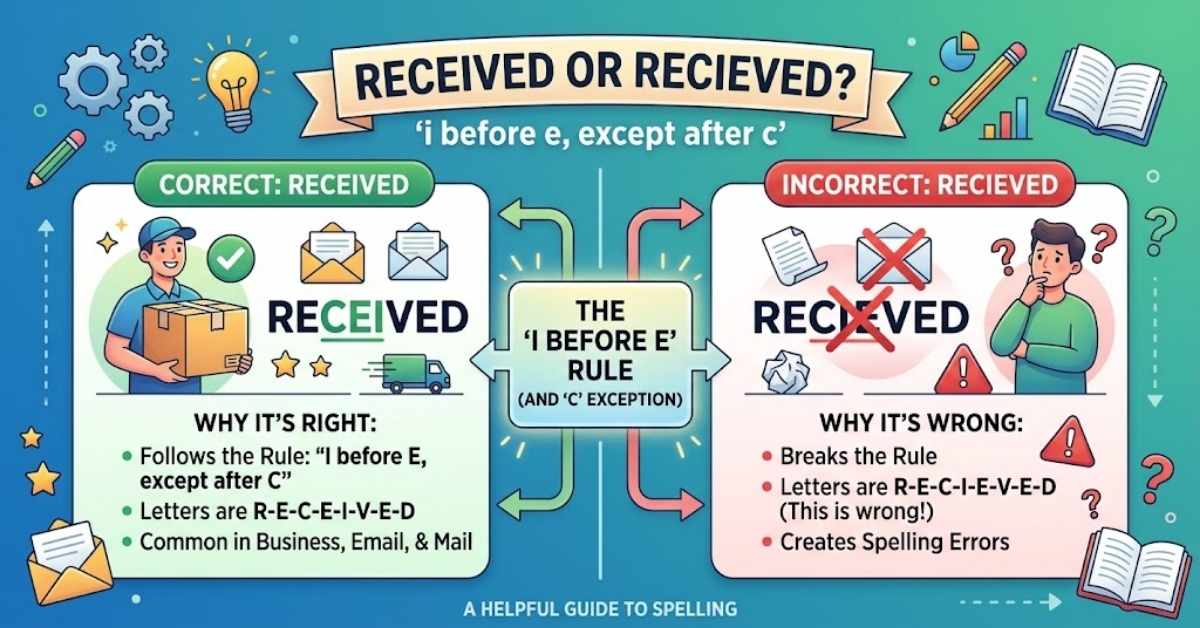
Recieved or received? The correct spelling is received. Recieved is a common misspelling caused by switching the e and i in the middle of the word. The correct spelling is r-e-c-e-i-v-e-d. Oxford lists received as both the past simple and past participle of receive.
So if you’re wondering received or recieved which is correct, use:
Received ✓
Not:
Recieved ✗
The good news is that once you understand the cei pattern in receive, the spelling becomes much easier to remember.
Recieved or Received: Which Is Correct?
Received is the standard English spelling.
| Spelling | Correct? | Explanation |
|---|---|---|
| received | ✓ | Correct spelling |
| recieved | ✗ | Common misspelling |
| recived | ✗ | Missing the “ei” |
| recevied | ✗ | Letters are rearranged |
| receieved | ✗ | Extra “e” |
The middle of the correct word is:
re-CEI-ve-d
The incorrect form changes that sequence to:
re-CIE-ve-d
That small letter swap is responsible for the entire received vs recieved confusion.
Correct examples
I received your email yesterday.
She received the package this morning.
We received your application.
He received an award for his work.
Incorrect examples
I recieved your email yesterday. ✗
She recieved the package. ✗
We recieved your application. ✗
Why Is “Received” Spelled With EI?
The easiest way to see the spelling is to start with the base verb:
receive
Then add -d:
receive → received
The important sequence is:
r-e-c-e-i-v-e
Notice the letters immediately after c:
e-i
So:
receive
becomes:
received
not:
recieved
Look at the word in pieces
re + cei + ve + d
The CEI sequence is the part worth remembering.
A useful mental image is:
C comes before EI.
That is more precise for this word than trying to remember the entire spelling as one long string.
Does “I Before E Except After C” Explain Received?
Yes, as a memory aid, but it should not be treated as a perfect rule for every English word.
The familiar mnemonic is:
I before E, except after C.
In receive, the ei follows c:
rec + ei + ve
The same pattern appears in related words such as:
- deceive
- perceive
- conceive
- receipt
- ceiling
Dictionary.com specifically identifies receive as an example where the usual “i before e” expectation is reversed after c.
However, English has plenty of exceptions to the famous mnemonic. So the safest approach is to treat it as a memory shortcut, not an absolute spelling law. LitSpelling documents several common exceptions.
For received, the practical rule is simple:
Remember CEI.
What Does “Received” Mean?
Received is the past form of the verb receive.
At its most basic, receive means to get, accept, or be given something. Cambridge gives examples involving letters, awards, work, and other things someone obtains or is given.
For example:
I received your letter.
This means:
I got your letter.
Another example:
She received an award.
This means:
She was given an award.
Received can describe many things
You can receive:
- an email
- a letter
- a package
- a payment
- a message
- an award
- a gift
- information
- feedback
- an invitation
- a phone call
- an application
Examples:
We received your payment.
I received a text message from Sarah.
The company received hundreds of applications.
She received useful feedback from her teacher.
Is “Received” the Past Tense of “Receive”?
Yes.
The basic forms are:
| Form | Example |
|---|---|
| receive | I receive emails every day. |
| receives | She receives emails every day. |
| received | I received an email yesterday. |
| receiving | We are receiving applications now. |
Oxford lists received as both the past simple and past participle of receive.
This is important because received isn’t just a spelling variation of receive. It is a specific grammatical form of the verb.
Received as the Past Simple
Use received for a completed action in the past.
I received your email yesterday.
She received the package this morning.
We received the payment last Friday.
He received the results two weeks ago.
The time reference can be explicit:
- yesterday
- last week
- this morning
- two days ago
- in 2025
Received as a Past Participle
Received is also the past participle.
It commonly appears with have, has, or had:
I have received your message.
She has received the documents.
We had received the information before the meeting.
The spelling remains exactly the same:
received
There is no alternative spelling such as recieved for the past participle.
Received vs Recieved Examples
Seeing the word in realistic contexts makes the difference easier to remember.
I received your email this morning. ✓
Not:
I recieved your email this morning. ✗
Package
She received the package yesterday. ✓
Payment
We received your payment. ✓
Application
The university received my application. ✓
Message
I received your message and will respond shortly. ✓
Award
He received an award for his research. ✓
Feedback
The team received positive feedback from customers. ✓
In every example, the spelling remains received.
Why Do People Spell “Received” as “Recieved”?
The mistake is understandable because English has several competing ie/ei patterns.
For example:
- believe
- achieve
- piece
have ie.
But:
- receive
- deceive
- perceive
- conceive
have ei after c.
A writer who remembers only:
“I before E”
may automatically produce:
recieved
The missing part of the familiar mnemonic is the exception:
except after C
That is why recieved is such a persistent spelling error.
Another reason is that received and recieved look visually similar. When typing quickly, switching the two vowels is easy to overlook.
What Is the Correct Spelling of Received?
The correct spelling is:
R-E-C-E-I-V-E-D
Break it down:
RE + CEI + VED
The key sequence is:
CEI
A useful way to remember it is:
You receive a receipt.
Both receive and receipt contain the cei pattern.
Dictionary.com also points to related -ceive words as useful spelling reminders.
Received or Recieved: Which Is Correct in American English?
For a U.S. audience, the answer is straightforward:
received is the correct standard spelling.
There is no American-English alternative in which recieved becomes an accepted spelling.
Oxford’s American Dictionary gives:
receive
with received as its past form.
So in American writing, use:
I received your email.
not:
I recieved your email.
Is the Spelling Different in British English?
No.
Unlike words such as color/colour or center/centre, received does not have a standard American/British spelling difference.
Both use:
received
The misspelling recieved is not an alternative British spelling.
Receive vs Received vs Receiving
These three forms are worth learning together.
| Word | Function | Example |
|---|---|---|
| receive | Base/present form | I receive emails daily. |
| received | Past / past participle | I received your email. |
| receiving | -ing form | We are receiving applications. |
Notice the spelling pattern
receive
received
receiving
The ei remains associated with the c in all three forms.
That makes the word family useful for remembering the spelling instead of memorizing received in isolation.
Is “Recieving” Correct?
No.
The correct spelling is:
receiving ✓
Not:
recieving ✗
Compare:
receive → receiving
The spelling changes because the final e is dropped before -ing, but the ei sequence remains:
receiving
not:
recieving
Learning the entire word family can therefore prevent several mistakes at once.
Common Misspellings of Received
The most common error is:
recieved ✗
But writers may also produce forms such as:
recived ✗
recevied ✗
receieved ✗
receved ✗
These are all spelling errors.
The standard form is:
received ✓
“I Received” vs “I Have Received”
Both are correct, but they can communicate slightly different grammatical perspectives.
I received
Simple past:
I received your email yesterday.
The sentence presents the receiving as a completed past event.
I have received
Present perfect:
I have received your email.
This connects the past event with the present situation.
For example, in a business email:
I have received your documents and will review them today.
The important point for this article is that both forms use received, never recieved.
“Was Received” vs “Has Been Received”
These are also both possible.
Was received
The payment was received yesterday.
This emphasizes a completed past event.
Has been received
Your payment has been received.
This emphasizes the present status resulting from the earlier event.
This distinction appears frequently in:
- customer-service messages
- payment confirmations
- application acknowledgments
- business correspondence
- shipping notices
Again, the spelling is always:
received
How “Received” Is Used in Everyday English
The verb receive has more meanings than simply “get.”
Oxford lists uses involving receiving something, experiencing treatment, forming an impression, reacting to something, formally welcoming someone, and receiving broadcast signals.
Receive something
I received a package.
The Receive treatment
The patient received medical treatment.
Receive attention
The proposal received considerable attention.
Be received by an audience
The film was well received by critics.
Receive a signal
The radio received a weak signal.
These uses show why receive is a much broader word than simply “get.”
LEARN MORE: Vinal vs Vinyl
Common Mistakes With “Received”
Mistake 1: Recieved
I recieved your email. ✗
Correct:
I received your email. ✓
Mistake 2: Recived
I recived the package. ✗
Correct:
I received the package. ✓
Mistake 3: Recevied
We recevied your application. ✗
Correct:
We received your application. ✓
Mistake 4: Recieving
We are recieving applications. ✗
Correct:
We are receiving applications. ✓
Mistake 5: Receieved
She receieved an award. ✗
Correct:
She received an award. ✓
The solution isn’t to memorize every incorrect version. Learn the correct word family:
receive → received → receiving
A Simple Memory Trick That Actually Works
If you regularly type recieved, use one of these two memory methods.
Trick 1: Remember CEI
Look at the center:
reCEIve
Then:
reCEIved
The letters C-E-I stay in that order.
Trick 2: Receive a receipt
Both words begin their tricky section with:
cei
receive
receipt
So when you think:
“I need to receive it.”
think:
“I need the cei spelling.”
This is often more useful than trying to reconstruct the entire word every time.
Quick Test: Received or Recieved?
Choose the correct spelling.
1. I ___ your email yesterday.
- A. recieved
- B. received
Answer: B — received
2. We have ___ your payment.
- A. recieved
- B. received
Answer: B — received
3. She ___ an award.
- A. received
- B. recieved
Answer: A — received
4. The company ___ hundreds of applications.
- A. recieved
- B. received
Answer: B — received
5. We are ___ new applications.
- A. recieving
- B. receiving
Answer: B — receiving
Frequently Asked Questions
Is it recieved or received?
Received is correct. Recieved is a misspelling.
I received your message. ✓
Recieved or received which is correct?
Received is the correct spelling.
The correct sequence is:
r-e-c-e-i-v-e-d
Is it recieved or received?
It is received.
If you’re writing a sentence such as:
I ___ your email.
the correct form is:
I received your email.
What does received or recieved mean?
Only received is the standard spelling. It is the past tense and past participle of receive, which commonly means to get, accept, or be given something.
For example:
I received your letter.
Is “recieved” a word?
Recieved is not the standard spelling of the English word. It is a common misspelling of received.
How do you spell received?
Spell it:
R-E-C-E-I-V-E-D
The important sequence is:
CEI
Why is received spelled with EI?
Because receive uses ei after c:
rec + ei + ve
The past form keeps that spelling:
rec + ei + ve + d
The familiar mnemonic “i before e, except after c” can help remember this pattern, although English has exceptions to the broader rule.
Is received the past tense of receive?
Yes.
receive → received
Oxford lists received as the past simple and past participle of receive.
Is “receiving” spelled correctly?
Yes.
Receiving is correct.
Recieving is incorrect.
The forms are:
receive → received → receiving
What is the difference between receive and received?
Receive is the base/present form:
I receive emails every day.
Received is the past form:
I received an email yesterday.
Is received the same in American and British English?
Yes. Received is the standard spelling in both American and British English.
What is the easiest way to remember received?
Remember:
C comes before EI.
Or connect it with:
receive a receipt
Both words reinforce the cei spelling pattern.
Final Answer: Recieved or Received?
The answer is simple:
Received ✓
Recieved ✗
If you’re wondering received or recieved which is correct, choose received every time in standard English.
Remember the spelling as:
RE-CEI-VE-D
And remember the word family:
receive → received → receiving
The most useful part to memorize is CEI. Once that pattern becomes familiar, the common recieved mistake becomes much easier to avoid.
So if you’re writing:
“I ___ your email.”
write:
“I received your email.”
not:
“I recieved your email.”
That one misplaced vowel is the entire difference between the standard spelling and the common misspelling.