

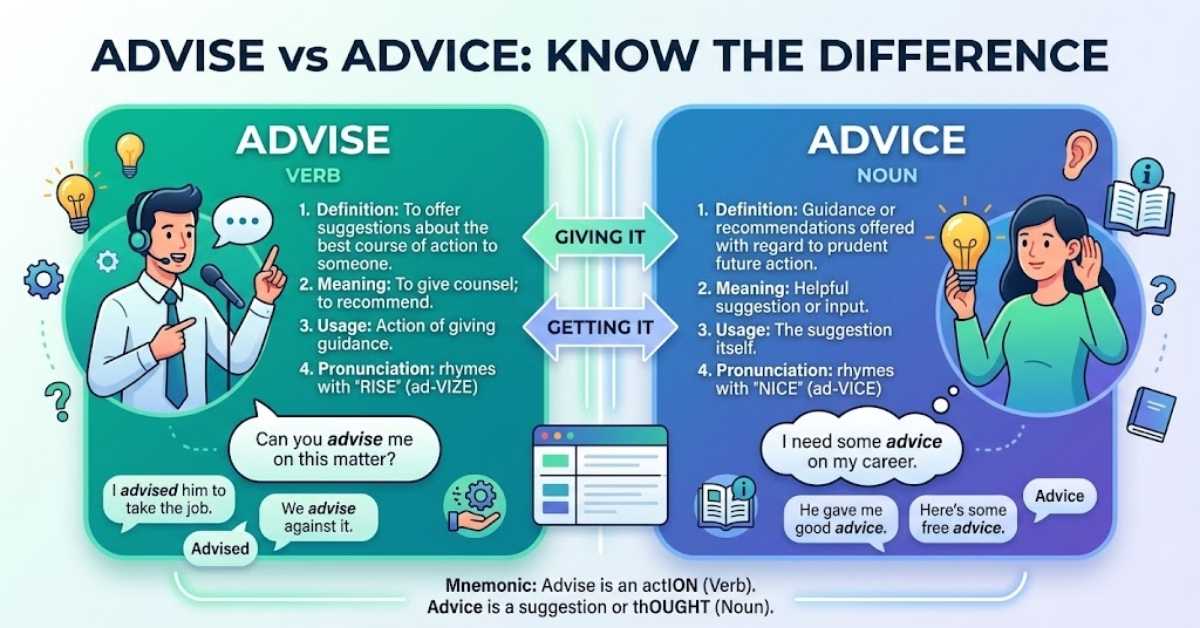
Advise vs advice is a common English confusion because the two words look almost identical and are closely related in meaning. The key difference is grammatical: advice is a noun, while advise is a verb. Advice is the guidance or recommendation itself; advise means to give that guidance or recommendation.
So:
- Advice = the suggestion or guidance
- Advise = the act of giving that suggestion or guidance
For example:
I need your advice.
Can you advise me?
Once you recognize whether your sentence needs a thing or an action, the choice becomes much easier.
Advise vs Advice: What Is the Difference?
| Word | Part of speech | Meaning | Example |
|---|---|---|---|
| advice | Noun | Guidance, recommendation, or suggestion | I need some advice. |
| advise | Verb | To give guidance or make a recommendation | I advise you to wait. |
Advice names the guidance. Advise describes the action of giving it.
Compare these two sentences:
My manager gave me some advice.
My manager advised me to wait.
In the first sentence, advice is the thing the manager gave. In the second, advised describes what the manager did.
This noun-versus-verb distinction is also the central explanation used by major grammar references and dictionaries.
The easiest rule
Ask yourself:
Am I naming the guidance, or am I describing the act of giving it?
- Naming the guidance → advice
- Describing the action → advise
What Does “Advice” Mean?
Advice is a noun meaning an opinion, suggestion, recommendation, or guidance about what someone should do.
For example:
I need some advice about my new job.
She gave me excellent advice.
His parents offered him some practical advice.
We followed the lawyer’s advice.
Cambridge defines advice as an opinion someone offers about what another person should do or how they should act in a particular situation. Oxford similarly defines it as an opinion or suggestion about what someone should do.
Advice is a noun
That means advice can function as the subject or object of a sentence:
Her advice was helpful.
I appreciated your advice.
We asked for professional advice.
He ignored my advice.
A useful test is to replace advice with another noun such as guidance, suggestion, or recommendation.
I need your advice.
I need your guidance.
The grammar works because both are nouns.
What Does “Advise” Mean?
Advise is a verb. It means to give someone advice, recommend a course of action, or tell someone what you think they should do.
For example:
I advise you to wait.
My doctor advised me to get more rest.
She advised us against taking the shortcut.
Can you advise me on what to do?
Cambridge and Oxford list several normal structures for the verb, including advise someone to do something, advise against something, and advise someone on something.
Advise can also mean “inform”
There is a second useful meaning that many simplified grammar articles overlook.
In formal contexts, advise can mean to give someone official information.
For example:
The airline advised passengers of the schedule change.
The company advised employees that the office would close early.
The court advised the parties of their rights.
Cambridge specifically recognizes this formal use of advise as giving official information.
So advise does not always mean “tell someone what they should do.” It can also mean notify or inform someone.
Advise vs Advice Examples
The fastest way to understand the advise vs advice difference is to see the words working in real sentences.
Examples with “advice”
I need your advice.
She gave me some useful advice.
His advice helped me make a decision.
We asked for professional advice before signing the contract.
My teacher gave me good advice about the exam.
Examples with “advise”
I advise you to read the contract carefully.
My teacher advised me to study earlier.
The doctor advised him to rest.
I would advise against making a quick decision.
Can you advise me on the next step?
The relationship is simple:
You advise someone by giving them advice.
That sentence captures the difference better than memorizing two isolated definitions.
Advise vs Advice Difference: Look at the Sentence Structure
A particularly effective way to choose between the words is to look at what comes immediately around them.
Pattern 1: Give + advice
Use advice after verbs such as give, offer, or receive.
She gave me some advice.
He offered useful advice.
I received excellent advice.
They asked for financial advice.
You are naming the guidance, so you need the noun advice.
Pattern 2: Advise + someone + to + verb
Use advise when someone is being told or recommended to do something.
I advise you to wait.
The teacher advised me to practice.
The lawyer advised her to read the agreement.
We advise customers to keep their receipts.
Oxford specifically identifies advise somebody to do something as a standard American-English construction.
Pattern 3: Advise + against
You can use advise against when recommending that someone not do something.
I advise against buying it.
The doctor advised against driving.
They advised against making a rushed decision.
This structure is especially useful because it cannot naturally be replaced with the noun advice without changing the sentence.
Pattern 4: Advise + someone + on/about + topic
Use advise when someone provides guidance concerning a subject.
She advised me on my career options.
The consultant advised us on the project.
He advised her about the application process.
Cambridge lists advise someone on something among the standard constructions of the verb.
Pattern 5: Advise + someone + of + information
For formal notification, use:
The company advised us of the change.
We were advised of the new requirements.
Here, advise is closer to inform than recommend.
Please Advise or Please Advice?
The correct phrase is:
Please advise. ✓
Not:
Please advice. ✗
Why?
Because the sentence needs a verb. Advise is the verb; advice is the noun.
Scribbr, QuillBot, and other major grammar references all identify please advise as the correct construction when asking someone for information or guidance.
Correct examples
Please advise me on the next steps.
Please advise whether the meeting has been rescheduled.
Please advise us of any changes.
The documents are attached. Please advise if anything else is required.
Incorrect
Please advice me on the next steps. ✗
Please advice whether the meeting has been rescheduled. ✗
Why “please advise” can sound formal
Please advise is grammatically correct, but tone is another issue.
In professional correspondence, it can be perfectly appropriate:
Please advise whether additional documentation is required.
In a more conversational email, you might choose:
Please let me know if you need anything else.
or:
Could you let me know what you recommend?
The choice depends on the relationship, context, and desired tone—not on whether please advise is grammatically correct.
Advice or Advise: Which Is Correct?
The answer is: both are correct words, but they are not interchangeable.
Use advice when you need a noun:
I need your advice.
Use advise when you need a verb:
Please advise me.
So the question “advice or advise which is correct?” has no single answer without a sentence.
Compare
Thank you for your advice. ✓
Thank you for your advise. ✗
But:
Please advise me. ✓
Please advice me. ✗
The surrounding grammar determines the correct word.
Is It Advice or Advise?
If you’re still unsure, try this quick substitution test.
Can you replace it with “guidance” or “suggestion”?
If yes, use advice.
I need your advice.
→ I need your guidance.
Can you replace it with “recommend” or “tell someone what to do”?
If yes, use advise.
I advise you to wait.
→ I recommend that you wait.
This isn’t a perfect replacement in every context, but it is an effective practical test for ordinary English.
Can You Say “An Advice”?
Usually, no.
In standard English, advice is an uncountable noun. Cambridge and Oxford both explicitly describe it this way.
So avoid:
She gave me an advice. ✗
Instead say:
She gave me some advice. ✓
Or:
She gave me a piece of advice. ✓
You can also say:
He gave me a word of advice. ✓
Can You Say “Advices”?
In ordinary standard English, advice is not normally pluralized as “advices.”
Instead of:
She gave me three advices. ✗
write:
She gave me three pieces of advice. ✓
Or:
She gave me three suggestions. ✓
This is an important point because learners sometimes assume that adding -s creates the plural simply because advice looks like an ordinary countable noun. It does not work that way in its ordinary meaning.
The useful formula
one piece of advice
two pieces of advice
some advice
Not:
one advice
two advices
Advise vs Advice Pronunciation
The two words are also pronounced differently at the end.
Advice
Advice ends with an /s/ sound.
Advise
Advise ends with a /z/ sound.
Cambridge gives advice as /ədˈvaɪs/ and advise as /ədˈvaɪz/ in its dictionary entries.
This difference is useful because the spelling and pronunciation work together:
- advice → final c → /s/
- advise → final s → /z/
A simple memory trick
Think:
advice → ice → /s/
advise → eyes → /z/
Dictionary.com uses a similar rhyme-based memory strategy to help distinguish the two words.
Advice, Advise, Adviser, and Advisor
These words belong to the same word family, which can make the spelling even more confusing.
Advice
The noun for the guidance:
Thank you for your advice.
Advise
The verb for giving guidance:
I advise you to wait.
Adviser / Advisor
A person who gives advice:
She is my financial advisor.
He works as a legal adviser.
Both adviser and advisor are established forms in American English. Cambridge lists both forms.
Common Advise vs Advice Mistakes
1. “Thank you for your advise.”
Incorrect:
Thank you for your advise. ✗
Correct:
Thank you for your advice. ✓
Why? You are referring to the guidance you received. That is a noun.
2. “I would advice you to wait.”
Incorrect:
I would advice you to wait. ✗
Correct:
I would advise you to wait. ✓
Why? The sentence requires a verb.
3. “Please advice me.”
Incorrect:
Please advice me. ✗
Correct:
Please advise me. ✓
4. “She gave me an advice.”
Incorrect:
She gave me an advice. ✗
Correct:
She gave me some advice. ✓
Or:
She gave me a piece of advice. ✓
5. “He gave me two advices.”
Incorrect:
He gave me two advices. ✗
Correct:
He gave me two pieces of advice. ✓
6. “The lawyer advised me on what to do.”
This can be correct.
The lawyer advised me on the available options. ✓
The structure advise someone on something is standard.
Advise vs Advice in Professional Writing
This distinction matters especially in emails, reports, applications, and workplace communication.
Consider:
Thank you for your advice.
This means you are thanking someone for the guidance they provided.
Now compare:
Please advise me on the next steps.
This asks the person to provide guidance or information.
The two words can even appear naturally in the same sentence:
I appreciate your advice, and I would be grateful if you could advise me on the next steps.
That sentence demonstrates the entire distinction:
advice = noun
advise = verb
A Better Alternative to Vague “Please Advise”
Although please advise is grammatically correct, a message can be clearer if you tell the reader exactly what you need.
Vague
Please advise.
Clearer
Please advise whether the application has been approved.
More conversational
Please let me know whether the application has been approved.
Asking for a recommendation
Could you advise me on which option you recommend?
This is an important writing lesson: grammatically correct does not always mean maximally clear or natural for every situation.
Advice vs Advise Definition: The One-Minute Rule
If you only remember one thing, remember this:
Advice is something you give or receive. Advise is something you do.
For example:
I received advice.
I advised my friend.
Or:
She gave me advice.
She advised me to wait.
That distinction will solve most everyday uses.
LEARN MORE: Half Mast or Half Staff?
Quick Comparison: Advice vs Advise
| Question | Answer |
|---|---|
| Is advice a noun? | Yes |
| Is advise a verb? | Yes |
| Does advice mean guidance? | Yes |
| Does advise mean to give guidance? | Yes |
| Is “please advise” correct? | Yes |
| Is “please advice” correct? | No, in the ordinary intended construction |
| Can you say “an advice”? | No, in ordinary standard English |
| Can you say “some advice”? | Yes |
| Can you say “a piece of advice”? | Yes |
| Can you say “two pieces of advice”? | Yes |
| Can you normally say “two advices”? | No |
| Does advice end with an /s/ sound? | Yes |
| Does advise end with a /z/ sound? | Yes |
| Can advise mean “inform”? | Yes, especially formally |
Quick Test: Advice or Advise?
Try filling in the blanks.
- I need your __ before I make a decision.
- I would __ you to check the contract.
- Thank you for your __.
- Please __ me when you have an answer.
- She gave me a useful piece of __.
- The doctor __ him to rest.
- They __ against traveling during the storm.
- Can you __ me on this issue?
Answers
- advice
- advise
- advice
- advise
- advice
- advised
- advised
- advise
The pattern becomes obvious once you identify the part of speech.
Frequently Asked Questions
Is it advice or advise?
Both words are correct, but they have different grammatical functions. Advice is a noun, while advise is a verb.
I need your advice.
Please advise me.
Is “please advise” or “please advice” correct?
Please advise is correct when you are asking someone to provide information or guidance. Advise is the verb required by the sentence.
Is “please advice” ever correct?
Not when you mean “please give me advice” or “please provide information.” In that ordinary construction, use please advise.
What is the difference between advise and advice?
Advice is a noun meaning guidance or a recommendation. Advise is a verb meaning to give guidance, recommend something, or, in formal contexts, provide information.
Is advice a noun or a verb?
Advice is a noun.
Her advice was helpful.
Is advise a noun or a verb?
Advise is a verb.
I advise you to wait.
Can I say “an advice”?
In ordinary standard English, use some advice or a piece of advice, not an advice. Advice is normally an uncountable noun.
Can I say “advices”?
Normally, no. Use pieces of advice when you need to count individual recommendations.
She gave me three pieces of advice.
What is the plural of advice?
There is normally no plural advices in its ordinary meaning. Use:
pieces of advice
For example:
I received two pieces of advice.
How do you remember advise vs advice?
Use this simple rule:
Advice = noun
Advise = verb
You can also remember the pronunciation:
advice ends in /s/.
advise ends in /z/.
Can I use “advise” with “to”?
Yes.
A very common structure is:
advise + someone + to + verb
For example:
The teacher advised me to study.
The doctor advised him to rest.
Oxford lists this as a standard construction.
Can you say “advise against”?
Yes.
I advise against buying the car.
The doctor advised against driving.
This means someone recommends that another person not do something.
Is “advise on” correct?
Yes.
She advised me on my career.
The consultant advised us on the project.
The verb can be followed by a person and on a subject.
Is “advice” countable?
In its ordinary meaning, advice is uncountable.
Use:
some advice
a piece of advice
two pieces of advice
rather than an advice or two advices.
Final Answer: Advise vs Advice
The advise vs advice difference comes down to one essential grammatical distinction:
Advice = noun → the guidance, suggestion, or recommendation itself.
Advise = verb → the act of giving guidance, making a recommendation, or formally providing information.
Remember:
I need your advice.
but:
Please advise me.
And when you’re writing an email, remember:
Please advise. ✓
not:
Please advice. ✗
If you can identify whether your sentence needs a noun or a verb, the correct choice becomes straightforward. The spelling difference is only one letter, but the grammatical difference is what determines which word belongs in the sentence.