

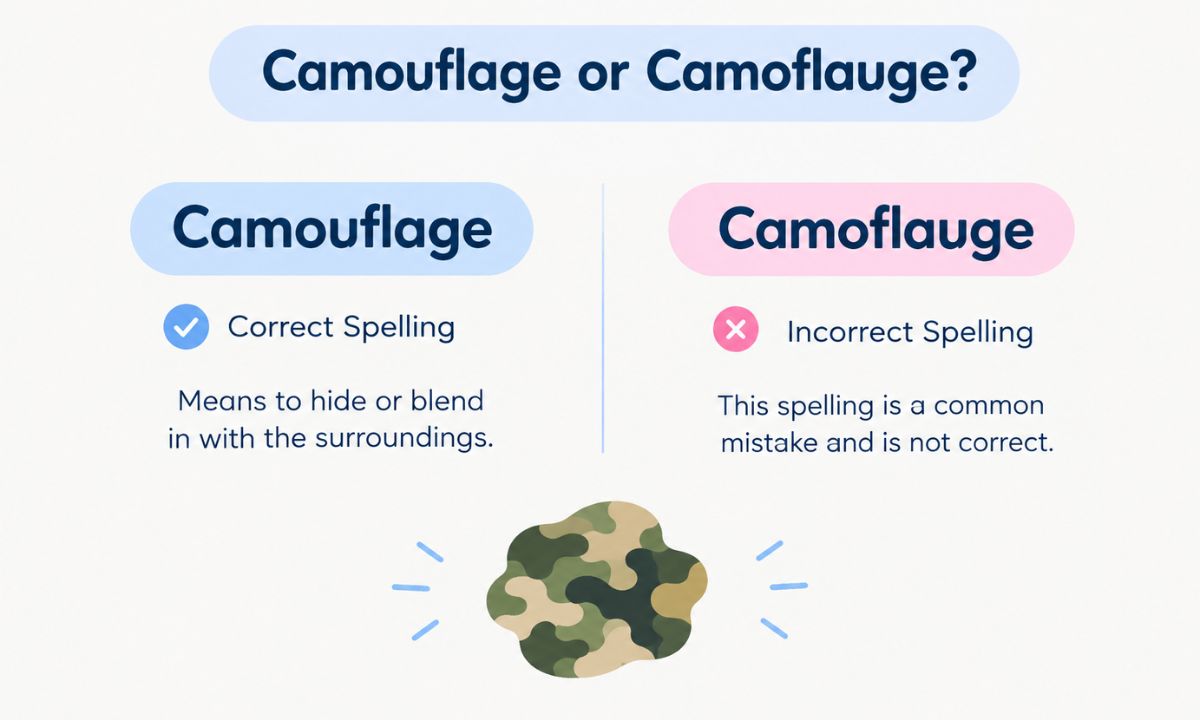
If you have ever wondered whether “camouflage” or “camoflauge” is correct, you are not alone. Many English learners and native speakers accidentally rearrange the letters in this word. The correct spelling is camouflage.
Camouflage refers to a way of hiding a person, animal, object, or place by making it difficult to notice. The word commonly appears in discussions about military clothing, wildlife, fashion, hunting, photography, and everyday situations.
The incorrect form “camoflauge” usually results from placing the letters “f” and “l” in the wrong order. Fortunately, a simple spelling trick can help you remember the correct version.
Camouflage or Camoflauge: Which One is Correct?
The correct spelling is camouflage.
❌ Camoflauge — Incorrect
✅ Camouflage — Correct
The correct word contains the letter sequence “flage” near the end:
C-A-M-O-U-F-L-A-G-E
A common mistake changes the order and produces “camoflauge.” Although this spelling appears in online searches and informal writing, standard English dictionaries recognize camouflage as the correct spelling.
Quick Comparison
| Word | Correct? | Meaning |
| Camouflage | ✅ Yes | Hiding by blending into surroundings |
| Camoflauge | ❌ No | Common misspelling of camouflage |
For example:
- The soldiers wore camouflage uniforms.
- The lizard uses camouflage to hide from predators.
- The jacket has a camouflage pattern.
However, you should avoid writing “camoflauge” in school assignments, professional documents, websites, or formal communication.
Meaning of Camouflage
Camouflage means using color, shape, pattern, texture, or surroundings to make something difficult to see or recognize.
The word can work as both a noun and a verb.
As a noun, it describes the method or appearance used for hiding:
The animal’s camouflage made it almost impossible to see.
As a verb, it describes the action of hiding something:
The net helped camouflage the equipment.
In simple words, camouflage means “to hide by blending in.”
The concept does not always require someone to disappear completely. Instead, camouflage makes a person or object less noticeable.
For instance, a green insect sitting on a leaf may remain difficult to spot because its body resembles the surrounding leaves.
Why People Write Camoflauge Instead of Camouflage
The misspelling “camoflauge” happens mainly because of the word’s unusual letter arrangement.
When people say the word aloud, the spelling does not always feel obvious. As a result, writers may remember the sounds rather than the exact letters. This can lead them to place “l” before “f”, creating the incorrect form.
Another reason involves visual memory. People often remember the beginning of the word correctly but become uncertain about the middle and ending.
Compare these forms:
Correct: camou + flage
Incorrect: camo + flauge
The important part to remember is:
FLAGE
Once you recognize this pattern, the correct spelling becomes easier to recall.
A Simple Spelling Breakdown
You can divide the word into smaller parts:
camou + flage = camouflage
The unusual “ou” combination can also make the word look harder than it actually is. Therefore, learning the whole word as a single spelling pattern works better than trying to spell it only from pronunciation.
Uses of Camouflage in Real Life
Camouflage has many practical uses. Although people often associate it with soldiers, the idea appears in nature, clothing, photography, design, and everyday situations.
Military Use
Military forces commonly use camouflage to help personnel and equipment blend into their surroundings.
For example, soldiers may wear patterned uniforms containing colors that resemble forests, grasslands, deserts, or other environments. Vehicles, shelters, and equipment can also use camouflage patterns.
The goal is to make them harder to notice from a distance.
Example:
The soldiers changed their camouflage according to the environment.
Different environments require different patterns. A design suitable for a woodland area may not work well in a sandy desert.
Nature and Wildlife
Animals use natural camouflage for survival.
Some animals blend into their surroundings to avoid predators. Others use camouflage while hunting.
Examples include:
- A stick insect resembling a small branch
- A snowshoe hare blending with snowy surroundings
- A leopard becoming difficult to notice among vegetation
- A chameleon changing its appearance in certain situations
- An octopus using color and texture to blend with its surroundings
For example:
The insect’s natural camouflage protected it from predators.
Therefore, camouflage plays an important role in the survival of many species.
Fashion and Design
Camouflage patterns have also become popular in fashion.
You may see camouflage prints on:
- Jackets
- T-shirts
- Pants
- Shoes
- Bags
- Hats
- Accessories
In fashion, the pattern does not necessarily serve a hiding purpose. Instead, designers often use it because it creates a distinctive military inspired appearance.
Everyday example:
He bought a camouflage jacket for casual winter wear.
Similarly, interior designers and graphic designers may use camouflage inspired patterns for decorative purposes.
Camouflage in Everyday Conversation
You do not need to discuss the military or wildlife to use camouflage correctly. The word can appear in ordinary conversations.
Here are some natural examples:
At a clothing store:
“Do you have this shirt in a camouflage print?”
Talking about a pet:
“I couldn’t find my cat because its fur blended into the sofa.”
Discussing photography:
“The bird’s camouflage made it difficult to photograph.”
Talking about decoration:
“The camouflage pattern gives the bag a rugged look.”
Talking about hiding something:
“The box was camouflaged by the surrounding decorations.”
These examples show that the word can describe both literal hiding and patterns inspired by concealment.
Camouflage as a Verb, Noun, and Adjective
Understanding the different forms of the word can improve your writing.
| Form | Use | Example |
| Camouflage | Noun | The animal has excellent camouflage. |
| Camouflage | Verb | The leaves camouflage the insect. |
| Camouflaged | Past participle/adjective | The vehicle was well camouflaged. |
| Camouflaging | -ing form | The bird is camouflaging itself among the branches. |
| Camouflage pattern | Noun phrase | She bought a camouflage pattern bag. |
This flexibility explains why camouflage appears in many types of sentences.
Easy Tricks to Remember the Correct Spelling
Remembering camouflage becomes easier when you use a visual pattern.
Trick : Remember “FLAGE”
Focus on the ending:
FLAGE
Not:
FLAUGE
So, when you hesitate, remember:
Camou + FLAGE = camouflage
Trick : Watch the “F-L” Order
The letters F and L occur in this order:
F → L
The incorrect spelling reverses this relationship.
Trick : Write It Three Times
Write the correct word several times:
camouflage
camouflage
camouflage
Repeated exposure helps your brain recognize the correct letter pattern.
Trick : Connect It With a Visual
Imagine a green soldier hiding among green trees. Then connect that image with the spelling camouflage.
This method can make the word easier to remember because you associate the spelling with its meaning.
Common Mistakes to Avoid
The biggest mistake is writing camoflauge instead of camouflage. However, several other errors can occur.
Mistake : Reversing “F” and “L”
❌ Camoflauge
✅ Camouflage
Mistake : Removing the “U”
Some writers may shorten the middle incorrectly.
❌ Camoflage
✅ Camouflage
Mistake : Relying Only on Pronunciation
English spelling does not always follow pronunciation perfectly. Therefore, spelling the word exactly as it sounds can create errors.
Mistake : Using the Wrong Word in Formal Writing
Because camoflauge is a common search spelling, writers may assume it is an alternative form. It is not the standard spelling.
Always use camouflage when writing in standard English.
Camouflage vs. Concealment: Are They the Same?
These words have related meanings, but they are not always interchangeable.
Camouflage involves blending something into its surroundings so that it becomes difficult to notice.
Concealment means hiding something from view or keeping it secret.
For example:
The bird uses camouflage among the leaves.
But:
The drawer provided concealment for the documents.
Therefore, camouflage often focuses on blending in, while concealment has a broader meaning of hiding.
Is Camouflage Used Only for Hiding?
No. The word can describe a pattern even when nobody intends to hide.
For example, a person may wear camouflage trousers simply because they like the design. In this situation, the pattern comes from traditional camouflage but does not necessarily function as concealment.
The same applies to bags, shoes, furniture, phone cases, and other products.
Consequently, camouflage can refer to both a practical hiding technique and a recognizable visual style.
FAQs
What is the correct spelling: camouflage or camoflauge?
The correct spelling is camouflage. Camoflauge is a common misspelling and should not be used in standard English.
Why is camoflauge incorrect?
Camoflauge is incorrect because it rearranges letters in the middle of the word. The correct spelling uses the sequence “flage.”
What does camouflage mean?
Camouflage means hiding a person, animal, object, or place by making it blend with its surroundings. It can also describe a pattern inspired by this method.
Where is camouflage used?
Camouflage appears in military equipment, wildlife, hunting, fashion, photography, outdoor products, art, and design.
How can I remember the correct spelling?
Remember the ending “FLAGE.” Think of the word as camou + flage. This helps prevent the common “camoflauge” mistake.
Is camouflage a noun or a verb?
Camouflage can function as both a noun and a verb. For example, “The animal uses camouflage” uses it as a noun, while “Leaves camouflage the insect” uses it as a verb.
Conclusion
So, camouflage or camoflauge? The answer is clear: camouflage is the correct spelling.
The word describes the process or appearance of blending into an environment to avoid attention. It has important uses in military settings and nature, while camouflage patterns also remain popular in fashion and design.
If you frequently confuse the two spellings, focus on the F-L sequence and remember “camou + flage.” With regular exposure and practice, the correct spelling will become much easier to remember.
In short:
✅ Camouflage = correct
❌ Camoflauge = incorrect
Whenever you mean hiding by blending into the surroundings, choose camouflage.