

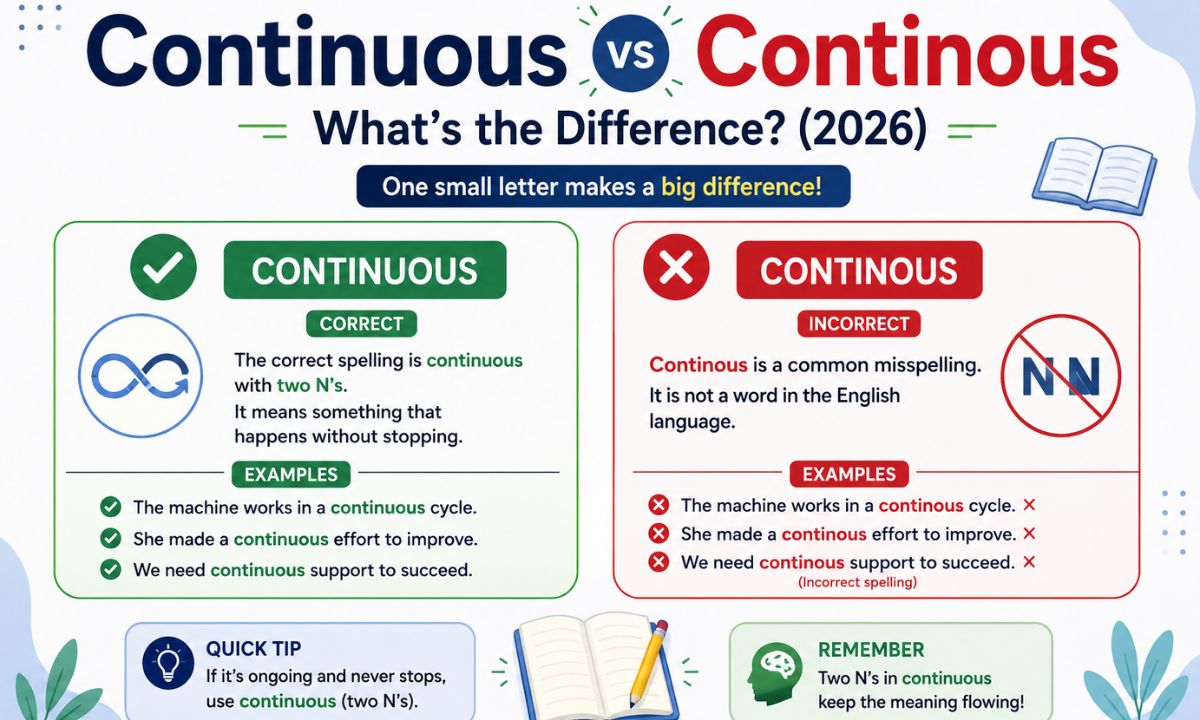
If you’ve seen both continuous and continous, you may wonder whether they are different words. The short answer is simple: continuous is the correct English spelling, while continous is a common misspelling.
Many students, ESL learners, and even experienced writers accidentally drop the second “u” when typing. This guide explains the correct spelling, meaning, pronunciation, usage, and the difference between continuous, continual, and the incorrect spelling continous.
What Does Continuous Mean? (And What Is Continous?)
Continuous
Part of Speech: Adjective
Definition
The word continuous describes something that happens without stopping, breaking, or interruption. It refers to an action, process, movement, or state that remains steady over time.
Most dictionaries define continuous as forming an unbroken whole or continuing without interruption.
Examples of Continuous
- The machine operated continuously for twenty four hours.
- She made continuous progress throughout the semester.
- Continuous rain flooded several streets.
- The company provides continuous customer support.
- Scientists collect continuous temperature data during the experiment.
Continous
Part of Speech: None
Definition
Continous is not an English word. It is a spelling mistake of continuous. Writers usually omit the second “u” by accident because English spelling contains many similar looking words.
Although you may see continous in emails, blogs, assignments, or social media posts, dictionaries do not recognize it as a correct spelling.
Incorrect Examples
❌ The noise was continous.
✅ The noise was continuous.
❌ We experienced continous delays.
✅ We experienced continuous delays.
❌ Continuous is the only correct spelling.
Etymology
The word continuous comes from the Latin continuus, meaning uninterrupted or without a break. It entered English through Old French before becoming part of Modern English.
Understanding its origin also explains why the spelling includes the second “u.”
Continuous vs Continual The Difference That Trips People Up
Many writers confuse continuous with continual, even though both words are correct English adjectives.
The difference lies in how often something stops.
- Continuous means without any interruption.
- Continual means repeated again and again with small breaks.
Imagine rain.
If rain falls nonstop for eight hours, it is continuous rain.
If rain starts, stops, and starts again throughout the day, it is continual rain.
Examples
Continuous:
- The internet connection remained continuous all afternoon.
- Continuous monitoring improved safety.
Continual:
- The child asked continual questions during dinner.
- We experienced continual interruptions throughout the meeting.
Although people sometimes use these words interchangeably in casual conversation, careful writing keeps their meanings separate.
Continuous vs Continual
| Feature | Continuous | Continual |
| Meaning | Without interruption | Repeated with pauses |
| Part of Speech | Adjective | Adjective |
| Action | Never stops | Stops and starts again |
| Example | Continuous music played all night. | Continual phone calls interrupted dinner. |
| Common Mistake | Misspelled as continous | Confused with continuous |
Quick Comparison
Think about a flowing river.
A river that never stops flowing is continuous.
A person who checks their phone every few minutes shows continual behavior because each check happens after a short pause.
This distinction improves both formal and academic writing.
Why Do People Spell It “Continous”?
The misspelling continous appears so often because English spelling can be tricky.
Several factors contribute to the mistake.
Missing the Second “U”
Most writers accidentally remove the second “u” after n.
Correct:
continuous
Incorrect:
continous
Fast Typing
People often skip letters while typing quickly. Spell check catches many mistakes, but not every platform checks spelling automatically.
Pronunciation
When spoken naturally, the second “u” sounds weak. As a result, many people believe it does not belong in the spelling.
Similar Words
Words like curious, serious, and obvious follow different spelling patterns. Therefore, writers sometimes assume continous should follow a similar structure.
ESL Learning
English learners frequently spell words based on pronunciation instead of memorized spelling. Consequently, continous becomes an understandable but incorrect guess.
American vs British English
Unlike many English words, continuous has the same spelling in both American English and British English.
| American English | British English |
| Continuous | Continuous |
There is no spelling difference between the two varieties.
However, both American and British dictionaries distinguish continuous from continual in the same way.
How to Use Continuous Correctly in a Sentence
Use continuous whenever something happens without stopping.
It often describes movement, time, sound, growth, improvement, communication, monitoring, production, learning, or service.
Examples
- Continuous practice builds stronger language skills.
- The road experienced continuous traffic during rush hour.
- Doctors provide continuous care for critical patients.
- The factory maintained continuous production all week.
- She received continuous encouragement from her family.
Common Mistakes
❌ The company offers continous support.
✅ The company offers continuous support.
❌ We faced continous challenges.
✅ We faced continuous challenges.
❌ There was a continous power supply.
✅ There was a continuous power supply.
When Not to Use Continuous
Do not use continuous when something happens repeatedly with breaks.
Incorrect:
❌ He made continuous phone calls throughout the day.
Better:
✅ He made continual phone calls throughout the day.
Likewise, never write continous in formal writing, academic papers, business emails, or published content because it is always considered a spelling error.
If you found this guide helpful, you may also enjoy these grammar articles:
- Impatient vs Inpatient What’s the Difference?
- Passersby vs Passerby vs Passerbyers
- Introduction To vs Introduction Of
- In the Street or On the Street
- Raise vs Rise
- Whole Day or All Day
- He Is Risen or He Has Risen?
- Unregister vs Deregister
- Time Slot vs Timeslot
These guides explain confusing English words with clear definitions, practical examples, and easy to remember tips.
Leave a Comment Cancel reply
Have you ever typed continous by mistake? Which spelling or grammar topic would you like us to explain next?
Share your thoughts, questions, or suggestions in the comments. We enjoy helping students, writers, bloggers, and English learners improve their grammar with simple, accurate explanations.
FAQs About Continuous vs Continous
Is it continuous or continous?
Continuous is the correct spelling. Continous is a common spelling mistake.
What does continuous mean?
Continuous means something that happens without stopping or interruption. For example, “The continuous rain lasted for hours.”
Why is continous incorrect?
Continous is incorrect because it leaves out the second u in continuous. The correct spelling is c-o-n-t-i-n-u-o-u-s.
How do you remember the spelling of continuous?
Remember that continuous contains “uous” at the end: continu + ous.
What is the difference between continuous and continual?
Continuous means happening without interruption, while continual means happening repeatedly, often with breaks in between.
Is continuous an adjective?
Yes, continuous is an adjective used to describe something that continues without stopping or interruption.
Final Verdict
The difference between continuous and continous is straightforward once you know the correct spelling. Continuous is the only accepted English word, and it describes something that happens without interruption. In contrast, continous is simply a spelling mistake that appears when the second “u” is omitted.
Writers also confuse continuous with continual, but the meanings are not identical. Use continuous for actions or processes that never stop, and choose continual for events that repeat after short pauses. This small distinction improves clarity and demonstrates strong command of English.
Whenever you proofread your work, look carefully for the missing “u.” Correct spelling not only strengthens your writing but also builds credibility with readers, teachers, clients, and search engines.
Our Vision
Our vision is to make English grammar simple, practical, and accessible for everyone. We publish clear, well researched guides that help students, professionals, bloggers, and ESL learners write with confidence. Every article focuses on accuracy, readability, and real world usage so you can learn the rules and apply them correctly in everyday communication.
Whether you want to master confusing word pairs, improve your writing skills, or understand grammar concepts more easily, our goal is to provide trustworthy resources you can rely on. We believe that strong communication begins with clear grammar, and we are committed to helping you achieve it one lesson at a time