

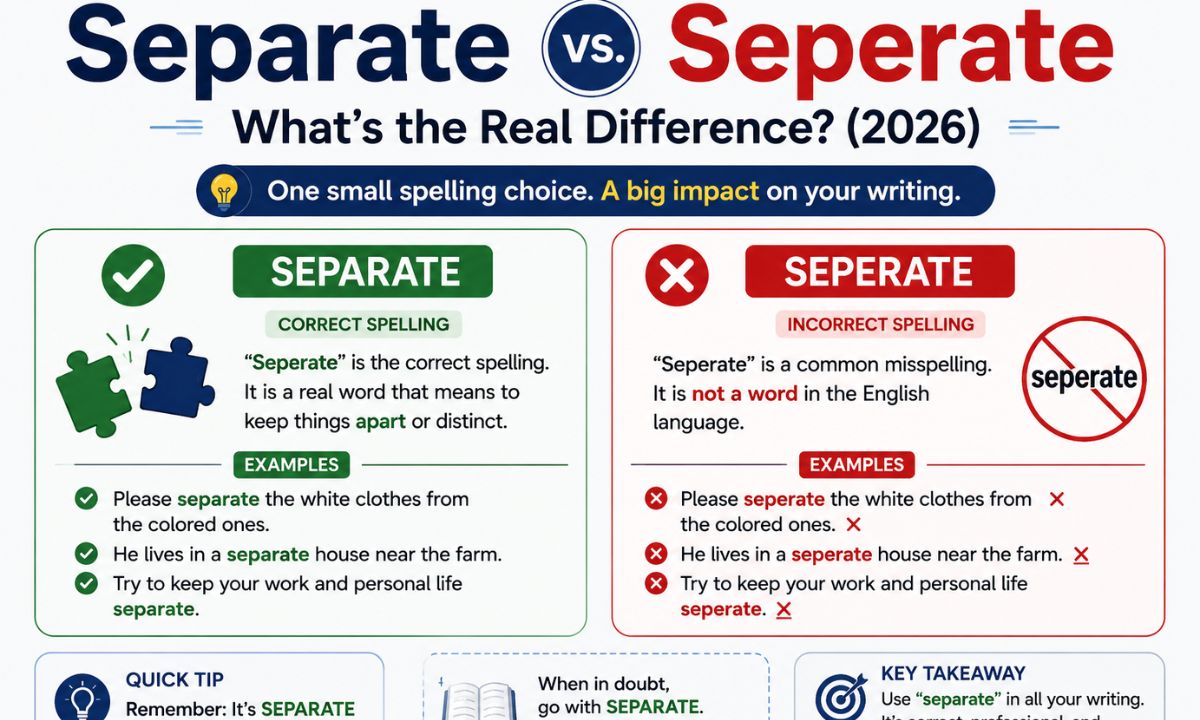
If you’ve ever typed “seperate” and watched your spell checker underline it in red, you’re not alone. Separate is one of the most commonly misspelled words in English because its pronunciation often tricks people into using an e where an a belongs. Although seperate looks believable, it is always incorrect in standard English.
The correct spelling is separate. It is the only form recognized in dictionaries, academic writing, business communication, and professional publishing. Whether you’re writing an essay, an email, or a social media post, choosing separate instead of seperate makes your writing clearer, more accurate, and more credible.
The Quick Answer
The answer is simple:
✅ Separate = Correct spelling
❌ Seperate = Incorrect spelling
Although many people accidentally write seperate, no major English dictionary recognizes it as a correct word. It is simply a spelling mistake.
Examples:
✅ Please keep the documents in separate folders.
✅ The teacher asked us to separate into groups.
❌ Please keep the documents in seperate folders.
❌ The teacher asked us to seperate into groups.
Whenever you’re unsure, always choose separate.
The Correct Spelling “Separate” and What It Means
The word separate is a standard English word that can function as both a verb and an adjective. It refers to dividing, keeping apart, or existing independently from something else.
Part of Speech
Separate works as:
- Verb
- Adjective
Understanding these two uses makes it much easier to use the word correctly.
Dictionary Meaning
As a verb, separate means:
To divide, disconnect, or move things or people apart.
As an adjective, separate means:
Existing independently, distinct, or not joined together.
Although the meanings are closely related, the grammar changes depending on how the word is used.
Etymology and Latin Roots of “Separate”
The word separate comes from the Latin verb separare, which means “to divide,” “to set apart,” or “to keep apart.”
It is formed from two Latin elements:
- se meaning apart
- parare meaning to prepare or to arrange
Over time, the word entered Old French before becoming part of Middle English. Despite changes in pronunciation over the centuries, the spelling separate has remained consistent..
How “Separate” Works as a Verb and an Adjective
One reason separate is such an important word is its flexibility. It can describe both an action and a state.
Separate as a Verb
When used as a verb, separate describes the action of dividing, disconnecting, or keeping things apart.
Examples:
- Please separate the white clothes from the colored ones before washing.
- The teacher asked the students to separate into smaller discussion groups.
- Oil and water naturally separate over time.
- The manager decided to separate the reports by department..
In each sentence, separate describes an action.
Separate as an Adjective
As an adjective, separate describes things that are distinct, independent, or not connected.
Examples:
- We booked separate hotel rooms for the trip.
- The twins attend separate universities.
- Please place these documents in separate folders.
- The company has separate departments for marketing and finance.
- Each applicant must submit a separate form.
- Our offices are located in separate buildings.
In these examples, separate describes nouns rather than actions.
Because it functions as both a verb and an adjective, separate appears frequently in academic writing, business communication, legal documents, journalism, and everyday conversation.
Separate vs. Seperate Quick Comparison
At first glance, separate and seperate look almost identical. The only difference is one letter a versus e in the middle of the word. However, that single letter makes a big difference because only one spelling is recognized as correct in English.
The correct spelling is separate. It appears in dictionaries, textbooks, newspapers, academic papers, and professional writing. Seperate, on the other hand, is a misspelling. It is not an alternative spelling in American English or British English, nor is it accepted in formal or informal writing.
If you want your writing to appear polished and professional, always use separate.
Separate vs. Seperate Comparison Table
| Feature | Separate | Seperate |
| Correct English Spelling | ✅ Yes | ❌ No |
| Found in Dictionaries | ✅ Yes | ❌ No |
| Accepted in Academic Writing | ✅ Yes | ❌ No |
| Used in Business Communication | ✅ Yes | ❌ No |
| Accepted in Exams | ✅ Yes | ❌ No |
| Common Typing Mistake | ❌ No | ✅ Yes |
| Part of Speech | Verb, Adjective | None (Misspelling) |
| Should You Use It? | ✔ Always | ✘ Never |
The table makes the difference clear: separate is the only correct spelling, while seperate is simply a spelling error.
Why Do So Many People Write “Seperate” Instead of “Separate”?
If seperate is always incorrect, why do millions of people type it every year?
The answer lies in the way our brains process spoken language. English spelling isn’t always predictable, and many words aren’t spelled exactly the way they sound. Because of this, people often rely on pronunciation instead of memorizing the correct spelling.
Another reason is that separate is one of the most frequently used words in English. The more often people type a word from memory, the greater the chance of making a familiar mistake.
Let’s look at the main reasons this error happens.
The Role of Phonetics and Pronunciation
One of the biggest reasons people write seperate is pronunciation.
When native speakers say separate, the middle vowel is usually pronounced as a weak schwa sound . This neutral vowel doesn’t sound clearly like a or e.
Because the sound is unclear, many learners assume the spelling should contain e.
Notice that the middle vowel sounds like “uh,” not a clear a.
As a result, many people instinctively write:
❌ seperate
instead of:
✅ separate
This is a classic example of why English spelling can be challenging. The pronunciation doesn’t always reveal the correct spelling.
The “Illusion of Truth” Seeing the Wrong Spelling Too Often
Another interesting reason involves psychology.
Researchers describe something called the Illusion of Truth Effect. This means that the more often we see something even if it’s wrong the more likely we are to believe it’s correct.
On social media, blogs, online comments, and informal messages, the misspelling seperate appears surprisingly often.
After seeing it repeatedly, your brain may start thinking:
“I’ve seen this spelling before, so it must be right.”
Unfortunately, repetition doesn’t make a spelling correct.
Even if you encounter seperate hundreds of times online, it remains a misspelling. Dictionaries, style guides, teachers, editors, and grammar experts all recognize only separate.
Whenever you’re writing professionally or academically, always ignore the incorrect version and use separate..
Common Grammar Mistakes Related to “Separate”
Misspelling separate is only one problem. Writers also misuse the word in different contexts or choose the wrong spelling in everyday expressions.
Here are some of the most common mistakes.
| Incorrect | Correct |
| seperate room | separate room |
| seperate account | separate account |
| seperate building | separate building |
| seperate issue | separate issue |
| seperate page | separate page |
| seperate email | separate email |
| seperate file | separate file |
| seperate entrance | separate entrance |
| seperate class | separate class |
| seperate discussion | separate discussion |
Using “Seperate” in Formal Writing
❌ Please submit your answers on a seperate sheet.
✅ Please submit your answers on a separate sheet.
Misspelling It in Emails
Professional emails should never contain obvious spelling mistakes.
❌ The documents are in seperate folders.
✅ The documents are in separate folders.
Misspelling It in Academic Assignments
Teachers and professors expect correct spelling.
❌ The experiment was divided into seperate stages.
✅ The experiment was divided into separate stages.
Misspelling It on Résumés
A spelling mistake on a résumé or CV can create a poor first impression.
❌ Managed seperate departments.
✅ Managed separate departments.
Assuming “Seperate” Is a British Spelling
Some people think seperate is simply the British version of separate.
It isn’t.
Both American English and British English use exactly the same spelling:
✅ Separate
There is no accepted English variety in which seperate is correct.
How to Use “Separate” Correctly in a Sentence
Knowing the correct spelling is only part of the lesson. You should also understand how to use separate naturally in different grammatical roles.
Separate as a Verb
As a verb, separate means to divide, disconnect, or keep apart.
Examples:
- Please separate the recyclable waste from the trash.
- The teacher separated the students into groups.
- Oil and water naturally separate after a few minutes.
- We need to separate fact from opinion.
- Police officers quickly separated the crowd.
Separate as an Adjective
As an adjective, separate means distinct, independent, or not connected.
Examples:
- They live in separate apartments.
- Please use separate passwords for each account.
- The twins attend separate schools.
- Each department has a separate budget.
- We booked separate hotel rooms.
- Keep raw meat in a separate container from vegetables.
Whether used as a verb or an adjective, separate always keeps its correct spelling with the letter a in the middle.
Common Phrases That Use “Separate”
The word separate appears in countless everyday expressions, making it one of the most useful words in English. Learning these common phrases will help you use the word naturally in conversations, emails, essays, and professional documents.
Separate Account
A separate account refers to an account that is kept independent from another account.
Examples:
- We opened a separate account for business expenses.
- They keep their savings in a separate account.
- The company maintains separate accounts for each department.
Separate Room
A separate room means an independent room that isn’t shared with someone else.
Examples:
- We booked a separate room for the meeting.
- Each guest received a separate room at the hotel.
- The children sleep in separate rooms.
Separate Issue
This phrase refers to a different problem or topic.
Examples:
- That’s a separate issue we’ll discuss later.
- Budget planning is a separate issue from hiring.
- Customer complaints are a separate issue altogether.
Separate Entrance
A separate entrance is a different doorway used for specific people or purposes.
Examples:
- Staff members use a separate entrance.
- The restaurant has a separate entrance for deliveries.
- Visitors should use the separate entrance at the back.
Separate Ways
This common expression means to end a relationship, partnership, or journey together.
Examples:
- After graduation, we went our separate ways.
- The business partners decided to go their separate ways.
- Although they remained friends, they chose to go separate ways professionally.
Separate Identity
A separate identity means having an independent character or role.
Examples:
- Every brand should have a separate identity.
- The twins wanted to develop separate identities.
- Each department maintains its own separate identity.
American vs. British English
One common question is whether separate is spelled differently in American and British English.
The answer is simple:
No.
Both American English and British English use the spelling separate.
There is no accepted English dialect in which seperate is considered correct.
Whether you’re writing for readers in:
- the United States
- the United Kingdom
- Canada
- Australia
- New Zealand
…the correct spelling remains exactly the same:
✅ Separate
This consistency makes the rule easy to remember. Unlike words such as color/colour or organize/organise, separate has no regional spelling variation.
Easy Memory Tricks to Never Misspell “Separate” Again
Because separate is one of the most commonly misspelled English words, using a few simple memory techniques can make the correct spelling stick.
The “A Rat” Mnemonic
One of the most famous spelling tricks is the “A RAT” mnemonic.
Look closely at the word:
sepA RATe
You can clearly see the letters:
A RAT
inside the word.
Whenever you’re unsure, remember:
There’s “A RAT” in sepARATe.
Many teachers use this trick because it’s easy to remember and works for learners of all ages.
Linking It to the Root Word “Par”
The word separate comes from the Latin word separare, meaning to divide or set apart.
Although the English word par has different meanings today, remembering the historical root can remind you that the correct spelling has an “a”, not an “e.”
Understanding a word’s origin often makes it easier to remember its spelling.
Think of “A” for “Apart”
Here’s another easy trick.
The word separate means to keep things apart.
Both words contain the letter A.
- Apart
- sepArate
If you remember that separate means apart, you’ll naturally remember the correct vowel.
Practice Quiz
Choose the correct spelling.
Please keep these files in folders.
A. seperate
B. separate
✅ Answer: B. separate
The teacher asked the students to into groups.
A. seperate
B. separate
✅ Answer: B. separate
Oil and water naturally.
A. seperate
B. separate
✅ Answer: B. separate
The company has departments for marketing and finance.
A. seperate
B. separate
✅ Answer: B. separate
Which spelling is correct?
A. seperate
B. separate
✅ Answer: B. separate
Real World Examples of “Separate” Used Correctly
In Academic Writing
Academic writing values precision, and separate frequently appears when discussing categories, groups, variables, or sections.
Examples:
- The researcher analyzed the data in separate categories.
- Each chapter covers a separate topic.
- Students should submit separate reports for each experiment.
- The survey results were organized into separate tables.
- The professor asked us to separate facts from opinions.
In Professional and Business Communication
In workplaces, separate is commonly used to describe departments, files, budgets, meetings, and responsibilities.
Examples:
- Please save each project in a separate folder.
- We created separate budgets for each team.
- Customer records are stored in separate databases.
- Let’s schedule separate meetings for each department.
- Keep confidential documents in a separate cabinet.
In Everyday Speech
The word separate also appears naturally in everyday conversations.
Examples:
- We ordered separate meals.
- The children sleep in separate bedrooms.
- Please keep the clean clothes separate from the dirty ones.
- They decided to go their separate ways after college.
- I bought separate tickets for everyone.
FAQs Separate vs. Seperate
Why is “seperate” wrong?
Seperate is a misspelling of separate. It does not appear as a correct spelling in major English dictionaries and should not be used in formal or informal writing.
How can I remember the spelling of “separate”?
A popular memory trick is the “A RAT” mnemonic: sepARATe contains the letters A RAT. You can also remember that separate means apart, and both words include the letter A.
Is “seperate” ever acceptable in formal writing?
No. Seperate is never acceptable in formal writing, academic papers, business communication, or professional documents. Always use separate.
Why do so many people make this mistake?
Many people misspell separate because its pronunciation doesn’t clearly reveal the middle vowel. Fast typing, habit, and frequent exposure to the incorrect spelling online also contribute to the error.
Does the misuse of “seperate” really matter?
Yes. While readers may still understand your meaning, the misspelling can make your writing appear less polished and may reduce your credibility in academic or professional settings.
Is “seperate” in the dictionary?
No. Standard English dictionaries list separate as the correct spelling. Seperate is recognized only as a common misspelling.
Is “separate” a verb or an adjective?
Both. Separate functions as a verb when it means to divide or keep apart and as an adjective when it describes things that are independent or distinct.
Conclusion
Although separate and seperate differ by only one letter, only separate is correct in standard English. The misspelling seperate is common because pronunciation can be misleading, but it is never accepted in dictionaries, exams, academic writing, or professional communication. By understanding the word’s meaning, learning its Latin roots, and using simple memory tricks like “A RAT” or “apart has an A,” you can avoid this mistake with confidence. The next time you write, remember always choose separate never seperate.