

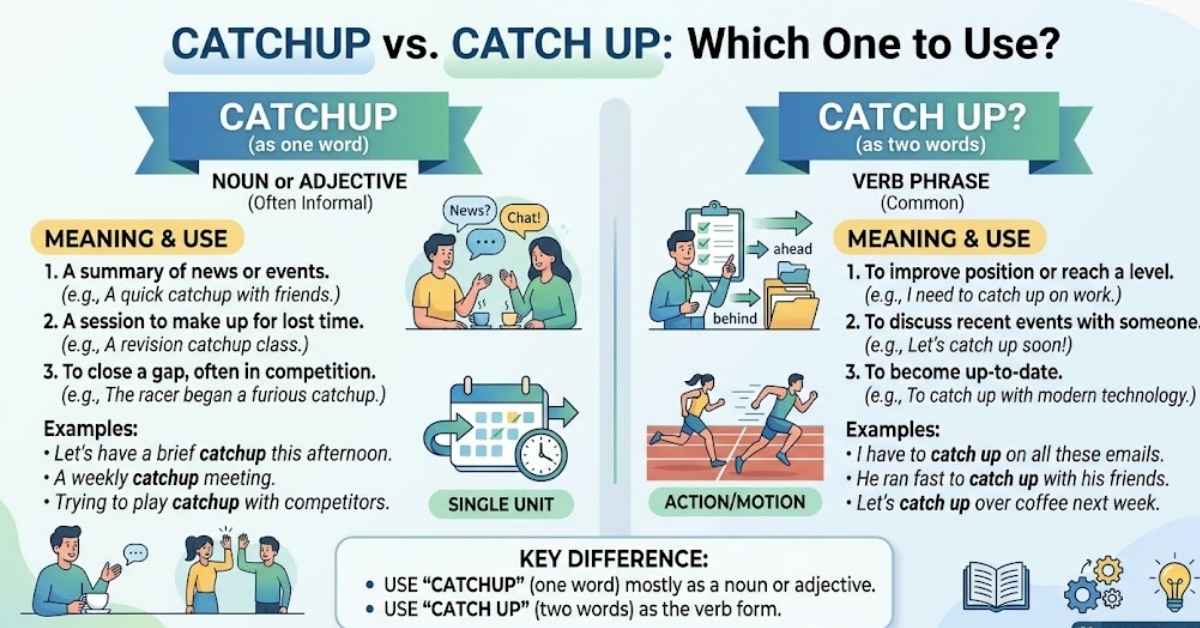
Catchup or catch up can be confusing because the three forms look and sound closely related, but they do not all perform the same grammatical job. In standard English, use catch up as the phrasal verb: “I need to catch up on my work.” Use catch-up as a noun or as a compound modifier: “We had a catch-up” or “We scheduled a catch-up meeting.” Catchup, written as one word, should not normally be used as the spelling of the phrasal verb.
The easiest way to remember the difference is to ask what the expression is doing in the sentence. If it describes an action, use catch up. If it names a thing, meeting, or type of session, catch-up may be appropriate.
Catchup or Catch Up: Which Is Correct?
For most everyday situations, the correct choice is catch up.
| Form | Typical function | Example |
|---|---|---|
| catch up | Phrasal verb | Let’s catch up tomorrow. |
| catch-up | Noun | We had a quick catch-up. |
| catch-up | Compound modifier | We scheduled a catch-up meeting. |
| catchup | Separate word with a different dictionary use | Catchup is a variant spelling of ketchup. |
So if you are writing “I want to catch up with my friend,” do not combine the words into catchup.
If you are writing “We had a catch-up meeting,” the hyphenated form is appropriate because catch-up modifies meeting.
What Does “Catch Up” Mean?
Catch up is a phrasal verb with several related meanings.
The central idea is closing a gap. That gap might involve distance, information, unfinished work, progress, or time spent apart.
1. To reach someone who is ahead
I walked faster to catch up with my friends.
Here, you are physically trying to reach people who are ahead of you.
2. To reach the same level or standard
She missed several classes, so she is working hard to catch up.
The gap here is educational progress.
3. To complete something you are behind on
I need to catch up on my emails.
You have accumulated unfinished work and want to get back to your normal level.
4. To get updated
I spent the evening catching up on the latest news.
You are learning information that you missed.
5. To reconnect with someone
It was great to catch up with my old college friend.
In this sense, you are talking with someone and exchanging news about what has happened since you last spoke.
These meanings share the same basic idea: moving from a position of being behind toward being current or even with someone or something.
Catch Up or Catch-Up: What Is the Difference?
The most useful distinction is grammatical.
“Catch up” is the verb
Use catch up when someone is performing an action.
Examples:
- I need to catch up on my work.
- Let’s catch up after lunch.
- She is trying to catch up with the rest of the class.
- I need to catch up with my old friends.
- We stayed late to catch up on emails.
Notice that you can change the tense:
- I catch up.
- I caught up.
- I am catching up.
- I will catch up.
That is a strong clue that you are dealing with the verb phrase.
“Catch-up” is a noun or modifier
Use catch-up when the expression functions as a noun or forms a compound modifier.
Examples:
- We had a quick catch-up.
- Let’s arrange a catch-up next week.
- I have a catch-up meeting with my manager.
- We scheduled a catch-up call.
- The school offers catch-up classes.
The grammatical role has changed, so the spelling changes too.
Is “Catchup” One Word Correct?
This is where many online explanations become misleading.
If you mean the ordinary phrasal verb meaning to get up to date, reach someone, complete missed work, or reconnect, write:
catch up
Not:
catchup
The word catchup does exist in English dictionaries, but it has a separate use. Cambridge lists catchup as another spelling of ketchup, the condiment. That does not make catchup the standard one-word spelling of the phrasal verb.
Therefore, these are the safest choices in standard U.S. writing:
- Let’s catch up.
- I need to catch up on work.
- I want to catch up with Sarah.
- We had a catch-up meeting.
- We had a quick catch-up.
Avoid writing catchup when you simply mean the verb catch up.
Catchup or Catch Up With Someone
When you mean talking to or reconnecting with a person, use:
catch up with someone
Examples:
- I want to catch up with my sister.
- We should catch up with our old classmates.
- I called Mike to catch up with him.
- It was nice to catch up with you.
- Let’s catch up with each other sometime.
The expression remains a verb phrase, so it stays as catch up.
“Catch up with” vs. “Catch up to”
These expressions can overlap, but context matters.
Catch up with someone can mean reconnecting socially:
I caught up with my friend yesterday.
It can also mean reaching someone who is ahead:
I ran faster and caught up with the group.
Catch up to someone emphasizes reaching the same physical position or level:
She ran faster to catch up to the leader.
For social conversations, catch up with someone is the natural choice.
Catch Up or Catch-Up Meeting?
If you are naming a meeting designed to exchange updates, catch-up meeting is the clearest form.
Correct
We have a catch-up meeting at 2 p.m.
Also natural
We need to catch up at 2 p.m.
The first sentence uses catch-up as a modifier describing meeting. The second uses catch up as the verb.
What about “catch up meeting”?
You will see catch up meeting online, particularly in informal workplace writing. However, when catch-up functions as a compound modifier before meeting, the hyphenated form provides clearer standard usage:
catch-up meeting
The same pattern applies to:
- catch-up call
- catch-up session
- catch-up class
- catch-up conversation
- catch-up lesson
- catch-up program
Catch Up Meeting vs. Catch-Up Meeting: Easy Test
Try removing the word meeting.
If you mean an actual meeting or conversation as a thing, you can say:
We had a catch-up.
If you mean the action of talking, say:
We should catch up.
This simple test helps separate the noun from the verb.
Compare:
Verb:
Let’s catch up tomorrow.
Noun:
Let’s have a catch-up tomorrow.
Compound modifier:
Let’s schedule a catch-up meeting tomorrow.
All three sentences are understandable, but the grammatical roles are different.
Catch Up on Work, Emails, News, and Sleep
Another important pattern is catch up on.
Use catch up on when you are dealing with something you missed or have fallen behind on.
Catch up on work
I need to catch up on my work.
Catch up on emails
I spent the morning catching up on emails.
The Catch up on reading
I need the weekend to catch up on my reading.
Catch up on the news
I watched the evening news to catch up on what happened.
Catch up on sleep
I hope to catch up on sleep this weekend.
In every example, catch up remains two words because it is functioning as a verb.
Do not write:
I need to catch-up on my emails.
Use:
I need to catch up on my emails.
Catch-Up as a Noun
A catch-up can refer to a conversation or meeting where people exchange updates.
Examples:
We had a quick catch-up before the presentation.
I enjoyed our catch-up yesterday.
Can we have a catch-up next week?
Thanks for the catch-up.
This noun form is particularly common in workplace and British English contexts, although dictionary evidence also recognizes catch-up as a noun in American English.
For a highly formal American business document, alternatives such as meeting, discussion, project update, or status meeting may sometimes sound more formal.
For ordinary workplace communication, however, catch-up is clear and widely understandable.
Catch-Up as an Adjective or Compound Modifier
When catch-up describes another noun, the hyphen connects the words into one descriptive unit.
Examples include:
- catch-up meeting
- catch-up call
- catch-up session
- catch-up class
- catch-up lesson
- catch-up course
- catch-up program
- catch-up work
For example:
The teacher arranged a catch-up class for students who missed the lesson.
Here, catch-up describes what kind of class it is.
Likewise:
I have a catch-up call with the marketing team.
The phrase tells the reader what type of call is being discussed.
Catchup or Catch Up UK: Is There a Difference?
The fundamental verb rule is the same in American and British English:
catch up is the phrasal verb.
For example:
Let’s catch up soon.
British English makes particularly visible use of the noun catch-up, including expressions such as:
a catch-up a catch-up meeting catch-up TV
Oxford and Cambridge both document catch-up as a noun, while Cambridge also distinguishes the American and British dictionary entries for related uses.
The important point is that UK usage does not turn the ordinary verb into “catchup.”
Whether the sentence is American or British English, write:
I need to catch up.
Not:
I need to catchup.
Catch Up With Someone: Social Examples
The phrase often appears in friendly conversations.
With a friend
I haven’t seen Jake in months. I should catch up with him.
The With family
We called Grandma to catch up with her.
With a former coworker
It was great to catch up with my former coworker.
After a long absence
We finally met for coffee and caught up.
In a text message
It’s been forever! Let’s catch up soon.
The spelling does not change simply because the context is informal.
“Let’s Catch Up” Meaning
When someone says:
Let’s catch up.
they usually mean:
Let’s talk, meet, or exchange recent news.
The exact method is not specified. It could mean:
- meeting for coffee
- talking on the phone
- having a video call
- chatting after work
- exchanging messages
- meeting for lunch
The expression is flexible.
In a workplace, “Let’s catch up” can instead mean:
Let’s discuss the latest developments or bring each other up to date.
“Nice to Catch Up” Meaning
“Nice to catch up” is a natural expression used after reconnecting with someone.
For example:
It was nice to catch up with you.
It usually communicates that the speaker enjoyed talking and sharing updates.
A warmer version is:
It was really nice catching up with you.
Both forms are natural.
Catch Up vs. Keep Up
These expressions are related but not identical.
Keep up generally means maintaining the same pace or level.
I can barely keep up with the workload.
Catch up generally means recovering from being behind.
I need to catch up on the workload.
Think of it this way:
keep up = stay at the same pace
catch up = close an existing gap
LEARN MORE: Alot or A Lot
Catch Up vs. Meet Up
Meet up simply means to meet someone.
Let’s meet up tomorrow.
Catch up emphasizes exchanging news or reconnecting.
Let’s catch up tomorrow.
You can do both at once:
Let’s meet up for coffee and catch up.
Common Mistakes With Catch Up
Mistake 1: Writing “catchup” as the verb
Incorrect:
I need to catchup on my emails.
Correct:
I need to catch up on my emails.
Mistake 2: Hyphenating the verb
Incorrect:
I need to catch-up on work.
Correct:
I need to catch up on work.
Mistake 3: Removing the hyphen from a compound modifier
Less clear:
We scheduled a catch up meeting.
Clearer standard form:
We scheduled a catch-up meeting.
Mistake 4: Using “catchup with someone”
Incorrect for the ordinary verb:
I want to catchup with my friend.
Correct:
I want to catch up with my friend.
Mistake 5: Assuming all three forms are interchangeable
They are not.
Catch up and catch-up have related meanings but different grammatical functions. Catchup has a separate dictionary identity and should not automatically be substituted for either form.
Catch Up or Catch-Up: Quick Decision Test
When you are unsure, ask three questions.
Is it an action?
Use catch up.
I need to catch up.
Is it a thing, meeting, or conversation?
Use catch-up.
We had a catch-up.
Is it describing a noun?
Use catch-up.
We had a catch-up meeting.
This three-question test solves most everyday cases.
Catch Up or Catch-Up Examples
| Sentence | Correct form | Why |
|---|---|---|
| Let’s ___ tomorrow. | catch up | Verb |
| I need to ___ on work. | catch up | Verb |
| I want to ___ with Sarah. | catch up | Verb |
| We had a quick ___. | catch-up | Noun |
| We scheduled a ___ meeting. | catch-up | Compound modifier |
| She needs to ___ on her reading. | catch up | Verb |
| It was nice to ___ with you. | catch up | Verb |
| We arranged a ___ call. | catch-up | Compound modifier |
| The school offers ___ classes. | catch-up | Compound modifier |
| I spent the weekend ___ on emails. | catching up | Verb form |
A Simple Memory Trick
Remember:
Action = two words
I need to catch up.
Thing or description = hyphen
We had a catch-up.
We had a catch-up meeting.
If you remember only one rule, remember the action test.
Ask:
“Is someone doing something?”
If yes, catch up is usually the answer.
Frequently Asked Questions
Is it catchup or catch up?
For the ordinary verb meaning to become current, reach someone, complete missed work, or reconnect, use catch up.
Is catch-up correct?
Yes. Catch-up is a recognized noun and can also be used as a compound modifier in expressions such as catch-up meeting and catch-up class.
Is catchup a correct spelling of catch up?
Not normally. Catchup is a separate dictionary-listed form associated with ketchup, rather than the standard spelling of the phrasal verb.
Is it catch up with someone or catchup with someone?
Use catch up with someone.
I need to catch up with my friend.
Is it catch-up meeting or catch up meeting?
Catch-up meeting is the clearer standard form when the phrase functions as a compound modifier.
Should I write catch up on work or catch-up on work?
Write catch up on work. Here, catch up is a verb phrase.
Is “Let’s catch up” correct?
Yes. Let’s catch up is a natural expression meaning “let’s talk or meet and exchange recent news.”
Is “a catch-up” correct?
Yes. A catch-up uses the hyphenated form as a noun.
Is catch-up used in American English?
Yes. Dictionaries recognize catch-up in American English, particularly for the noun meaning an effort or process of closing a gap. Usage can vary by context and register.
Is catch-up more common in British English?
The noun use of catch-up, especially for a meeting or conversation, is particularly established in British English. The verb remains catch up.
Can “catch up” mean finish missed work?
Yes.
I need to catch up on my assignments.
Can “catch up” mean reconnect with a friend?
Yes.
I can’t wait to catch up with my old friend.
What is the plural of catch-up?
When used as a countable noun, catch-ups can be used.
We have weekly catch-ups with the team.
In many contexts, however, writers may simply use meetings, calls, or discussions.
Final Answer: Catchup or Catch Up?
If you are asking “is it catchup or catch up?”, the standard answer for the ordinary verb is catch up.
Use catch up when it is an action:
Let’s catch up soon.
Use catch-up when it is a noun or compound modifier:
We had a catch-up.
We scheduled a catch-up meeting.
And be careful with catchup. Although the spelling exists in English, it has a separate dictionary use associated with ketchup, so it should not be treated as a simple one-word replacement for catch up.
The most reliable way to choose the correct form is to look at the grammar of the sentence, not simply how the expression sounds. If you are describing something someone does, choose catch up. If you are naming a meeting, conversation, or related compound, catch-up is usually the appropriate form.