

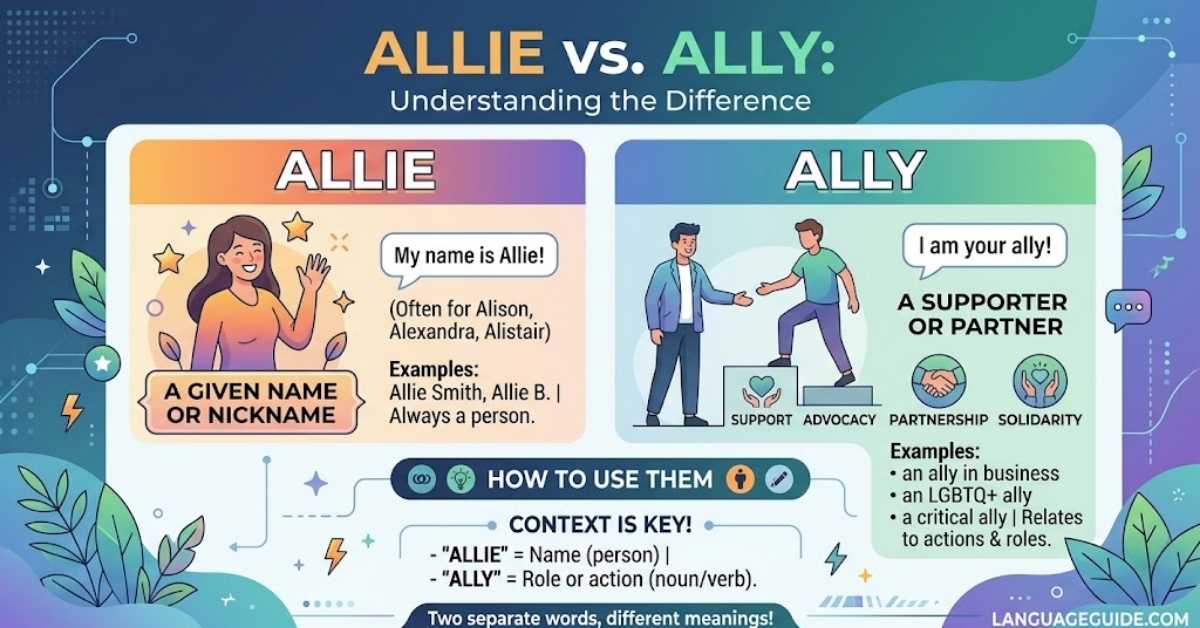
Allie or ally? The correct spelling depends on what you mean. If you mean a supporter, partner, or person who cooperates with someone else, the standard English word is ally. If you mean someone’s first name or nickname, both Allie and Ally can be correct, because people can have either spelling as their name.
For example:
- She is a strong ally. → supporter or partner
- Allie is coming to dinner. → person’s name
- Ally is coming to dinner. → also correct if that person’s name is Ally
- The two countries became allies. → countries cooperating
- The countries formed an alliance. → the relationship between them
The easiest rule is:
Use ally for the English word meaning a supporter or partner. Use the person’s actual spelling when you’re writing a name.
Allie or Ally: What’s the Difference?
The two spellings overlap, but they do not have exactly the same job.
| Spelling | Main use | Example |
|---|---|---|
| ally | Supporter or partner | She is my ally. |
| ally | Verb meaning to unite | The groups allied together. |
| Allie | Personal name/nickname | Allie called me. |
| Ally | Personal name/nickname | Ally called me. |
The key point is often missed in simple spelling articles:
Ally can be either a common English word or a person’s name.
Allie is commonly a personal name or nickname.
So asking “Which spelling is always correct?” is the wrong question. Meaning and context determine the answer.
What Does “Ally” Mean?
As a common English noun, an ally is a person, group, organization, or country that supports or cooperates with another.
Oxford’s American English dictionary defines an ally as a country that has agreed to help and support another country, or a person who helps and supports someone.
Examples:
- She became an important ally during the project.
- We need a trusted ally in the negotiations.
- The United States has longstanding international allies.
- He found an unexpected ally in his coworker.
- Every team needs an ally who will support its goals.
The word does not necessarily mean best friend.
An ally is someone who provides support or cooperates with you, often around a particular goal or situation.
For example:
My coworker is my ally during the negotiations.
That sentence tells us about the coworker’s support in a particular situation. It does not necessarily tell us that the coworker is the speaker’s close personal friend.
What Does “Allie” Mean?
Allie is commonly a personal name or nickname.
Behind the Name lists Allie as an English feminine name and identifies it as a diminutive associated with names such as Alison and Alexandra.
Examples:
- Allie called me after work.
- I met Allie at the conference.
- Allie is studying at the university.
- I sent the document to Allie.
In these sentences, Allie identifies a particular person. It is not the ordinary English noun meaning “supporter.”
That distinction is important because Allie is not simply a misspelling whenever it appears in writing.
If someone’s name is Allie, then Allie is the correct spelling of that person’s name.
Can “Ally” Be a Girl’s Name?
Yes.
This is one of the most important details to include when answering allie or ally.
Although lowercase ally is a standard English noun and verb, Ally can also be a personal name. Name references identify Ally as a given name and a variant associated with names such as Alison and Alexandra.
So these can both be correct:
Allie is my sister.
Ally is my sister.
The correct sentence depends entirely on how that person’s name is actually spelled.
If her name is Allie, write Allie.
If her name is Ally, write Ally.
You should not “correct” someone’s name based on what you think the standard English spelling ought to be.
The name rule is simple
Names belong to the people who have them.
A dictionary can tell you that ally is the standard English word for a supporter. It cannot tell you that every person named Allie should instead spell their name Ally.
Is It Ally or Allie for a Person’s Name?
Either can be correct.
Suppose you meet two people:
- Allie Johnson
- Ally Johnson
If the first person spells her name Allie, use Allie.
If the second person spells her name Ally, use Ally.
Both spellings are legitimate personal names.
This is different from choosing the spelling of an ordinary English word.
Compare:
She is an ally.
Here, ally means supporter.
Allie is joining us.
The Here, Allie is a person’s name.
Ally is joining us.
Here, Ally is also a person’s name.
The capitalization alone cannot always solve the problem. Context and the person’s actual name spelling matter.
Allie or Ally for Alliance?
If you are talking about an alliance, the correct English word is ally, not Allie.
For example:
The country found a powerful ally.
The two countries became allies.
The nations formed an alliance.
The relationship between these words is useful:
ally → allies → allied → alliance
An ally is a participant or supporter.
An alliance is the relationship or agreement between people, groups, or countries.
Allied describes people or groups that have joined or cooperated.
Oxford lists ally, allied, and alliance as related members of the same word family.
Compare the meanings
The countries became allies.
The countries are now cooperating partners.
The countries formed an alliance.
The sentence emphasizes the partnership or agreement itself.
The countries were allied.
The sentence describes their relationship.
So if your question is “Is it Allie or ally for alliance?”, the answer is:
Use ally when you mean the person, group, or country that participates in the alliance.
Use alliance for the partnership itself.
Ally in War and History
When discussing war or military history, ally is the standard English word.
For example:
- The country asked its allies for assistance.
- The two nations became military allies.
- Britain was an ally of the United States.
- The countries fought alongside their allies.
Oxford specifically includes the meaning of a country that agrees to help and support another country, particularly in wartime.
You may also encounter the capitalized historical expression the Allies, referring to groups of countries that fought together in major wars.
So:
ally → one supporter or partner
allies → multiple supporters or partners
the Allies → historical groups of nations
Allie → ordinarily a person’s name
Ally vs. Alliance vs. Allied
These words are closely related, but they are not interchangeable.
| Word | Meaning | Example |
|---|---|---|
| ally | A supporter or partner | She is an important ally. |
| allies | More than one ally | The countries are allies. |
| alliance | A partnership or agreement | They formed an alliance. |
| allied | Joined or connected | Allied countries cooperated. |
| ally | To unite or cooperate, as a verb | The groups allied with one another. |
Dictionary.com also lists ally as a verb meaning to unite or associate with another.
This gives you an easy semantic relationship:
An ally participates in an alliance. Allied groups have joined together.
Can “Ally” Be a Verb?
Yes.
This is another reason ally is different from Allie.
As a verb, ally means to unite, associate, or join with another person or group.
Examples:
- The organizations allied with one another.
- Several countries allied against a common enemy.
- The company allied itself with a larger partner.
- The groups decided to ally with local organizations.
Common forms include:
- ally
- allies
- allied
- allying
Allie is not normally used this way.
Does “Ally” Mean Friend?
Sometimes, but not exactly.
An ally can certainly be a friend, but the two words emphasize different things.
Friend generally emphasizes a personal relationship.
Ally emphasizes support, cooperation, or a shared objective.
Compare:
Sarah is my friend.
This emphasizes the personal relationship.
Sarah is my ally in the negotiations.
This emphasizes the support Sarah is providing in a particular situation.
A coworker can be your ally without being your close friend.
Likewise, a friend can support you without necessarily being described as your ally.
Why Are Allie and Ally So Easy to Confuse?
There are several reasons.
1. They look very similar
The only obvious spelling difference is the ending:
- ally
- Allie
2. They can refer to people
An ally can be a person.
Allie can also be a person.
That makes the distinction more difficult than pairs where one word refers to an object.
3. Both can be names
People can legitimately be named:
- Allie
- Ally
4. Spell-check may not catch the mistake
This is an important practical problem.
If you write Allie when you mean ally, a spell-checker may not flag it because Allie is a legitimate name.
Likewise, if you write Ally when someone’s name is actually Allie, ordinary spelling software may not know that you used the wrong person’s name.
The software sees valid-looking text.
You need context to identify the intended meaning.
LEARN MORE: Flies or Flys?
How Do You Spell Allie or Ally?
If you mean a supporter, partner, or cooperating person/group, spell it:
ally
If you mean a person’s name, use the person’s actual spelling:
Allie or Ally
For example:
She is a reliable ally.
But:
Allie is my coworker.
Or:
Ally is my coworker.
The final two sentences are both grammatically correct if those are the person’s respective names.
How to Spell Ally or Allie: The Fastest Test
When you are unsure, ask yourself one question:
Am I describing a role, or am I writing someone’s name?
If you’re describing a role:
Use ally.
He became an important ally.
If you’re naming a person:
Use that person’s actual name.
Allie joined the meeting.
or:
Ally joined the meeting.
This is much more reliable than trying to memorize a rule that says one spelling is always correct.
Pronunciation: Are Ally and Allie the Same?
This needs a little care.
The ordinary American English noun ally is pronounced /ˈælaɪ/. Oxford gives that pronunciation for the noun.
Allie, as a personal name, is commonly pronounced /ˈæli/.
However, personal names can have individual pronunciations, and Ally as a name can be pronounced differently from the common noun.
So pronunciation can sometimes help, but it is not a universal spelling rule for names.
If someone introduces herself as Ally, the safest approach is to use the spelling and pronunciation she uses.
Common Mistakes With Allie and Ally
Mistake 1: Using “Allie” for a supporter
❌ She is a strong Allie of the organization.
If you’re using the ordinary English word meaning supporter, write:
✅ She is a strong ally of the organization.
Mistake 2: Changing someone’s name
Suppose someone’s name is Allie.
❌ Ally sent me the report.
✅ Allie sent me the report.
If someone’s name is Ally, reverse the situation:
❌ Allie sent me the report.
✅ Ally sent me the report.
Names should be spelled according to the individual’s actual name.
Mistake 3: Confusing ally and alliance
❌ The country became an alliance.
✅ The country became an ally.
Or:
✅ The countries formed an alliance.
An ally is a participant; an alliance is the relationship.
Mistake 4: Using “ally” as a synonym for “friend” in every situation
An ally may be a friend, but the terms are not identical.
A colleague can become an ally during a workplace dispute.
That does not necessarily mean the colleague is a close friend.
Mistake 5: Forgetting the plural
The plural of ally is:
allies
Not:
❌ allys
Examples:
- The two countries are allies.
- She has several allies at work.
- The organization gained new allies.
Allie or Ally in Emails
The answer depends entirely on whether you’re using the word as a name or as an ordinary noun.
If you’re addressing someone named Allie:
Hi Allie,
Could you send me the updated report when you have a chance?
The If you’re addressing someone named Ally:
Hi Ally,
Could you send me the updated report when you have a chance?
If you’re describing a supportive colleague:
She has been a valuable ally throughout the project.
The capitalization changes because Allie and Ally are names in the first two examples, while ally is a common noun in the third.
Allie or Ally in School and Academic Writing
For an ordinary English sentence:
The author describes the country as an ally.
Use lowercase ally because it is a common noun.
For a person’s name:
Allie submitted her research paper.
Use a capital letter because Allie is a proper name.
The same principle applies to:
- essays
- reports
- emails
- presentations
- resumes
- workplace documents
- social media posts
The context determines the capitalization and spelling.
Allie or Ally on Social Media
Social media makes this distinction particularly confusing because capitalization is inconsistent.
Consider:
“I’m grateful for every ally who supported me.”
Here, ally means supporter.
Now:
“Happy birthday, Allie!”
Here, Allie is a name.
And:
“Happy birthday, Ally!”
This is also correct if the person’s name is Ally.
So don’t automatically “correct” a social-media spelling based only on how familiar one version looks.
LEARN MORE: Advice or Advise
A Simple Decision Guide
Use this table whenever you are unsure.
| Ask yourself… | Correct choice |
|---|---|
| Do I mean a supporter? | ally |
| Do I mean a partner? | ally |
| Do I mean a cooperating country? | ally |
| Am I talking about an alliance participant? | ally |
| Do I mean several supporters? | allies |
| Do I mean the partnership itself? | alliance |
| Do I mean someone named Allie? | Allie |
| Do I mean someone named Ally? | Ally |
| Am I using the verb meaning “join”? | ally |
| Am I writing a person’s name? | Use their actual spelling |
The 10-Second “Allie or Ally?” Test
Before you hit send, ask:
1. Is this a person’s name?
If yes, check how the person actually spells it.
2. Am I describing someone who supports another person or group?
Use ally.
3. Am I talking about countries cooperating?
Use ally or allies.
4. Am I talking about the partnership itself?
Use alliance.
5. Am I describing something as connected or joined?
You may need allied.
This framework handles most everyday uses without requiring you to memorize complicated grammar terminology.
Frequently Asked Questions
Is it Allie or Ally?
Both can be correct. Ally is the standard English word for a supporter or partner. Allie is commonly a personal name or nickname. Ally can also be a personal name, so the correct spelling of someone’s name depends on how that person spells it.
Is “Allie” a real name?
Yes. Allie is an established given name and nickname, particularly associated with names such as Alison and Alexandra.
Can Ally be a girl’s name?
Yes. Ally is also used as a personal name. Therefore, you should not assume that every capitalized “Ally” is an ordinary English noun.
Is Ally or Allie the correct spelling for a name?
Whichever spelling the person actually uses. Both Allie and Ally can be legitimate names.
Is it “Allie” or “ally” for a supporter?
Use ally.
She is my strongest ally.
Is it Allie or Ally for alliance?
Use ally when referring to a person, group, or country that participates in an alliance.
The country became an ally.
Use alliance when referring to the partnership itself.
The countries formed an alliance.
Is “Allie” a misspelling of “ally”?
Not necessarily. Allie is commonly a personal name, so it is perfectly correct when that is the person’s chosen name.
Can Ally be a common noun?
Yes. ally is a common noun meaning a supporter or partner. It can also function as a verb meaning to unite or associate with another.
What is the plural of ally?
The plural is allies.
The two countries are allies.
What is the difference between ally and alliance?
An ally is a person, group, or country that supports or cooperates with another. An alliance is the relationship or agreement connecting them.
Does ally mean friend?
Not exactly. An ally can be a friend, but ally emphasizes support or cooperation, while friend generally emphasizes a personal relationship.
Is ally used in American English?
Yes. Ally is a standard American English word. Oxford’s American English entry defines it as a person or country that provides support.
How do you spell ally or Allie?
For the ordinary English word meaning supporter or partner, spell it ally. For a person’s name, use Allie or Ally according to the person’s actual spelling.
Bottom Line: Allie or Ally?
The answer isn’t simply “Ally” or “Allie.”
Ally is the standard English word when you mean a supporter, partner, or cooperating person, group, or country.
Allie is commonly a personal name or nickname.
Ally can also be a personal name, which means both spellings can be correct when you’re naming a person.
So the easiest rule is:
Supporter or partner → ally Person’s name → use the spelling that person uses
And when the subject is an alliance:
ally → person/group involved allies → more than one alliance → the partnership allied → joined or connected
Once you separate meaning from name spelling, the Allie-or-Ally question becomes much easier to solve.