

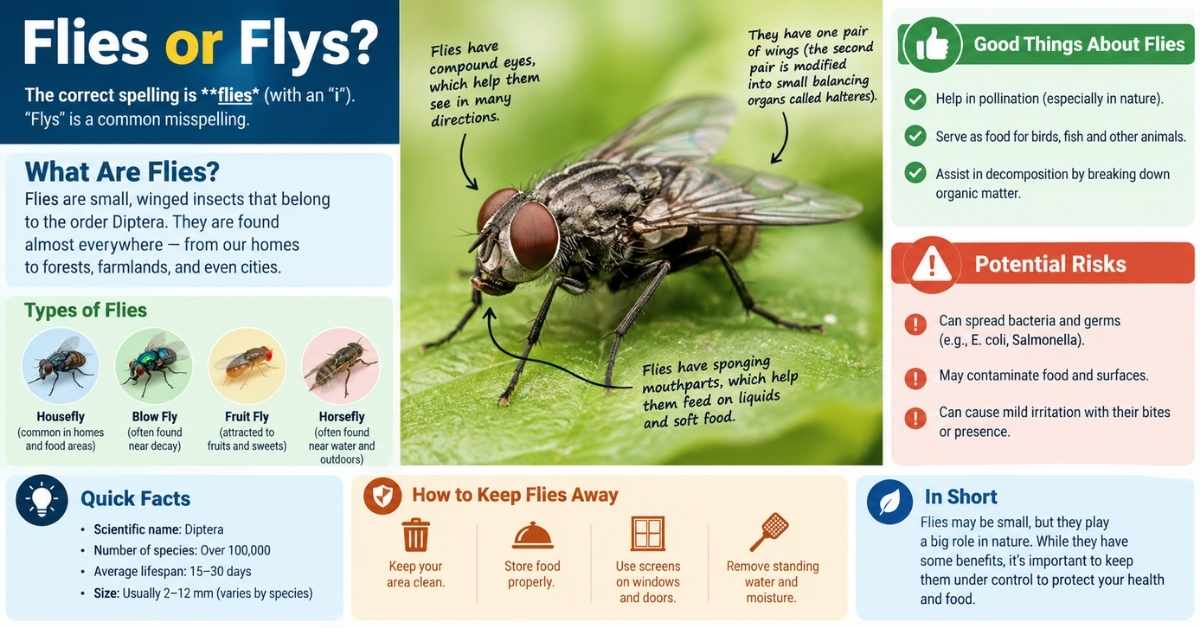
Flies or flys may look like two possible spellings, but flies is the correct form in standard modern English when you mean more than one fly or the third-person singular form of the verb fly. Write “two flies,” “the bird flies,” and “time flies.” Flys is normally a spelling error in these contexts. Major dictionaries list flies as both the plural of the noun fly and the present-tense verb form used with a singular third-person subject.
The spelling becomes much easier once you know the rule: when a regular noun or present-tense verb ends in a consonant followed by y, English normally changes the y to i and adds -es. Cambridge Grammar illustrates this pattern with forms such as baby → babies and reply → replies.
Flies or Flys: Quick Answer
Use flies.
Correct:
Three flies entered the kitchen.
The bird flies over our house every morning.
She flies to New York twice a month.
Time flies when you’re having fun.
Incorrect in normal modern English:
Three flys entered the kitchen.
The bird flys over our house.
Time flys.
For everyday American English, the practical rule is:
fly → flies
Flies vs. Flys at a Glance
| Form | Standard? | Meaning or Use | Example |
|---|---|---|---|
| fly | Yes | One insect / base verb | A fly landed here. / Birds fly. |
| flies | Yes | More than one fly | The flies are buzzing. |
| flies | Yes | Third-person singular verb | She flies every week. |
| flys | Normally no | Usually a spelling error | Time flys ❌ |
| fly’s | Yes | Singular possessive | The fly’s wings |
| flying | Yes | -ing form | The bird is flying. |
| flew | Yes | Past tense | The bird flew away. |
| flown | Yes | Past participle | It has flown away. |
Flies or Flys Meaning
The flies or flys meaning question is slightly unusual because flies has more than one grammatical job.
In standard English, flies can be either:
- a plural noun, or
- a third-person singular present-tense verb.
Context tells you which meaning is intended.
Flies as a Plural Noun
When flies is a noun, it commonly means more than one fly, the insect.
Singular:
one fly
Plural:
two flies
Examples:
Several flies were buzzing around the trash can.
Fruit flies appeared near the ripe bananas.
The horses flicked their tails at the flies.
Cambridge explicitly identifies flies as the plural of fly.
The spelling is therefore:
fly → flies
not:
fly → flys
Flies as a Verb
Flies can also be a verb.
It is the present-tense form of fly used with he, she, it, or another singular third-person subject.
Compare:
I fly to Chicago.
You fly to Chicago.
They fly to Chicago.
But:
She flies to Chicago.
The pilot flies to Chicago.
The plane flies to Chicago.
Collins lists flies as the third-person singular present form of fly.
This distinction is important because flies does not always mean insects.
In:
The flies are annoying.
Flies is a noun.
In:
The eagle flies high.
Flies is a verb.
Same spelling. Different grammatical function.
Why Is It Flies Instead of Flys?
English has a spelling pattern for many words ending in consonant + y.
When forming certain plurals or third-person singular verbs, you normally:
- remove the y,
- change it to i,
- add -es.
So:
fly → flies
The final letters of fly are:
l + y
Because l is a consonant, the pattern applies.
The Consonant + Y Rule
Compare:
baby → babies
city → cities
story → stories
party → parties
For verbs:
try → tries
cry → cries
carry → carries
study → studies
fly → flies
Cambridge Grammar applies this consonant-plus-y rule to both noun plurals and regular verb -s forms.
When You Keep the Y
The rule changes when a vowel comes before y.
Then you normally keep the y and simply add -s:
day → days
boy → boys
key → keys
For verbs:
play → plays
enjoy → enjoys
stay → stays
Compare:
fly → flies
but:
play → plays
That contrast is more useful than simply memorizing flies by itself.
Is It Time Flies or Time Flys?
The correct phrase is:
Time flies.
Not:
Time flys.
Cambridge uses “time flies” when describing time seeming to pass quickly.
Why?
In the sentence:
Time flies quickly.
time is a singular subject.
The verb is fly.
A singular third-person subject requires:
flies
So:
Time flies when you’re having fun.
How time flies!
Time flies by so quickly.
All use flies.
The expression is figurative. Time does not literally move through the air; flies means it seems to pass very quickly.
Is It Bird Flies or Flys?
Write:
The bird flies.
Not:
The bird flys.
The subject bird is singular, so fly becomes flies.
Compare:
One bird flies south.
Two birds fly south.
Notice what changes:
Singular subject:
The bird flies.
Plural subject:
The birds fly.
This is a subject-verb agreement issue as well as a spelling issue.
Is It Plane Flies or Flys?
Use flies.
The plane flies from Dallas to Miami every morning.
Likewise:
She flies frequently for work.
My brother flies helicopters.
This airline flies to 20 countries.
In each case, flies is the correct present-tense verb form.
LEARN MORE: Roll Call or Role Call?
One Fly or Two Flies?
For the insect, the singular and plural are:
one fly
two flies
many flies
This follows the same spelling pattern as:
one baby → two babies
one city → two cities
one story → two stories
So if you are describing insects in a kitchen, garden, barn, restaurant, or anywhere else, use flies.
Fly, Flies, Flying, Flew, and Flown
The verb fly has several forms, and mixing them up can create a different type of grammar error.
| Form | Function | Example |
|---|---|---|
| fly | Base/present form | Birds fly south. |
| flies | Third-person singular present | A bird flies south. |
| flying | Present participle / -ing form | The bird is flying. |
| flew | Past tense | The bird flew away. |
| flown | Past participle | The bird has flown away. |
Collins lists the standard sequence as flies, flying, flew, flown.
That means this is wrong:
The bird flies away yesterday.
Use:
The bird flew away yesterday.
And this is wrong:
The bird has flew away.
Use:
The bird has flown away.
Is “Flies” a Participle?
No.
This is a mistake that occasionally appears in explanations online.
Flies is the third-person singular present-tense form.
The present participle is:
flying
The ordinary past participle is:
flown
So:
She flies.
The She is flying.
She has flown.
Each form has a different grammatical job.
The Baseball Exception: Flied
There is an expert-level exception worth knowing.
For ordinary movement through the air:
fly → flew → flown
But in baseball, when fly means to hit a fly ball, Cambridge records:
fly → flied → flied.
Example:
The batter flied out to center field.
Not:
The batter flew out to center field
when you specifically mean the baseball action.
This exception affects the past tense, however. It does not make flys correct.
Flies vs. Fly’s
Do not confuse flies with fly’s.
Flies
No apostrophe.
It can mean several insects:
The flies landed on the fruit.
Or function as a verb:
The airplane flies overnight.
Fly’s
The apostrophe normally shows singular possession:
The fly’s wings were damaged.
That means:
the wings belonging to the fly
Compare:
The fly’s wings moved rapidly.
The flies moved rapidly.
The apostrophe completely changes the grammatical meaning.
Is Flys Ever Correct?
For ordinary modern English, do not use flys for insects or the verb fly.
Write:
flies
A capitalized or stylized Flys could appear in:
- a surname,
- username,
- business name,
- product name,
- artistic title,
- intentionally unusual branding.
Those are proper-name decisions rather than standard English grammar.
There is also a historical curiosity. Older references recorded flys as a plural of fly when fly meant a particular small horse-drawn carriage. A historical spelling dictionary explicitly distinguished ordinary flies from flys for that carriage sense.
You are extremely unlikely to need that form in contemporary American writing.
So for normal use:
insect → flies
verb → flies
time passes → flies
Other Meanings of Fly and Flies
The word fly has several meanings beyond a flying insect.
Fishing Fly
A fly can be an artificial fishing lure.
Plural:
flies
Example:
The angler packed several dry flies.
Collins records fly in angling and gives the noun plural as flies.
Clothing Fly
A fly can mean the covered opening at the front of pants.
Cambridge recognizes this clothing sense, and British usage can use plural flies in expressions concerning the trouser fastening.
This is another reason claims that the modern plural should be flys are misleading.
Baseball Fly
A fly or fly ball is a ball hit high into the air.
Again, flys is not the standard modern plural you should learn.
Theater Flies
In theater terminology, the flies can refer to the space above the stage where scenery and equipment are suspended. Collins explicitly records this plural form.
LEARN MORE: Dateline or Deadline?
Common Flies vs. Flys Mistakes
Mistake 1: Writing “Time Flys”
Incorrect:
Time flys when you’re having fun.
Correct:
Time flies when you’re having fun.
Mistake 2: Pluralizing the Insect as “Flys”
Incorrect:
There are five flys in the kitchen.
Correct:
There are five flies in the kitchen.
Mistake 3: Writing “She Flys”
Incorrect:
She flys to California every month.
Correct:
She flies to California every month.
Mistake 4: Applying the Rule to Every Word Ending in Y
Not every y changes.
Correct:
boy → boys
toy → toys
play → plays
Why?
A vowel comes immediately before the y.
But:
fly → flies
because a consonant comes before the y.
Mistake 5: Calling Flies a Past Tense
Flies is present tense.
Past:
flew
Example:
Present:
The plane flies overhead every morning.
Past:
The plane flew overhead yesterday.
Mistake 6: Using Fly’s for the Plural
Incorrect plural:
Three fly’s were on the wall.
Correct:
Three flies were on the wall.
Fly’s normally shows possession, not plurality.
Easy Way to Remember Flies or Flys
Remember this pattern:
FLY → FLIES
Then connect it to:
TRY → TRIES
CRY → CRIES
If you can remember tries, you can remember flies.
Another easy reminder is the familiar expression:
Time flies.
If flies is correct there, the same spelling is also correct in:
She flies.
The bird flies.
and:
Two flies.
Frequently Asked Questions
Is It Flies or Flys?
Use flies in standard English. It is both the plural of fly and the third-person singular present form of the verb fly.
What Is the Flies or Flys Meaning?
Flies can mean multiple flying insects or function as a verb meaning that one person, animal, aircraft, or thing flies.
Flys is normally a spelling error in those meanings.
Is Flys a Real Word?
It is not the standard modern form for either multiple insects or the present-tense verb. It can occur in proper names and is historically documented in the obsolete carriage sense of fly.
What Is the Plural of Fly?
The plural of fly is flies.
One fly → two flies.
Cambridge explicitly lists flies as the plural.
Is It Time Flies or Time Flys?
Time flies is correct.
Time is singular, so the verb fly takes the third-person singular form flies.
Is It “She Flies” or “She Flys”?
Write:
She flies.
The same applies to he and it.
Is It “Bird Flies” or “Bird Flys”?
Write:
The bird flies.
But with a plural subject:
The birds fly.
What Is the Singular of Flies?
If flies refers to insects, the singular is fly.
Why Does Fly Become Flies?
Because fly ends in a consonant + y. For regular plurals and verb -s forms, English generally changes the y to i and adds -es.
Is It Flies or Fly’s?
They have different meanings.
Flies = plural noun or verb.
Fly’s = usually singular possessive.
Example:
The flies escaped.
The fly’s wing was damaged.
What Are the Verb Forms of Fly?
The ordinary forms are:
fly → flies → flying → flew → flown.
Is the Past Tense of Fly “Flied”?
Normally, the past tense is flew.
However, baseball uses flied when fly means to hit a fly ball:
He flied out to right field.
Is There a U.S. vs. UK Difference?
Not for the central spelling rule. Standard American and British English both use flies for the ordinary plural noun and third-person singular verb.
Final Answer: Flies or Flys?
If you’re deciding between flies or flys, choose flies for standard modern English.
Use flies when you mean more than one fly:
Three flies landed on the table.
Use flies when fly is a present-tense verb with a singular third-person subject:
The bird flies south.
She flies to Boston.
Time flies quickly.
The spelling follows a common English pattern:
consonant + y → change y to i and add -es
So:
fly → flies
For normal American writing, flys is not an alternative spelling. Outside proper names and a narrow historical carriage usage, you should use flies.