

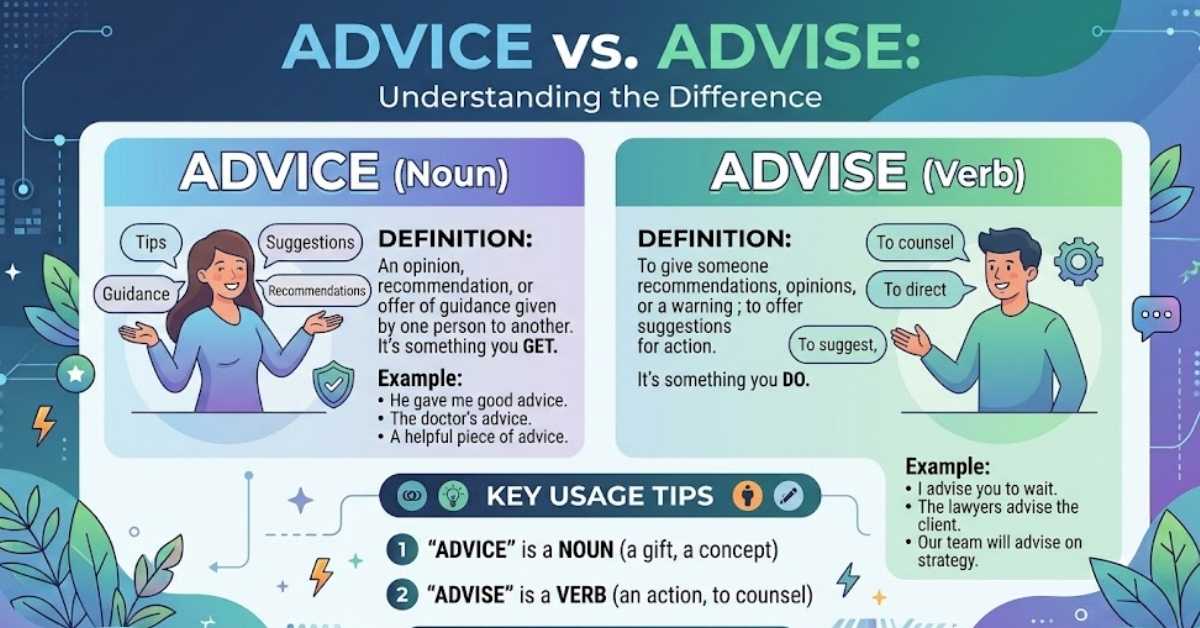
Advice or advise are both correct English words, but they are not interchangeable. The simplest rule is: advice is a noun, while advise is a verb. You give advice, but you advise someone.
For example:
- I need your advice. ✅
- I advise you to wait. ✅
- Thank you for your advice. ✅
- Please advise me. ✅
- I need your advise. ❌
- I advice you to wait. ❌
Once you recognize whether your sentence needs a thing (advice) or an action (advise), the choice becomes much easier.
Advice or Advise: Which Is Correct?
Both are correct words. The correct choice depends on the job the word performs in the sentence.
| Word | Part of speech | Meaning | Example |
|---|---|---|---|
| advice | Noun | Guidance, recommendation, or suggestion | She gave me good advice. |
| advise | Verb | To give guidance or recommend something | I advise you to wait. |
Think of it this way:
Advice = the guidance. Advise = the action of giving guidance.
That distinction explains most cases of advice or advise.
Cambridge Dictionary similarly defines advice as a noun meaning a suggestion about what someone should do, while advise is the verb used for giving that guidance.
What Does “Advice” Mean?
Advice is a noun. It refers to guidance, an opinion, recommendation, or suggestion intended to help someone decide what to do.
Examples:
- I need some advice about my career.
- She gave me excellent advice.
- His advice helped me make a decision.
- We followed our lawyer’s advice.
- Can I ask you for some advice?
Notice that you can give advice, receive advice, ask for advice, seek advice, take advice, follow advice, or ignore advice.
A useful substitution test is:
If guidance, suggestion, or recommendation fits naturally, advice is usually the word you need.
For example:
I need your advice.
→ I need your guidance.
That works because both advice and guidance are nouns.
Is “advice” countable?
Normally, no. In standard English, advice is an uncountable noun. That means we normally do not say:
- ❌ an advice
- ❌ two advices
- ❌ many advices
Instead, say:
- some advice
- a piece of advice
- two pieces of advice
- a bit of advice
- a word of advice
This usage is documented by Cambridge, Dictionary.com, and Scribbr.
What Does “Advise” Mean?
Advise is a verb. It describes the action of giving guidance, making a recommendation, or telling someone what you think they should do.
Examples:
- I advise you to check the document.
- The teacher advised me to study earlier.
- My lawyer advised against signing the contract.
- We were advised to arrive early.
- Please advise me on the next step.
The verb changes form depending on tense:
- advise — present
- advises — third-person present
- advised — past tense/past participle
- advising — -ing form
A particularly useful pattern is:
advise + person + to + verb
The manager advised me to wait.
Another common structure is:
advise + against + noun/-ing
The doctor advised against driving.
The Easiest Way to Remember Advice vs. Advise
If you remember only one rule, remember this:
You give advice, but you advise someone.
Compare:
- She gave me advice.
- She advised me to wait.
The meaning is closely related, but the grammar is different.
Another useful test:
Can you replace it with “recommend”?
If yes, you probably need advise.
I advise you to leave early.
→ I recommend that you leave early.
Can you replace it with “suggestion” or “guidance”?
If yes, you probably need advice.
I need your advice.
→ I need your guidance.
This replacement method is often faster than trying to remember a formal grammar definition.
Advice vs. Advise in Real Sentences
Look at these pairs:
I need advice. The word names the guidance being requested.
I need you to advise me. The word describes an action you want someone to perform.
She gave me advice. Advice is the thing she gave.
She advised me to apply. Advised describes what she did.
His advice was helpful. Advice is a noun.
He advised me to be careful. Advised is a verb.
A quick sentence-pattern guide
| Pattern | Correct word |
|---|---|
| your ___ | advice |
| some ___ | advice |
| good ___ | advice |
| give ___ | advice |
| need ___ | advice |
| ask for ___ | advice |
| please ___ | advise |
| I would ___ you | advise |
| ___ someone | advise |
| ___ someone to do something | advise |
| ___ against something | advise |
This is not a substitute for understanding the grammar, but it is an extremely useful writing-time shortcut.
Please Advise or Please Advice?
The correct expression is:
Please advise. ✅
Not:
Please advice. ❌
Why?
Because advise is the verb required to express the action you are asking someone to perform.
Compare:
- Please help me.
- Please tell me.
- Please call me.
- Please advise me.
You are asking someone to do something.
By contrast:
- Please give me your advice.
- I would appreciate your advice.
- Thank you for your advice.
Here, advice is the noun.
Scribbr specifically identifies “Please advise” as correct and “Please advice” as incorrect.
Is “Please advise” professional in an email?
Yes, it is grammatically correct and remains common in professional correspondence. But correct grammar does not automatically mean ideal tone.
A bare:
Please advise.
can sound formal, vague, or abrupt depending on the context. Modern business-writing guidance often recommends stating exactly what you want the recipient to tell you.
Instead of:
Please advise.
you might write:
Could you let me know how you would like to proceed?
Or:
Could you confirm which option you prefer?
The Or:
I would appreciate your guidance on the next step.
Or:
Could you let me know whether the revised deadline works for you?
The important distinction is:
“Please advise” is grammatically correct. Whether it is the best email wording depends on tone and context.
Thank You for Your Advice or Advise?
The correct phrase is:
Thank you for your advice. ✅
Not:
Thank you for your advise. ❌
The reason is easy to see if you look at the sentence structure.
your advice
The word your modifies a noun. Therefore, advice is required.
Compare:
- Thank you for your advice.
- I appreciate your guidance.
- Thank you for your recommendation.
All three nouns fit the same grammatical position.
LEARN MORE: Roll Call or Role Call?
I Need Advice or Advise?
The correct phrase is:
I need advice. ✅
Or:
I need some advice. ✅
Or:
I need your advice. ✅
Not:
I need advise. ❌
Here, need is followed by a noun phrase naming what you need.
Compare:
I need your advice.
with:
Can you advise me?
The first asks for the thing—guidance.
The second asks someone to perform the action of giving guidance.
Any Advice or Advise?
Use:
Do you have any advice? ✅
Not:
Do you have any advise? ❌
Again, advice is a noun.
Other natural examples include:
- Do you have any advice for a new manager?
- Any advice for someone starting college?
- Do you have any advice about applying for jobs?
- Is there any advice you would give me?
If you want the verb, change the structure:
Could you advise me on what to do?
Give Advice or Give Advise?
The correct expression is:
give advice. ✅
Not:
give advise. ❌
Examples:
- My parents gave me good advice.
- She gave me some useful advice.
- Can you give me a piece of advice?
- He gave us professional advice.
Why?
Because give takes the noun advice.
The corresponding verb construction is:
She advised me to wait.
This is one of the most important collocations to remember:
give advice receive advice ask for advice follow advice take advice offer advice
But:
advise someone advise someone to do something advise against something
How to Spell Advice and Advise
Both spellings are correct, but they have different grammatical functions:
Advice → noun Advise → verb
There is also a pronunciation difference.
- advice ends with an /s/ sound
- advise ends with a /z/ sound
Cambridge gives the pronunciations as /ədˈvaɪs/ for advice and /ədˈvaɪz/ for advise.
This provides a useful memory aid:
advice sounds like the ending in ice advise has a voiced z sound
The spelling and pronunciation therefore work together as a useful reminder.
Common Advice vs. Advise Mistakes
1. “Thank you for your advise.”
❌ Incorrect:
Thank you for your advise.
✅ Correct:
Thank you for your advice.
The word after your is a noun.
2. “I advice you to wait.”
❌ Incorrect:
I advice you to wait.
✅ Correct:
I advise you to wait.
The word describes an action, so you need the verb.
3. “Please advice me.”
❌ Incorrect:
Please advice me.
✅ Correct:
Please advise me.
You are asking someone to perform an action.
4. “She gave me an advice.”
❌ Usually incorrect in standard American English:
She gave me an advice.
✅ Better:
She gave me some advice.
Or:
She gave me a piece of advice.
5. “He gave me three advices.”
❌ Incorrect in standard usage:
He gave me three advices.
✅ Correct:
He gave me three pieces of advice.
Or:
He gave me three recommendations.
6. “Please advice on the next steps.”
❌ Incorrect:
Please advice on the next steps.
✅ Correct:
Please advise on the next steps.
Even better for many modern workplace situations:
Could you let me know what you recommend as the next step?
The second version makes the requested response more explicit.
Advice vs. Advise in American English
For U.S. English, the core distinction is straightforward:
- advice = noun
- advise = verb
This is not a case where American English uses one spelling and British English uses the other. Both varieties maintain the grammatical distinction.
The important U.S. usage point is that advice is normally uncountable when it means guidance.
So American English generally prefers:
some advice
rather than:
an advice
and:
two pieces of advice
rather than:
two advices.
Advice, Advise, Advisor, and Adviser
These related words can create another layer of confusion.
Advice
Noun
Her advice was helpful.
Advise
Verb
She advised me to wait.
Advisor / Adviser
Noun
A person who gives advice.
My financial advisor helped me understand the options.
Both advisor and adviser are established spellings, although usage varies by context and organization. Scribbr notes both forms in its explanation of the word family.
LEARN MORE: Flies or Flys?
A 10-Second Advice vs. Advise Test
When you are writing and suddenly stop at advice or advise, don’t overthink it.
Ask:
1. Am I naming guidance?
Use advice.
I need your advice.
2. Am I describing someone giving guidance?
Use advise.
I would advise you to wait.
3. Can I replace it with “guidance” or “suggestion”?
If yes, choose advice.
4. Can I replace it with “recommend” or “tell”?
If yes, choose advise.
5. Am I counting the advice?
Use:
a piece of advice
not:
an advice
6. Am I asking someone to do something after “please”?
Use:
Please advise.
This six-step test solves the overwhelming majority of everyday cases.
Quick Reference: Advice vs. Advise
| If you mean… | Use |
|---|---|
| guidance | advice |
| a recommendation | advice |
| a suggestion | advice |
| something you receive | advice |
| something you give | advice |
| the act of recommending | advise |
| the act of guiding someone | advise |
| telling someone what they should do | advise |
| asking someone to provide guidance | advise |
Remember:
You give advice.
You advise someone.
That’s the core rule.
Frequently Asked Questions
Is it “advice or advise” which is correct?
Both are correct words, but they are used differently. Advice is a noun, while advise is a verb.
Is “please advise” or “please advice” correct?
Please advise is correct. Advise is the verb required in the request. Please advice incorrectly uses the noun.
Is “thank you for your advice” or “thank you for your advise” correct?
Thank you for your advice is correct because your is followed by the noun referring to the guidance.
Is “I need advice” or “I need advise” correct?
I need advice is correct. You need a noun after need.
Is “any advice” or “any advise” correct?
Any advice is correct when you mean suggestions or guidance.
Is “give advise” or “give advice” correct?
Give advice is correct.
She gave me some good advice.
Is advice a noun or verb?
Advice is a noun.
Is advise a noun or verb?
Advise is a verb.
Can I say “an advice”?
In standard American English, advice is normally uncountable, so use some advice or a piece of advice instead.
Can I say “advices”?
Normally, no. Use pieces of advice, recommendations, or another appropriate countable noun.
What is the past tense of advise?
The past tense is advised.
The teacher advised me to study more.
How do you pronounce advice and advise?
Advice ends with an /s/ sound, while advise ends with a /z/ sound.
Is “please advise” appropriate in a professional email?
Yes, it is grammatically correct. However, a standalone “Please advise” can sound formal or vague depending on the context. A specific request such as “Could you confirm the next step?” may communicate your intent more clearly.
Is the rule different in American and British English?
No. Both varieties distinguish advice as the noun and advise as the verb.
Final Rule to Remember
When you’re unsure about advice or advise, don’t focus on the spelling first.
Focus on the job the word is doing.
Advice is the thing—the guidance, recommendation, or suggestion.
Advise is the action—to give that guidance or recommendation.
So:
I asked for advice, and she advised me to wait.
If you can remember that one sentence, you’ll have a reliable answer to almost every advice vs. advise question.