

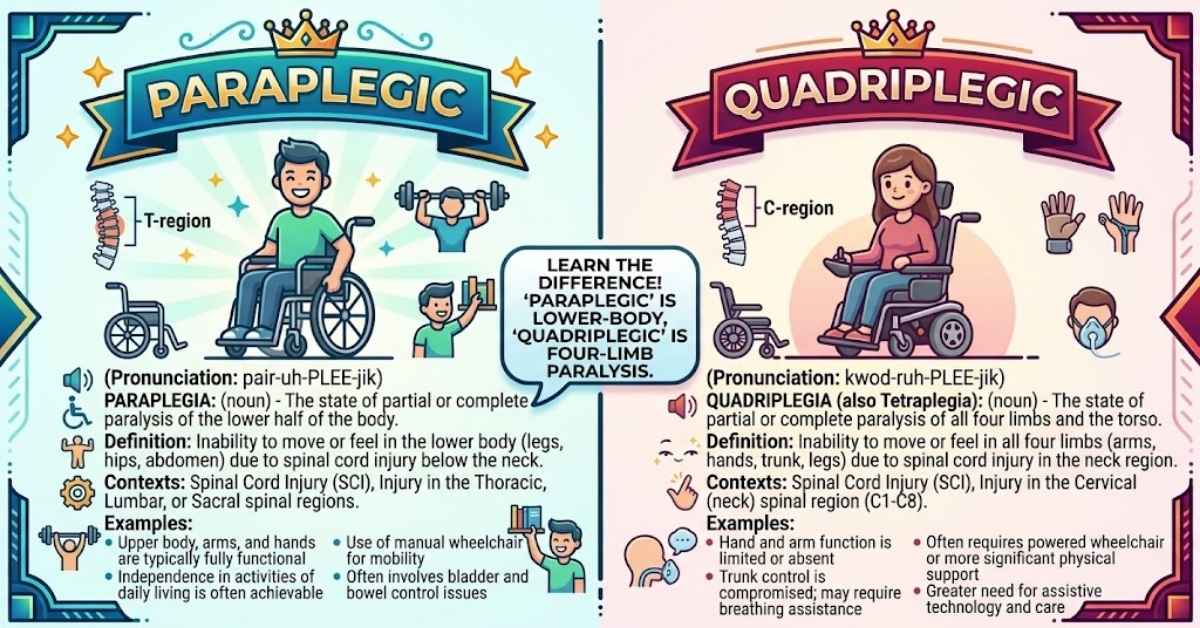
Paraplegic vs quadriplegic describes two different patterns of paralysis, mainly distinguished by which parts of the nervous system and body are affected. In general, paraplegia affects the legs and may involve the lower trunk and pelvic organs while sparing arm function. Quadriplegia—also called tetraplegia—results from impairment in the cervical spinal cord and can affect the arms, hands, trunk, legs and pelvic organs.
The important point is that these terms do not tell you everything about a person’s abilities. A person with paraplegia may retain enough leg function to stand or walk with assistance, while a person with an incomplete cervical spinal cord injury may retain substantial arm movement. The neurological level and whether the injury is complete or incomplete are essential to understanding actual function.
Paraplegic vs Quadriplegic: The Quick Difference
| Feature | Paraplegia | Quadriplegia / Tetraplegia |
|---|---|---|
| Main pattern | Affects both legs and may affect the lower trunk | Affects the arms and legs and may affect the trunk |
| Typical SCI location | Thoracic, lumbar or sacral spinal cord | Cervical spinal cord |
| Arm function | Generally spared | May be partly or substantially impaired |
| Hand function | Generally preserved | May be affected |
| Leg function | Impaired to varying degrees | Impaired to varying degrees |
| Trunk function | May be affected depending on injury level | Commonly affected to some degree |
| Breathing | Often less affected, depending on level | Higher cervical injuries can seriously affect breathing |
| Bowel/bladder function | May be affected | May be affected |
| Clinical terminology | Paraplegia | Tetraplegia is the preferred term in international SCI standards |
The International Standards for Neurological Classification of Spinal Cord Injury define tetraplegia as impairment or loss of motor and/or sensory function in cervical spinal-cord segments. Paraplegia refers to impairment or loss of motor and/or sensory function in thoracic, lumbar or sacral segments, with arm function spared.
What Is Paraplegia?
Paraplegia is a pattern of paralysis primarily affecting the lower part of the body. In spinal cord injury, it generally occurs when the thoracic, lumbar or sacral portions of the spinal cord are affected.
The exact effects vary according to the neurological level and completeness of the injury.
A person with paraplegia may experience:
- weakness or paralysis in both legs
- changes in sensation in the legs or lower body
- difficulty standing or walking
- altered bowel or bladder control
- changes in sexual function
- muscle spasms or spasticity
- neuropathic pain
- changes in trunk control
Importantly, paraplegia does not necessarily mean complete paralysis of everything below the waist. Cleveland Clinic notes that lower spinal injuries can sometimes allow a person to walk with or without braces or a walker.
The upper limbs are generally spared because the neurological pathways controlling the arms originate above the affected thoracic, lumbar or sacral levels.
What Is Quadriplegia?
Quadriplegia, also known as tetraplegia, refers to paralysis or loss of motor and/or sensory function associated with damage to the cervical spinal cord.
Because the cervical spinal cord is located in the neck and contains pathways serving the upper and lower body, cervical injuries can affect:
- shoulders
- arms
- hands
- trunk
- legs
- pelvic organs
The degree of impairment depends heavily on the neurological level and whether the injury is complete or incomplete.
For example, someone with a lower cervical injury may retain meaningful shoulder, elbow or wrist function even though their legs are significantly impaired. Someone with a higher cervical injury may have much more extensive impairment and may experience serious respiratory difficulties.
Cleveland Clinic explains that quadriplegia can result from cervical spinal cord injury but can also occur from other neurological conditions.
The Most Important Point: Location Is Not the Same as Severity
This is where many paraplegic vs quadriplegic explanations become misleading.
The two terms primarily describe the pattern and neurological location of impairment.
They do not independently tell you how complete the paralysis is.
A spinal cord injury may be:
Complete
A complete injury means there is no preserved sensory or motor function below the injury in the relevant clinical classification.
Incomplete
An incomplete injury means some sensory and/or motor function remains below the neurological level.
This distinction is critical.
For example, two people may both have tetraplegia but have very different abilities. One may have substantial arm function, while another may have very limited upper-limb movement.
Likewise, two people with paraplegia may have very different amounts of sensation, leg strength and walking ability.
The International Standards specifically use neurological examination and the ASIA Impairment Scale (AIS) to classify spinal cord injury rather than assuming that “paraplegia” or “tetraplegia” automatically means complete paralysis.
Paraplegic vs Quadriplegic: What Is the Spinal Cord Difference?
A useful way to understand the distinction is to think about the spinal cord as a communication pathway between the brain and the rest of the body.
Cervical spinal cord
The cervical region is in the neck.
Damage here can affect the pathways serving the arms and legs, which is why cervical spinal cord impairment can result in tetraplegia.
Thoracic spinal cord
The thoracic region is in the upper and middle back.
Injury here can affect the trunk and legs while generally preserving arm function.
Lumbar and sacral regions
Injuries lower in the spinal cord can primarily affect the hips and legs, although the exact neurological effects depend on the level and structures involved.
The National Institutes of Health explains that the spinal cord level of injury is described using cervical, thoracic, lumbar and sacral regions, with higher injuries generally capable of affecting more areas of the body.
LEARN MORE: Saucey or Saucy
Can a Person With Paraplegia Walk?
Sometimes, yes.
This is one of the most common misconceptions about paraplegia.
Walking ability depends on factors including:
- neurological level
- completeness of the injury
- remaining muscle strength
- sensation
- balance and trunk control
- rehabilitation
- orthopedic complications
- assistive devices
Someone with an incomplete or lower-level injury may retain enough function for assisted walking.
Other people may rely on a manual or power wheelchair for primary mobility.
Therefore, “paraplegic” should not automatically be interpreted as “cannot move the legs at all.”
Cleveland Clinic specifically describes situations in which people with lower-level paraplegia may walk with or without braces or a walker.
Can a Person With Quadriplegia Move Their Arms?
Yes, some can.
Quadriplegia does not mean that every person has identical loss of arm function.
The amount of preserved movement depends heavily on the cervical neurological level and whether the injury is complete or incomplete.
Depending on the injury, a person may retain some:
- shoulder movement
- elbow movement
- wrist movement
- finger movement
- grasp or release ability
This is why describing someone simply as having “no movement from the neck down” can be inaccurate.
Mayo Clinic emphasizes that the neurological level and completeness of spinal cord injury determine which functions remain after an injury.
Paraplegia vs Quadriplegia: Causes
Both conditions can have traumatic or non-traumatic causes.
Traumatic causes
Common traumatic causes of spinal cord injury include:
- motor vehicle crashes
- falls
- sports and recreational injuries
- violence
- other high-impact trauma
Cleveland Clinic identifies motor vehicle crashes, falls, penetrating injuries and sports injuries among common traumatic causes of paralysis associated with spinal cord injury.
Non-traumatic causes
Paralysis can also result from medical conditions such as:
- spinal tumors
- infections
- inflammation
- spinal cord ischemia
- syringomyelia
- multiple sclerosis
- transverse myelitis
- certain congenital conditions
- neurological diseases
The exact cause matters because the potential course and treatment depend on what damaged or disrupted the nervous system, not simply on whether the resulting pattern is called paraplegia or quadriplegia.
How Paraplegia and Quadriplegia Can Affect Daily Life
The difference is not simply about walking.
Spinal cord injury can affect several body systems.
Mobility
Someone with paraplegia may be able to propel a manual wheelchair independently if their upper-body function permits it.
Someone with higher-level tetraplegia may require a power wheelchair or other assistive technology.
Transfers
Moving between a wheelchair, bed, toilet or vehicle requires different techniques depending on:
- arm strength
- trunk control
- balance
- sensation
- leg function
Dressing and personal care
Preserved hand and arm function can make a major difference in activities of daily living.
Someone with paraplegia may have substantially preserved upper-limb function, whereas someone with cervical SCI may need adaptive equipment or assistance.
Bowel and bladder function
Spinal cord injury can disrupt communication between the brain and the bladder or bowel.
Both paraplegia and tetraplegia can therefore involve neurogenic bowel or bladder, although the exact effects vary.
Sexual function
Spinal cord injury can affect sexual sensation and function. The effects vary considerably according to injury level, completeness and individual circumstances.
Breathing
Respiratory effects are particularly important with higher cervical injuries because muscles involved in breathing can be affected.
Mayo Clinic lists breathing and coughing difficulties among possible spinal-cord-injury symptoms and notes that the level and completeness of injury influence the resulting functional loss.
Paraplegia vs Quadriplegia and Rehabilitation
There is no single rehabilitation program that fits everyone.
Rehabilitation may involve:
- physical therapy
- occupational therapy
- mobility training
- strengthening preserved muscles
- wheelchair skills
- transfer training
- adaptive equipment
- bowel and bladder management
- respiratory care
- prevention of pressure injuries
- management of spasticity and pain
- home and workplace accessibility
- psychological and social support
The goal is not simply to “make someone walk again.”
Rehabilitation can also focus on maximizing independence, preventing secondary complications and helping a person use the functions that remain effectively.
Cleveland Clinic notes that rehabilitation and assistive devices can help people with paralysis improve function and independence.
Is Quadriplegia the Same as Tetraplegia?
Yes.
In modern spinal-cord-injury terminology, quadriplegia and tetraplegia refer to the same basic pattern of neurological impairment.
The International Standards prefer the term tetraplegia. The reason is linguistic: tetra- comes from Greek, as does -plegia, whereas quadri- comes from Latin. Using tetraplegia keeps the word roots consistent.
However, quadriplegia remains widely used, particularly in general public communication and some medical/legal contexts.
So if you see both terms in medical information, they are not automatically describing two different conditions.
Why the Terms “Paraplegic” and “Quadriplegic” Need Context
The words are useful, but they should not be treated as complete descriptions of a person’s abilities.
For example:
- A person with paraplegia may have substantial leg function.
- A person with tetraplegia may retain useful arm movement.
- Two people with the same neurological level can have different functional abilities.
- A diagnosis does not reveal every person’s mobility, independence or daily routine.
Some disability-language guidance recommends person-centered language, such as “person with paraplegia” or “person with tetraplegia.” At the same time, language preferences vary, and some people use disability-related terms as identity-first language. The respectful approach is to follow the individual’s own preference when known.
LEARN MORE: Winning or Wining
Paraplegic vs Quadriplegic: Which Is More Severe?
It is tempting to answer this by saying quadriplegia is always “more severe.”
That is too simplistic.
A cervical spinal cord injury generally has the potential to affect more body regions and functions because the injury occurs higher in the spinal cord. However, the actual impact on an individual depends on neurological level, completeness and other clinical factors.
For example, an incomplete cervical injury and a complete thoracic injury can produce very different functional profiles.
So a more medically useful question is:
What is the neurological level, and is the spinal cord injury complete or incomplete?
That information tells you substantially more about function than the label alone.
Paraplegia vs Quadriplegia: Recovery
Recovery is highly individual.
Factors that influence outcome can include:
- location of the spinal cord injury
- completeness of the injury
- cause of the injury
- neurological examination findings
- complications
- treatment
- rehabilitation
- overall health
It is therefore inappropriate to promise that a person will or will not recover based only on whether they are described as paraplegic or quadriplegic.
Mayo Clinic notes that the neurological level and completeness of spinal cord injury are important in determining the potential for recovery.
A Simple Way to Remember the Difference
Think of the spinal cord in terms of where the disruption occurs:
Paraplegia → lower-body pattern → arms generally spared.
Tetraplegia/quadriplegia → cervical pattern → arms and legs can be affected.
Then add the second question:
Complete or incomplete?
That second question helps explain why two people with the same broad diagnosis can have very different abilities.
When Sudden Paralysis Requires Emergency Care
Sudden weakness, numbness or paralysis after an accident should be treated as a medical emergency.
Warning signs can include:
- severe neck or back pain
- sudden weakness
- numbness or loss of sensation
- loss of bladder or bowel control
- difficulty walking
- loss of coordination
- trouble breathing after an injury
Mayo Clinic advises treating a suspected spinal injury seriously and seeking emergency medical help rather than moving the injured person unnecessarily.
If paralysis develops suddenly for any reason, seek emergency medical evaluation.
Frequently Asked Questions
What is the difference between paraplegic and quadriplegic?
Paraplegia generally affects the legs and may involve the lower trunk while sparing the arms. Quadriplegia, or tetraplegia, results from cervical spinal-cord impairment and can affect the arms, legs and trunk. The exact abilities vary according to neurological level and completeness.
What is a paraplegic vs quadriplegic?
A person with paraplegia generally has impaired function in the lower body with preserved arm function. A person with quadriplegia/tetraplegia has impairment involving the cervical spinal cord, which can affect all four limbs and the trunk.
What is the paraplegic vs quadriplegic difference?
The central difference is the pattern and neurological level of impairment. Paraplegia is associated with thoracic, lumbar or sacral spinal-cord impairment, while tetraplegia is associated with cervical spinal-cord impairment.
Can a paraplegic walk?
Some people with paraplegia can walk, particularly when the injury is incomplete or lower in the spinal cord. Others rely on wheelchairs for mobility. Walking ability cannot be determined from the word “paraplegia” alone.
Can a quadriplegic move their arms?
Some people with quadriplegia can move their arms. The amount of preserved movement depends on the cervical neurological level and whether the injury is complete or incomplete.
Is quadriplegia the same as tetraplegia?
Yes. They refer to the same basic pattern of cervical spinal-cord impairment. Tetraplegia is the preferred term in the International Standards for neurological classification of spinal cord injury, although quadriplegia remains widely used.
Is paraplegia always permanent?
Not necessarily. The course depends on the underlying cause and neurological damage. Some causes can improve when the underlying condition is treated, while severe spinal cord damage can result in lasting impairment.
Is quadriplegia always complete paralysis?
No. Tetraplegia can be incomplete. A person may retain different amounts of sensation or movement in the arms, hands, trunk or legs.
Does paraplegia affect the bladder and bowel?
It can. Spinal cord injury can disrupt bladder and bowel control regardless of whether the resulting pattern is paraplegia or tetraplegia. Management depends on the neurological injury.
Does quadriplegia affect breathing?
It can, especially with higher cervical spinal cord injuries. The higher the injury, the greater the potential impact on respiratory muscles.
What is the difference between paraplegia and paraparesis?
Paraplegia describes impairment or loss of motor and/or sensory function in the lower body associated with relevant spinal-cord injury. Paraparesis generally refers to weakness affecting the lower limbs. The International Standards caution against using paresis terminology as a simplistic substitute for the neurological classification of an incomplete SCI.
Final Answer: Paraplegic vs Quadriplegic
The simplest accurate explanation is:
Paraplegia primarily affects the lower body while generally sparing the arms. Quadriplegia, also called tetraplegia, results from cervical spinal-cord impairment and can affect the arms, hands, legs and trunk.
But that is only the starting point.
To understand what a particular person can or cannot do, you also need to know the neurological level of injury and whether the spinal cord injury is complete or incomplete. Those factors explain why people with the same broad diagnosis can have very different movement, sensation, mobility and care needs.
This article is educational and does not replace an examination or individualized advice from a qualified healthcare professional.