

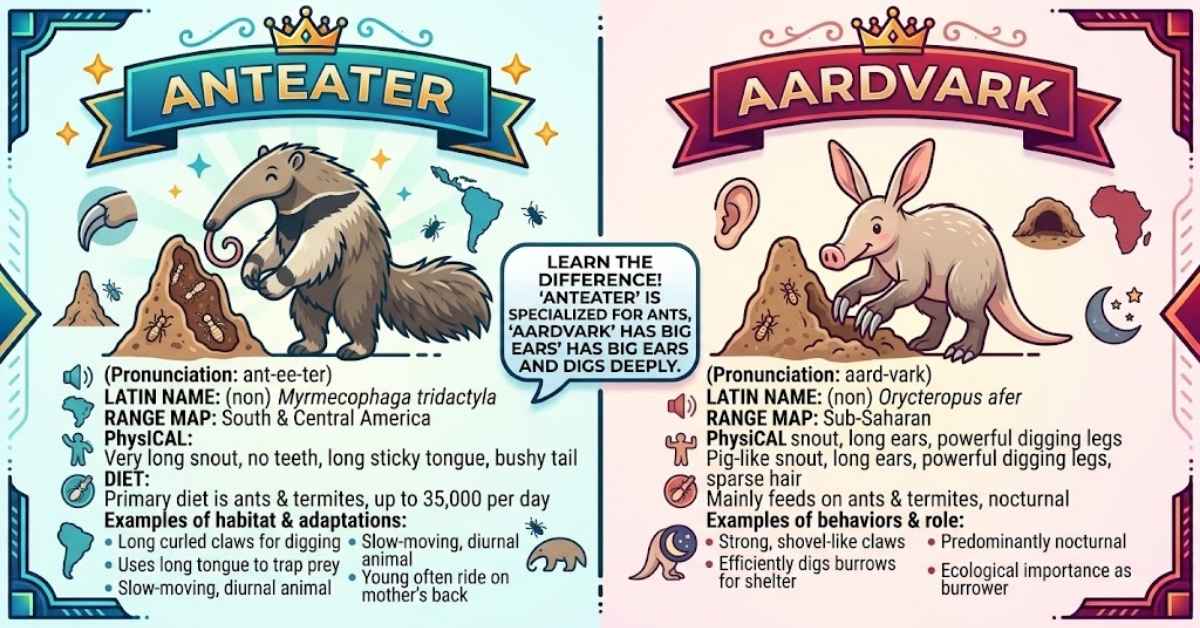
Anteater vs aardvark is a surprisingly common animal comparison because the two mammals have long snouts, powerful claws and a taste for ants and termites. But they are not the same animal and are not close relatives. Aardvarks are African mammals in the unique order Tubulidentata, while true anteaters are American mammals in the group Pilosa, alongside sloths.
Their similar appearance is a classic example of convergent evolution: unrelated animals independently developing similar adaptations because they exploit similar foods.
The fastest way to tell them apart is simple: an aardvark has a stockier, pig-like body, large upright ears, a thick tapering tail and specialized teeth, while a giant anteater has shaggy fur, a huge bushy tail, a distinctive black-and-white shoulder pattern and no teeth.
Anteater vs Aardvark: Quick Comparison
| Feature | Aardvark | Giant Anteater |
|---|---|---|
| Scientific name | Orycteropus afer | Myrmecophaga tridactyla |
| Native region | Sub-Saharan Africa | Central and South America |
| Order | Tubulidentata | Pilosa |
| Close living relatives | Afrotherian mammals | Sloths and other anteaters |
| Main food | Ants and termites | Ants and termites |
| Teeth | Yes — specialized peg-like teeth | No |
| Tongue | Long and sticky | Extremely long and sticky |
| Fur | Short/coarse | Long, shaggy fur |
| Ears | Large and prominent | Small |
| Tail | Thick and tapering | Large and bushy |
| Lifestyle | Primarily nocturnal | Often diurnal, though activity varies |
| Burrowing | Excellent burrower | Does not normally construct permanent burrows |
| Main defense | Digging and powerful claws | Powerful foreclaws |
The exact comparison varies if “anteater” means one of the smaller anteater species rather than the giant anteater, so the physical comparison above focuses on the giant anteater—the species most commonly pictured in this matchup. Smithsonian’s National Zoo identifies the giant anteater as the largest of the four anteater species.
What Is an Aardvark?
The aardvark is a distinctive African mammal scientifically known as Orycteropus afer. It is the only living species in the order Tubulidentata, making it an unusually isolated branch of the mammalian family tree.
Aardvarks occur across much of sub-Saharan Africa, particularly in habitats such as savannas and grasslands where ants and termites are abundant and the soil is suitable for digging.
At first glance, an aardvark can look like an odd combination of several familiar animals:
- a pig-like snout
- rabbit-like ears
- a heavy body
- a long tail
- powerful digging claws
But it isn’t a pig, anteater or giant rodent.
Its body is specialized for digging, detecting and eating social insects.
Aardvark teeth
One of the easiest ways to separate an aardvark from a true anteater is the mouth.
Aardvarks have specialized peg-like teeth toward the back of the mouth. Their teeth lack conventional enamel and are built from densely packed tubules of dentine surrounded by dental cement.
That is a remarkable contrast with the giant anteater, which has no teeth at all.
What Is an Anteater?
An anteater is not a single species.
The term generally refers to four living species in the suborder Vermilingua:
- giant anteater
- northern tamandua
- southern tamandua
- silky anteater
They belong to the order Pilosa, the same larger order that contains sloths.
True anteaters are native to Central and South America.
The giant anteater is the largest and most recognizable species. Smithsonian’s National Zoo reports that giant anteaters can reach 6–8 feet in total length, including the tail, and weigh about 60–100 pounds.
Their most famous adaptations are their:
- long tubular snout
- enormous bushy tail
- powerful forelimbs
- long claws
- sticky tongue
- toothless mouth
Aardvark vs Anteater: Are They Related?
No—not closely.
This is one of the most interesting parts of the comparison.
The aardvark belongs to Tubulidentata, while true anteaters belong to Pilosa. Molecular and anatomical evidence places aardvarks within the African mammal group Afrotheria, while anteaters belong to the Xenarthran lineage that also contains sloths and armadillos.
So why do they look alike?
Because they have solved a similar ecological problem.
Both animals specialize in finding and consuming ants and termites. Over evolutionary time, that lifestyle favored traits such as:
long snouts + strong claws + sticky tongues + reduced reliance on vision + strong smell.
This is called convergent evolution.
The similarity is therefore not evidence that an aardvark evolved from an anteater.
It is evidence that similar environmental pressures can produce similar biological solutions in unrelated animals.
Why Do Aardvarks and Anteaters Look So Similar?
Imagine two engineers working independently on the same problem.
If both need to build a machine that reaches into narrow termite tunnels, breaks open nests and collects tiny insects, some of their designs may end up looking surprisingly similar.
Evolution can work in much the same way.
Both aardvarks and anteaters need to:
- locate ant or termite colonies;
- break into nests;
- avoid aggressive insects;
- collect large numbers of tiny prey;
- digest food that is very different from a typical mammal diet.
The result is a similar toolkit:
- elongated snout
- long tongue
- powerful forelimbs
- claws
- reduced emphasis on biting prey
- strong sense of smell
But the underlying anatomy is different.
That’s why similar appearance does not mean close evolutionary relationship.
Aardvark vs Anteater: The Biggest Physical Differences
1. Snout
Both animals have elongated snouts, but their overall shapes differ.
An aardvark’s snout has a more pig-like appearance, while the giant anteater’s head narrows into a long, tubular feeding structure.
2. Ears
Aardvarks have large, upright ears that are one of their easiest field marks.
Giant anteaters have much smaller ears.
3. Tail
The tail is another excellent visual clue.
A giant anteater has a large, bushy tail that can make the animal look dramatically larger.
An aardvark has a thick, tapering tail that is much less furry.
4. Fur
Aardvarks have relatively short, coarse hair.
Giant anteaters have noticeably longer, shaggy fur, particularly around the tail.
5. Teeth
This is perhaps the best anatomical distinction.
Aardvarks have specialized teeth. Giant anteaters have none.
Which Has the Longer Tongue?
The giant anteater has the extraordinary tongue.
Smithsonian’s National Zoo describes it as roughly 2 feet long and capable of flicking in and out up to 150 times per minute. Sticky saliva helps insects adhere to the tongue as the animal feeds.
The aardvark also has a long, sticky tongue adapted for collecting ants and termites, but its feeding strategy relies heavily on its powerful digging ability.
So both have impressive tongues—but the giant anteater is the better-known tongue specialist.
Aardvark vs Anteater: How They Eat
Both are myrmecophagous, meaning they specialize in eating ants and/or termites.
How an aardvark feeds
An aardvark can use its powerful claws to break into ant and termite nests. It may dig rapidly while feeding, sweeping insects into its mouth with its sticky tongue.
Its muscular, gizzard-like stomach helps process the insects.
How a giant anteater feeds
A giant anteater uses its strong forelimbs and claws to tear open an insect nest.
It then rapidly extends its sticky tongue into the opening.
Smithsonian reports that giant anteaters may consume roughly 140 insects from a single mound during one feeding event, illustrating why their feeding strategy depends on repeatedly exploiting many colonies rather than completely destroying one.
Where Do Aardvarks Live?
Aardvarks are native to sub-Saharan Africa.
They occupy environments including:
- savannas
- grasslands
- woodland areas
- other habitats with suitable soil and insect prey
Animal Diversity Web notes that aardvarks generally avoid extremely hard or rocky soil because digging is fundamental to their survival.
Their burrows are not merely sleeping chambers.
They can provide:
- shelter from predators
- protection from environmental extremes
- places to raise young
- refuge during the day
Aardvarks are strongly associated with nocturnal activity.
Where Do Anteaters Live?
True anteaters are native to Central and South America.
The giant anteater occupies a variety of habitats, including:
- grasslands
- wetlands
- forests
- tropical areas
Smithsonian’s National Zoo reports that giant anteaters occur across Central and South America, although their historical range has been reduced in several areas.
Unlike aardvarks, giant anteaters do not normally construct elaborate permanent burrow systems. Animal Diversity Web describes them as using abandoned burrows, vegetation or ground depressions for resting.
LEARN MORE: Saucey or Saucy
Aardvark vs Anteater: Day or Night?
Aardvarks are primarily nocturnal.
Giant anteaters can be active during the day, although their activity pattern can change depending on environmental conditions and human disturbance.
Smithsonian notes that giant anteaters become more likely to be nocturnal in areas with higher human population density.
That means “aardvark = night” is a useful identification clue, while “anteater = always day” would be too absolute.
Which One Is Bigger?
The answer depends on which anteater species you mean.
For the giant anteater, Smithsonian gives a total length of approximately 6–8 feet and a typical weight of 60–100 pounds.
Animal Diversity Web lists adult aardvarks at roughly 40–82 kg (88–181 pounds) and about 100–158 cm (39–62 inches) in body length, excluding the tail.
So an aardvark can be heavier and more heavily built than a giant anteater even though the giant anteater can be longer overall because of its enormous tail.
This is why simply asking “which is bigger?” can be misleading.
Body length and body mass tell different stories.
Aardvark vs Anteater: Behavior
Both animals are generally solitary.
Aardvarks typically live alone and maintain territories, although mothers stay with their young. Animal Diversity Web describes them as solitary, territorial and nocturnal.
Giant anteaters are also generally solitary except during breeding or when mothers are raising young.
Neither animal is built around a social herd lifestyle.
Their feeding strategy instead depends on moving through a large area and locating scattered insect colonies.
Aardvark vs Anteater: Defense
Neither animal is a conventional predator.
Their main defenses are closely connected to their anatomy.
Aardvark defense
An aardvark can:
- dig rapidly
- escape into a burrow
- use powerful claws
- defend itself with its forelimbs
Animal Diversity Web notes that an aardvark can dig itself into shelter when threatened and can use its claws defensively if escape is not possible.
Giant anteater defense
A giant anteater may rear up and use its large foreclaws when threatened.
Its powerful forelimbs are primarily feeding tools, but they can also become formidable defensive weapons. Smithsonian describes giant anteaters rearing up and using their claws when necessary.
Aardvark vs Anteater vs Tapir
The comparison becomes even more interesting when a tapir enters the picture.
At first glance, all three can look like strange long-nosed mammals.
But a tapir is fundamentally different.
| Feature | Aardvark | Giant Anteater | Tapir |
|---|---|---|---|
| Main diet | Ants/termites | Ants/termites | Plants |
| Snout | Long, pig-like | Long, tubular | Flexible, trunk-like |
| Teeth | Yes | No | Yes |
| Body | Stocky | Shaggy, elongated | Heavy, barrel-shaped |
| Tail | Thick/tapering | Bushy | Very short |
| Major group | Tubulidentata | Pilosa | Perissodactyla |
| Relatives | Afrotherians | Sloths/armadillos | Horses/rhinoceroses |
San Diego Zoo classifies tapirs in Perissodactyla, the same order that includes horses and rhinoceroses. Tapirs use their flexible snout to grab leaves and fruit rather than specializing in ants and termites.
So if you see a long-nosed animal eating leaves or fruit, a tapir is a much better candidate than an aardvark or anteater.
Aardvark vs Anteater vs Pangolin
A pangolin creates another common identification trap because some pangolins are called “scaly anteaters.”
But pangolins are not true anteaters.
| Feature | Aardvark | Anteater | Pangolin |
|---|---|---|---|
| Main food | Ants/termites | Ants/termites | Ants/termites |
| Body covering | Hair | Fur | Keratin scales |
| Teeth | Specialized teeth | None | None |
| Tongue | Long/sticky | Very long/sticky | Long/sticky |
| Geographic range | Africa | Americas | Africa and Asia |
| Defense | Digging/claws | Claws | Curling into a ball |
| Relationship to anteaters | Distant | True anteater | Not a true anteater |
San Diego Zoo explicitly notes that pangolins are sometimes called scaly anteaters, but they belong to their own family and are not related to true anteaters.
Pangolins are particularly easy to identify because of their overlapping scales, which are made of keratin—the same broad material found in human fingernails.
Aardvark vs Tapir vs Anteater: The Fastest Identification Guide
If you’re looking at a wildlife photograph, use these clues:
Large ears + African habitat + pig-like snout
Think aardvark.
Huge bushy tail + shaggy fur + extremely long snout
Think giant anteater.
Flexible little trunk + bulky body + plant-eating behavior
Think tapir.
Overlapping scales + long tongue + curling into a ball
Think pangolin.
This field-mark approach is more useful than memorizing taxonomy alone.
Are Aardvarks and Anteaters the Same Animal?
No.
They are separate mammals from different evolutionary lineages and different continents.
The confusion comes from their similar:
- diet
- snouts
- claws
- tongues
- insect-feeding behavior
Those similarities are examples of convergent evolution, not evidence that one is descended from the other.
LEARN MORE: Paraplegic vs Quadriplegic
Are Aardvarks Related to Pigs?
No.
Their pig-like appearance is superficial.
The name “aardvark” comes from Afrikaans and is associated with the idea of an earth pig, but the animal itself is not a pig. Its classification places it in the unique order Tubulidentata and within the broader Afrotherian lineage.
Are Anteaters Related to Sloths?
Yes.
True anteaters and sloths belong to the order Pilosa.
That relationship is much closer than the relationship between an anteater and an aardvark.
This is one of the best examples of why appearance can be deceptive in zoology.
An anteater looks somewhat like an aardvark, but its evolutionary relatives include animals that look completely different—sloths.
Do Aardvarks and Anteaters Eat the Same Food?
Broadly, yes.
Both specialize heavily in ants and termites.
But their feeding methods and anatomy differ.
The aardvark uses its digging ability and specialized mouth and teeth, while the giant anteater relies on its powerful forelimbs, claws and exceptionally long sticky tongue.
Do Aardvarks Have Teeth?
Yes.
Aardvarks have specialized teeth consisting of numerous tiny tubules.
This is one of the clearest differences from true anteaters, because giant anteaters are completely toothless.
Do Anteaters Have Teeth?
No.
Giant anteaters have no teeth.
Instead, they collect ants and termites with a highly specialized sticky tongue and swallow them.
Which Animal Has the Better Sense of Smell?
Both rely strongly on smell to locate food.
Animal Diversity Web describes aardvarks as having an exceptionally developed sense of smell, while giant anteaters also have a highly developed olfactory system.
That makes evolutionary sense: when your food is hidden inside nests and mounds, detecting insects by scent is far more useful than relying exclusively on excellent eyesight.
Conservation: Why the Difference Matters
Understanding the difference isn’t just an academic exercise.
Different species require different conservation strategies because they occupy different ecosystems.
Giant anteaters face threats including habitat loss and human-related mortality, while aardvarks can also be affected by habitat conversion and loss of their insect food resources.
Pangolins face an even more severe conservation challenge: Smithsonian describes pangolins as the most trafficked mammals in the world, with all eight species protected under national and international laws and several species facing serious extinction threats.
So correctly identifying an animal matters when discussing its ecology and conservation.
Frequently Asked Questions
What is the difference between an anteater and an aardvark?
An aardvark is an African mammal in the order Tubulidentata, while true anteaters are American mammals in Pilosa. Aardvarks have specialized teeth; giant anteaters have no teeth. Both eat ants and termites and have evolved long snouts and other similar adaptations independently.
Are aardvarks and anteaters related?
Not closely. Aardvarks belong to an Afrotherian lineage, while true anteaters belong to Xenarthra. Their similar appearance is largely the result of convergent evolution.
Is an aardvark an African anteater?
No. “African anteater” has sometimes been used informally for aardvarks because they eat ants and termites, but an aardvark is not a true anteater.
Is an anteater the same as a pangolin?
No. Pangolins are sometimes called scaly anteaters, but they belong to a separate mammalian family. Their scales are their most obvious distinguishing feature.
Is a tapir an anteater?
No. Tapirs are primarily plant-eating mammals in Perissodactyla, the same order that contains horses and rhinoceroses.
Which is bigger, an aardvark or an anteater?
It depends on the anteater species and whether you’re comparing weight or total length. A giant anteater can reach about 6–8 feet in total length, largely because of its enormous tail, while aardvarks can weigh considerably more.
Which has a longer tongue, the aardvark or anteater?
The giant anteater has the more spectacular tongue. Smithsonian reports a tongue around 2 feet long that can move in and out up to 150 times per minute.
Do both animals eat termites?
Yes. Aardvarks and anteaters both specialize in ants and termites, although their feeding techniques differ.
Why do aardvarks and anteaters look alike?
They evolved similar adaptations for a similar ecological niche. This is known as convergent evolution.
What is the difference between aardvark vs anteater vs tapir?
Aardvarks and anteaters specialize in ants and termites, while tapirs primarily eat vegetation. Aardvarks are African, anteaters are native to the Americas, and tapirs occur in the Americas and Southeast Asia.
What is the difference between aardvark vs anteater vs pangolin?
All three can eat ants and termites, but they are very different mammals. Aardvarks are African burrowers with specialized teeth, true anteaters are toothless American mammals, and pangolins are scaly mammals found in Africa and Asia.
Are aardvarks dangerous?
Aardvarks generally avoid confrontation and are more likely to escape by digging. However, like any wild animal, they can defend themselves with powerful claws if threatened.
Are giant anteaters dangerous?
Giant anteaters are generally solitary and avoid threats when possible, but their large foreclaws can be used defensively. They should be treated as wild animals rather than harmless pets.
Final Answer: Anteater vs Aardvark
The simplest answer to anteater vs aardvark is this:
An aardvark is an African, burrowing mammal with large ears, a pig-like snout and specialized teeth. A true anteater is an American mammal with a long tubular snout, powerful claws, a sticky tongue and—at least in the giant anteater—no teeth.
They look alike because they evolved similar adaptations for eating ants and termites, not because they are close relatives.
If you remember only four clues, remember:
Africa + big ears + teeth = aardvark.
Americas + shaggy fur + toothless mouth = anteater.
Scales + curling into a ball = pangolin.
Flexible plant-eating snout + bulky body = tapir.
That distinction turns what first looks like one family of strange long-nosed mammals into four very different evolutionary stories.