

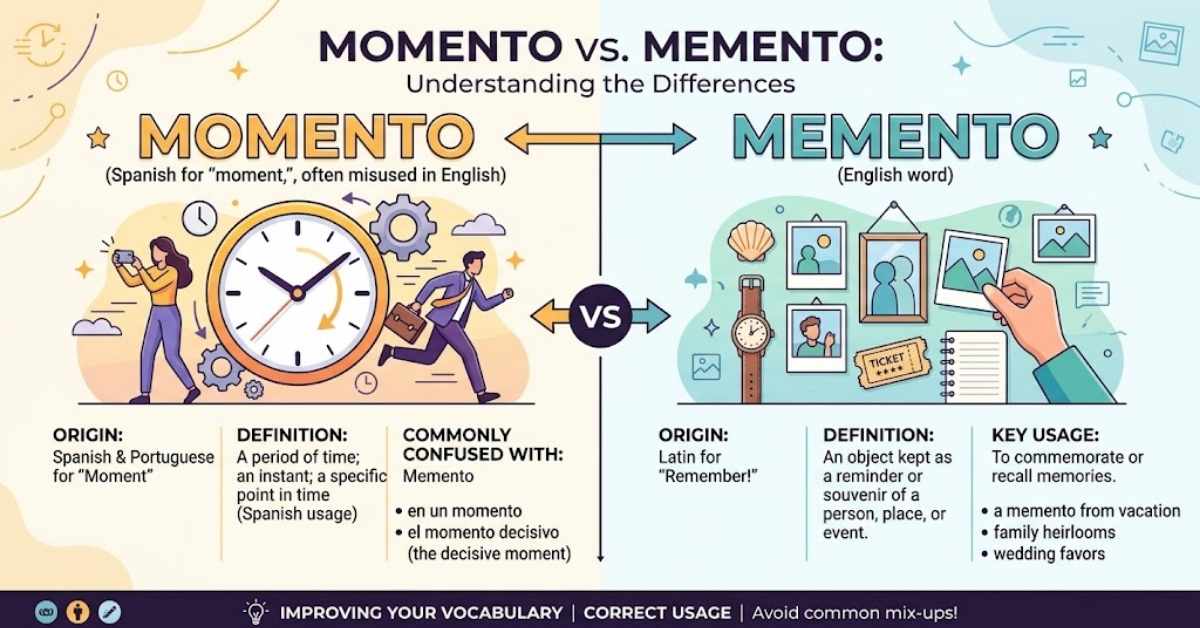
Momento or memento? If you mean a keepsake, souvenir, or object that helps you remember a person, place, event, or experience, memento is the safest and preferred spelling in standard English. Momento is not simply an invented form, however: major dictionaries record it as a variant spelling, while also noting that it is commonly treated as a misspelling or nonpreferred form. For polished U.S. English, use memento.
That small difference is easy to miss because a memento is often connected with a memorable moment. The spelling therefore feels logical even when it is not the form most editors would choose.
Momento or Memento: Which Spelling Is Correct?
If you are asking “is it memento or momento?”, write memento when you mean a keepsake or reminder.
- Memento = a thing kept or given to remind someone of a person, place, event, or experience.
- Momento = a documented variant spelling of memento, but one that many readers, editors, and usage authorities regard as nonstandard or a misspelling.
This distinction matters because “correct” can mean two different things.
A spelling can be recognized in dictionaries without being the spelling you would normally choose in formal or edited writing. That is the situation with momento. Merriam-Webster records the variant but explains that it is typically considered a misspelling. Dictionary.com likewise recognizes the variant while noting that it is often regarded as an error.
So the practical rule is simple:
Writing about a keepsake or reminder? Choose memento.
Quick comparison
| Form | Status in English | Meaning | Best choice for polished writing |
|---|---|---|---|
| memento | Standard/preferred | Keepsake or reminder | Yes |
| momento | Recorded variant, often treated as nonstandard | Generally the same intended meaning | Usually avoid |
| moment | Standard word | A period of time or occasion | Use when referring to time |
What Does Memento Mean?
A memento is something you keep because it reminds you of someone, somewhere, an event, or an experience.
For example, a memento could be:
- a photograph from a family trip
- a concert ticket
- a handwritten letter
- a graduation medal
- a wedding invitation
- a souvenir from a vacation
- a gift from someone who is important to you
- an object connected with a significant event
The important idea is remembrance.
You are not simply keeping the object because it is useful. You are keeping it because the object carries a connection to something you want to remember.
For example:
She kept the old photograph as a memento of her childhood.
The signed book became a treasured memento of the author’s visit.
He brought home a small memento from his vacation.
The medal is a permanent memento of her achievement.
Oxford and Cambridge both define memento around this idea of something retained to help someone remember a person, place, or event.
Is Momento a Real Word?
This is where many quick spelling guides become too absolute.
It is common to see the statement:
“Momento isn’t a word.”
That is too simplistic.
Major dictionaries do record momento as a variant of memento. Merriam-Webster explains that the form is generally considered a misspelling, but it has appeared often enough in edited English to receive dictionary recognition. Dictionary.com similarly lists momento as an alternate spelling.
So there are really three separate questions:
Is “momento” found in English? Yes.
Can dictionaries recognize it as a variant? Yes.
Is it the spelling you should normally choose in careful U.S. English? No. Memento is the safer choice.
That distinction is especially useful for writers because “dictionary-listed” and “preferred in edited prose” are not always identical concepts.
If you are writing an essay, business email, website, report, book, caption, or professional document, memento avoids unnecessary doubt.
Why Do People Confuse Momento and Memento?
The confusion is actually quite understandable.
1. The word is connected with a memorable moment
A memento often reminds you of a particular moment in your life.
You might keep a photograph because it reminds you of a special moment. You might keep a ticket because it brings back memories of an important event.
The brain naturally connects:
moment → memory → memento
That makes momento look surprisingly plausible.
2. The pronunciation does not strongly reveal the spelling
In American English, memento is pronounced with the main stress on the middle syllable. The unstressed first vowel can make the written e easy to overlook.
3. Other languages use “momento”
There is another layer of confusion: momento exists in languages such as Spanish and Italian with the meaning “moment.”
That does not change the standard English spelling of the keepsake noun, but it helps explain why some English writers have encountered the spelling before.
4. Spell-check does not always solve the problem
A spell-checker can detect many typographical errors, but it cannot always determine whether the word fits your intended meaning.
Because momento is attested as a variant, software may not treat it as a straightforward typo.
That is why context and vocabulary knowledge still matter.
Memento vs. Moment: What Is the Difference?
This is one of the most useful distinctions to learn.
Moment
A moment is a short period of time or a particular occasion.
Please wait a moment.
It was the happiest moment of her life.
I knew that was the right moment to speak.
Memento
A memento is something kept as a reminder.
She kept the photograph as a memento of that moment.
Notice how both words can appear in the same sentence:
The photograph became a memento of an unforgettable moment.
That’s also a good way to understand why the spellings are so easily confused.
Moment = something you experience in time. Memento = something you keep to remember it.
What Does Memento Mori Mean?
If you searched “momento or memento mori,” the correct phrase is:
memento mori
Not momento mori.
Memento mori is a Latin phrase traditionally translated as “remember that you must die” or “remember that you will die.”
The first word, memento, comes from a Latin imperative meaning “remember.” Mori means “to die.”
In English, memento mori can refer to an object, image, symbol, or artistic motif intended to remind people of mortality.
Historical examples include imagery such as:
- skulls
- bones
- hourglasses
- extinguished candles
- wilting flowers
- decaying fruit
The point is not simply that an object is old or frightening. The underlying idea is mortality and the limited nature of human life.
This is why the established Latin phrase retains the spelling memento.
LEARN MORE: Advice or Advise
Memento or Momento in U.S. and UK English
If your search includes “momento or memento UK,” the practical spelling answer is the same: memento is the standard form in both American and British English.
The pronunciation can differ somewhat.
In American English, dictionaries give a pronunciation represented approximately as:
/məˈmɛntoʊ/
British English commonly uses a pronunciation ending in an -oh sound represented as:
/məˈmentəʊ/
The spelling itself does not change.
So whether you are writing for a U.S. audience or a UK audience:
memento is the dependable standard spelling.
What Is the Plural of Memento?
Both mementos and mementoes are established plural forms.
For example:
She keeps several mementos from her travels.
The museum contains historical mementoes from the period.
In contemporary American writing, mementos is a straightforward choice.
The important point is that the plural is not normally formed as momentos when you are following the preferred spelling.
Singular and plural
- one memento
- two mementos
- several mementos
- a collection of mementos
Memento Synonyms: What Words Can You Use Instead?
If you’re looking for a momento or memento synonym, the closest alternatives depend on context.
Keepsake
A keepsake is something retained because it has sentimental value.
The necklace was a keepsake from her grandmother.
This is often the closest everyday substitute for memento.
Souvenir
A souvenir is commonly an object kept as a reminder of a place, trip, or experience.
She bought a small souvenir from Paris.
Memento and souvenir overlap strongly, although souvenir often has a stronger travel or tourism association.
Reminder
Reminder is broader.
The photograph served as a reminder of their friendship.
A reminder does not have to be a physical keepsake.
Token
A token can be an object representing affection, appreciation, recognition, or another relationship.
The award was presented as a token of appreciation.
Remembrance
Remembrance emphasizes the act or state of remembering rather than necessarily referring to a physical object.
Memorabilia
Memorabilia generally refers to a collection or category of objects associated with people, events, places, or periods.
For example, sports memorabilia might include signed jerseys, programs, photographs, and tickets.
So don’t treat every synonym as perfectly interchangeable. Memento is particularly useful when a specific object serves as a personal reminder.
Real-Life Examples of Memento
The word becomes easier to understand when you see it across different situations.
Travel
I kept the train ticket as a memento of my first trip to New York.
Family
The recipe card is a precious memento of my grandmother.
Graduation
Each student received a small memento of the graduation ceremony.
Wedding
The framed invitation became a memento of their wedding day.
Professional recognition
The company presented her with a watch as a memento of her years of service.
Historical context
The museum preserves letters and photographs as mementos of the period.
Personal memory
He kept the old baseball glove as a memento of his childhood.
These examples show that a memento does not have to be expensive. Its value is often emotional or commemorative rather than monetary.
Common Mistakes With Momento and Memento
Mistake 1: Writing “momento” because of “moment”
A special object may remind you of a moment, but the preferred English spelling remains memento.
Preferred:
She kept the ticket as a memento.
Mistake 2: Writing “momento mori”
The established Latin phrase is:
memento mori
Mistake 3: Assuming memento means “a moment”
It doesn’t.
“Give me a memento.”
means something very different from:
“Give me a moment.”
The first asks for a keepsake or reminder; the second concerns time.
Mistake 4: Assuming every dictionary-listed variant is equally suitable
A dictionary can document how language is actually used without telling you that every variant is equally appropriate for every context.
For polished writing, memento is the safer option.
Mistake 5: Forgetting the plural
Use:
mementos or mementoes
rather than automatically changing the spelling to momentos.
The Easiest Way to Remember the Spelling
Use this memory connection:
Memento → memory → remember
The spelling begins with me, not mo:
m-e-m-e-n-t-o
Another useful mental distinction is:
A moment is something you experience; a memento is something you keep to remember it.
That isn’t the historical origin of the word, but it is an effective way to keep the spellings apart.
LEARN MORE: Allie or Ally
Which One Should You Use in an Email, Essay, or Professional Document?
If you are deciding between momento or memento while writing something right now, choose memento.
That is particularly true for:
- school assignments
- academic papers
- business emails
- professional reports
- website copy
- published articles
- resumes and cover letters
- formal speeches
- edited books
Even though momento is documented as a variant, it can still look like a spelling error to readers.
Using memento eliminates that distraction.
A 5-Second Decision Rule
When you’re unsure, ask:
Am I talking about time, or something I keep to remember?
If you mean time or an occasion → moment
If you mean a keepsake or reminder → memento
The If you’re writing the Latin phrase about mortality → memento mori
If you are simply choosing the spelling of the keepsake word → memento
That’s all most writers need to remember.
FAQ: Momento or Memento?
Is it memento or momento?
Memento is the preferred spelling in standard English when you mean a keepsake, souvenir, or reminder. Momento is documented as a variant spelling, but it is commonly treated as nonstandard or a misspelling, so memento is the safer choice.
Momento or memento: which one is correct?
For careful U.S. English, choose memento.
Memento or momento: which is correct?
Memento is the standard and preferred form for a keepsake or reminder.
Is “momento” a real word?
Yes, with an important qualification. Major dictionaries record momento as a variant of memento, but also explain that it is often considered a misspelling or nonpreferred form. It is therefore better not to treat the two spellings as equally recommended.
What does memento mean?
A memento is an object or item kept or given as a reminder of a person, place, event, or experience. Common examples include photographs, souvenirs, letters, medals, and keepsakes.
What does memento mori mean?
Memento mori is Latin for “remember that you must die” or “remember that you will die.” It refers to a reminder of mortality and is also used for a long-standing artistic and philosophical motif.
Is it “momento or memento mori”?
It is memento mori. The established Latin phrase uses memento, not momento.
What is a synonym for memento?
Depending on context, synonyms include keepsake, souvenir, reminder, token, remembrance, memorial, and, in broader contexts, memorabilia.
What is the plural of memento?
The accepted plural forms are mementos and mementoes. Mementos is a simple and common choice in modern U.S. writing.
Is memento spelled differently in British English?
No. Memento is used in both American and British English. Pronunciation can vary, but the preferred spelling remains the same.
Why do people spell memento as momento?
The spelling is easy to confuse with moment because a memento often reminds someone of a memorable moment. The similarity in sound also makes the missing e easy to overlook.
Can I use momento in formal writing?
You can encounter momento in dictionaries and published English, but memento is the safer choice for formal and edited writing because momento is commonly perceived as a misspelling or nonpreferred variant.
Is memento the same as souvenir?
They overlap considerably. A souvenir is often something retained to remember a trip or place, while memento has a broader sense and can refer to an object reminding someone of a person, event, place, or experience.
Bottom Line
If you’re wondering momento or memento, use memento when you mean a keepsake, souvenir, or reminder.
The nuance is worth remembering: momento is documented as a variant spelling, so calling it completely nonexistent is inaccurate. But for standard, polished U.S. English, memento is the spelling to choose.
And if the phrase is memento mori, keep the established Latin spelling exactly as written: memento mori.
The simplest memory trick is:
Memento = memory. Moment = time.